
Trout fishing - South Island's braided rivers

Peter Langlands is a big fan of the South Island’s iconic braided rivers.
For me as a keen trout angler based in Christchurch, braided rivers are a characteristic part of the local angling spectrum. There is also a good range of braided rivers in Otago, Southland, Marlborough and some smaller ones in Hawkes Bay in the North Island.
Braided rivers typically have multiple, ever-changing channels across an expansive gravel bed. The rivers offer an angling environment which is continually re-inventing itself.
Many anglers have written off braided rivers as being, in many places, barren and windswept environments, but they can offer exciting angling often for a mixed fishery of browns and rainbows in a wide range of sizes. Never being quite sure what you will catch next is part of the appeal of fishing these rivers, which are surely some of the most dynamic of our trout fishing environments.
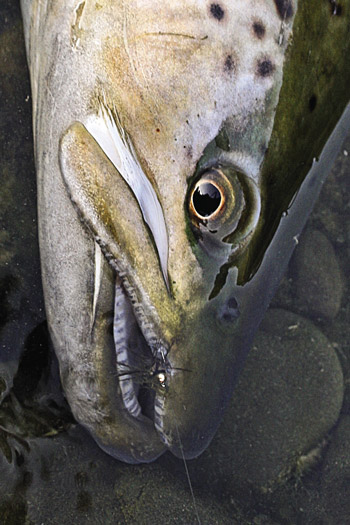 The most characteristic braided rivers have big flows throughout the year and do not dry up like smaller coastal rivers. Also, many are open all year round in the eastern zone and some of the inland braided rivers that flow into the larger lakes in Otago have a season that extends into May, so they are a good focus at this time of year. Autumn triggers trout to move out of the lakes into braided rivers and fishing their mouths can be especially rewarding for brown trout, lake-locked salmon and later in the season for rainbow trout.
Inland braided rivers such as the north branch of the Hurunui, the Ahuriri and the Hunter run into lakes. The Ahuriri is one of the most productive and best known, but many of the South Island’s larger lakes have braided rivers running into them along their northern edges.
Large braided rivers that flow into the sea have trout scattered throughout them all year round and in winter a lot of non-spawning and maiden trout use the more stable edges of the channels to feed when the larger spawning fish have moved into the headwaters. Maiden fish up to two kilograms can be caught all year round, which are top eating. They are a sustainable part of the trout resource to harvest.
Running from north to south, the main braided rivers on the South Island’s east coast are the Wairau, Waiau, Hurunui, Waimakariri, Rakaia, Rangitata and Waitaki. In Southland the Waiau is a standout braided river and perhaps one of New Zealand’s best trout fishing rivers, yielding large brown and at times rainbow trout. On the West Coast the Haast is a top braided river with the Taramakau and Grey Rivers also offering a lot of scope for exploration. In Hawkes Bay the Tukituki River is one of the most characteristic.
In the lower reaches sea-run trout are a characteristic part of the braided river experience in the spring and early summer, but at this time of year the middle reaches offer the best fishing for large numbers of smaller trout that are still fun to catch.
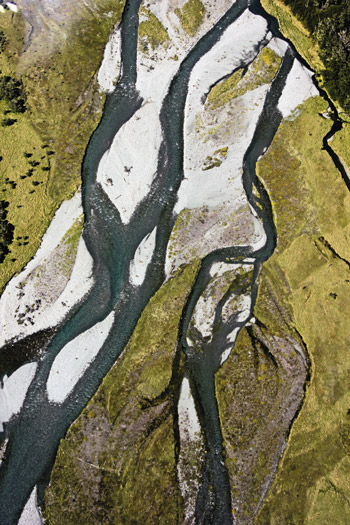 Trophy fish can be found in the upper reaches of braided rivers, especially on the more stable side channels or just downstream of where spring creeks flow in. Large spring creek fish often fall back into the main river channels, perhaps in response to the presence salmon smolt. That’s why Rapala lures that imitate salmon smolt are a great search tool, especially when the wind picks up. Indeed, given the variance in the water encountered, spin and fly-fishing methods are perfectly compatible on braided rivers.
It can pay to look for areas where there is a line of brown or green algae marking out where the river channel has been stable for some time. This is where insect populations are likely to be relatively high and where trout will be found.
Sometimes side channels are maintained for one or two years and act as stable streams in the short term, at least until the next large flood. The longer a braided river has been stable between large floods, the better its fishing opportunities. As a result, the best fishing is in the late autumn and early winter when flows are at their lowest and the trout are more concentrated. Low, clear flows are ideal for fly-fishing and slightly coloured water is better suited to spin-fishing.
The edges of the main channels where there are some decent-sized boulders are key areas to prospect. Others include rock groynes as the large rocks offer some stability and cover. Irrigation outtake structures can also provide a stable environment where trout will hold. Some rivers such as the Waitaki have large ponds connected to the outflow channels that can provide top fishing. Bells Pond is a good example.
Collapsed grassy banks are good areas to look because chunks of bank lying in the river channel break the current giving trout places to lie; sometimes simply a matagouri bush that’s fallen into the river forms a lie. Larger trout in particular will seek out areas where there is some cover.
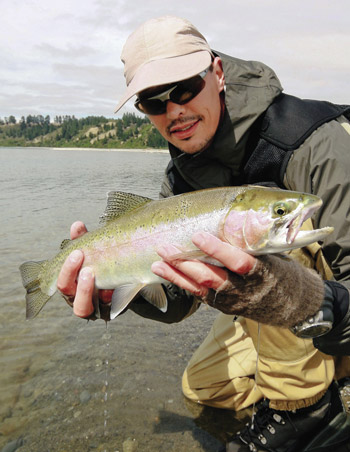 Larger and flashier flies tend to work best on braided rivers. A gold Beadhead and Flashback nymph combo is one of my favoured search rigs when combined with a large, buoyant indicator. Quickly covering the water with deeply-set nymphs is one of the best ways to fish these large rivers, as there will be a lot of empty water between trout, although trout are sometimes grouped up in pods.
Braided rivers are well suited to spin-fishing as you can quickly find trout using this method. Once a group of trout is found you can switch over to the fly rod. Trout sometimes chase the spinner but refuse it at the last second. At that point, knowing a trout is present, rest the water for a short while and then fish through it with a fly. This can be very effective.
Overall I love the feeling of expanse and freedom I get from fishing braided rivers. There is always plenty of room to explore and the dynamic and ever-changing nature of the rivers certainly keeps you on your toes. When you do find a group of trout you can enjoy catching them in solitude with no one else in sight.
|
|
This article is reproduced with permission of |


Major Bites
Minor Bites
Major Bites
Minor Bites
Latest Articles

Extreme Aluminium Trailers Review
June 2026Extreme Boats has long been recognised for its award-winning aluminium vessels, and is now expanding into high-quality aluminium trailers... Read More >
The Export NZ Fishing Competition Announces Season Winners
June 2026Another exciting season of The Export NZ Fishing Competition – has come to an end, and we’ve just announced our prize winners... Read More >
History of Zane Grey's Fishing in NZ
June 2026One hundred years ago, the trajectory of big game fishing in NZ changed forever with the arrival to its shores of one man - Zane Grey... Read More >
BBQ'd Gurnard with Citrus and Herb Butter
May 2026This is a pretty ‘cheffy’ recipe, featuring a sauce that is definitely one to impress guests with, but it's fairly easy to cook... Read More >
Mackenzie Country Trout & Tahr
May 2026The Mackenzie Country winter months of June, July, and August herald the main spawning time for canal trout... Read More >