
History of Zane Grey's Fishing in NZ
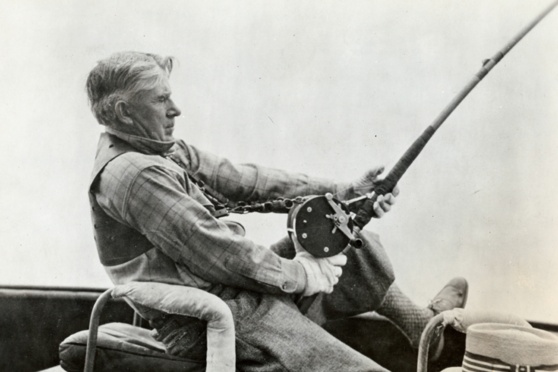
One hundred years ago, the trajectory of big game fishing in New Zealand changed forever with the arrival to its shores of one man.
That man was American author Zane Grey. The techniques he brought with him and the book he wrote in the wake of his visit, Tales of the Angler’s Eldorado, New Zealand, opened the world’s eyes to the untapped potential of Aotearoa’s waters. There would be world records set and great battles fought, but the forthright manner of the proud and prickly Grey ensured not all of these battles would be on the water.
A new frontier calls
By the mid-1920s, Zane Grey was not just a celebrated and prolific writer of Western novels but one of the most well-known names on the planet. As the world’s first millionaire author, he had tapped into a popular appetite for tales of courageous gunslingers, rugged landscapes, and frontier stories featuring cinematic-style romance. His books translated readily to the screen and the burgeoning Hollywood film industry devoured them. The money rolled in. In 1925, his earnings were estimated at approximately USD $300,000, around USD $5.5 million in today’s money.
Grey’s wealth enabled him to indulge his lifelong passion for fishing, and he travelled extensively in pursuit of records, recognition and new species. The New Zealand Government, conscious of what a glowing review of their under-exposed fishery could mean for tourism, extended him an invitation via the New Zealand-born businessman, and fellow big game angler, Charles Alma Baker. Grey was fertile ground.
“No sportsman had ever tried them,” he wrote of New Zealand’s waters. “I conceived an impression of magnificent unknown virgin seas, so far as fish were concerned. What a splendid thrill that gave me.”
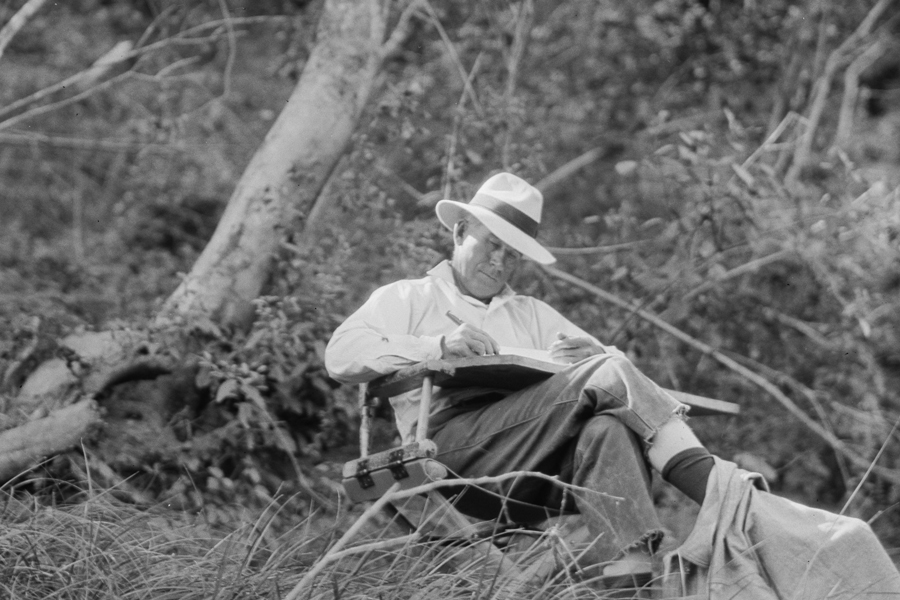
By the mid-1920s, Grey was not just a celebrated and prolific writer of Western novels but one of the most well-known names on the planet. Photo: Original held in L. Tom Perry Special Collections, Harold B. Lee Library, Brigham Young University.
Epic journey down under
On 30 December, 1925, Grey boarded the Royal Mail SS Makura in San Francisco, headed for Wellington via Tahiti and Rarotonga. Three weeks later he arrived in Wellington, where a large welcoming party included a gaggle of children, disappointed the Western author was not sporting the anticipated sombrero, chaps, spurs, and guns.
Two long days’ travel north brought Grey and his entourage – including fishing companion Captain Laurie Mitchell and a film cameraman to capture the action – to Russell and finally the establishment of a camp on Urupukapuka Island. As he gazed out at an unspoilt panorama of ocean, islands, channels and bays, his 26-day journey was at an end, and the fishing could begin.
Early success and first impressions
Grey spent much of his time around Piercy Island, Black Rock Reef, Cape Brett, Deep Water Cove, The Ninepin, the Cavalli Islands and the Poor Knights. He enjoyed almost immediate success, raising six marlin in the first two days, proving that his teasers and single-hook rigs worked as well in New Zealand as in America.
A thoughtful and innovative angler, Grey wanted to learn about local tactics and tackle, and with a small flotilla of half-a-dozen local boats often jockeying alongside him each day, he had his opportunity at close quarters.
Grey surmised the local gear had evolved from English salmon fishing tackle: 7-8ft wooden rods with huge guides spaced few and far between, and large, single-action, Nottingham-style reels mounted underneath, paired with 20-30ft heavily braided wire traces and gang-hooks.
The most common local method involved drifting live and dead baits with the wind or tide around rocky outcrops, 60–90ft down. Local anglers seldom worked the edges of baitballs, as Grey did.
“No anglers had ever run out to sea to any extent; and trolling, such is the practice of American anglers, was practically unknown,” he wrote. “The use of teasers behind the boat had never been heard of; and the fact of drawing Marlin swordfish up to the surface was quite incomprehensible to these boatmen.”
He declared both local tackle and tactics “hopelessly inadequate”. By contrast, he had arrived with cutting-edge equipment: Coxe reels, Murphy hickory rods and Hardy Brothers tackle.
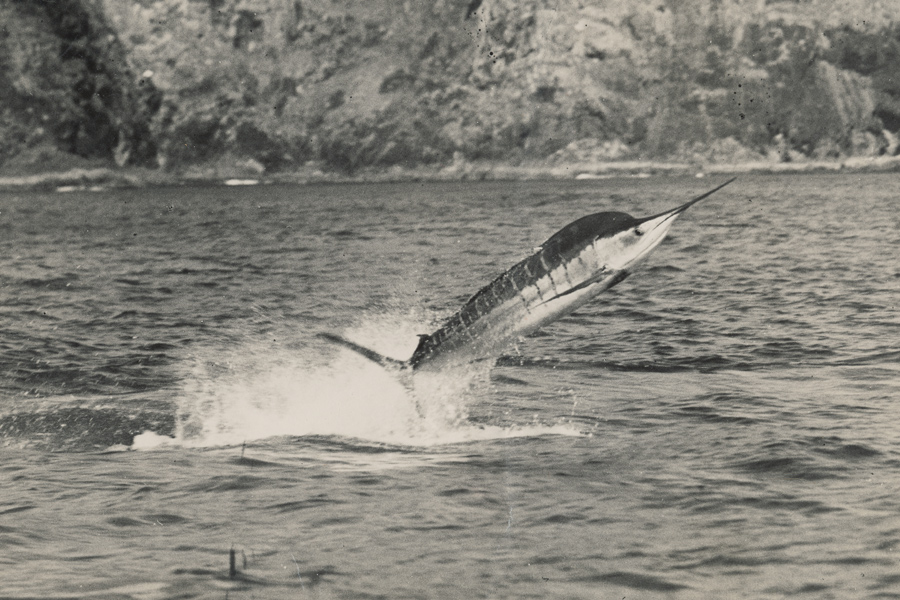 Grey spent much of his time around Piercy Island, Black Rock Reef, Cape Brett, Deep Water Cove, The Ninepin, the Cavalli Islands, and the Poor Knights, enjoying almost immediate success on striped marlin. Photo: Courtesy of Ed Pritchard – AntiqueFishingReels.com
Whilst most of his observations were probably on point, the brusque and dismissive way he made them, both in print and in person, endeared him to no one. He was the guest at a party calling his host a dunce, and he had set the tone.
The action intensifies
As you would expect from one of the premier writers of his day, the narrative in Angler’s Eldorado skips along at pace. The action is hectic, with fish after fish risen to the teasers, giving substance to Grey’s claims regarding his methods and also the sheer number of gamefish present in New Zealand waters.
“It seemed I had indeed established another fact – that the swordfish of the waters of the antipodes could be raised to the surface by trolling. I was immensely pleased, for that must eventually change the whole fishing method around New Zealand.”
A true nature lover, Grey’s most poetic and powerful descriptions are of the environment around him: sunsets, flora and fauna, and the majestic fish with which he now does battle.
“Not long afterwards the teasers lured another from the purple depths. How he blazed in the clear water back of the boat, weaving to and fro before he hit the bait…a beautiful striped tiger of the sea. His pectorals stood out like jib booms on a ship.”
There are few big game fishers who couldn’t visualise that picture.
World records tumble
Though Grey and Captain Mitchell had enjoyed plenty of action, the headline fish had eluded them. That changed when Mitchell landed the first big black marlin of the trip after a two-hour fight.
“Up the grand fish came. Black. Huge. Not a stripe on him…His eye gleamed, he rolled heavily; the leader and hook held.”
At 12½ft long, with a girth of 5½ft, and weighing 685lb, it was a new world record.
Soon afterwards, Grey caught a 400lb broadbill, the first of the species known to have been taken on rod and line in New Zealand.
“Such a marvelous and amazing fish as the broadbill had never been imagined by them,” he wrote of those gathered back at camp regarding the fish.
The fish was quickly usurped by Mitchell and another absolute beast of a black marlin. At 12½ft long, with a 6’2” girth and 4ft tail spread, it weighed 976lb, another world record, exceeding the previous by nearly 300lb. You can’t help but hear the tinge of envy in Grey’s description, particularly as he reminds everyone he still holds the world tuna record.
“As slowly the glistening opal monster was hoisted out of the water I was further amazed, staggered…For 12 years ever since I knew about marlin, I had dreamed of such a fish. Of course I was glad Captain Mitchell had caught it, just as I knew he was glad when I beat his tuna record with my 758-pounder.”
Unfortunately, the official weight was well short of reality, as the fish had to be cut into three pieces to be weighed back in Russell. Given the resultant loss of bodily fluids and stomach contents, it would’ve weighed considerably more than the magical 1,000lb mark when first boated.
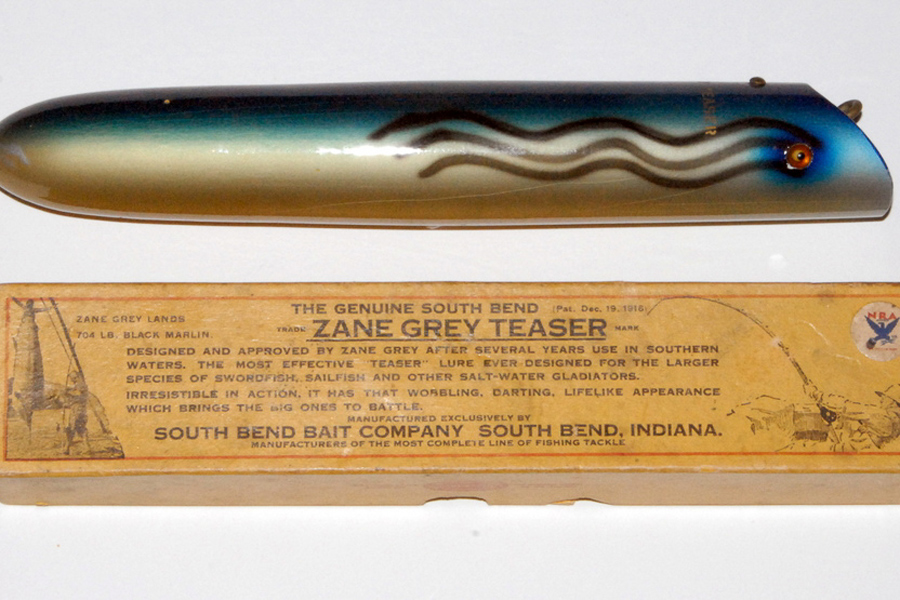 Grey arrived on Kiwi soil with cutting-edge equipment, including teasers which were his trademarked invention. Photo: Courtesy of Ed Pritchard – AntiqueFishingReels.com
These captures caused a sensation across the country, but Grey was still in search of his first black marlin. When that opportunity came, disaster struck. Hooked up to a big one, his line tangled in the boat propeller and it escaped. The man, who was known to suffer periodic dark moods, sat silently in his fighting chair momentarily before getting up and walking away.
“I went into the cabin and lay down, conscious of a loss utterly out of proportion to the actual facts. It was only a fish. But the transition from sheer exultation to stark tragedy was too violent, too swift for me to bear with equanimity. Bad indeed were those few moments in the cabin.”
Let’s face it, even if it wasn’t with a black marlin, we’ve all been there.
The showdown
In every great Western story there is a pivotal plot point, a signature moment, the showdown. Grey got the chance at his after an impressive act of generosity from his fishing buddy.
Captain Mitchell had a fish pick up his bait and take off with such calmness and authority that he believed it must be a marlin of considerable size. He called Grey across from the neighbouring launch and magnanimously handed him the rod. In what must rank as one of the great descriptions of a big game fish fight, across the next 12 pages Grey relates the battle which followed.
“I took a turn at the drag wheel and shut down with both gloved hands on the line. It grew tight. The rod curved. The strain lifted me. Out there a crash of water preceded a whirling splash. Then a short blunt beak, like the small end of a baseball bat, stuck up, followed by the black-and-silver head of an enormous black marlin…He led us out to sea, and in two miles he flung his immense gleaming body into the air 10 times…Out of a boiling hissing smash he climbed, scarce a hundred feet from the boat, and rose gloriously in the light, a black opal indeed, catching the fire of the sun…His descent was a plunge into a gulf, out of which he thundered again in spouting green and white, higher this time, wilder, with catapultic force.”
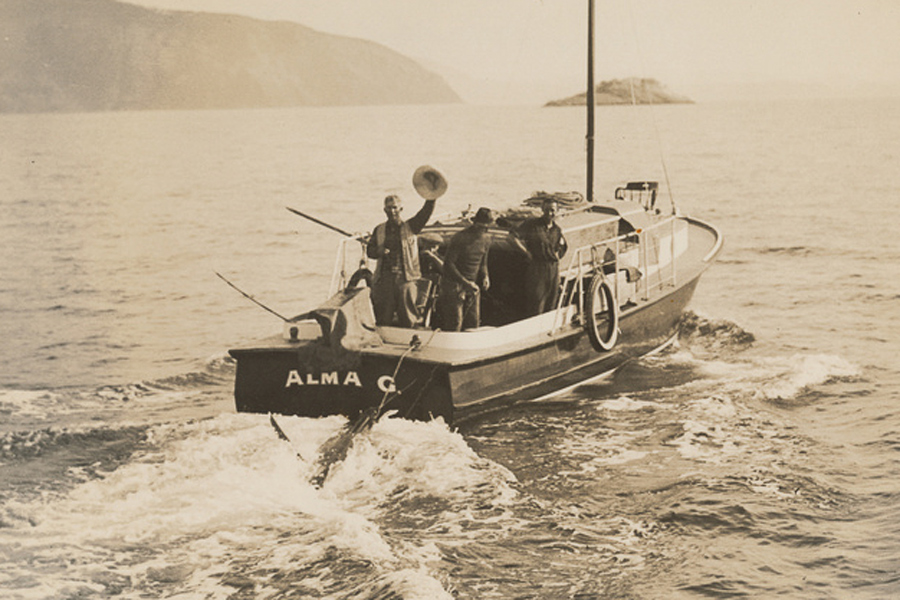 Grey rented the Alma G – built of thick heart kauri planks and modelled on the design of early whale-chasing boats – for his Bay of Islands fishing escapades. Photo: Courtesy of Ed Pritchard – AntiqueFishingReels.com
Grey describes the muscles of his right leg shaking uncontrollably and the panic-stricken moments as the reel falls from his rod, not once, not twice, but three times. The ebbs and flows of the battle, the physical and mental challenges played out across three hours echo down the ages, sensations as familiar to big game anglers today as they were a century ago.
With the fight finally over, they towed the great fish in. It weighed 704lb.
Nearing the end of his Bay of Islands stay, Grey still had time for more significant captures, including a 40lb snapper whilst reef fishing, and a world record kingfish of 111lb, a fish he took 45 minutes to subdue on big game gear. And, with a last hurrah, he signed off with another headline-grabber, the world record striped marlin of 450lb; a fish which almost dragged him over the gunwale and “took the four of us to load him on the boat”.
Grey and Mitchell’s final tally read: 62 striped marlin, three black marlin, one broadbill swordfish, 23 mako sharks, two hammerheads, nine kingfish and seven bronze whalers. This included three new world records for black marlin, striped marlin and kingfish.
Tourism and legacy
With the big game fishing portion of his trip finished, Grey travelled south to fish for trout around Taupō, and in particular on the Tongariro River. His Bay of Islands stay, however, and the spectacular captures registered, had proved a validation of his methods, albeit a controversial one.
His blunt and very public criticism of local tackle and practices developed into a spat which necessitated Grey’s dedication of an entire chapter to it at the end of his book, defending and explaining his position. The ruffling of local feathers aside, Angler’s Eldorado, first published in 1926, proved hugely popular, selling an estimated 100,000 copies worldwide and being reprinted four times.
Grey’s account fired the imaginations of anglers and the ripple effects were practical: charters, launches, better tackle, international visitors, media stories. In 1927, a lodge and club were formed at Urupukapuka Island’s Otehei Bay, named the Zane Grey Sporting Club, which catered to wealthy anglers seeking to walk in the great author’s footsteps. The building remains can still be explored today on the Urupukapuka Archaeological Track.
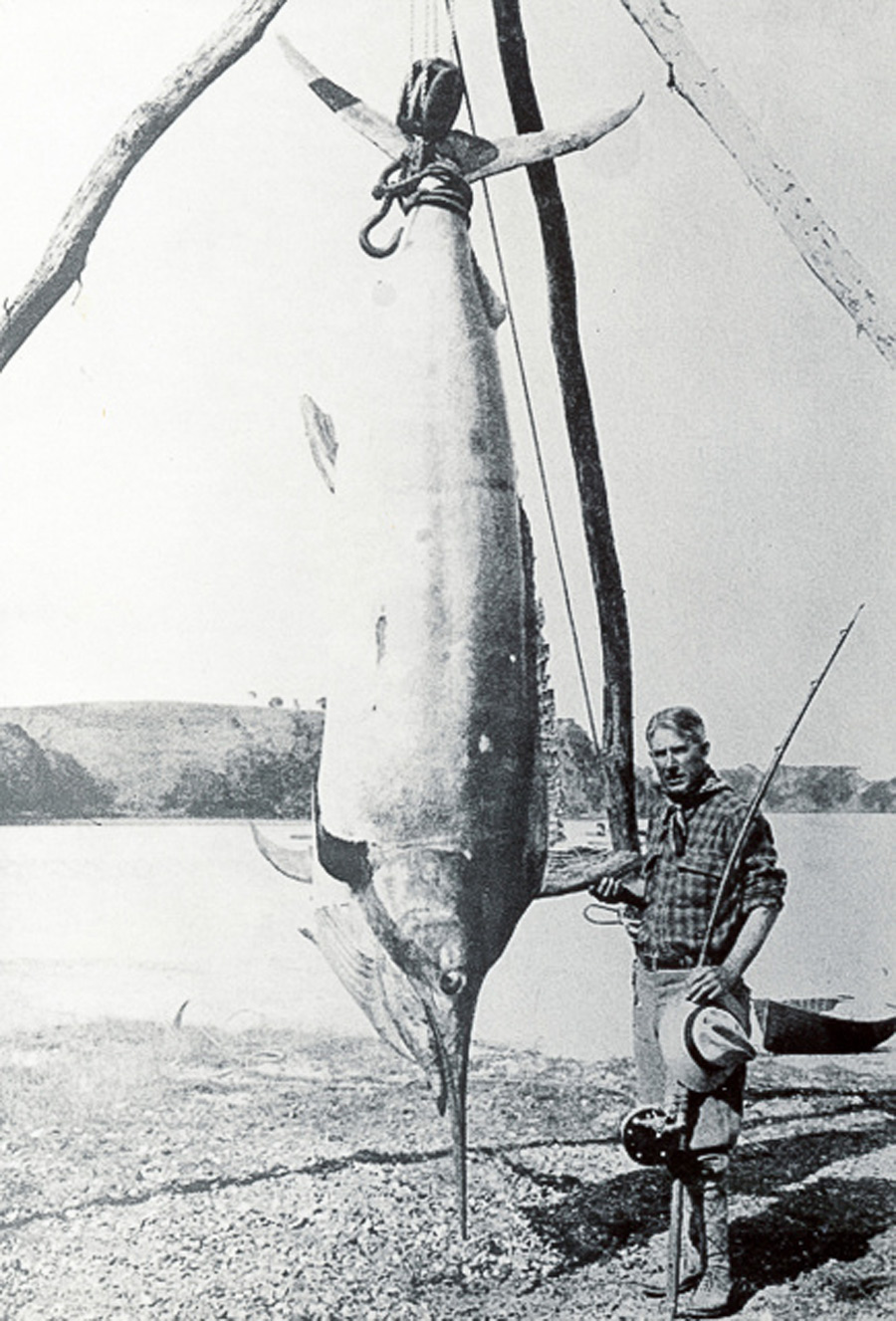 After watching Captain Mitchell land consecutive world record black marlin, Grey finally caught his prize – a 704lb fish. Photo: Courtesy of Ed Pritchard – AntiqueFishingReels.com
Grey’s legacy is not without complexity. He visited New Zealand four times in total and even apologised to local anglers for his earlier harsh assessment, though whether genuinely or pragmatically is open to debate.
He was a complex character: driven, vain, a teetotaller and serial womaniser, lone wolf yet ardent self-publicist, and someone who had few long-lasting friendships. By his death, he had alienated almost everyone close to him. One of his sons believed his father was likely bipolar.
Yet in a sporting sense, Grey’s 1926 expedition was a defining moment. Many of the concepts he introduced or popularised, including the use of teasers, are still in use 100 years later. It also marked the point at which the country’s offshore fishing moved from local pastime to international prospect.
New Zealand, the big game fishing destination, was on the map.
With thanks to Ed Pritchard and the Zane Grey’s West Society for their generous assistance in compiling this article.
- By James Fuller
Recent Forum Posts Visit Forum

2026 Grunter Hunter
in The Briny Bar10 hours ago
krow
Thanks Guys. I'll have another go as soon as the weather and work miss-align. I have Kahawai and Mullet. ...

Manukau Harbour & West Coast fishing
in Fishing Reports11 hours ago
smudge
That's a great catch Schecter! Kayak fishers do it so much harder than anyone else. It would be an absolute pleasure to hand over the $5k...

Knife sharpeners
in The Briny Bar59 hours ago
krow
I'm about to order a couple from Amazon. Check your PM Smudge...
1989 Evinrude 90hp V4
in The Boat Shed60 hours ago
bricker
Inherited the above outboard on a boat - is in very good order with little use. The serial number is A1351974. Is there a way of...

Auckland Yakkers
in Yak Yak Yak138 hours ago
BananaBoat
Out from Mission bay this evening. Went to the red marker by Mission & Kohi. Never fished this area beforeHad a quick looksie for some structure....
Yellowfin
in The Briny Bar155 hours ago
krow
I heard there were Yellowfin East of the chicks yesterday but I'd suggest this is unusual this late in the season as the water is cooling....

Mac'nificent Autumn Fishing....Mokau!
in Fishing Reports181 hours ago
Snappa Geoff
Thankyou for the replies guys... Tagging some bigger fish is a good idea Krow! but it doesn't interest me enough to get involved....
Yozuri crystal minnow deep diver lure 6"?
in Popper and Topwater Fishing221 hours ago
SeniorInvissibl
Anyone ever used this lure before to provide feedback? I've never used yozuri before.The package states it dives to 20 feet, I'm using it to troll...
Smart battery chargers
in The Briny Bar325 hours ago
Mc Tool
I went for the Victron Blue smart IP22 12v 15a with 3 outputs , (max 15a across any of 1 - 3 outputs ) $249 .Thanks...

Popular Articles

Softbait Fishing - Part 1 - gear selection
John Eichlesheim writes an article about selecting the right equipment for softbait fishing... Read More >
Softbait fishing Pt 2 - tips and tricks
Techniques, tips and tricks of softbait fishing – getting the most from your soft baits.... Read More >

Surfcasting - setting yourself up
Gary Kemsley helps sort out the necessary gear for intending surf fishers.... Read More >

Squid - How to catch them
Squid fishing is a rapidly growing aspect of fishing - Paul Senior shares some hints and tips to get started.... Read More >
Fishing Reports Visit Reports
Tauranga Fishing Report - 28/05/26
Tarakihi on the bite Trips are few and far between at this time of year,... Read More >
Canterbury Fishing Report - 28/05/26
Fresh and salt turning it on! It is not very often I get to say... Read More >
Bay of Islands Fishing Report - 28/05/26
Lures paying dividends We finally had a break in the SE winds that have been... Read More >
Manukau/West Coast Fishing Report - 28/05/26
Snapper and gurnard in the harbour The weather has finally taken a turn for the... Read More >
Comments