
Fishing & Diving Adventure in Fiordland, NZ
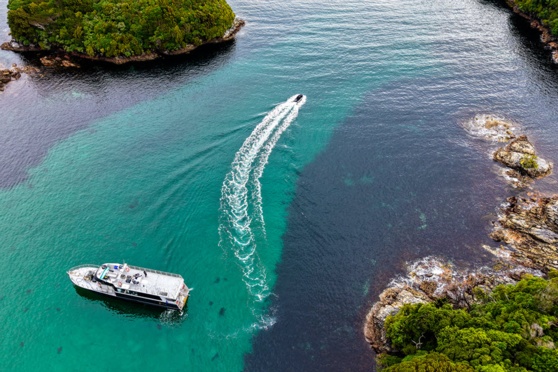
Fiordland – and within it, the twin labyrinths of Breaksea Sound and Dusky Sound – form a kind of last frontier: remote, brooding, and astonishingly alive. This was the setting for a five-day adventure aboard SEA Fiordland – a journey not simply into fishing and diving wilderness, but into a layered story of geology, wildlife, human history, and kaimoana.
Into the Deep South
Access to most of Fiordland is by sea or air only, and the weather dictates those terms, immediately stripping away any illusion of casual travel. To reach our starting point in Doubtful Sound, we travelled to Manapouri, where we caught a ferry across Lake Manapouri, followed by a coach trip over the Wilmot Pass to Deep Cove. The coach stopped in the middle of the gravel road as SEA Fiordland’s vessel, MV Tasman Explorer, revealed itself from behind the native bush. Owner/skipper Clint Gollop, chef Piki Clark, and deckie Caleb Dodunski greeted us warmly and, fortunately, were not overwhelmed by the endless bags of fishing, diving, and camera gear heading their way. With an all-inclusive safety briefing, rundown of the boat, and plans for the day ahead communicated, the ropes were cast, and the adventure began in earnest.
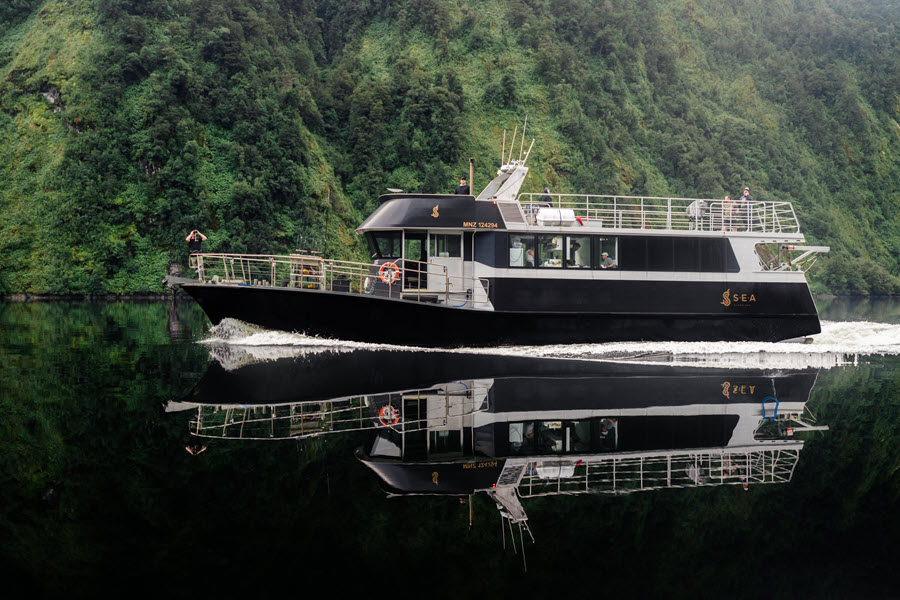
SEA Fiordland’s vessel, MV Tasman Explorer.
From above, the fiords reveal themselves as flooded valleys. Fiordland contains some of the oldest rocks in New Zealand, predominantly hard metamorphic rocks like gneiss and schist, and igneous rocks like granite. Lying close to the Alpine Fault, where two plates of the Earth’s crust meet, the area has constantly been folded, faulted, uplifted, and submerged. Over the last two million years, glaciers have periodically covered the area, gouging into the rock and creating U-shaped valleys, many of which are now fiords.
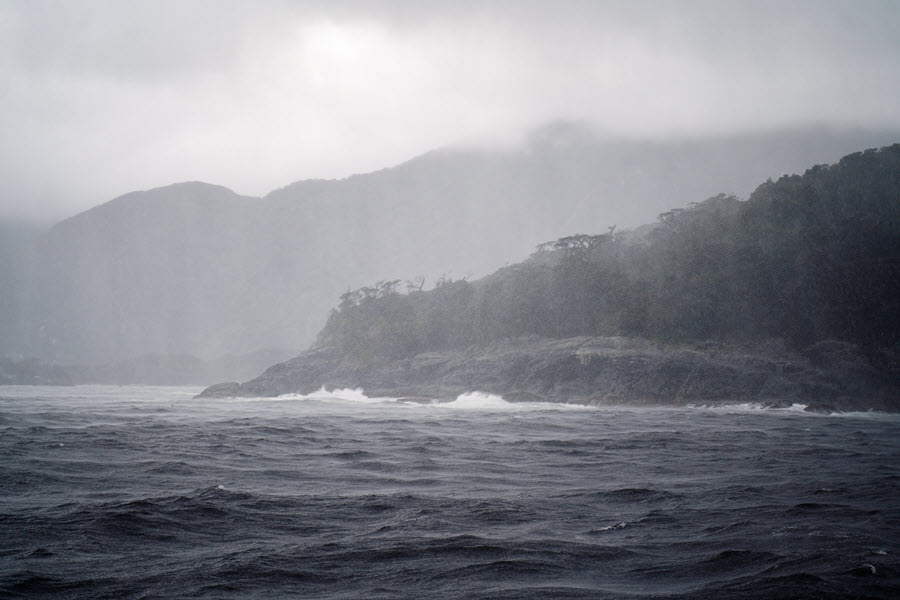
From the deck of MV Tasman Explorer, those same valleys loom even larger. Waterfalls thread down from cloud-hidden summits, fuelled by the famously relentless Fiordland rain. The earthy, tannin smells were replaced by those of the sea as we exited Doubtful Sound. Three-and-a-half-metre swells rolling in from the Southern Ocean detonated along the coastal cliffs, producing a thick haze of salt spray. We’d only started our 20NM coastal trip south to the mouth of Breaksea Sound and a few of the louder personalities aboard had become conspicuously silent – a couple out the back looking decidedly green and another comatose in the fetal position on a bunk. I, however, was enjoying the experience – the MV Tasman Explorer felt composed and rock solid in open water, and it felt right that we were ‘earning’ our entry into Fiordland proper.
Along the way, mollymawks sailed by and sporadic seals waved us past. We kept our eyes peeled for signs of southern bluefin tuna. Clint reckons bluefin are reliably caught here nine months of the year, with the average size increasing as the water cools. Although it was a bit sporty for Clint to run his typical spread of two surface lures and a bibbed minnow, and certainly not the conditions for topwater casting, he reassured us that we would get our chance tomorrow.
As we passed the mouth of Dagg Sound, Breaksea Island loomed in the distance, carrying the promise of calm waters and the first chance to wet a line.
Fishing time
Breaksea and Dusky Sounds stretch vast and intricate, connected by the narrow Acheron Passage and scattered with islands – Resolution, Anchor, Long, and Cooper – each with its own myriad sheltered coves and hidden channels. Breaksea Island guards the northern entry into this maze of opportunity, and this is where Clint pulled back the throttles for our initial taste of Fiordland fishing.
“Right, first off, we need to catch some kahawai or ‘couta for bait,” he informed the crew.
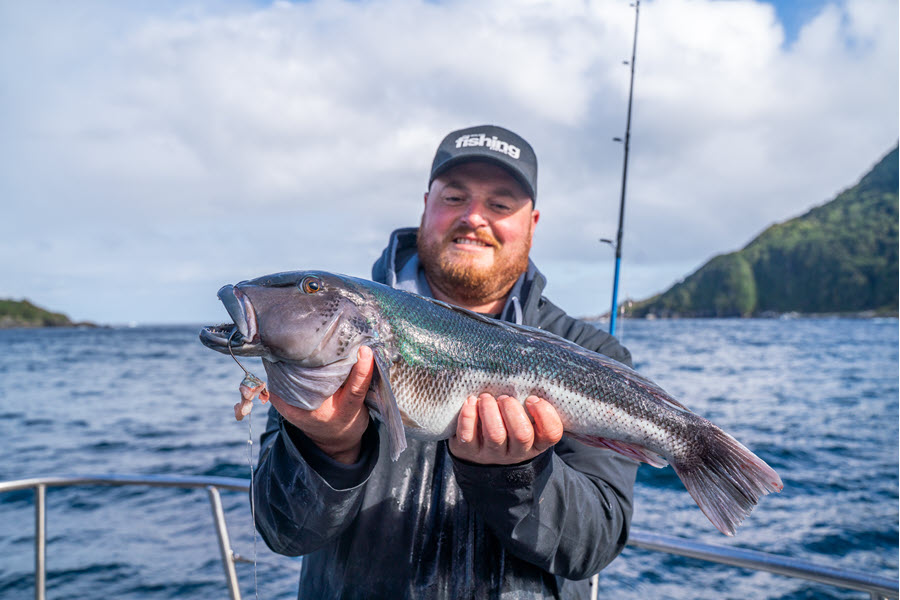
Big blue cod were a fishing highlight.
Although Grant Blair quickly pulled in a chunky kahawai for fresh cut baits, Clint was telling fibs – bait was certainly not a prerequisite for fishing fun ‘round these here parts. Armed with a stack of new softbaits and shiny slowjigs from Daiwa, we were instantly into hearty blue cod and fat tarakihi, along with a colourful array of wrasse species. Particularly effective was the Daiwa Blade Breaker – a quirky lure featuring a shiny willow blade and kabura-style skirts. When fished yo-yoing along the bottom or with a slow wind, it proved irresistible to the local cod population.
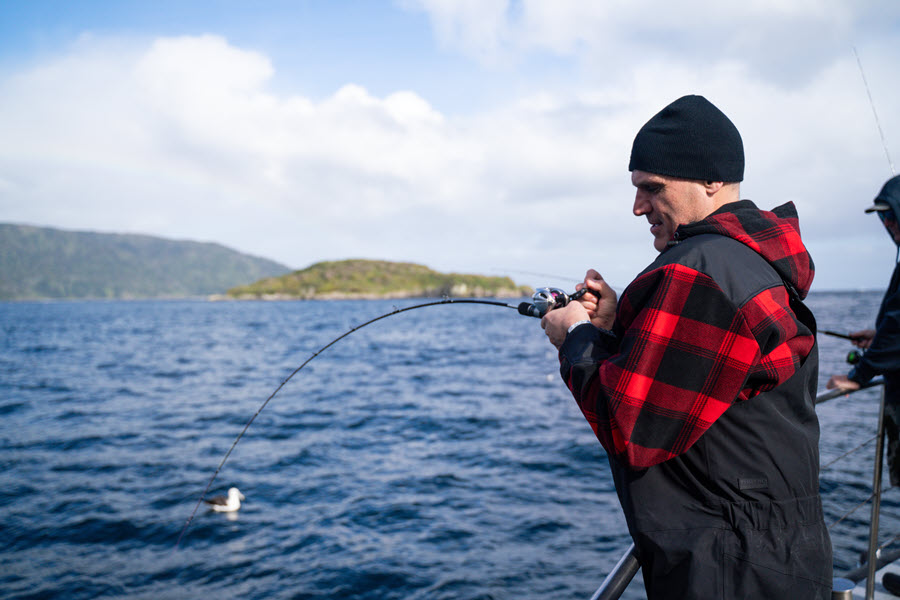
Rich Bowe hooked up on slowjigging gear.
As we fished, Clint logged the exact number of each species caught, kept, and released, and once Piki was happy with the amount of fish harvested for the crew’s kai, we ventured into a serene bay and put the pick down. Here, Clint demonstrated in detail how he processes blue cod. Nothing is wasted – the heads and throats are kept for smoking onboard, and any offal is destined for the craypots. At the same time, the infamous Fiordland sandflies also demonstrated their talent for finding any bare skin showing. While Caleb finished off the last few fish, I flicked out a small spinner towards the shoreline shallows. Within seconds, I was hooked up, and as the fish was brought to the surface, it revealed itself as a tarakihi accompanied by three more of its ilk splashing around on the surface. Topwater tarakihi – only in Fiordland!
Craypot mania
Part of the SEA Fiordland experience is learning as you go, and Clint is an excellent teacher. Setting craypots was next on the agenda, and all the troops got their hands dirty setting up the pots correctly and tossing them in the drink. With the pots now soaking, Clint steered MV Tasman Explorer towards our spot for the evening, tucked inside Harbour Island. No sooner had we settled in than a pod of resident bottlenose dolphins cruised past. In the comparatively cold waters of Fiordland, bottlenose dolphins reach up to 3.5 metres in length – significantly larger than the 2.5 metres they typically attain in warmer climes. Although the evening scenery and serenity were superb up on the top deck, the sandflies were gathering, and the smell of Piki’s roast lamb with all the trimmings beckoned us inside.
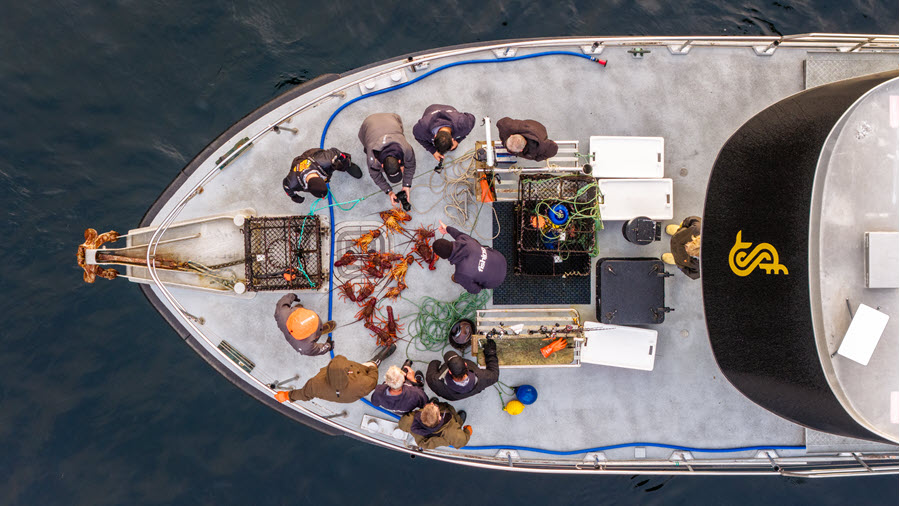
Plenty of crays were hauled up in each pot for sorting.
As we enjoyed our feast and a few cold Exports around the saloon tables, talk began of a sweepstake regarding the number of crays that would be hauled up in the three pots. Clint was last up.
“Fifty-two,” he said, without an ounce of a smirk on his mug.
Lo and behold, as the boys hauled up the three pots the next morning, each bulging with solid bugs, the final tally settled on 52! After some quick pictures for us wide-eyed city folk, most of the crays were released back into the inky water unharmed. Clint puts back the females and the biggest male crays in each pot, and only enough for a feed are harvested. With the pots secured on the bow, it was time to hit the open water in search of the prized bluefin tuna.
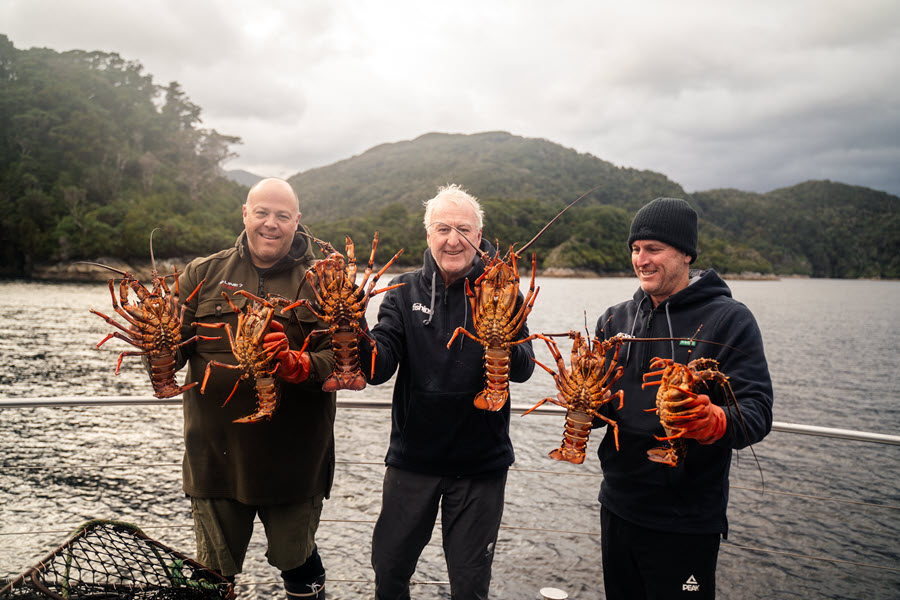
Some happy city folks with their bugs. From left: Dean Harris, Grant Blair, and Tom Clancy.
It felt quite strange setting game lures a stone’s throw from land, but nobody asked any questions given what Fiordland had already shown us! The conditions along the coast had mellowed significantly from the day prior, and as the lures splashed out back, I settled into some of the excellent reading aboard.
Layers of history
Now, I’m not much of a history buff, but there’s much to be said about learning the history of an area in situ – it simply seems more tangible when you’re physically there.
Long before European arrival, Māori visited these waters, likely using them primarily as seasonal hunting grounds, although there are accounts of small permanent populations. Later, in 1770, James Cook first sighted the inlet, naming it Dusky Bay. On his second voyage in 1773 aboard HMS Resolution, he spent six weeks exploring and charting the area, establishing a temporary settlement in Pickersgill Harbour complete with workshops and – something close to my heart – what is believed to be New Zealand’s first brewery.
Beyond Cook’s practical assessment of the Sound as a safe harbour, his expedition also marked one of the earliest scientific studies of New Zealand’s flora and fauna, with naturalists Johann Reinhold Forster and his son, George Forster, documenting species that still inhabit the region today, along with some that no longer exist. Astronomer William Wales set up an observatory at what is now known as Astronomer Point, and Cook met with and befriended local Māori, gaining their initial trust by throwing them gifts of trinkets and inviting them aboard the Resolution. The locals would not walk but instead crawled up the gangway, perhaps distrustful of what held the massive ship together. They were curious about the ship’s cat, ‘stroking its fur backwards’, and a young woman described as ‘not so disagreeable’ aroused considerable interest from the Pākehā men so long at sea. For all this, Cook did not consult them on place names, choosing instead to apply English names to the area.
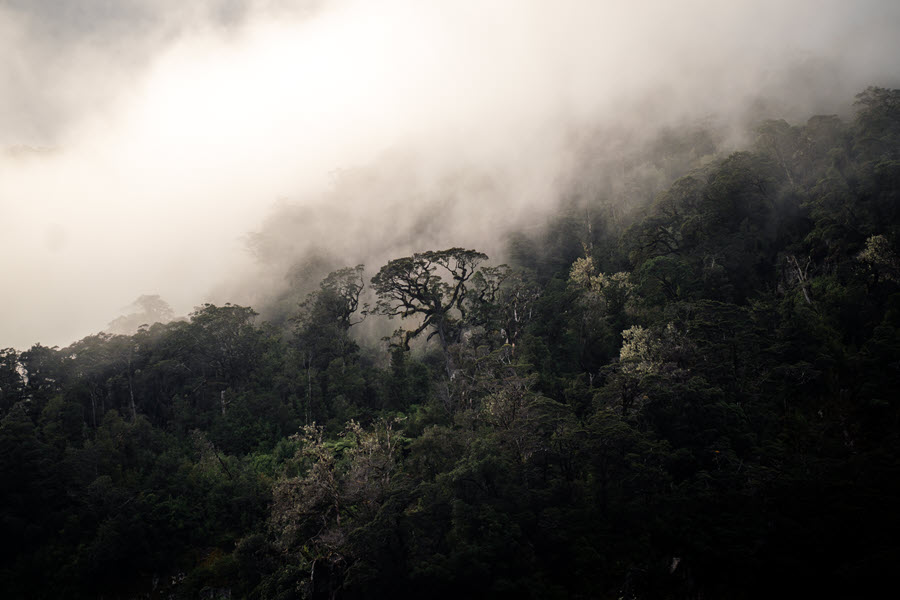
Long before European arrival, Māori visited Fiordland for seasonal hunting and foraging.
Later, sealers and whalers passed through, leaving behind traces of a harsher, more extractive era. Shipwrecks in Dusky Sound include the 800-tonne Endeavour, which sank off Facile Harbour in 1795, and the tourist steamer Waikare, which came into mischief by Stop Island in 1910 during a summer cruise. Today, little remains of either. While I’m not a history buff, I am a chart nerd; while searching for these wreck locations on the chart, I came across a bunch of noteworthy names, including the Useless Islands, Disappointment Cove, Fanny Bay, and Girlies Island.
The region experienced its own gold rush, and one particular character from that era was a diminutive Swedish miner named Jules Berg. He set up station to the south of Dusky in Preservation Inlet, where he grew giant parsnips in a manure of rotten fish, the end product being his potent ‘parsnippy wine’ that flowed freely whenever visitors arrived. Visitors had to be careful on approach to his abode, however, as Jules had booby traps set up in his garden for shooting deer. After a few ‘parsnippies’, Jules would dress up as a cowboy with two live six-shooters slung carelessly from his hip, complete with a sombrero lathered in a mixture of rancid butter and kerosene to keep the sandflies away.
Deer and moose were released into the area in the late 19th and early 20th centuries, leading to an exciting period that included a ‘gold rush’ for wild venison export, including cowboy-like shooting from helicopters and live capture – Señor Berg would have been proud.
The crayfish industry also has prominence in Fiordland’s history. Following World War II, the cray trade grew significantly as access improved by sea. Current operations emphasise the sustainability of the rock lobster population, with strict quotas and regulations in place to protect the fishery.
Yet, unlike many other coastal regions, Fiordland never sustained permanent settlement. The land and sea have remained largely dominant, and conservation efforts have long aimed to keep it that way. Richard Henry is widely regarded as New Zealand’s first conservationist, setting up residence on Resolution Island in 1894 with the task of moving as many native birds as he could to the island, presumed then to be beyond swimming distance of mustelids. Today, much of the area is protected within Fiordland National Park, and a network of marine reserves has been established in conjunction with area-specific recreational fishing rules and regulations.
Bluefin bonanza
“Tuna jumping!” was the call that quickly took my mind away from the books and back to the present.
Racing out on deck, we saw birds circling and the odd bluefin tuna jumping clear of the water, and it wasn’t long before a reel began screaming. Clint’s favourite diving lure – an orange and silver number – had been inhaled, and Tom Clancy strapped into the harness, ready for battle. Clint turned MV Tasman Explorer so it was idling forward with the swells, and Tom set about regaining line. The size and yellow finlets of the fish exposed it as, indeed, what we were looking for, and Clint hopped into the tender attached at the stern to secure our prize.
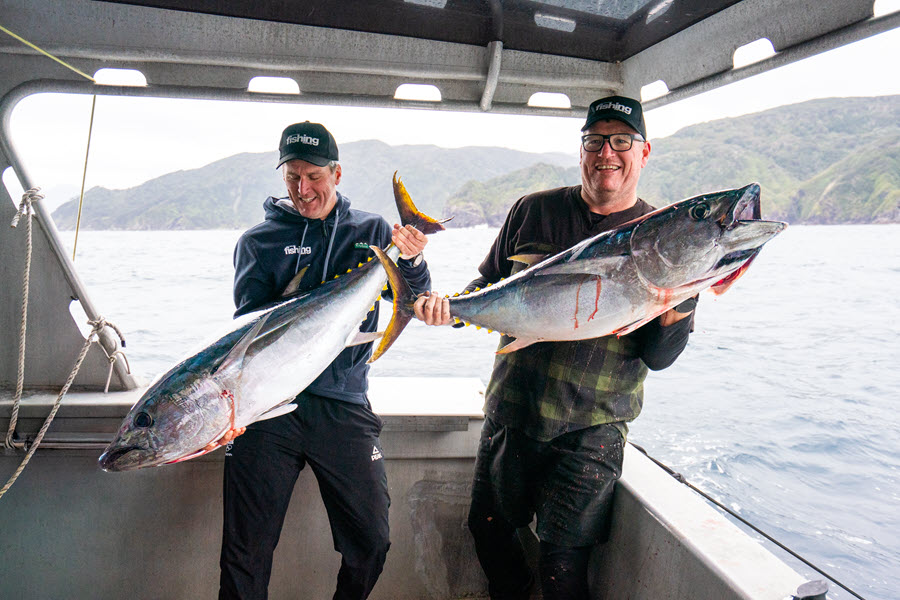
Delicious and hard-fighting southern bluefin tuna are reliably caught nine months of the year along the coast.
With birds still feeding around us, the lures were again deployed, and this time we had a double strike. One fish fell off shortly after, but Dan Given remained attached and brought in a similar-sized 30kg bluefin – also a victim of Clint’s lucky lure. With the bluefin box efficiently ticked off, the agenda turned to full Fiordland immersion – diving.
Swimming with ‘puka and sharks
I’d met a local diving guide on the Lake Manapouri ferry who advised me, in no uncertain terms, to never agitate a sevengill shark as they’re virtually blind and can become “unpredictable”. This was at the forefront of my noggin as we dived into the murky, tannin-stained water up the aptly named Wet Jacket Arm later that afternoon. We were in a marine reserve, and the mission was to swim with hāpuku and sevengill sharks. Sure enough, once through the hazy surface layer, the visibility improved and a horde of 5-15kg ‘puka, escorted by a languid 2.5-metre long sevengill shark, made themselves company. It was undoubtedly another ‘only in Fiordland’ experience!
Stunning diving
On the surface, Fiordland might appear austere – dark water, cloudy skies, heavy forest – but beneath that surface lies one of the most unique marine environments on the planet. Scientists often refer to the ‘Fiordland effect’: a layer of freshwater, stained brown by forest runoff, sits atop denser saltwater, creating a dim underwater environment even at shallow depths. The result is extraordinary. Species typically found in deep ocean habitats, like the famous black coral (which is actually white when it’s still alive), thrive here at recreational diving depths.
.jpg)
Fiordland offers diverse underwater options for both scuba and freedivers.
Being a Fiordland first timer, I assumed that freediving would be challenging due to this freshwater layer I’d heard about. Yet, what I didn’t anticipate was that in many places the freshwater barely exists, and the visibility from the surface is stunning. Such was our next dive spot in an idyllic bay boasting more than 15 metres’ visibility from the surface. We had a combo of scuba and freedivers onboard with a mix of experience, yet this location catered to all.
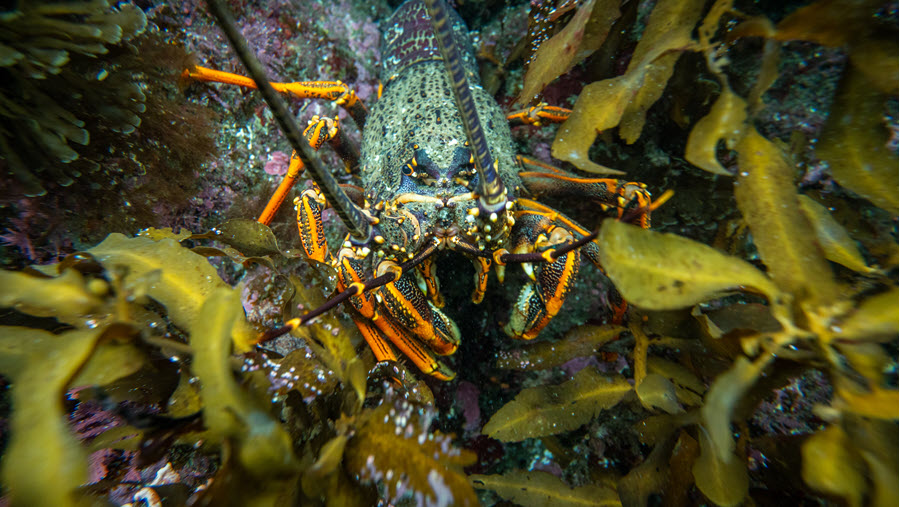
There were crays everywhere.
After filming the rest of the crew gearing up and heading off (geez, those bubble-blowers take an age to get ready!), I jumped in with cameraman Oscar Hetherington sans tank. On my second dive down, I spotted the biggest red cray I’d ever seen, nonchalantly walking around out in the open. With a two-handed grab across his bulking carapace, I held him up for Oscar to snap a few pics before placing him back in the kelp forest. There were crays everywhere. Some cracks and crevices were so jam-packed they were riding on each other’s backs. As Clint prefers clients to harvest crays from pots rather than diving in order to reduce incidental damage to feelers and legs, we left the rest alone and simply enjoyed the spectacle. Big blue cod flitted around on the bottom, and schools of tarakihi hung around the weed edges. The kina were the size of small pumpkins, and we cracked one open and began hand feeding a variety of fish species, including a sizeable trumpeter – it was scarcely believable!
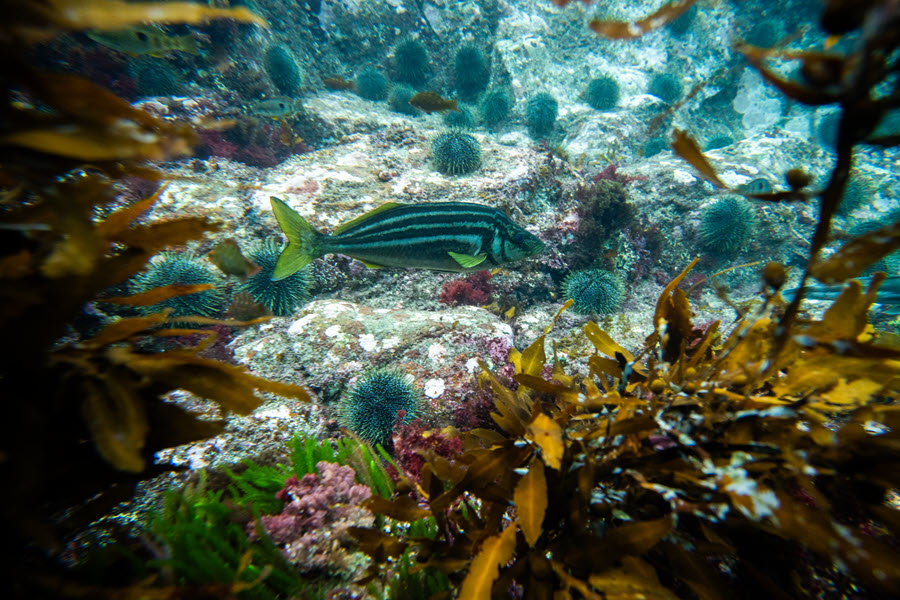
Pumpkin-sized kina and a passing trumpeter.
The troops were buzzing when they got back to the boat, and after a hot shower we tucked into more of Piki’s epic fare – this time, fresh fish and crayfish with a selection of salads.
More and more
The fishing and diving over the next few days became an enjoyable blur of outlandish scenery, crayfish, fish, and wildlife. Above and below the waterline, the richness continued; more huge crays wandering around, friendly seal interactions, short-tailed stingray encounters, patches of big pāua (left untouched due to the scuba gear aboard), sightings of Fiordland crested penguin, blue cod ever present, and the odd kākā flying overhead. Wherever we wet a line, fish were there to be caught, and the sheer scale of habitat meant the fishing possibilities were endless. The only target that managed to elude us on rod and reel was a ‘puka. The cuisine also lived up to its billing. Highlights included Piki’s ‘marry me caramel slice’ and fresh bluefin tuna served multiple ways. ‘Sealebrity’ Injun Park even chipped in with his trusty flame torch to add a touch of sear on one tuna dish, too.
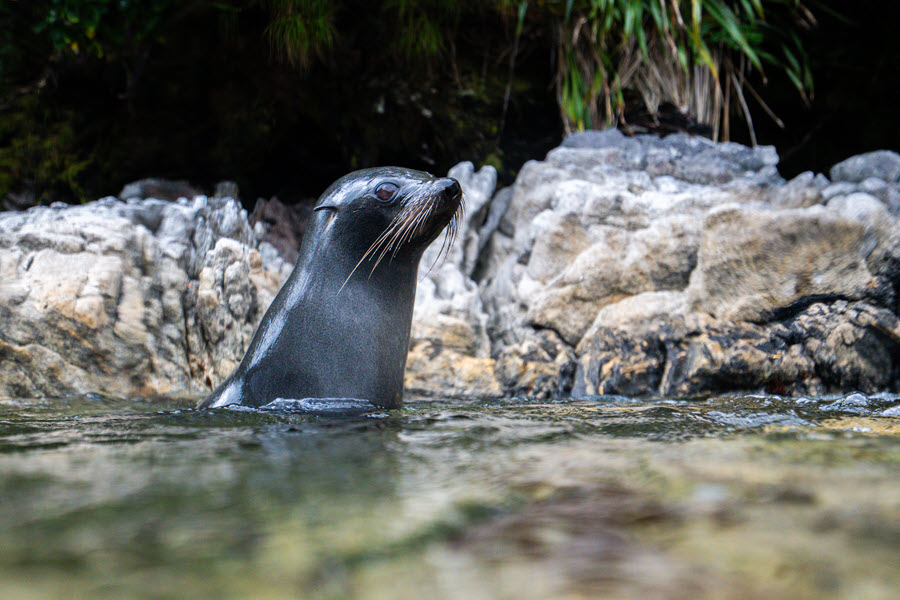
Wildlife interactions included friendly seals.
Life aboard SEA Fiordland
A five-day trip aboard SEA Fiordland is as much about the rhythm of the place as it is about the activities. Days begin early, typically with calm conditions surrounded by bush. Clint and his crew work tirelessly to make everything a smooth operation, and the vessel is well laid out for fishing and diving activities and socialising at the end of the day. The overall vibe is laid back, and we all enjoyed plenty of banter over the five days aboard. Fishing sessions are interspersed with dives, shore excursions if you wish, and slow cruises through narrow channels. Each day, Clint hatches a plan based on what you’d like to do, his knowledge of the area, and what cards the Fiordland weather is dealing.
Concluding a fishing adventure is never easy, particularly in a place like Fiordland. Luckily, we had an exciting ending, as we were picked up directly from the boat’s upper deck by choppers for a dramatic ride back to civilisation.
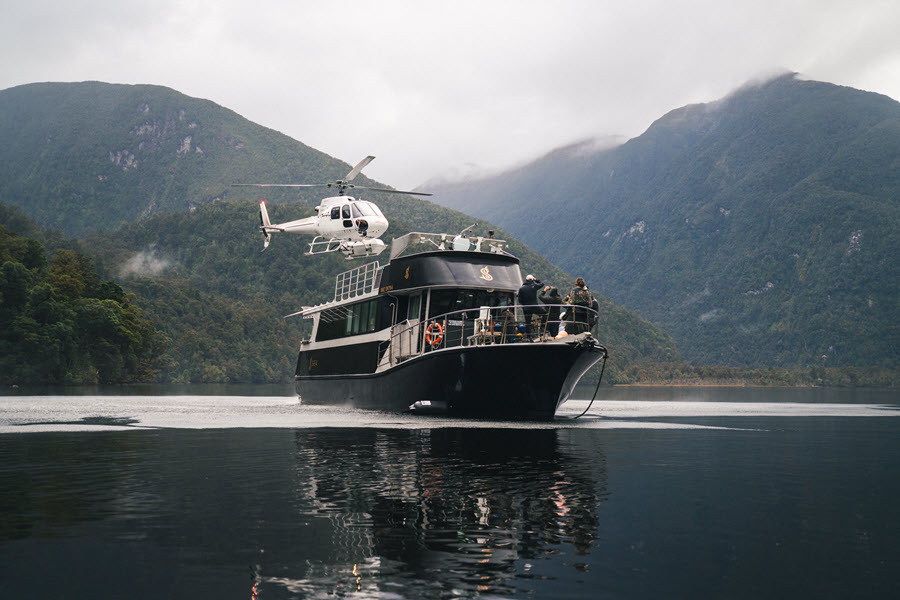
An exciting chopper ride back to civilisation concluded the trip.
Fiordland is not untouched – no place truly is – but it remains one of the closest approximations we have in New Zealand.
“It would take many lifetimes to truly explore Fiordland,” Clint told me on our final day. I wholeheartedly believe him.
To find out how you can experience Fiordland as we did, check out SEA Fiordland here.
- Words by Nick Jones; images by Oscar Hetherington, Nick Jones & Grant Blair


Major Bites
Minor Bites
Major Bites
Minor Bites
Latest Articles

Extreme Aluminium Trailers Review
June 2026Extreme Boats has long been recognised for its award-winning aluminium vessels, and is now expanding into high-quality aluminium trailers... Read More >
The Export NZ Fishing Competition Announces Season Winners
June 2026Another exciting season of The Export NZ Fishing Competition – has come to an end, and we’ve just announced our prize winners... Read More >
History of Zane Grey's Fishing in NZ
June 2026One hundred years ago, the trajectory of big game fishing in NZ changed forever with the arrival to its shores of one man - Zane Grey... Read More >
BBQ'd Gurnard with Citrus and Herb Butter
May 2026This is a pretty ‘cheffy’ recipe, featuring a sauce that is definitely one to impress guests with, but it's fairly easy to cook... Read More >
Mackenzie Country Trout & Tahr
May 2026The Mackenzie Country winter months of June, July, and August herald the main spawning time for canal trout... Read More >