
Pegasus Bay fish spots
It might seem overly handy to a populous area, but Peter Langlands believes Pegasus Bay has even more to offer than is commonly believed…
Sitting right next to Christchurch and extending some 35 kilometres to the north is Pegasus Bay. The bay starts at the Christchurch suburb of Sumner, which sits against Banks Peninsula’s Port Hills, and sweeps north to the coastal hills just north of Amberley Township. While sandy near Christchurch, it gets increasingly gravelly towards Amberley Beach. Two main rivers empty into the bay, with the better-known one being the Waimakariri River at the beach settlement of Kairaki. The second is the Ashley River, a much smaller waterway.
The coastal suburb of New Brighton and its Brighton Pier are well known for the recreational fishing opportunities they offer, as does Kairaki Beach, yet the remainder of the bay is underutilised by recreational fishers. In addition to having many access points along the coast, a reasonable amount of the beach can be accessed at low tide using a four-wheel-drive vehicle.
Pegasus Bay is open and expansive, so may appear intimidating at first. However, with some local knowledge and by picking the right weather patterns, it offers lots of fishing as well as seafood gathering opportunities – mainly paddle crabs and shellfish.
While having access to a boat or 4WD is an advantage, several points afford good 2WD access to Pegasus Bay. Picking the right weather is important though, because the bay can get very rough after northeasterlies and also chops up in a northwesterly, especially along the southern end. The ideal wind for fishing the surf here is a southwesterly, which flattens the surf and clears up the water, improving fishing conditions.
Unlike the Canterbury Bight to the south, Pegasus Bay’s gently sloping beaches do not have the strong undertows and longshore rips, making offshore kayak fishing and boating safer.
The bay is ideal for flounder drag-netting in the surf, especially the beach just north of Kairaki at the Waimakariri River mouth, which is very productive for drag-netting yellowbelly and sand flounders; a few sole are also taken, but mostly in the cooler months. Low tide provides the best conditions for drag-netting, because you’re dragging over the sand where the flounders feed through all tides.
During spring and summer, elephantfish and rig (along with a range of other ‘odds and ends’) are also caught in drag nets. The rich bounty of shellfish and crabs in the shallows sees many species of fish coming close in to feed.
Late spring and summer are the best times for surf casters to fish Pegasus Bay, with a wide range of desirable fish species moving close inshore. The beach out from Spencer Park is a wellknown spot for elephantfish in November; good catches are made by surf casters and fishers using beach torpedoes. Pick relatively calm sea conditions and a low tide, especially at night, to get the best conditions.
Elephantfish can also be caught right on Christchurch’s doorstep at New Brighton Beach from October to February. Few people target them, but those who do get good catches.
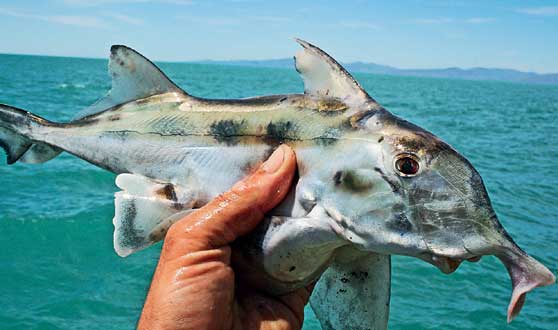
In all cases tuatua and paddle crabs are locally abundant and provide great sources of bait for anglers chasing elephantfish.
Rig, like elephantfish, are very common in Pegasus Bay from October through to April, and can be caught in very shallow water, especially at night. Amberley Beach is a popular night-fishing spot for rig, with good numbers of paddle crabs (the rig’s preferred prey item) offshore. The steeper beaches along Pegasus Bay’s northern end are well suited to surf casting for rig, but Sumner and the Brighton Pier also provide good opportunities.
Given the bay’s expansive nature, long-lining provides a very effective way to cover the ground and get a feed of fish. Elephantfish and rig are the main targets, but other species – such as gurnard – also occurr in good numbers, as do school sharks, which feed and move through Pegasus Bay (the area out wide from the Sumner and the Avon-Heathcote River bar is a good area for catching them). School sharks are highly responsive to salmon berley.
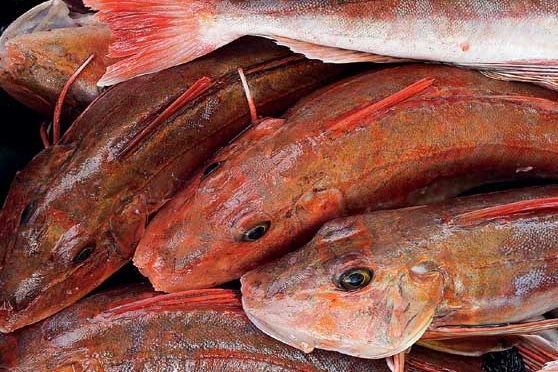
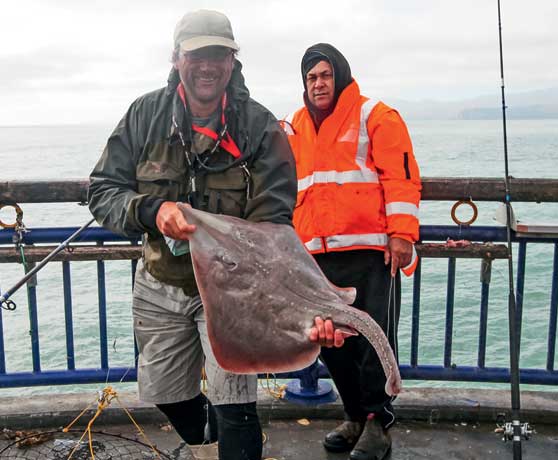
Offshore boat fishing turns up gurnard, red cod, skates (which are increasing in popularity as people learn of their good eating qualities), kahawai, sea-run salmon and, over the summer, kingfish. The last can be found out wide from the Waimakariri River mouth and around kelp rafts offshore from Sumner Heads, which marks the bay’s southern limit.
Trolling is a good way to cover the ground while chasing kingfish, but make sure at least two strands of line connect your Rapala lure in case barracouta are about – often a very numerous species in the bay!
Flocks of terns feeding over the water may mark work-ups of kahawai or barracouta, with kingfish being attracted to the activity. At times groups of hectors dolphins will also indicate spots where kingfish are aggregating. In recent years large numbers of rat kingfish have been caught, perhaps indicating a recovering fishery, so hopefully larger fish will be around in years to come.
While rig and school sharks are the main food sharks, blue sharks also come in close, sometimes right off the Brighton Pier over the summer months, and can be taken on relatively light tackle. Thresher sharks turn up in the summer as well, attracted by the large shoals of kahawai.
As already mentioned, Pegasus Bay has huge numbers of paddle crabs, and Brighton Pier is a popular spot to catch them. However, a kayak or small pontoon boat offers an easy way to set the crab pots, too. The largest crabs are taken off the beach out from Amberley. Paddle crabs have a very sweet flavour and are a bountiful food source that’s available year round.
Of course the crab numbers are a reflection of the vast numbers of shellfish present in the bay, too. There are four species of surf clam in Pegasus Bay, and in recent years they have become the basis for a multi-million-dollar surf-clam industry.
Tuatua are the most readily accessible species and can be taken over most low tides, with Brighton Beach, Spencer Park and Ashley-Waikuku Beaches being popular spots for gathering them. On very low tides (0.1m to 0.3m), when an offshore wind flattens the surf, you can also gather triangle shells by carefully wading out from the shore at Amberley Beach.
The two other species of surf clam, which are generally overlooked by recreational fishers but are available for harvesting, are the moonshell clam and the deepest (but yummiest of them all!), the storm clam. Storm clams are taken in 3-5 metres depth. Recreational dredging – or when the sea is clear, diving from a pontoon boat – are options for gathering the deeper water surf clam species.
WHILE PEGASUS BAY may appear open and expansive, it offers a rich seafood basket right on Christchurch’s doorstep. So take the time to explore it when the weather allows, accompanied by some knowledge about your target species and a little persistence, and you will certainly not be disappointed.
|
|
This article is reproduced with permission of |


Major Bites
Minor Bites
Major Bites
Minor Bites

Latest Articles
The Export NZ Fishing Competition Announces Season Winners
June 2026Another exciting season of The Export NZ Fishing Competition – has come to an end, and we’ve just announced our prize winners... Read More >

History of Zane Grey's Fishing in NZ
June 2026One hundred years ago, the trajectory of big game fishing in NZ changed forever with the arrival to its shores of one man - Zane Grey... Read More >
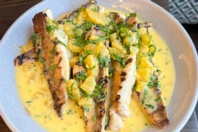
BBQ'd Gurnard with Citrus and Herb Butter
May 2026This is a pretty ‘cheffy’ recipe, featuring a sauce that is definitely one to impress guests with, but it's fairly easy to cook... Read More >
Mackenzie Country Trout & Tahr
May 2026The Mackenzie Country winter months of June, July, and August herald the main spawning time for canal trout... Read More >
The Hutchwilco NZ Boat Show Official Guide - 2026
May 2026This year, The Hutchwilco New Zealand Boat Show returns bigger than ever as New Zealand's ultimate boating and fishing showcase... Read More >