
Rod and Rifle Season
- P_Articles_General

The months March, April, and May are a special time for both trout anglers and deerstalkers. It is the mating season for most deer species and heralds the spawning season for trout; brown trout in particular.
Autumn is a season worth waiting for. It is colourful, calm, cool, and dry with many rivers open and running at low flow. Light frosts and foggy dawns often turn into bluebird days.
Brown trout spawn early, starting in mid-March, while five of New Zealand’s seven free-range deer species begin rutting from late March and peaking in the month of April. Passing storms often encourage trout pods to push into the tributaries early on and the same drop in temperature sees red stags start first in the rutting queue. Only rusa and sambar deer don’t get the memo and must wait until winter.
Autumn is often described as the ‘silly season’ as trout and deer lose their wariness, and everyone (hunter and hunted) is out there doing it. Over two months, major changes in fish and deer behaviour provide superb hunting and fishing opportunities.
Trout become aggressive, while deer are more active, noisy, stroppy, and visible. Hunters will seek red deer stags and fallow bucks right across the country, stalk sika stags in the central North Island, climb high for wapiti bulls in Fiordland, and bush hunt whitetail bucks mostly on Stewart Island. Then to finish off a great few weeks, the first weekend in May heralds the opening of duck shooting season and about the same time the arrival of many seriously big mating rainbows in the upper reaches of the Mackenzie Basin canals. So many distractions, so little time.
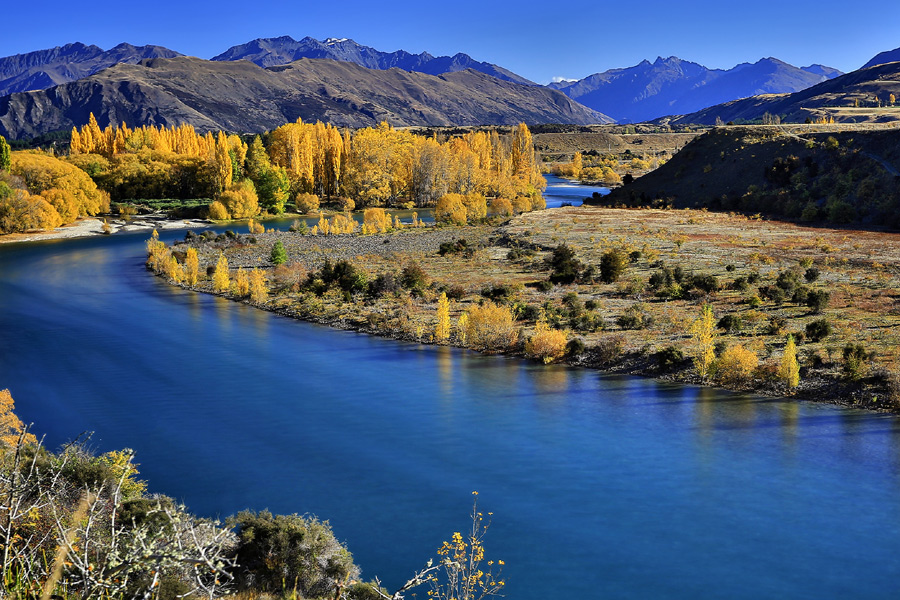 The Clutha River/Mata-Au in all its autumn glory.
Down my way in Otago, autumn creeps up on you, with daylight hours reducing slowly and deciduous trees gradually turning yellow, red, or orange. Through March and into April, brown trout congregate at the top of local lakes and dams and, when ready to spawn, enter favoured streams. If you encounter fish groups poised to enter spawning tributaries, the fishing can be outstanding.
At this time of year, I tend to fish with heavier lures and spinners because fish are resting deep in pools. Finding the fish is the most important factor as the fish are on a mission and can be here today but gone tomorrow. The Clutha River/Mata-Au above Lake Dunstan is a big river so tracking down spawning brown trout after they leave the lake can be hit and miss, but still better odds than finding the rainbows that spawn in winter when river flows are high.
One year after a very hot summer, a tributary of the Clutha River where brown trout like to spawn ran dry. This meant that, for a few weeks in early autumn until rain brought the dry river back to life, the early spawning trout had to cool their heels in the main river. The Clutha at that time was also going through a sustained period of low flow which lessened the usual fast current and made spinning easy.
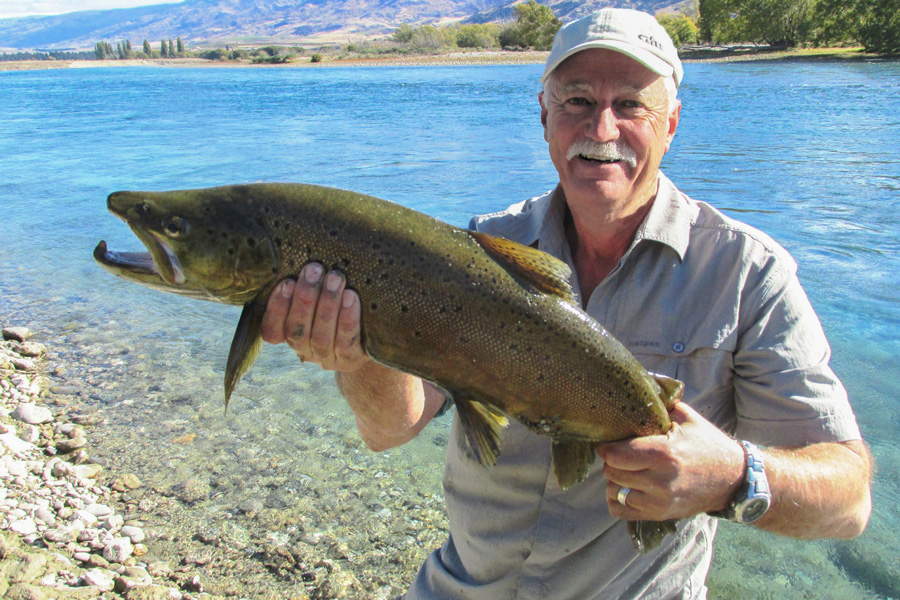
I stumbled onto this situation by chance while out exploring. I had landed two fat trout in the very first casts so re-visited several times after that success. In the trips following, I experienced some of the best Clutha River brown trout fishing I have ever had, culminating in some 20-odd well-conditioned trout brought to the net. The best of them was a solid 4.5kg jack.
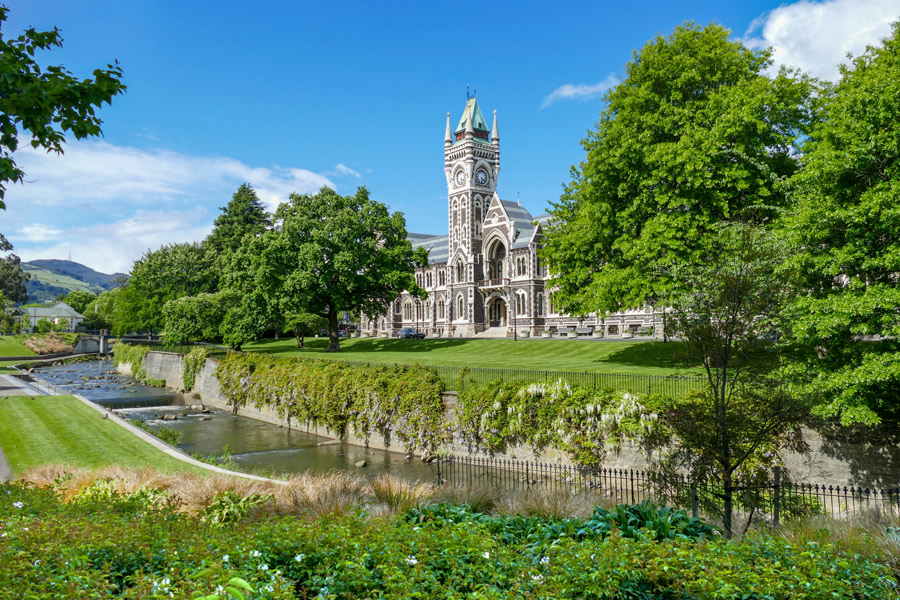 The Water of Leith, most famous as the waterway which meanders through the University of Otago, was where the first trout was legally caught in New Zealand in 1874.
A couple of smaller browns and the only rainbow were kept for the pot with the rest being quickly released. The spawning males in particular were very dark in colour; either blackish or olive and quite slimy to the touch. Most landed trout were jacks, and they all whacked the lure with animosity and virtually none got off as they engulfed the lure. The best day saw six trout come to the bank averaging about 1.5kg. This purple patch was a once-ever occurrence in my time, and since then high Clutha River flows in autumn have made it hard to target returning fish.
Recently, Fish & Game Otago released a brown trout report which focussed on spawning data results identified using their new computer modelling system. Two interesting points were the following:
• In Otago, brown trout and salmon spawning generally occurs in late autumn and early winter, while rainbow trout spawning takes place from late winter to spring.
• The species distribution modelling predicts that 25% of river and stream lengths across the region are likely to sustain trout and salmon spawning.
On the Water of Leith on December 1, 2024, Fish & Game Otago held a re-creation of the first time a licensed angler fished for trout in New Zealand. The original event occurred on the same date in 1874, 150 years ago. That angler was Alexander Campbell Begg who became the first person to legally catch trout in New Zealand.
Near where I was fishing on the Clutha is another historic game introduction site. Otago is also recognised as the liberation site of magnificent Scottish blood highland red deer. In 1871, three years before the first licensed angler caught a trout on the Leith, seven imported Scottish wild red deer were transported to, and then released in, the Morven Hills Station area which is located in the Lindis Pass. A memorial was later erected by the NZ Deerstalkers Association to commemorate this acclimatisation feat.
These animals adjusted quickly to their new habitat, and in the early years their population increased quickly and spread widely, both locally and across the West Coast. The stags descended from these animals are famous for producing long, wide, and even antlers.
Otago stags look like the one painted in 1851 by Sir Edwin Landseer. That oil on canvas painting was titled ‘The Monarch of the Glen’ and depicted a bulky, royal red stag looking majestic in the highlands of Scotland. In hunter terms, a royal stag is an outstanding red stag trophy carrying 12 points. On each antler is a brow, bey, and trey tine and three top tines. In a perfect royal, the tines are mirrors of each other. The original painting is on display in The Scottish National Gallery.
Quality spawning rivers such as the Timaru, Dingle Burn, Hunter, and Ahuriri flow through the original Otago red stag country. Brown and rainbow trout enter the three former rivers from Lake Hawea and the Ahuriri River from Lake Benmore.
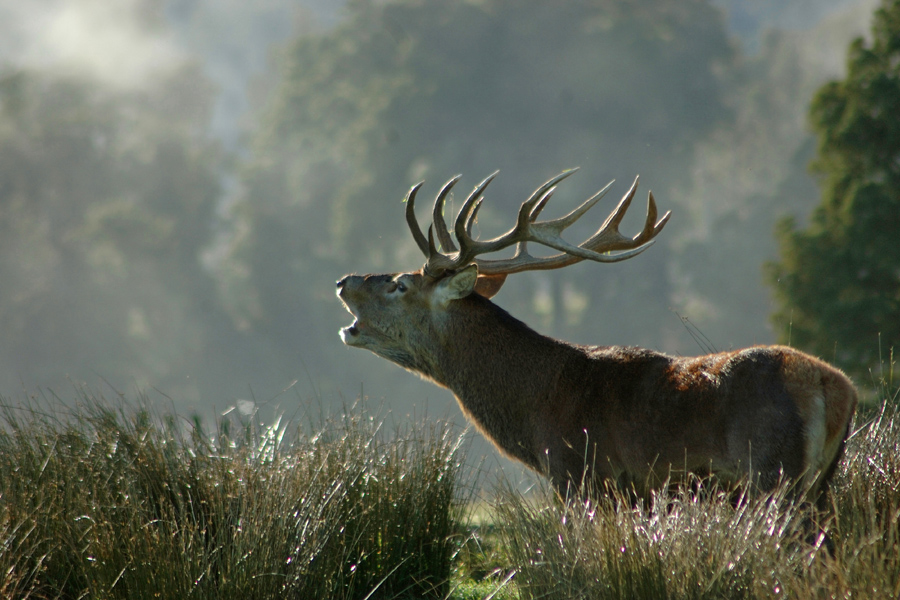
Red deer are the number one deer species in New Zealand and their rutting period is known as the roar. This term is used because rutting stags bellow, groan, and roar from late March to late April as they seek out hinds to mate with. The herd stag roars to display his virility to the hinds, and as a warning to rivals, while the other satellite stags roar in frustration.
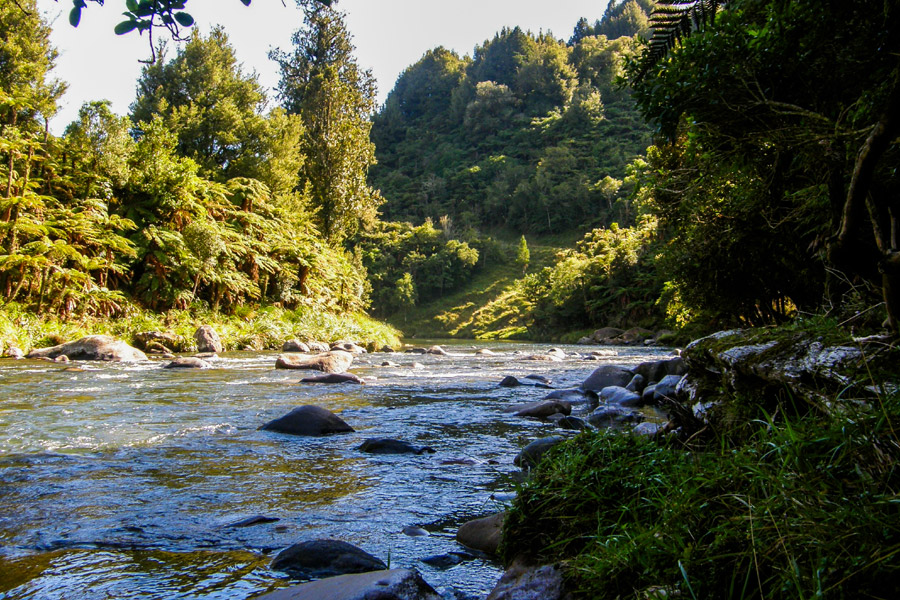 The upper Whanganui River.
You know a big stag is close when you come upon used wallows and marked trees. The big boys will chase away or fight any stag who tries to steal hinds on his watch. Fights are rare but can be vicious when a boss stag faces off against a heavyweight opponent who won’t back down. I have only ever seen one serious fight, as most are avoided through parallel walking intimidation.
Each Easter period, all this anticipated noise attracts hunters to the hills like bees to the flowers. The rutting stags can be located precisely, attracted closer by mimicked roaring noises, and are far less wary than usual. The best hunting time is dawn or dusk, or when the weather turns cold.
One excellent fishing river I had a chance to fish during an April red stag hunting trip was the North Island’s Whanganui River, in its upper reaches. This 220-kilometre river is the third longest in New Zealand, and up where I was hunting it flowed through thick native bush and scattered clearings. Way in the background were a couple of volcanic peaks.
When in red stag country during March or April, hunters often take a four-piece fly or spinning rod because the middle of the day is often a quiet time for the stags so a great time to go fishing for a few hours before the magic hunting hour or two near dusk.
The hunting had finished early, so with one full day free before leaving to catch my plane I went fishing. Riverbank access permission had been granted, so I got up early on the last day and headed out at first light. Borrowing a quad bike, I worked my way through some paddocks and parked up at the bottom of a long stretch of very fishy-looking water. I knew I was in wilderness country when I soon spotted some wild goats on the riverbank and a pair of blue ducks (whio) ducking and diving in a rapid. I had seen whio before in Fiordland, but this was a first for me in the North Island. They are called torrent ducks because their bills are designed for scraping food off rocks located in fast water. If you are lucky enough to spot some, it is most likely to be in a gorge, on a rapid, or a pair resting on a calm pool above or below a stretch of fast water. They like swift rivers with a clear, shingle bottom that is surrounded by bush. I snapped a photo as they swam past.
I recently read the book Sam the Trap Man written by Sam Gibson. It was a great read, and in the book he described how he helped form a community conservation group to remove whio predators on his stretch of the Waioeka River. With Department of Conservation permission and supportive sponsors, his East Coast organisation set up a trapping programme. The Eastern Whio Link was established in 2020. One decal they stuck on their vehicle windows read Whio Country is Trout Fishing Country. Very true, in the case of the place I was fishing.
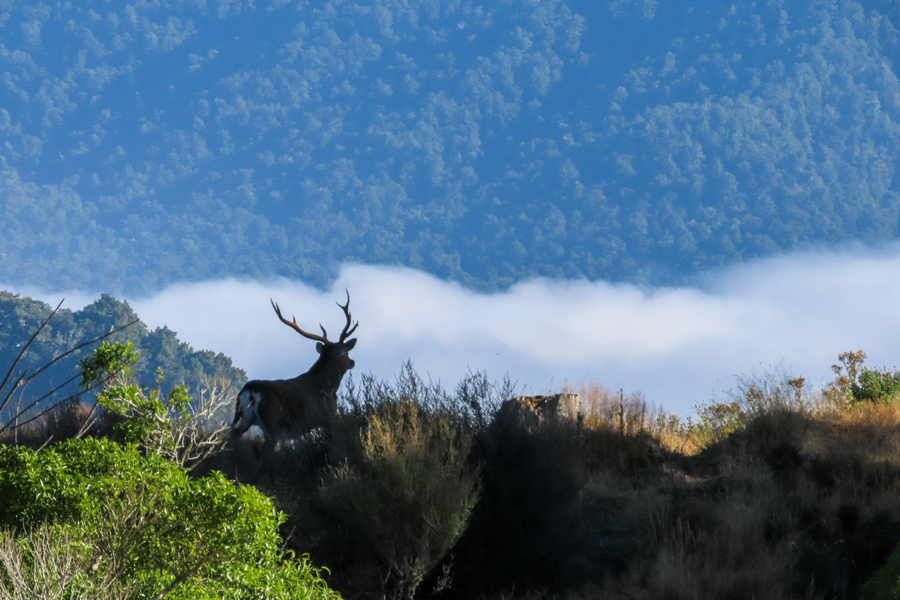 The Poronui sika stag that Greg spooked.
The Whanganui River season in the spot I was fishing runs from October 1 to the end of June and allows the use of spinning gear. I had brought some of my favourite spinners and a couple of heavier Tasmanian Devils. All had single hooks. The water was clear and fast flowing and tended to have long tail-water glides with a few swirly pools and several big boulders. I started with the spinners but they were too light for the conditions, so I eventually changed to a gold-coloured Tassie. The change in weight put the Tassie where the fish were holding, and on the first cast using it I was whacked by a fat rainbow hen. I kept this one for the pot, as the hunters back in camp had requested a couple of trout for a change in diet.
I worked my way upstream, probing the quieter water with the Tassie. I landed and released two more rainbows and kept a fat maiden brown trout. I paused for a break and while having lunch I spotted movement on an opposite slip; it turned out to be a nomadic red stag looking for hinds. He slowly walked across the steep face, then paused on the edge of the bush where I took a photograph of him as he let out one last forlorn roar before disappearing.
In the afternoon the fishing tapered off, so I decided to fish just one more pool before heading back downstream to the bike. The first cast was ignored but on the second cast a chasing trout nailed the Tassie virtually at my feet. It swirled back into the current and fought totally differently from the earlier rainbows. It was no surprise when I landed an olive-coloured brown trout. While the spawning jack lay immersed in water in the net, I set up the camera self-timer and got a photo before letting him go. It had been a great conclusion to my trip.
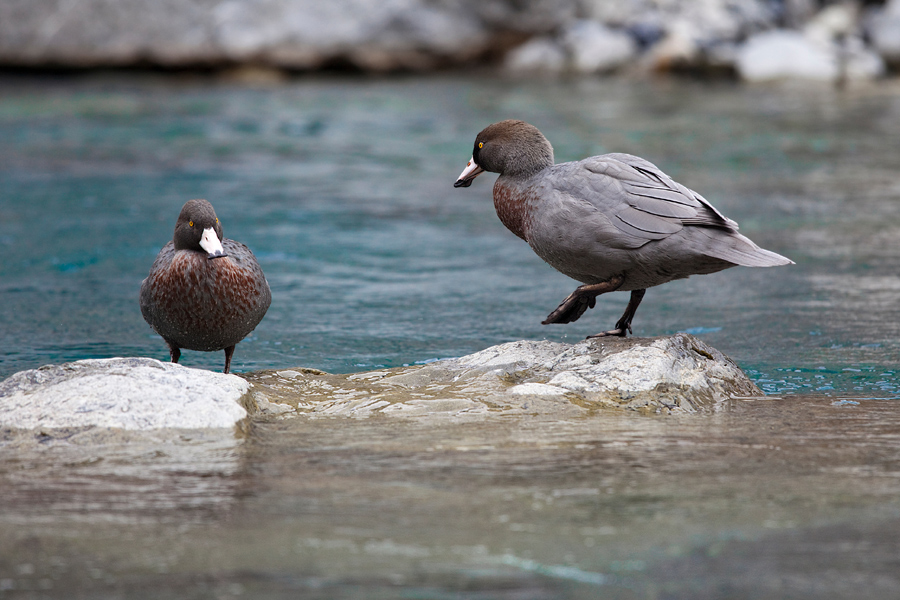 Whio (blue ducks) favour swift rivers with a clear, shingle bottom that is surrounded by bush.
Another memorable place to fish and hunt is the Central North Island. It is often referred to as sika country because this deer species is prevalent throughout the Kaimanawa and Kaweka Ranges and across several private properties. Helicopters during the rut are booked solid as clients fly into prime rainbow trout and trophy sika stag wilderness blocks. Many bring rods as well as rifles.
Sika is derived from ‘shika’, the Japanese word for deer. The herds that inhabit New Zealand are of mixed parentage, as they are descended from Japanese and Chinese subspecies. In April the urge to mate brings on a red mist. Eating food is replaced with territorial calling, marking and defending turf, digging scrapes, threatening and fighting rivals, and pestering hinds.
Sika stags have an ‘in your face’ attitude.
“Who are you?” and “What are you doing on my land?” are questions they want answered or else.
My main knowledge of sika is through observation, and that observation tells me they are assertive, curious, tough, and gregarious, yet wary away from the rut. A sika expert once told me that during the rut sika stags are not just ‘he-haw’ and ‘shrill whistle’ vocalisers. Get in close, he told me, and there are a multitude of other noises going on. He was right. On an early trip I stalked in on a rutting stag and gave him a call to get his attention. The result was amazing. He spun around and came straight at me, grinding his teeth, and making low growls, moans, and squeaks. His eyes sparked anger and his body posture was all agro. At distance you would not hear any of these messages. He only spun away when he caught my scent. Even then he only ran a few paces before glaring back at me and high-stepping into the bush. If I had been a stag he would have had me.
Over the years I have shot quite a few sika stags, with my best being a spotted eight-pointer shot at long range. Early and late in the day is the best time for hunting success. Success is rewarded as sika venison is fantastic.
I felt I had ticked the trophy box and since then gave myself a new goal – a photograph of a free-range trophy sika stag at close range. Lots of other rifle hunters turn to archery to get that up-close thrill.
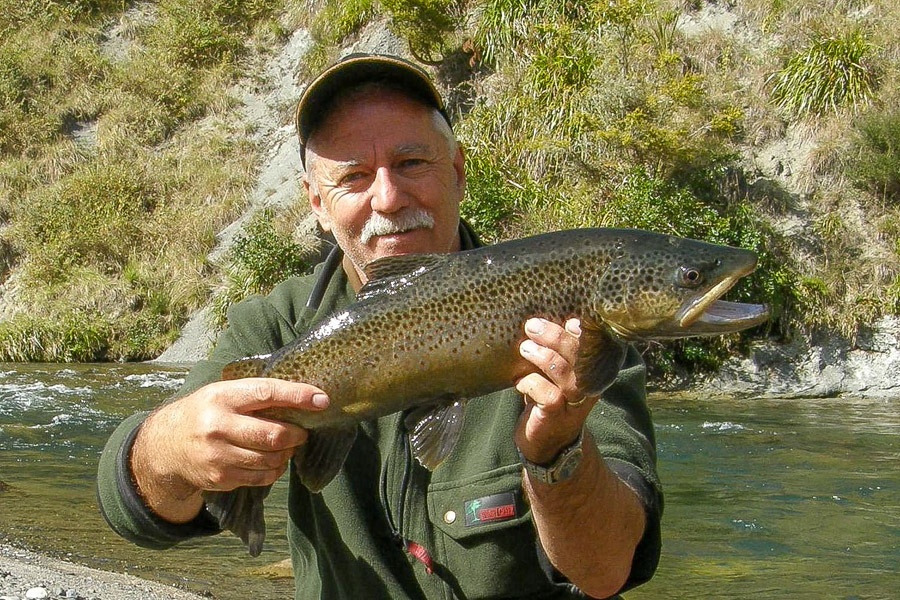 Greg found success spinning with gold Tasmanian Devils on the Whanganui River.
Last year I was lucky enough to be on site for a few days at Poronui, inland from Taupo, writing about tourism changes that had recently occurred on the property. A window in this schedule allowed me time to try and deceive one of the local trout that lived in the Taharua River and also try and get that special free-range sika photo.
Both goals would be a challenge. The local Poronui trout are no easy-beats, and I am far from being a skilled fly fisherman. I had borrowed a rod and gear from a local and gone wandering along the riverbanks close to where I was staying. I decided to bet all my chips on a black blowfly dry foam imitation. I have had quite a lot of success with this pattern over the years. The Taharua River is slow in many places, but steep banks mean it is hard to access the water without being seen.
The morning was a flop, with several fish seen, but all of them saw me, too, and scarpered. I still had confidence in my dry fly choice so persevered with it. Coming around a corner in the afternoon, I spotted a big brown parked up on my side of the river. He was on station and ducking in and out to grab food I couldn’t identify. I began false casting out to the right, away from the water, then pivoted and let the final cast whistle out over the water. It went just where I wanted direction-wise but half a metre too short. I felt gutted, but the trout threw me a break. He had heard the noise of the fly landing and swam down to check out what it was. He drifted along under the fly; then, satisfied it looked real, he sucked it in, and after saying, “God save the King,” I struck.
Fish on. Like many browns near spawning, the fight was fairly underwhelming. Soon after hooking and a couple of short runs I had him in the net. A photo of him lying in the net was taken, then he was released to do what spawning trout are all about at this time of year. He was my only success for the day, but I was very happy. Sometimes the difference between a good and so-so day is one quality fish. He weighed 2.25kg. Now it was sika time.
Poronui is the location where the country’s first sika deer were released in January 1905. The 16,000-acre private property has excellent free-range deer habitat comprising some remnant exotic gum plantations, river flats, scrub, swampland, native forests, and cut-over hills. In addition, the farmland backs on to thousands of acres of public land forests. There is no shortage of deer, but the old stags get old for a reason. My visit was at the tail-end of the rut, so while the stags were still hanging around the fringes they were starting to form bachelor groups again.
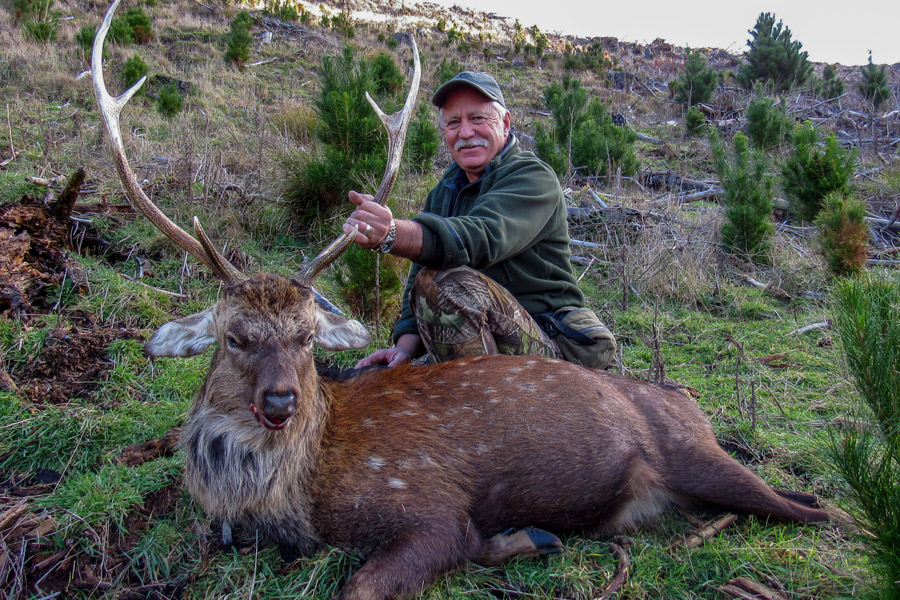 Greg with a trophy sika stag.
When I had spare time, I had been checking out all the bush edges for sika. One evening, away in the distance, on a knoll, I could see some forest stags sunning themselves. The next morning dawned foggy, so I was on my way early to sneak up on their position. I spooked one stag on a ridge but on the plus side got a great snap of him running along a spur with fog and hills in the background. Two hours later I approached the spot where I had seen the stags and began creeping towards the highest crest.
The fog was now gone, and the rising sun was low and directly behind my right shoulder. I had my camera screwed onto the top of my monopod pole. This allows it to double as a walking pole and camera stability aid. I was about to crest the final rise when I suddenly realised a massive sika stag was standing on my side of the ridge, staring away from me down to the flats below. He was half obscured and seemed unaware of me, but soon after my sighting of him he must have got a vibe that something was not right. He turned slowly, looked straight at my silhouette and then raised his head with surprise and alarm. Luckily, as this was happening, I had time to lower my head behind the camera, and this move, combined with the full sun in his eyes, meant my white face had disappeared from view.
He just stared at the black camera and then relaxed. At one point he even ignored me totally and looked back down the valley. I began taking photographs, marvelling at how magnificent he looked standing in the direct sunlight, with trees and a mountain behind him. He finally became uneasy about some approaching deer and casually turned, walked over the crest, into the trees, and out of my life. But I have the photos to remind me of this tough, old warrior.
What an experience. His eight-point antlers were wide, even, and long. His spotted pelt hinted at Manchurian bloodlines. A length of vine hung from his right antler, a deep gash was evident under his left eye, an ear was scabbed, and several tines had tip damage. It is an encounter I will never forget and the sort of experience most likely to occur for anglers and hunters only during autumn.
- By Greg Morton
Similar Articles
New Zealand's Kingfish Fishery
28 May 2026Yellowtail, kingfish, or both together – call them what you like, but our most prolific gamefish features highly on the fishing calendar right throughout the year.... Read More >
New Toys - Winter 2026
27 May 2026Check out these hot new products, fresh out this winter. JAF x Victory Bare Bones A heritage blade maker and a modern fishing label have come... Read More >
Spearfishing World Championships in Brazil
21 April 2026Every two years, the top spearfishers from all four corners of the globe pit themselves against one another at the CMAS Spearfishing World Championships, seeking to... Read More >
Fishing & Hunting in West Otago
15 April 2026West Otago is a tucked-away rural area that, in outdoors terms, punches well above its weight. This is especially true when it comes to pursuits such... Read More >
How Tides Influence Fishing Success
1 April 2026“Time and tide wait for no man,” wrote the ‘father of English literature’, Geoffrey Chaucer, way back in 1395 in his classic The Canterbury Tales. Now,... Read More >
Recent Forum Posts Visit Forum

2026 Grunter Hunter
in The Briny Bar4 hours ago
Kevin.S
The results have been posted, but there seems to be a mistake as I can't see Smudge anywhere amongst the prize winners....
FC 595 For Sale
in Buy Sell Trade or Exchange51 hours ago
Kevin.S
I have reluctantly decided to sell my boat. It really is not getting enough use to justify keeping it. It is a 2016 FC 595 with...


Manukau Harbour & West Coast fishing
in Fishing Reports90 hours ago
smudge
That's a great catch Schecter! Kayak fishers do it so much harder than anyone else. It would be an absolute pleasure to hand over the $5k...

Knife sharpeners
in The Briny Bar138 hours ago
krow
I'm about to order a couple from Amazon. Check your PM Smudge...
1989 Evinrude 90hp V4
in The Boat Shed139 hours ago
bricker
Inherited the above outboard on a boat - is in very good order with little use. The serial number is A1351974. Is there a way of...

Auckland Yakkers
in Yak Yak Yak216 hours ago
BananaBoat
Out from Mission bay this evening. Went to the red marker by Mission & Kohi. Never fished this area beforeHad a quick looksie for some structure....
Yellowfin
in The Briny Bar233 hours ago
krow
I heard there were Yellowfin East of the chicks yesterday but I'd suggest this is unusual this late in the season as the water is cooling....

Mac'nificent Autumn Fishing....Mokau!
in Fishing Reports260 hours ago
Snappa Geoff
Thankyou for the replies guys... Tagging some bigger fish is a good idea Krow! but it doesn't interest me enough to get involved....
Yozuri crystal minnow deep diver lure 6"?
in Popper and Topwater Fishing300 hours ago
SeniorInvissibl
Anyone ever used this lure before to provide feedback? I've never used yozuri before.The package states it dives to 20 feet, I'm using it to troll...

Popular Articles

Softbait Fishing - Part 1 - gear selection
John Eichlesheim writes an article about selecting the right equipment for softbait fishing... Read More >
Softbait fishing Pt 2 - tips and tricks
Techniques, tips and tricks of softbait fishing – getting the most from your soft baits.... Read More >

Surfcasting - setting yourself up
Gary Kemsley helps sort out the necessary gear for intending surf fishers.... Read More >

Squid - How to catch them
Squid fishing is a rapidly growing aspect of fishing - Paul Senior shares some hints and tips to get started.... Read More >
Fishing Reports Visit Reports
Tauranga Fishing Report - 28/05/26
Tarakihi on the bite Trips are few and far between at this time of year,... Read More >
Canterbury Fishing Report - 28/05/26
Fresh and salt turning it on! It is not very often I get to say... Read More >
Bay of Islands Fishing Report - 28/05/26
Lures paying dividends We finally had a break in the SE winds that have been... Read More >
Manukau/West Coast Fishing Report - 28/05/26
Snapper and gurnard in the harbour The weather has finally taken a turn for the... Read More >
Comments