
Maverick Renegade 450
A CAPITAL CAT
Catamarans are not common amongst New Zealand-built recreational powerboats, yet they have many positive aspects including: a huge amount of internal space for a given length; a high level of stability; and substantial load-carrying ability.
When Wellington-based entrepreneur, diver and fisherman David McLellan decided to turn his hand to creating a recreational boat, he formed an alliance with Jarrod Hall, of Hall Marine Design, and the Maverick Cat was born. An established and experienced CPC-certified North Island boat manufacturer then signed up to produce these hulls.
I found myself looking at the resulting vessel at the Tarakena Bay ramp on Wellington’s South Coast just a few minutes after getting off a plane from Auckland on a fine but windy day at the end of November.
Skinning a cat
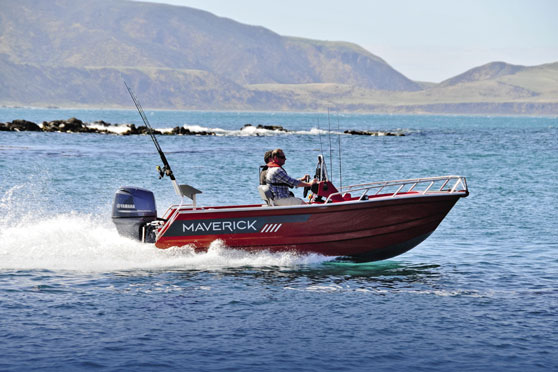
David had set up the Renegade 450 – the first cab off the rank – with a Yamaha 100hp four-stroke outboard with a 16-inch pitch propeller. This is not because the boat needs this amount of power (a 60hp Yamaha will push it to 30mph), rather it’s because four divers and all their dive gear can easily be accommodated; such a load requires a bit of boogie on the back to tote it around. Although still trying different props and engine heights, the rig was achieving 35mph at 5000rpm. This is at the bottom-end of the engine’s maximum rev range of 5000-6000rpm, so there is more speed to be had yet.
Painted an attractive ‘Wildtrak Orange’, this was a head-turning rig, configured as a centre console with an attractive rising sheerline. The hull is constructed from 4mm-thick 5083 aluminium alloy, and the internal layout of this 4.5m (4.93m LOA) craft had been left relatively clean and uncluttered. Buoyancy is mostly contained in two sealed and pressure-tested chambers (one in each hull). The excess of buoyancy over the hull and engine weight is a creditable 990kg.
An open-topped anchor well is situated in the bow, along with a tie-off cleat and fairlead with split bow rails. Interestingly, the Voyager trailer (especially designed for the cat with ramps, benches and eight keel rollers) has a set of steps built onto the winch post, allowing boarding from the bow when the boat is on the trailer.
The foredeck has Deck Tread panels as an aid to boarding over the bow, as has the forward casting platform, which also serves as a bench seat and the hatch to a substantial dry-storage locker (built with drainage channels). The main Tread Plate deck is sealed and drains astern to duckbill scuppers.
The modest-sized centre console has a polycarbonate ‘screen and two levels of stowage, with the battery set up on a shelf. It is intended to alter the transom wall design to incorporate a battery locker in the 2015 production hulls, as well as make the console a bit larger to provide more stowage space. A Raymarine sounder-GPS is mounted on the dash; instruments, hydraulic steering, switching and throttle/shift are mounted on the console and a Lowrance Link-5 VHF is slung under it.
Behind the console is a comfortable, two-person, fixed pipe-frame seat with reversible backrest and space for a 56-litre Icey-Tek cooler underneath, which can store the catch and bait, or lunch and drinks.
The transom wall houses two 25-litre tote tanks, and over the stern are twin boarding platforms with Deck Tread finish, grab rails, and a fold-down ‘T’ boarding ladder on the port side – ideal for divers.
Blown away
As readers will know, it has been a windy old spring and settled periods have been short, few, and far between. What looked like a just-workable day, forecast at 15-20 knots of NW saw the weather-window slammed shut as the wind picked up to 30, gusting 40 knots. At least it was nice and sunny, and we had a degree of lee shore along the south coast to work with. A run to the east saw the Wellington Harbour’s entrance looking like a washing machine, with strong winds coming from two directions (along the coast and out the entrance), the tide from a third vector, and a two-metre swell from a different angle again!
The cat handled the watery mishmash safely, but it was far from comfortable, so we decided that a spot of fishing under the shelter of the hills west of Owhiro Bay might be preferable.
Even there the wind was screaming down the gullies, but the Renegade was like a sports car to drive, responsive and stable. This is an asymmetrical cat design, meaning in this case that the hulls are curved on the outside, but nearly straight inside the tunnel. This configuration has one aspect that some people find a little disconcerting until they get used to it – the boat heels to the outside when turning, the opposite to a monohull.
Tunnel design can be critical in cats. Get it wrong and you will get cat ‘sneeze’ (spray chuffed forward from the tunnel, which curls straight back over the bow), atomised spray coming out of the tunnel at the stern (which is sucked into the cockpit by the low-pressure void formed while running forward), and hammering in a head sea (as the breastplate hits the water). Despite the manky conditions on the day, the Maverick proved to have none of those issues; Hall Marine appears to have got the hull design pretty-much spot on, first time round.
The Renegade is a great little sport boat. The stability and plenty of internal space – a combination of the beamy cat design and centre-console layout – make it ideal for fishing and diving.
However, with the currents racing, it was not a day for diving, so despite it being the middle of a bright day in shallow water, we dropped a line over the side. In the process the stability and space came to the fore, with the wide gunwales making useful perches that complemented the bench seat. There were plenty of bites, but we were rewarded only with a string of small blue cod and parrot fish. Then, when the combination of swell and howling wind bent our grapnel tines straight, even this modest enterprise came to an end. Taking the hint, we called it quits.
Fishing fittings on the boat included four through-gunwale rod holders, a vertical carry rack for three rods on the corner of the console, and a removable bait-station on the transom that drains overboard and has three more rod holders on the back.
Well-designed and built with a high level of finish, this is one cool cat. Without getting too serious about the fishing layout (the simplicity of the boat’s fit-up is one of its assets), the Maverick Renegade 450 has all the basics for a nifty fish-and-dive day boat, especially if your fishing includes drift-fishing and casting, which suit this rig particularly well.
|
|
This article is reproduced with permission of |

Fishing Reports Visit Reports
Tauranga Fishing Report - 28/05/26
Tarakihi on the bite Trips are few and far between at this time of year,... Read More >
Canterbury Fishing Report - 28/05/26
Fresh and salt turning it on! It is not very often I get to say... Read More >
Bay of Islands Fishing Report - 28/05/26
Lures paying dividends We finally had a break in the SE winds that have been... Read More >
Manukau/West Coast Fishing Report - 28/05/26
Snapper and gurnard in the harbour The weather has finally taken a turn for the... Read More >


Major Bites
Minor Bites
Major Bites
Minor Bites
Popular Articles

Softbait Fishing - Part 1 - gear selection
John Eichlesheim writes an article about selecting the right equipment for softbait fishing... Read More >
Softbait fishing Pt 2 - tips and tricks
Techniques, tips and tricks of softbait fishing – getting the most from your soft baits.... Read More >

Surfcasting - setting yourself up
Gary Kemsley helps sort out the necessary gear for intending surf fishers.... Read More >

Squid - How to catch them
Squid fishing is a rapidly growing aspect of fishing - Paul Senior shares some hints and tips to get started.... Read More >
Comments
Latest Articles
Extreme Aluminium Trailers Review
June 2026Extreme Boats has long been recognised for its award-winning aluminium vessels, and is now expanding into high-quality aluminium trailers... Read More >
The Export NZ Fishing Competition Announces Season Winners
June 2026Another exciting season of The Export NZ Fishing Competition – has come to an end, and we’ve just announced our prize winners... Read More >
History of Zane Grey's Fishing in NZ
June 2026One hundred years ago, the trajectory of big game fishing in NZ changed forever with the arrival to its shores of one man - Zane Grey... Read More >
BBQ'd Gurnard with Citrus and Herb Butter
May 2026This is a pretty ‘cheffy’ recipe, featuring a sauce that is definitely one to impress guests with, but it's fairly easy to cook... Read More >
Mackenzie Country Trout & Tahr
May 2026The Mackenzie Country winter months of June, July, and August herald the main spawning time for canal trout... Read More >