
Niue: The Rock of Polynesia
- Sam Mossman

After closures to protect the island from Covid, Niue finally opened its borders to quarantine-free travel from NZ on June 28 2022, which is just in time for the winter wahoo season, writes Sam Mossman.
Just three and a half hours’ flight from Auckland with Air New Zealand (flights leave every Tuesday morning), Niue was for many years a New Zealand protectorate before agreeing to independence in 1974. But the island nation remains in ‘free association’ with New Zealand, so life is simple for Kiwi visitors to Niue.
The New Zealand dollar is local currency, crime is almost unheardof, there are no dangerous animals, insects, or reptiles to worry about, and the people are very genuine and friendly, doing all they can to make you feel at home.
Known as ‘The Rock of Polynesia’, Niue’s topography is different to a lot of other Pacific islands. Technically a raised coral atoll, it is in effect a huge limestone block, built by coral growth on a nearsurface seamount. Titanic upheavals in the distant past have resulted in the current structure – sea-cliffs, wave-cut coral reef platforms, chasms, caves, blowholes, and intimate little sandy coves.
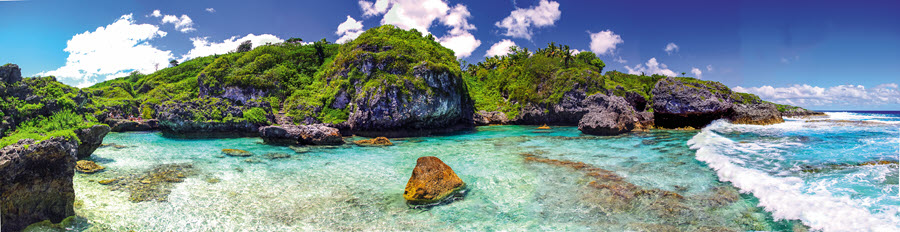
The chasms are a sort of reversed coral reef; rather than extending out to sea, they are breaks in the cliffs where the ocean extends into the island, forming safe swimming pools filled with coral and tropical fish. The coral has formed into limestone cliffs 30m high and is girdled by a narrow reef platform, cut by the relentless action of the sea. Off the edge of the island, the ocean floor quickly drops to abyssal depths.

Rock Fishing
Fishing boats are either traditional vaka (one man outrigger canoes), or aluminium trailer boats lifted in and out by crane at the main wharf (limiting their size to around seven metres). This is not an issue for local fishermen, however, as the steep shoulders of the island and lack of a barrier reef mean that most of the fishing action takes place within a kilometre of the shore.
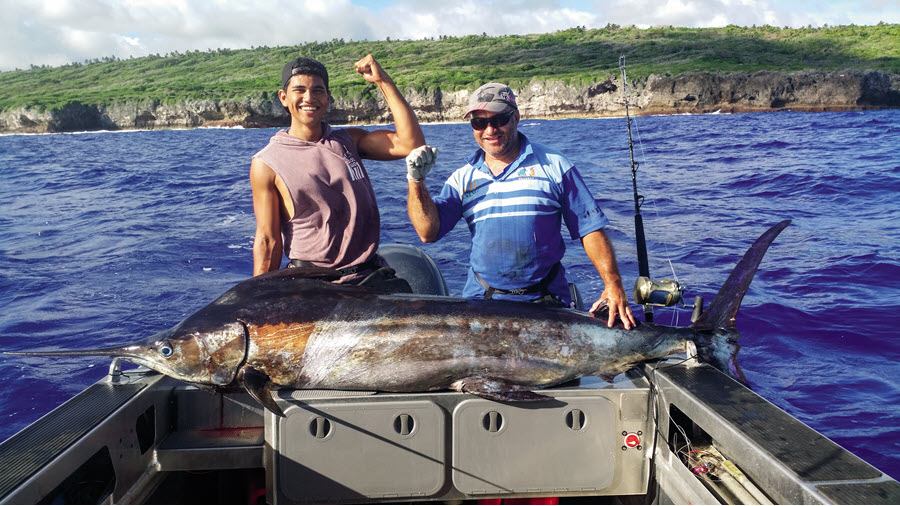
Trolling and other forms of fishing are often centred around a series of FADs placed by the local Fisheries Department near underwater ridges running off the shoulders of the island. Some huge fish, including blue marlin of over 350kg, have been taken from small boats near Niue – real Old Man and the Sea stuff – but the usual targets are tuna, wahoo, and mahimahi, supplemented with bottomdwelling reef fish. This combination of species is what predominantly feeds the local people and supplies the local restaurants.
Depending on the time of year, the mix of fish species varies. The summer months see more tuna, particularly yellowfin and skipjack, while wahoo are more prevalent during the winter, from June onwards. Mahimahi, sailfish, and blue marlin may be encountered at any time of year but are more common in the summer.
Supporting actors are tropical barracuda, the powerful red bass (or fangamea as they are locally called), bluefin, goldspot, bigeye, black and giant trevallies, rainbow runner, and a wide range of tropical snappers, jobfish, groupers, and other reef fish. Longtailed red snapper and ruby snapper, various jobfish, amberjack, black trevally, saddle-back snapper, dogtooth tuna, and other bottom fish may be targeted from the deeper waters around the island.
Billfish are not usually actively targeted by local boats, but are often encountered – mostly sailfish and blue marlin, although black and striped marlin are sometimes caught, as are bigeye tuna and sharks. Overall, a huge range of opportunities are available for anglers visiting Niue.
Wahoo is the fish of choice in Niuean waters. It is the fish that everybody there wants to eat, and so it is also the one everybody wants to catch. As mentioned, they are most common in the winter months – June to September – which is when most tourists visit the island.
I had previously caught some very nice specimens and had some great action during winter trips to Niue, but during a recent visit at the end of February, I still managed to put a few in the boat. There is not much that anyone could teach the locals about wahoo fishing – they are masters of the game and they even claim that if wahoo are near the surface in an area, they can smell them!
Charter fishing in Niue is pretty much like going fishing with your mate in his tinny – something that most Kiwi fishermen can identify with. Charter boats in Niue are mostly 5-8m aluminium trailer boats, well equipped with safety and communications gear, auxiliary engines, and basic practical tackle, although if you want to fish lighter gear or want specialist gear (such as topwater or deep-water braid rigs) it can pay to take your own.
Charters are either half or whole day, but the fishing grounds start right at the wharf, and even a half-day is a good spell of fishing (that may last a little longer than the allotted period if the fish are biting). The catch belongs to the boat and is sold or distributed domestically. This is reflected in very reasonable charter rates, and if you’d like to try some, most skippers are happy to supply their anglers with a portion of the catch for dinner.
Fishing is weather dependent so be flexible and don’t leave charter organisation until you get to the island. Also, be aware that most skippers want to be on the water before dawn.

If you want to paddle an outrigger canoe, walk in the bush and on reefs, and learn the lore of ancient Polynesian ways, then Niue is the island to visit.
Taking the long view
Niue is the largest single-raised coral atoll in the world, with a substantial Exclusive Economic Zone. Niue’s marine ecosystems include the narrow fringing reef around the island, several seamounts (notably Endeavour Seamount and Lachlan Seamount), submerged atolls (including Beveridge Reef and Antiope Reef), and open ocean. Niue’s EEZ is approximately 317,500 km2.
Niue is dependent on its marine resources. Implementing a new approach where industrial fishing and other extractive activities are limited to carefully considered and tightly managed resource use zones, the government and people of Niue developed a marine management program to ensure food security for the Niuean people.
Further, this management approach can leverage sustainable income from ecotourism and sportfishing by visitors that will economically support the communities that depend on the ocean.
On 13 April this year, Niue announced bold new marine legislation that will ensure sustainable use across its entire EEZ. The Niue Nukutuluea Multiple Use Marine Park safeguards 100 percent of its Exclusive Economic Zone (EEZ and Territorial seas) with 40 percent as a large-scale no-take Marine Protected Area.
The MPA will see the waters around Niue and nearby Beveridge Reef (an uninhabited, semi-submerged atoll) closed to commercial fishing. Large-scale commercial fishing activity will be banned throughout this protected area, while still allowing indigenous artisanal fishing and tourist sportfishing in some areas.
.jpg)
Dive the Rock
All rain that falls on Niue goes straight underground. And with no rivers, visibility is excellent – up to 80m. With no barrier reef, dives are on the island drop-offs, and temperatures range through the year between 25 and 30°C. Local operator Niue Blue offers a range of exquisite dive trips. Marine life includes hawksbill turtles, banded sea snakes, white tip reef sharks, barracuda, coral gardens and a wide range of tropical fish.
Humpback whales come to Niue to breed and calve every year between July and October, and spinner dolphins are common. If you want to do your own thing in a leisurely fashion, then hire fins and masks and head off to snorkel some of the chasms that are features of coastal Niue.
Some are harder to reach than others, but all are signposted from the round island road; many have concrete pathways leading to them, and picnic facilities. Limu, Matapa, and Avatele are easy spots to start with.
Further advice can be gained at the Tourism Office. Blue water spearfishing is a relatively recent development on Niue, but several local skippers are now experienced in the techniques of putting free divers onto pelagic sportfish, especially wahoo, dogtooth, and mahimahi.
Other activities
There is plenty to do in Niue, apart from fishing and diving. Although there is no protected anchorage, deep water moorings and shore facilities are available to visiting boats.
There is a golf course and plenty of tracks and walks, including the Huvalu Forest Conservation Area. A limestone cave system is one of the most extensive in the Pacific. Expert forest guide and ebony carver Jack Feleti is the man to talk to. As mentioned, Humpback whales arrive to breed and calve between July and October.
You don’t even need to get on a boat to do some whale watching; they can often be seen from shore and there are lookouts on the coastal road that are ideal for this. Bikes and e-bikes are available for hire and there are some challenging mountain bike tracks on the island. A range of Island tours are available, including art and culture.
Recently, Niue became the world’s first country to become a ‘Dark Sky Nation’, receiving formal accreditation covering the whole country with Dark Sky protection. Niueans have a long history of star navigation and a life regulated by lunar cycles and star positions. Visitors to Niue can view the spectacle of an unspoilt tropical night sky. Guided Astro-tours are led by trained Niuean community members.
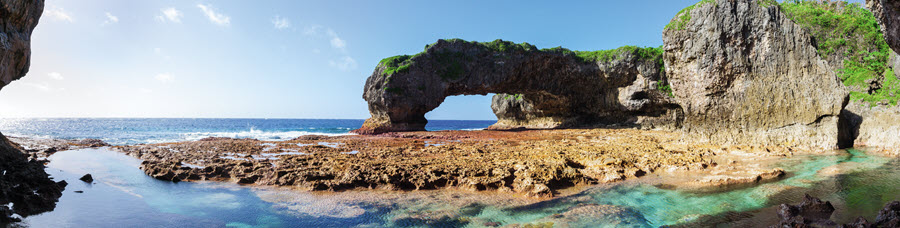
Visitors will be treated to stunning views.
Accommodation
There is an excellent full-service hotel with an international resortstyle setting; many self-catering fales or cottage style units; guesthouses, motels, and backpacker options. All service expectations are covered. Some accommodation providers have pools, many have air conditioning, most have views, and all are clean.
Eating out
At last count there were about a dozen restaurants and cafes on the island. Hygiene seems good, you can get a decent coffee, food is well cooked, and substantial meals are provided. Because customer numbers are not high, not every establishment is open every day. So, it pays to make bookings or at least check opening days and times for evening meals.
If you want to shop for expensive luxuries and loaf on a white-sand beach, Niue might not be your cup of tea. But if you want to fish, dive, explore caves, paddle an outrigger canoe, walk in the bush and on reefs, and learn the lore of ancient Polynesian ways, mountain bike through the rainforest, snorkel in hidden saltwater pools, eat well, relax, and meet some great people, then you will love it on the ‘Rock of Polynesia’.
Visit www.niueisland.com for more information on Niue Island.

July 2022 - Sam Mossman
New Zealand Fishing News Magazine.
Copyright: NZ Fishing Media Ltd.
Re-publishing elsewhere is prohibited


Major Bites
Minor Bites
Major Bites
Minor Bites
Latest Articles
The Export NZ Fishing Competition Announces Season Winners
June 2026Another exciting season of The Export NZ Fishing Competition – has come to an end, and we’ve just announced our prize winners... Read More >
History of Zane Grey's Fishing in NZ
June 2026One hundred years ago, the trajectory of big game fishing in NZ changed forever with the arrival to its shores of one man - Zane Grey... Read More >
BBQ'd Gurnard with Citrus and Herb Butter
May 2026This is a pretty ‘cheffy’ recipe, featuring a sauce that is definitely one to impress guests with, but it's fairly easy to cook... Read More >
Mackenzie Country Trout & Tahr
May 2026The Mackenzie Country winter months of June, July, and August herald the main spawning time for canal trout... Read More >
The Hutchwilco NZ Boat Show Official Guide - 2026
May 2026This year, The Hutchwilco New Zealand Boat Show returns bigger than ever as New Zealand's ultimate boating and fishing showcase... Read More >