
World Fly Fishing Champs In Spain

James Fuller describes his experience at the World Fly Fishing Championships in Spain...
Be like ninja,” came the whispered, thickly accented instruction from behind.
I was stalking my way heron-like up a picturesque stretch of river in Northern Spain, through the mottled light cast by a cathedral arch of entwined bankside trees towards a venerable single-arch stone bridge; the kind of structure which is hewn from local rock, the kind which melts into the landscape as if it’s always been there.
The instruction comes from our guide Alejandro and, as with a lot of his advice, is delivered with a dollop of tongue-in-cheek playfulness. But whilst the ‘ninja’ references always come with a glint in the eye, their essence is solid. The trout of this region are heavily fished and notoriously wary, and a summer of negligible rainfall has left the rivers thirsty and the fish even more skittish than usual. “Low and slow” will become a mantra for our approach.
It is practice week ahead of the 41st FIPS-Mouche World Flyfishing Championships in the principality of Asturias, a lush mountainous region that exudes antiquity. Stretching back in time, its countryside has been home to Romans, Moors, Christian pilgrims, some of the earliest known humans and, before them all, dinosaurs. This verdant landscape, dotted with quaint stone farmhouses, barns and villages, retains a sense of yesteryear and bears, wolves, and wild pigs still roam the hillsides and forests.
I am here as one of a three-man New Zealand Silver Flies line-up, alongside teammates Tim Rich and Ollie Bassett, and the only wildlife we’re interested in is trout. Though the average size of the native brown trout here is considerably smaller than New Zealanders are used to. This stature, added to a cagey reputation and the prevailing local conditions, will necessitate a different approach.
A fresh approach
This means lighter, stealthier, more sensitive equipment; for euro nymphing, I’m using an 11’ 2wt and for dry fly a 9’6” 3wt, but it’s the terminal tackle where the difference is most marked. 8X tippet, with a diameter 0.09mm and breaking strain of 2lb, will become our go-to, even dropping down to 9X and 10X on occasion. The flies are small too; with dries predominantly Spanish-style split-wing CDC patterns in 16s and 18s, and the nymphs are mostly perdigons and pheasant tails in sizes 18-20, with beads largely in the 2-2.3mm range.
It’s not just the set-up which needs to adjust but the angler behind it and our early practice provides evidence of that. Fishing a pocket on the far bank of the Caudal my dry stops and I strike, instinctively, as if I am still back home on New Zealand rivers... that is to say way too hard. Snap. All I see is the golden roll of a nice looking brown as confirmation of my mistake. With small, thin wire hooks and ultra-light tippet, the strike required is barely more than a wrist flick, there’s certainly no need to engage the arm as I just have. I hear an intake of breath over my shoulder and turn to see Alejandro’s raised eyebrows. “Nice fish,” he says. “Too hard?!” I reply, more statement than question. “Too hard,” he says with a smile spreading across his face.
The people you meet
A big part of the competition experience is the people encountered and, for us, two of those people will be our guides, Alejandro Dias Santos and Javier Tejedor. Alejandro is an experienced local angler who, as it turns out, seems to know pretty much everyone in Asturias, and Javier is an individual and team world champion with the Spanish Masters (a category for anglers over 50) side. Two good guys to have onboard.
Asturians are proud with a strong local identity; they are also supremely friendly and generous hosts. I lost track of the times we floated a query only for Alejandro to simply raise an index finger in a say-no-more gesture. “I have a friend.” A short jabbering phone conversation later and someone was clearly on the case. In short time Alejandro’s “Bad boys, bad boys, whatcha gonna do” ringtone would pierce the riverside serenity and the news that everything was sorted would follow. Dry fly leaders delivered the next morning, hooks and fly-tying materials the same, no problem. For his part Javier, who as well as being a superb fisherman is an equally superb fly-tier, selflessly gave of his time and materials to tie dozens of flies for us over the course of our stay. Neither would accept a scrap of payment in return.
The pair were also something of a double act. One day, Javier, a trim dapper man in his 60s, having just been on the receiving end of some leg-pulling from Alejandro, pointed to himself and then did a top-to-toe wave of his friend’s rather more fulsome physique. “Running... no running,” he said.
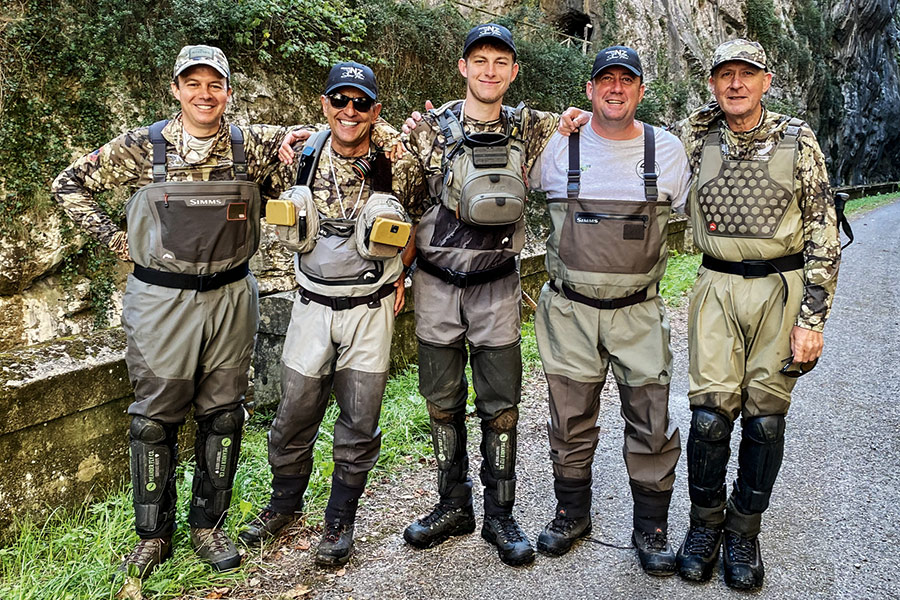
The practice week had disappeared in a blur, and before we knew it we were moving into the competition hotel, joining up with around 120 anglers from 23 other nations, as well as our own Team Manager – and Ollie’s dad – Paul Bassett.
The venues
The World Championships are held annually in a different host country each time but with distance, costs and other considerations New Zealand averages a team every other year. Spain 2022 would in fact see the first kiwis competing in three years. This year’s competition featured four 4-hour river sessions on the Caudal, Piloña, Trubia and Narcea and one 4-hour lake session, at El Arenero, over five consecutive days in late September.
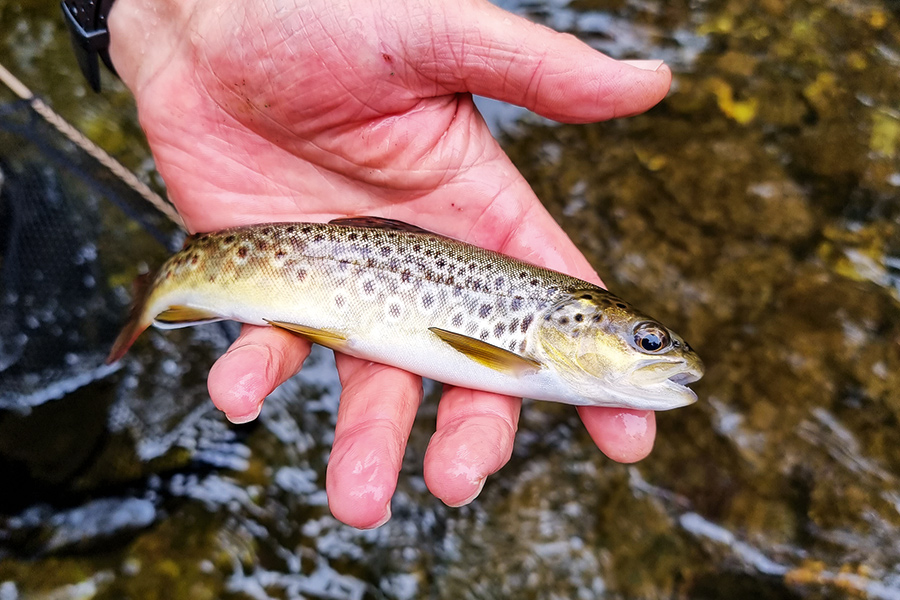
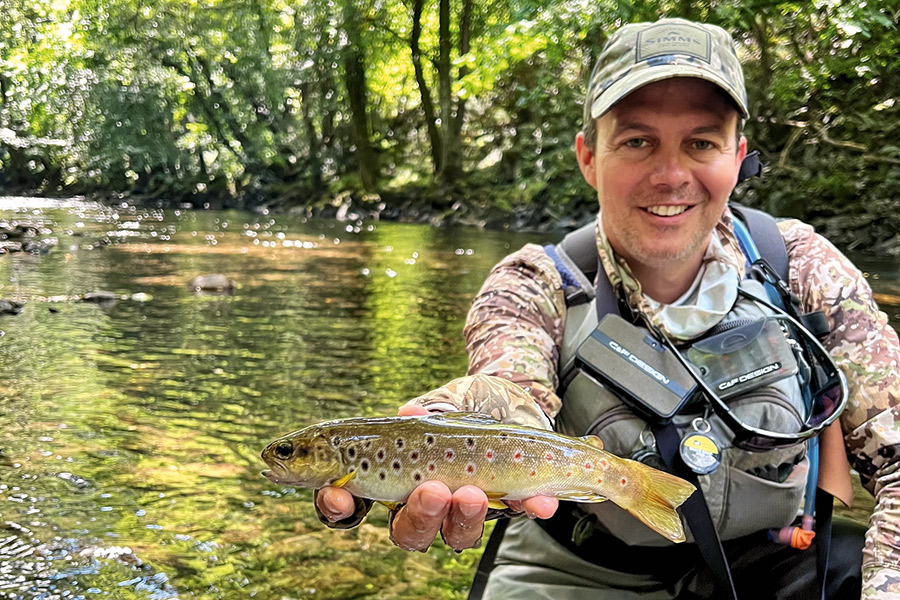
The Trubia, Narcea and Piloña are bedrock and freestone rivers of varying sizes but all feature some beautiful pocket water, riffles, pools and, on the Piloña and Narcea in particular, extensive glides. The Caudal is a larger river, the competition beats of which flowed through an urban and semi-urban environment and featured a series of manmade weirs. My favourite was undoubtedly the characterful gin-clear little Trubia, with its bubbling bouldery pocket water and stunning browns so quick on the take.
The lake, El Arenero, was altogether another experience. With vertical banks, hedgerows and fences behind many pegs, casting ranged from tricky to hair-pulling. A small artificial fishing reservoir was fished on a six-peg rotation, with 40 minutes on each. The most successful guys I witnessed, who clearly knew what they were coming to do, used 11’ 8wts paired with front-loaded lines to roll-cast bungs out into the middle of the lake and target fish beyond the reach of others. But I’m getting ahead of myself.
The championship routine
The competition days developed a rhythm of their own. They would begin with the phone alarm buzzing around the bedside table at 5.30am, a quick shower and change and it was down to the hubbub of a communal breakfast with the smell of cooked bacon and fresh coffee heavy in the air. At the team table, plans would be hatched for the day, confirmation of bus departure times made and last-minute pieces of advice and encouragement shared.
Organising 120 anglers across five venues on a daily basis is a daunting logistical exercise but the organisers nailed it. For their part, most anglers were impeccably organised as well but there was the odd outlier to be seen each day hotfooting it back to their rooms having forgotten some vital piece of equipment. One morning, when I was on a later bus, I was doing my final checks when I heard a solid and prolonged knock at the door of my neighbour, who was from another nation, and clearly still in another world. The knocking became increasingly loud and frantic until a muffled response, like a teenager being woken by his parents, came from inside. “You better hustle man, your bus leaves in 5 minutes.” The response quickly went from muffled to highly agitated, amidst the sound of much throwing of gear and expletives.
Outside the hotel, in the early morning murk, anglers changed into their boots and waders before boarding their buses in an effort to save time at the other end. Journey times to the venues varied between 40 minutes and an hour-and-a-half, and these were invariably used to catch up on some much-needed sleep. As the venues neared, your randomly allocated beat number was announced, and you were subsequently dropped off next to it with your controller.
You’re given a minimum of 30 minutes to walk your beat; time used to mentally dissect it and draw up a plan of where to focus your time and the methods you’ll employ. Most of the beats averaged around 400 metres but some were longer, making beat and time management even more critical than usual.
At the end of each day’s session, the anglers were picked up again and taken to a local eatery to sample some of the regional specialities; dishes like fabada (a hearty, meaty bean stew), cachopo (veal fillets combined with ham and cheese, crumbed and fried), and slow-roasted lamb (cooked for six hours over an open fire, and combined with chimichurri seasoning, for a succulently intense depth of flavour).
Plate after plate was served over the best part of two hours and as undeniably delicious as this was it did mean we were arriving back at the hotel, usually in a food coma, after 6pm each evening. That left a couple of hours for a debrief, team talk, pep talk, fly tying and gear prep for the following day; then dinner from 9-10pm, any additional prep and then bed. Rinse and repeat. It’s a hectic schedule. I mean, it’s not ultra-marathon running or open-ocean swimming, of course, but you’re still pretty exhausted by the time the final siren sounds.
The results - Spanish, French, Czech dominance continues
In the final shake-up, the Spanish took out the team title, closely followed by the French in second and the Czechs in third. These are familiar names at the top of the leaderboard; of the last 10 world championships, the Spanish have won four, the Czechs three, the French two, and the Fins one.
In the individual competition, it was the French and Spanish again, with France’s Julian Daguillanes claiming gold and David Arcay and Ruben Santos of Spain taking silver and bronze, respectively.
Taking the Spanish as an example, it’s difficult to convey how good these guys are; technically flawless, their skills have been honed on some of the toughest waters going and against a standard and depth of competition which simply isn’t found in the vast majority of countries. An illustration of this is Alejandro’s local club, Club de Pesca Rio Piloña. Its members include senior world champions in Pablo Castro, David Ferreras, and David Arcay, and masters world champions Javier Tejedor, Isai Ferreras, and Carlos Prada. That’s a team which could compete internationally, and take some beating, from one local club.
For all three kiwi anglers, the competition was their first senior world championships. For me, it was also my first representative event of any kind, whereas Tim and Ollie have previously represented New Zealand at other international competitions.
The results were ultimately mixed. After three days, Ollie was in the top 20 and Tim and I were sitting mid-pack. However the last two days saw the team’s fortunes go on divergent paths with poor days for myself and Tim seeing us finish three-quarters of the way down the field. Ollie on the other hand kicked on in a serious way, securing 11th place, and in so doing, registered one of the best overseas finishes ever by a New Zealand angler. He beat some big names in the competition fishing world, an incredible achievement. At just 21 years of age, it’s also a result which bodes well for the future.
One minor disappointment was that New Zealand did not feature in the team competition. Covid-related matters, be they fears of becoming marooned in Europe or the impact already felt by people’s businesses, had depleted our original squad meaning we were unable to meet the quota of five anglers for a full team.
Looking ahead
And so our adventure had come to an end, and what an incredible adventure it was, leaving us all with indelible memories of a very special place and with new friendships made with like-minded souls from across the globe. It was a privilege to be a part of it all.
Time doesn’t stand still, of course, and the 10-strong squad for next year’s world championships in Slovakia has already been selected, but I would like to take this opportunity to thank a few people. Thank you to Manic Tackle for its sterling support of the Silver Flies and of sport fly fishing in general. Thanks also to my teammates Ollie and Tim, and to Ollie’s mum Leeann who was camp-mum-extraordinaire during practice week and to Ollie’s dad Paul who did a similarly sterling job as our team manager. Most importantly, thank you to the Sport Fly Fishing New Zealand committee and selectors for allowing us to represent.
Competition fly fishing - some of the rules
• Barbless hooks only
• Maximum of three flies
• Flies must be a minimum of 50cm apart
• Only fish hooked in the mouth area (i.e., in front of the gill cover’s rear edge) count
• Strike indicators are not allowed
• The use of cell phones, radio or any other electronic communication methods is not permitted.
• Each fish over 20cm scores 100 points and also 20 points per centimetre of length. These points are added together for a session score. Anglers are then ranked by these scores and given a session placing.
• The placing points are added together for all the sessions fished and this cumulative total is your final score and determines the overall positions.
• The International Federation of Sport Fly Fishing (FIPS-Mouche) Competition Rules apply universally.

December 2022 - James Fuller
New Zealand Fishing News Magazine.
Copyright: NZ Fishing Media Ltd.
Re-publishing elsewhere is prohibited


Major Bites
Minor Bites
Major Bites
Minor Bites
Latest Articles
The Export NZ Fishing Competition Announces Season Winners
June 2026Another exciting season of The Export NZ Fishing Competition – has come to an end, and we’ve just announced our prize winners... Read More >
History of Zane Grey's Fishing in NZ
June 2026One hundred years ago, the trajectory of big game fishing in NZ changed forever with the arrival to its shores of one man - Zane Grey... Read More >
BBQ'd Gurnard with Citrus and Herb Butter
May 2026This is a pretty ‘cheffy’ recipe, featuring a sauce that is definitely one to impress guests with, but it's fairly easy to cook... Read More >

Mackenzie Country Trout & Tahr
May 2026The Mackenzie Country winter months of June, July, and August herald the main spawning time for canal trout... Read More >

The Hutchwilco NZ Boat Show Official Guide - 2026
May 2026This year, The Hutchwilco New Zealand Boat Show returns bigger than ever as New Zealand's ultimate boating and fishing showcase... Read More >