
Fly Fishing for Taimen in Mongolia

As a relatively experienced fly fisherman, I have been fortunate to have fished a handful of European destinations that are not on everyone’s radar, including Bosnia, Slovenia, Slovakia, and Iceland – although I have always wondered what a more exotic and remote trip might look like.
About 10 years ago I spoke to a European friend about his fly fishing exploits in Mongolia. He described his trips as true adventures to one of the world’s last fishing frontiers, and he had tales of a magnificent apex predator known as the taimen or ‘river wolf’. At the time, this seemed an unlikely destination for me – why would I travel all that way from the great fishing of New Zealand to risk catching nothing? Then two years ago, during a European trip, my interest started to grow while I was fishing the Hron river in Slovakia. I was lucky enough to catch some hucho hucho or (Danube salmon), looking so similar to taimen that you could call them brother and sister. I was surprised by the predatory nature of these fish, their aggressive behaviour, and the size they could grow to.
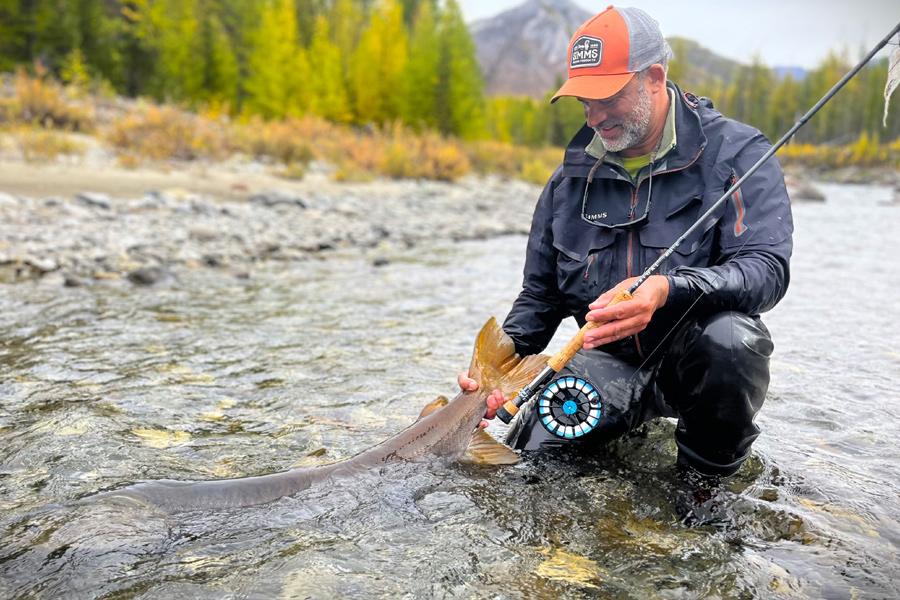 Taimen are the world’s largest salmonoid, known for taking out large prey, from rodents or ducklings on the surface, to fish such as the grayling or lenok that inhabit the Mongolian rivers.
More recently, the invite came to chase taimen in northern Mongolia, joining my very good Slovakian friends Jozef and Michal whom I have known and fished with for 20 years. Both are excellent anglers and easy to travel with, which is important on long-distance trips. They had done their homework about the Mongolian fisheries and had previously caught some incredibly large taimen (over 120cm). So, I accepted the challenge of travelling to pursue these fish, not knowing this trip would leave me with an almost spiritual connection to this incredibly wild country. To avoid any potential disappointment, I decided to approach this adventure with not only fishing on my mind but also to see the country and learn about the culture. It turns out I was not disappointed on any front.
The country
From New Zealand the trip took three flights: Auckland to Beijing; Beijing to the capital of Mongolia, Ulaanbaatar; and one domestic flight to Murun. From there, it was another full day of travel further north, as some of the better taimen fishing is in the northern Khovsgol region, near the Russian border.
After you leave the hustle and bustle of the capital Ulaanbaatar that is home to almost half of the population, you enter the endless, barren-looking landscape of Mongolia, typified by rolling hills known as steppes. While travelling on the dry dirt roads we saw many nomads living in gers (yurts) and farming yak, wild horses, goats, and sheep. Mongolia is inhabited by people of character, with a rich history including conqueror Chinggis (Genghis) Khan, famous for uniting the tribes of Mongolia and building the powerful Mongol Empire in 1206. Nowadays, Mongolia has a population of around 3.4 million, of which a decent proportion is nomadic with a strong farming and equestrian culture. Mongolia is a landlocked country situated in central Asia, with Russia to the north and China to the south. It is one of the world’s highest countries, with an elevation averaging 5,180 feet (1,580 metres). The Gobi Desert lies to the south, with the stunning mountains and Lake Khuvsgol to the north.
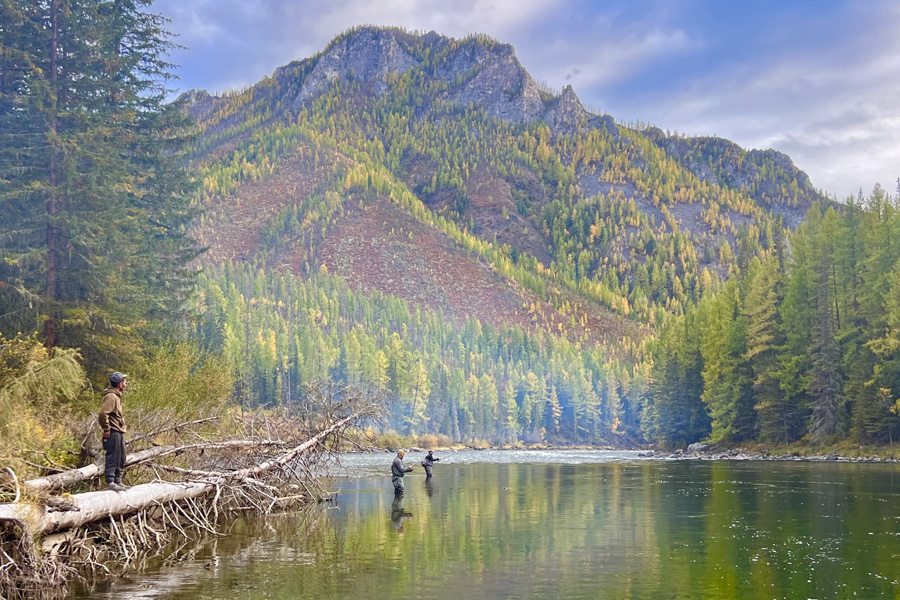 The scenery is breathtaking – high, snow-frosted, rugged mountains and golden yellow Siberian taiga forests with many coniferous trees including Siberian pine, larch, and fir trees.
Seasons
Within this diverse and wild landscape, the climate can be harsh, with winter temperatures dipping as low as -40°C. Summer can be short (between mid-June to August), and we planned our trip in September which proved to be the start of the change of season. The first snow is apparently beneficial for fishing for taimen, as the sudden cold snap can get fish into a feeding frenzy before the winter freeze-over and a periodic slowdown of available food. I had a minor concern that if we fished in October, we would be stuck there, isolated because of the cold weather.
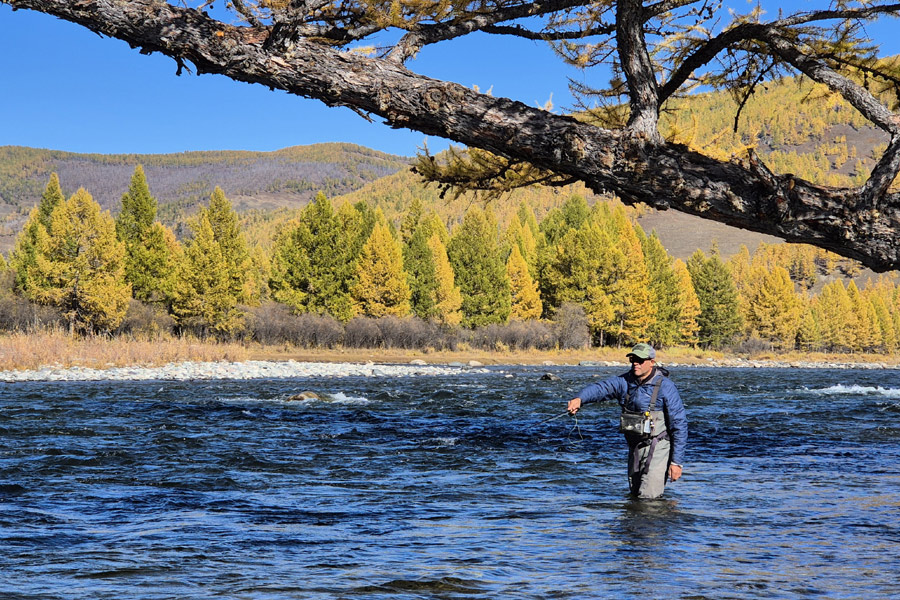
The river wolf
Taimen are the world’s largest salmonoid, and some fish can reach more than 40 or 50 years of age. They are known for taking out large prey, from rodents or ducklings on the surface, to fish such as the grayling or lenok that inhabit the Mongolian rivers.
These ambush predators deserve a lot of respect. With a longer body shape than your average trout, they can consume their prey and hunt effectively with ease. They have a set of eyes designed to see their target at distance, and a lateral line fine-tuned to absorb any minor changes to river conditions, picking up vibrations from sudden movements of prey items within their feeding areas. They appear to be quite a resident fish, however there is still much to learn about their movements. Taimen are not exclusive to Mongolia, as variations of this ancient fish can be found in China, Kazakhstan, Russia, and Japan.
The tackle
Alongside packing plenty of warm clothes, I received some advice on tackle to bring and flies to prepare, but you can never get it all correct. I had high hopes of swinging flies on a double hander, however the flies were much too big to cast and it was super important for quick hooksets to keep a controlled line as these fish are big! The tackle I ended up using was a Primal Mega CCC 9’ #10 paired with a Lamson Centrefire to hold the grunt of a 10-weight fly line. This was needed to tame these massive fish while throwing ‘big’ fluff. Flies consisted of floating mouse flies, grayling imitation streamers, or weighted bully-head flies equivalent to the size of a medium softbait jig-head. Flies were debarbed for safety and to practise careful catch and release. After fishing Taupō rivers over winter and brushing up on my skills with a few saltwater trips on fly, I felt prepared enough to understand the need to be fishing ‘on point’ and putting in a lot of casts until it hurt. I was pleasantly surprised at how my equipment handled the big rivers, knowing good old tennis elbow could strike at any time.
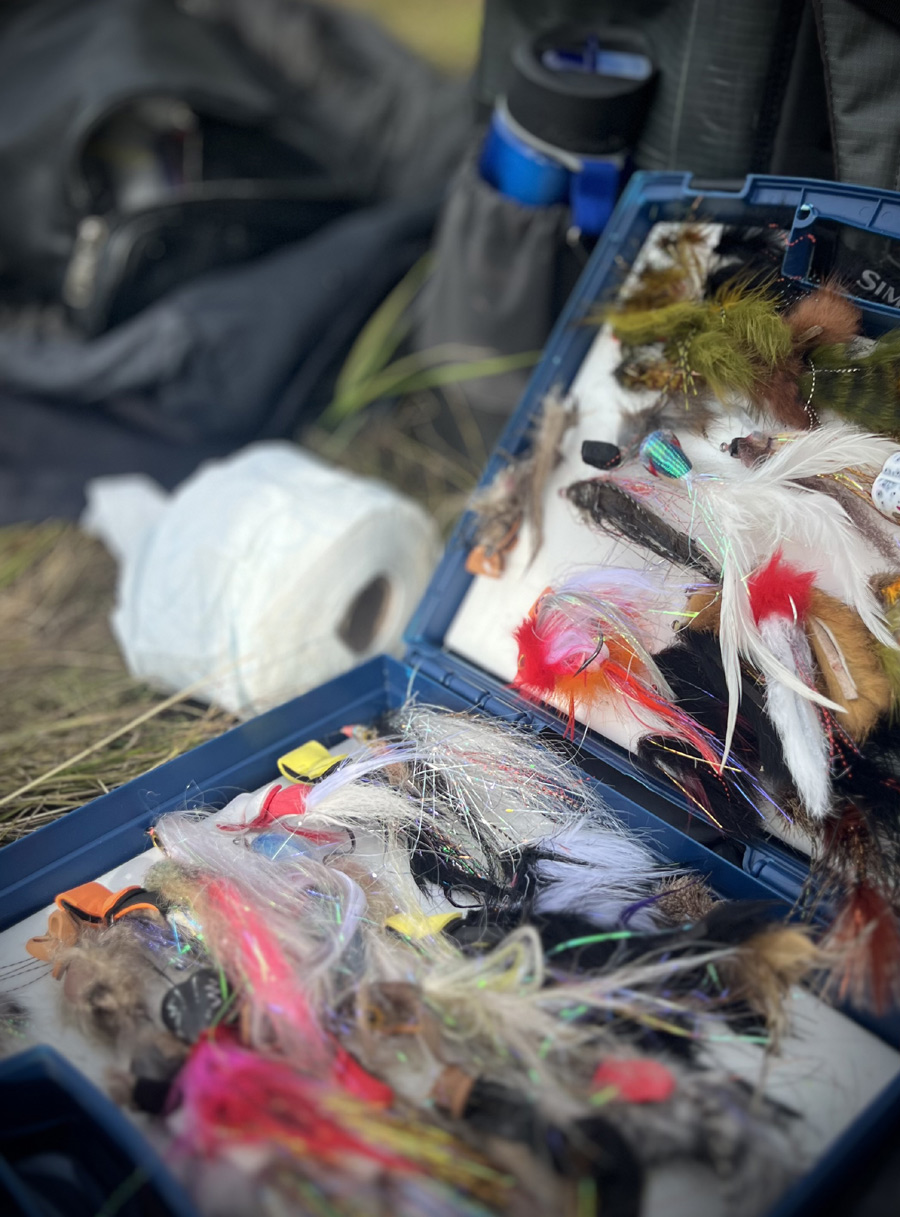 River Wolf fishing essentials.
The adventure
I arrived at Ulaanbaatar Airport and waited for my friends travelling on another flight. A few hours later they arrived in shock – their bags were missing after their one flight from Prague. Fortunately, a day later their bags arrived, and it was a massive relief as we all had essential camping gear, warm clothes and survival equipment, as well as specialist fishing gear packed. The next day we set off on the internal flight from Ulaanbaatar to Murun, then began the crazy off-road journey north. The journey was an experience I’ll never forget, with our driver set up with a fully equipped Toyota Landcruiser suitable for emergency situations to get through snow, swamps, and other road hazards.
Arriving at our base destination that evening, we met our experienced fishing guide who had family-owned riverside property nearby. We jumped on his raft to get downriver to our first campsite, officially kicking off our seven-day fishing adventure. Each riverside campsite was luxury-free as we were camping in the absolute wild, and our Mongolian guide and his brother would kindly set up camp each day so we could fish. Our camp consisted of a partially insulated tent and sleeping rough on floor mats in sleeping bags. The very cold nights meant sleeping in a puffer jacket and a woolly hat.
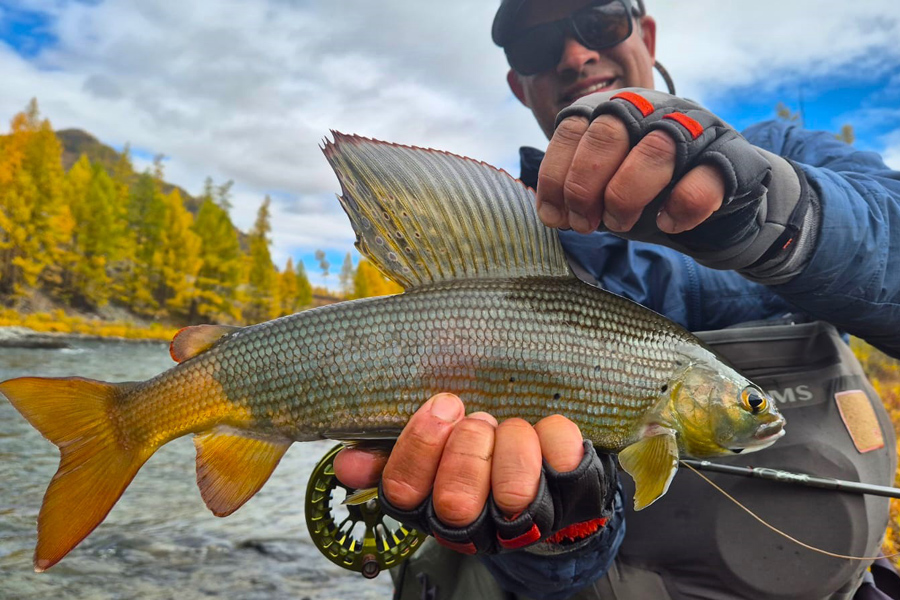 The beautiful Mongolian grayling.
One night I was awakened by rain dripping on my head, so I woke the guys up to shuffle gear into the driest place, and we shimmied rods onto the rooftop, creating makeshift tent poles for water to drain away. Fortunately, this only occurred one night as it was very hard to get anything to stay dry. Each day our guide cooked breakfast and dinner inside the tent using a traditional wood-burning stove which could hold a large wok. Heating was vented with a collapsible chimney through the tent roof. Meals consisted of tough yak stew and Mongolian bread. Every meal was welcome as it was all about keeping warm and saving energy to fish.
The freestone rivers in the northern Khuvsgol region were all beautifully clear. The biggest river held a large volume of water – for comparison, I would say it was five times bigger than the Tongariro River in New Zealand – and some intimidating rapids. The smaller rivers were easier to navigate despite being slippery. Insect life was abundant with many stoneflies and caddis; the colder weather thankfully put a stop to sandflies and mosquitoes.
 Each wilderness camp spot was luxury free.
Our guide possessed a second sense of where the fish might be located that proved vital over the week. His raft was used to access the rivers, and we got out to walk various riverbanks and explore gorges and confluences. The raft was set up with an adequate motor but was void of all the safety equipment you would expect in a western context. The element of risk certainly added to the adventure of potentially catching dream-sized fish. The scenery when travelling by river was breathtaking – high, snow-frosted, rugged mountains and golden yellow Siberian taiga forests with many coniferous trees including Siberian pine, larch, and fir. Adding to the serenity of the landscape were occasional eagles soaring high above.
My first taimen was around 80cm and produced a memorably hard fight with some acrobatic jumps. Presentation of the fly was important while we were swinging or nymphing the big flies, as not all fish were active. A few fish I caught were sighted, making the whole experience that much more rewarding. The size of some fish (around 130cm) went beyond the possibility of netting – the only way to land them was letting the guide tail-grab them. My friends, on a previous trip, had witnessed the guide getting tail smacked into the water! This might give you an understanding of the scale of some of these fish. Overall, I was delighted to catch eight taimen, mostly on large grayling imitation flies or bully-head nymphs.
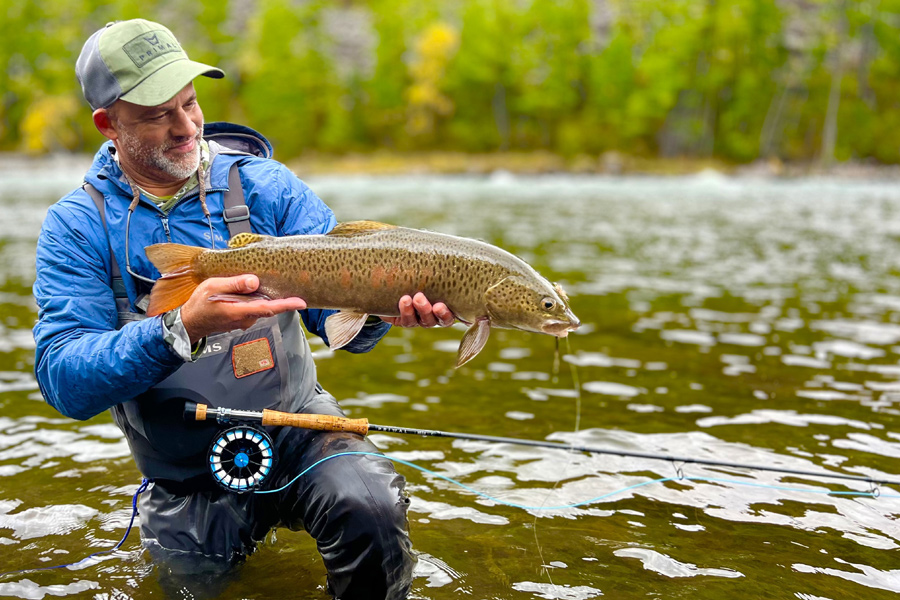 Lenok were an enjoyable bycatch.
After several days of camping downriver, we spent our last three nights in a warmer riverside cabin upriver towards base – a welcome change. We looked back after catching some amazing taimen, including my all-time largest fish on fly at just over 130cm. The last days were more civilised as we changed down to fish light tippet and target grayling. The Mongolian grayling were some of the prettiest grayling I have caught. Compared to Europe’s grayling, they have iridescent greens and turquoise, capped with a colourful dorsal sail fin. A memorable highlight on our last day fishing a smaller river was helping a Mongolian army guard catch his first grayling on fly. The smile on his face was priceless.
All in all, Mongolia exceeded my expectations. Mongolian people are warm and friendly and place emphasis on extending their hospitality to travellers. This adventure taught me an appreciation for the basic things we need in life to be content. Some simple tasks stood out, such as collecting wood for heating, working together, and cooking using basic equipment. It made me appreciate how good we have it in New Zealand and what important skills we have lost in the process. To Mongolia and good friends, thanks for making everlasting memories. In life, it’s not always the final destination that stands out as memorable, but the journey to get there.
- Words and Images by Rob Vaz


Major Bites
Minor Bites
Major Bites
Minor Bites
Latest Articles
The Export NZ Fishing Competition Announces Season Winners
June 2026Another exciting season of The Export NZ Fishing Competition – has come to an end, and we’ve just announced our prize winners... Read More >
History of Zane Grey's Fishing in NZ
June 2026One hundred years ago, the trajectory of big game fishing in NZ changed forever with the arrival to its shores of one man - Zane Grey... Read More >

BBQ'd Gurnard with Citrus and Herb Butter
May 2026This is a pretty ‘cheffy’ recipe, featuring a sauce that is definitely one to impress guests with, but it's fairly easy to cook... Read More >

Mackenzie Country Trout & Tahr
May 2026The Mackenzie Country winter months of June, July, and August herald the main spawning time for canal trout... Read More >

The Hutchwilco NZ Boat Show Official Guide - 2026
May 2026This year, The Hutchwilco New Zealand Boat Show returns bigger than ever as New Zealand's ultimate boating and fishing showcase... Read More >