
Senator Typhoon MH670
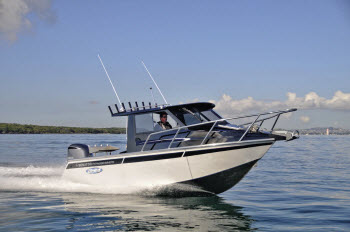 The 6m aluminium monohull bracket makes up a very large part of the trailerboat market in New Zealand.
In terms of fish- and dive-orientated boats, there are probably more of this type around than just about any other, with New Zealand’s changeable weather making the open-backed hardtop configuration particularly popular.
Well-known Napier boatbuilders Senator Boats produce their popular pontoon hulls in this size, but also make several ranges of conventional monohulls. I have trialled some of the large ‘Offshore’ series in the past, but was less familiar with their smaller ‘Typhoon’ range, available in five sizes between 5.7m and 8m, in cuddy and hardtop versions.
Rollos Marine in Hamilton are the agents for the Typhoon range from Taupo to the Far North. I recently got together with them in the Hauraki Gulf, halfway up their ‘turf’, to have a look at some of these models. The subject of this test is the 670, a 6.2m (6.7m LOA) hull and the foundation for this range. Various other lengths are available with two different beam measurements (2.38m and 2.5m external beam), the longer hulls using the wider beam. For comparison, and as a camera boat, we had a smaller brother – the Typhoon 630 – along as well.
Construction
 Senator Boats are happy to customise to a client’s requirements, even altering the cabin/wheelhouse height and length.
The bottom shape of the 670 was derived from Senator’s proven pontoon hulls, and incorporates four full-length bearers, three bulkheads, and frames at 400 centres. The keel and chine assemblies are butted plates, fully seam-welded inside and out. Senator supplied a reserve buoyancy figure of 1100kg.
The MH670 is configured as an open-backed hardtop. The hull bottom is a substantial 6mm, with 4mm sides, 3mm topsides and 4mm treadplate deck.
With a deadrise of 18°, no strakes, and big, downturned chines, the hull travels well, but remains stable at rest. The welding appears to be robust and the rig was topped off with a quality paint job.
Power and performance
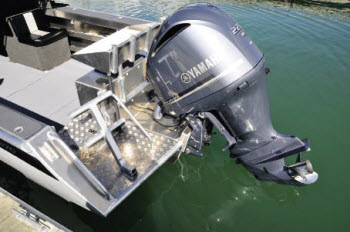 The test boat was powered by one of Yamaha’s F225 V6 four-stroke outboards spinning a 19-inch pitch propeller. This rig has some get up and go, with the 225 Yammie pushing it along to a top-end speed of 77kph (41.6 knots) at 5100rpm. Given that the top-end revs for this engine are given as 5000-6000rpm, this prop is just ‘in the zone’ and fine for fishermen, but there is room to reduce the prop pitch down to, say, a 17-inch if you wanted even more boogie for a hole-shot, perhaps for skiing. A nice cruise speed of 48kph (26 knots) was produced at 3500rpm.
Fuel capacity is 230 litres, but tank size can be customised to suit the owner by sacrificing some of the space taken up by the under-deck holds in the test boat. The fuel tank features a fuel containment system – effectively a second internal tank. The filling port is set on the rear of the transom top and the fuel line fitted with an expansion chamber that prevents blow-back while filling, or ‘weeping’, caused by fuel expansion in a full tank on a hot day.
Smaller brother, the MH630, had a Yamaha F150 four-stroke bolted to the back and produced a top-end performance of 70.8kph (38.2 knots) at 5800rpm with a 17-inch pitch prop.
Test day was almost without wind – one of the best for weeks – but the Waitemata Harbour sees a lot of traffic, even on week days, with some of the larger craft putting up substantial wakes that gave us something to get an indication of the hulls’ performances. Both produced similar rides. With an 18° deadrise and fine entry, the 670 cuts through the water nicely and lands softly. These hulls are stable and I would characterise the ride as lively, but not harsh. They are a bit noisy through the water, as many aluminium boats are.
Anchoring
 Access to the bow is good around the sides of the cabin, with substantial bow rails, hand rails on the hardtop, and non-skid-decking finish fitted. Other access to the bow is through the hatch in the forecabin roof. There is not much working space up on the foredeck, but with a helm-controlled Lewmar Pro Series 700 warp and chain capstan mounted, there’s not much reason to go up there.
A Rocna 6 anchor is permanently mounted on a bowsprit/fairlead combination, and the capstan feeds the warp and chain through the deck into an anchor locker up in the bow. This can be accessed through a hatch in the forward bulkhead. A crucifix bollard is welded to the foredeck for mooring duties.
Layout
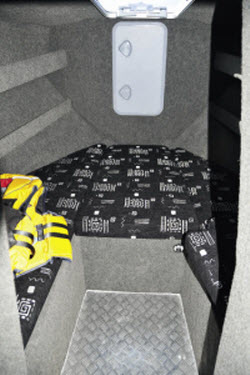
 The forecabin is lined to the treadplate deck, and the cabin step-down is drained to the stern via two bunged, floodable, under-deck holds. The two levels of side shelving feature padded faces that serve as backrests when seated on the berths. The cabin could sleep up to three adults with a berth infill added. There is more stowage space under the side berths, and a flush toilet is hidden under the central berth. A hinged hatch gives easy access to the wiring and steering in the back of the console, and a cabin light is fitted. The sliding, lockable cabin door allows privacy, as well as security for stored gear.
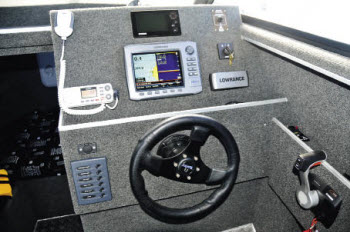
The helm position features a large dash tray lined with dark grey marine carpet, which helps cut internal reflection on the ‘screen. The forward windows are 6mm toughened glass, as are the side sliders. Visibility is good. Secondary dash tray levels, side shelves and a ‘glove box’ offer other stowage options. Grab rails are fitted for the passengers, and there are a further two up under the hardtop. LED cabin lights are fitted.
Steering is Teleflex Sea Star hydraulic and this, along with a Yamaha Electronic Active throttle/shift, makes the boat easy to helm.
Electronic requirements are largely taken care of by a Lowrance HDS8, which features GPS and sounder functions, and also incorporates a sound system with ipod dock. A Uniden UM380 VHF handles communications, and other controls are for the Lectrotab trim-tabs and anchor capstan.
 Seats are swivelling upholstered bucket types, with fold-up bolsters to allow more space when standing at the helm, and treadplate footrests. Added to this are rear-facing bench seats in a ‘king and queen’ configuration, tucked under the protection of the hardtop; the seating unit has two levels of internal stowage.
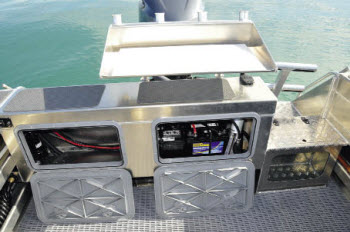
The wheelhouse is also lined down to the treadplate deck, which in turn is covered by non-skid plastic matting – ‘Crossgrip’, I think. The sealed deck drains to a sump under the transom, fitted with an 1100gph bilge pump. Between the seats, as mentioned, are two under-deck holds, which can be flooded and drained via bungs. Two levels of long (approx 4m) side shelves are tucked under the gunwales, with a Johnson pressurised wash-down hose fitted. More grab rails are added to the rear and sides of the hardtop.
Gunwale and transom tops are finished with Deck Tread panels. These provide good footing, and stop the aluminium from either burning or leaching all the heat out of your backside when sat on, depending on the season. House and start batteries are housed in a central locker in the transom wall; a second locker provides more stowage.
Treadplate boarding platforms are on each side of the engine. The passenger side of the transom wall features a step-through with drop door that gives easy access out onto one of them, fitted with a fold-down ‘T’ boarding ladder (divers prefer this ladder configuration, as they are more easily used with fins on). Stern grab rails and solidly-made mooring cleats (central and stern) complete the deck furniture.
A good, comfortable and practical layout with heaps of workspace in the cockpit.
Fishability
 The hull is stable, and the combination of treadplate with Crossgrip matting gives good footing. The flat gunwale faces offer comfortable support at the top of the thighs when working a fish, and there is all-round toe room, except for the port section of the transom. Here, alongside the fuel tank expansion chamber, is a mackerel-sized plumbed live-bait tank under the transom step-through.
There are three through-gunwale rodholders along each side and two more on the outside of the transom. These last two are used to mount a substantial bait-station. Four more rodholders are fitted to the back of the bait-station (useful for rig stowage when underway, as reels are out of the spray). The cutting board has a fish measure incised into it and no lip on the front, allowing a nice low blade angle if filleting the catch. A tray at the rear drains overboard.
In addition, a nine-position rocket launcher is mounted on the hardtop, along with a cockpit floodlight. The catch can be stored in one of the under-floor holds, or, as is usually the case these days, in an after-market icebox.
Again, a practical fish and dive layout that could easily be set up for bluewater fishing if required.
Trailering
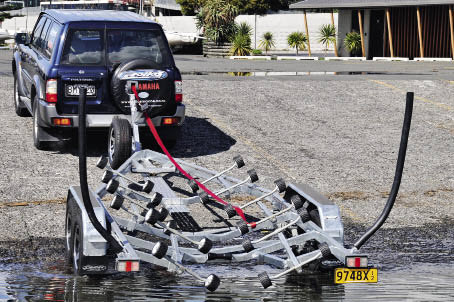 The 670 was carried on a particularly swept-up tandem-axle DMW Premier trailer with mags and spare wheel. This is a cradle A-frame design with guide poles, board walk, and a hydraulic stainless braking system on the front axle. Loading is aided by an entry bay, keel roller and six pairs of wobble rollers per side.
Suspension is zinc-protected leaf springs, and the galvanised trailer’s life is further extended with an internal freshwater flushing system. The galvanised-steel wheel guards have a non-skid panel on top, and other features include: submersible LED lights; a Trojan triple-ratio manual winch (1:1, 5:1 and 10:1); wind-down jockey wheel; and twin safety chains. The rig’s tow weight was given as approximately 2100kg.
All in all
 I haven’t written much about the MH630 in this review – there is not the space to write up two boats of this complexity here, but it is fair to say that both hulls have similar characteristics, albeit with the 670 having more space and in this case being fitted out to a higher level.
Overall, Senator’s MH670 is a dependable, well-laid-out fish and dive machine of the type that has become a Kiwi classic. Senator Boats is willing to customise, and Rollos can fit them out to the customer’s requirements.
Specifications
Material: aluminium
Configuration: open-back hardtop
LOA: 6.7m
Beam: 2.5m (external)
Bottom: 6mm
Sides, deck: 4mm
Topsides: 3mm
Deadrise: 18°
Recommended hp: 200-225hp
Test engine: Yamaha F225 four-stroke outboard
Prop: Saltwater series 19-inch pitch
Fuel: 230 litres
Trailer: DMW Premier tandem
Tow weight: 2100kg approx
Base key-turn: $91,500 (Yamaha 200hp HPDI)
Price as tested: $136,500
Test boat courtesy of Rollos Marine.
 |
This article is reproduced with express permission of
written by Sam Mossman - 2012 Originally published in New Zealand Fishing News |
Fishing Reports Visit Reports
Manukau/West Coast Fishing Report - 15/10/26
Big spring snapper in 60 metres. The El Niño weather pattern isn’t going to be... Read More >
Rotorua Fishing Report - 15/10/26
Solid start to the season! The Rotorua lakes have all started the season well, and... Read More >
Tutukaka Fishing Report - 15/10/26
Big snapper in shallow. Things remain relatively quiet on the fishing front out of Tutukaka,... Read More >
Tauranga Fishing Report - 15/10/26
Bait and temperature on the rise. It’s been great to get out and see some... Read More >


Wednesday 21 October 2026
Major Bites
 - -
Minor Bites
 - -
Thursday 22 October 2026
Major Bites
- - Minor Bites
- - Popular Articles

Softbait Fishing - Part 1 - gear selection
John Eichlesheim writes an article about selecting the right equipment for softbait fishing... Read More >
Softbait fishing Pt 2 - tips and tricks
Techniques, tips and tricks of softbait fishing – getting the most from your soft baits.... Read More >

Surfcasting - setting yourself up
Gary Kemsley helps sort out the necessary gear for intending surf fishers.... Read More >

Squid - How to catch them
Squid fishing is a rapidly growing aspect of fishing - Paul Senior shares some hints and tips to get started.... Read More >
Comments
Latest Articles
Yellowfin Tuna Trolling & Topwater Fishing
October 2026If there’s one thing the last season has taught Kiwi anglers, it’s that yellowfin can be found in places – and conditions – that might surprise... Read More >
Trout Fishing in Rabbit Country
October 2026Early to mid-December is a great time to be fishing for both trout and perch... Read More >
Spearfishing Tips & Tricks
September 2026The South Seas Spearo team provide some salient advice for spearfishers about how to get the most out of their time in the salt this season... Read More >
New Fishing Tackle - Spring 2026
September 2026Check out these hot new products, fresh out this spring... Read More >
NZ Saltwater Fly Fishing Seasons
September 2026Sandflats and mudflats are beautiful fish-rich habitats that are particularly suited to fly fishing... Read More >