
Revo 601 Super fly - boat review
- 2 Comments
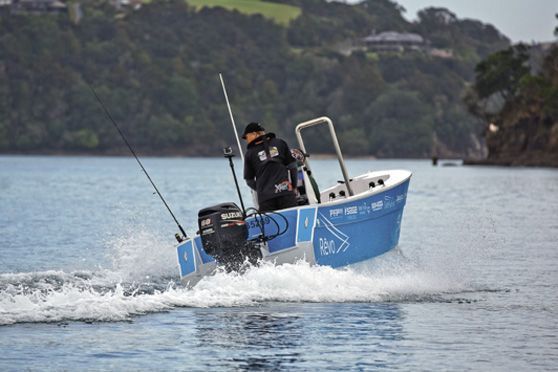
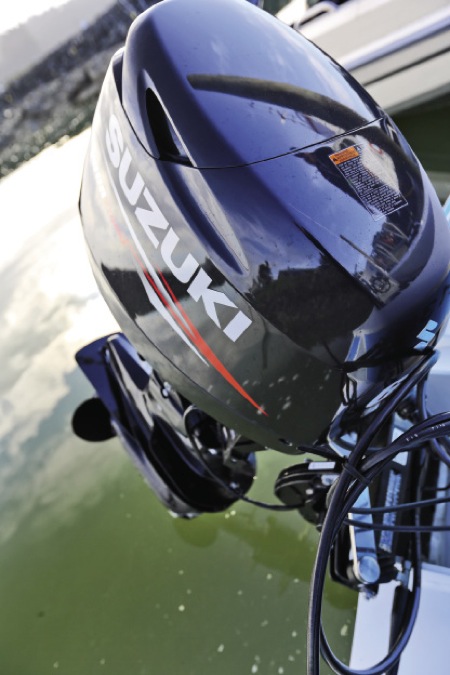
But, unlike more familiar rotationally-moulded boats and kayaks, it uses high molecular weight polyethylene (HMWPE) panels, which is a New Zealand first. It is also the first HMWPE boat put into New Zealand survey and the first boat in New Zealand fitted with Suzuki’s new high-thrust DF60AV three-cylinder four-stroke outboard.
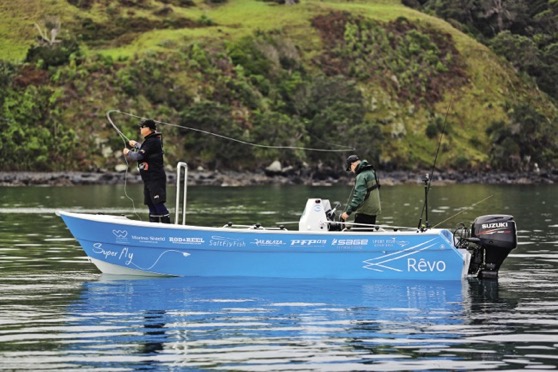
The Revo 601 was designed and built for a very specific application: saltwater fly fishing. Designer Jim Pauling worked with Brett Patterson, who heads up Sportfish Adventures, and Matthew Von Sturmer, from specialist Auckland fly-fishing outfitter and guiding service Rod & Reel, to develop the boat.
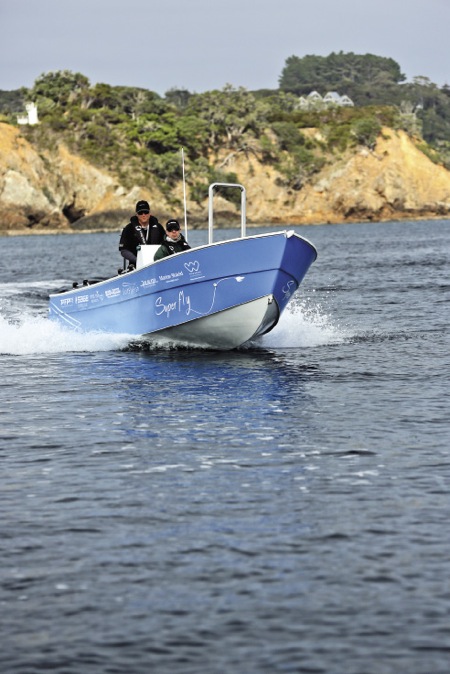 Although destined to charter-fish out of Auckland in conjunction with Von Sturmer and Rod & Reel, the Revo 601 was also designed with the tropical Pacific in mind, specifically the vast lagoon of Aitutaki in the Cook Islands, renowned for its hard-fighting bonefish. Bonefish are a fly-fishing prize, and Sportfish Adventures sends tour groups of keen fly-fishers to Aitutaki all year round. With the addition of a poling platform in the stern, this boat would be ideal for Aitutaki’s lagoon, or anywhere else this style of fishing is practiced.
Stealthy approach
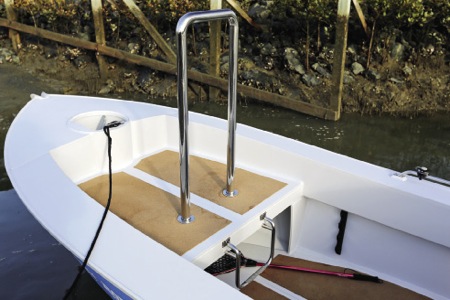
The boat’s most noticeable fishing feature is the raised casting platform in the bow. This gives a fly-fisher a raised position from which to cast a fly, the U-shaped backrest providing welcome support and security. This platform is handy for any sort of lure fishing, not just fly fishing.
The Revo 601 draws very little water, so can fish over sand flats and nose into the shallows. HPWME construction has resulted in an extremely quiet hull, making the boat ideal for stealth fishing, and the plastic is also tough, which is reassuring when exploring shallow water where contact with the bottom is always possible. The Suzuki’s high-thrust lower unit is handy here too, offering excellent control at low speed, especially in reverse should you need to back away from an obstacle in a hurry.
Long waterline
The 601’s hull design is long and narrow, rather like the pangas or longboats many readers will be familiar with from the islands of the South Pacific. Like a longboat, the hull is easily driven and an excellent load carrier. The rear half of the hull is rather dory-like, but the bow is much more conventional, with a steepish forefoot and modest reverse chine/spray rail. The boat has a long waterline for its 5.99m length, which enhances its ability to plane at low speed and all but eliminates bow lift during the transition onto the plane.
Planing is achieved at around 10 knots boat speed, but once on the plane the hull holds level right down to seven or eight knots. Apply the power and the boat instantly slides onto the plane. Acceleration is strong, but performance tapers off towards the top of the rev range. We saw around 27-knots maximum on test day, which is ample for this style of boat. A proposed propeller change might add a couple or three knots, but there may be a trade-off in acceleration and/or time to get onto the plane. According to Jim Pauling, this hull will perform quite adequately with just 40hp, and with an all-up weight of 750kg on its unbraked, single-axle aluminium trailer, it’s easy to tow.
A unique feature of the Revo 601 is a sealed air buoyancy ring right around the boat at gunwale height. The foam is part of the structure, added as the boat was being built. It helps the Revo 601 pass survey, ensuring it floats right way up when full of water, as well as providing welcome stiffness to the hull. The HPWPE material is itself buoyant, so the boat has plenty of reserve buoyancy.
Sweet handler
The Revo 601 handles very nicely. The throttle-gear shift is a little stiff, a fault many centre-console boats share with their convoluted cable routing, but the steering is light and responsive. The turning circle is excellent and control in reverse outstanding. I enjoyed carving turns in the 601, which feels serenely unruffled, while pushing it through wakes produced very little bow lift. It was a calm day, but the hull gave the impression it is a soft rider.
A very noticeable feature of the high-thrust motor is how well it pulls in reverse. A long, narrow boat can be a bit of a pig to steer when going backwards, but the Suzuki offers so much thrust, it literally drags the stern of the boat around, making it much easier to manage when coming alongside or berthing.
The choice of HMWPE construction was an informed one. Pauling chose it because HMWPE’s very robust, so can withstand the general wear and tear that goes with charter fishing. The boat could equally well be constructed using aluminium, timber or composite panels.
HMWPE sheets absorb shock, are UV resistant and deaden noise, so the boat is a remarkably smooth, quiet runner – even quieter than a GRP boat – and the hull won’t deteriorate due to sun exposure. Also, as already mentioned, this is a very tough material, so the 601 can be pulled up onto beaches and used in very shallow water where there is the chance of bumping into submerged rocks. A low-speed impact is unlikely to damage the Revo 601’s hull, and minor damage is easily repaired.
The centre console, forward platform, seats and lockers are also made from HMWPE, computer cut and then welded together. Because it’s a relatively narrow boat, the console is wide enough only for the helmsman, who stands up to drive. Motorcycle-style seating behind the helmsman will accommodate two people sitting astride, and there’s a padded seat on top of the locker in front of the console for another passenger, or two at a squeeze. The boat’s twin tote tanks slide neatly into transom recesses either side of the rear seat.
 The dashboard has room for a reasonably comprehensive range of flush-mounted Garmin and Raymarine instruments, including a GPS-chartplotter-fishfinder and a separate GPS-engine data display, along with the VHF radio, a pair of switch panels and the throttle control. There are no analogue gauges. A large compass is hung off the back of the console beside the wheel (part of the survey requirements), while one of the boat’s two batteries is housed in the console locker, with the second living inside the aft-seat locker along the boat’s centerline.
Storage options
Dry storage can be at a premium in an open boat, and because it’s long and narrow, the 601’s internal volume isn’t much greater than the volume of, say, a 4.6m boat with a wider beam. However, the 601 is reasonably well endowed for its size: there’s ample space for tackle bags, fly-rod tubes and other gear under the forward casting platform and quite a bit of dry stowage under the front- and rear-seat squabs. In addition, an open storage locker in the console accommodates a fire extinguisher and gives access to the bilge, while a shallow underfloor wet locker is used to stow the sea anchor. Further, there is fly-rod storage in racks along the sides and a plethora of rail- and flush-mounted Railblaza Starport receptacles all over the boat. These accept a wide range of accessories, including rod, drink, cellphone and tablet holders, and much more – a versatile storage solution for an open boat.
Anglers plus guide
Under normal operating conditions Super-Fly will fish one or two anglers, plus a guide. While underway, the anglers often occupy the padded seat forward of the console, or perhaps straddle the rear seat if conditions are unpleasant. Anglers can take turns at the casting platform in the bows with its stainless steel backrest. It’s quite secure up there, with the U-shaped stainless steel backrest offering a decent handhold and the non-slip deck providing good footing. The boat’s simple interior is uncluttered, and, importantly, up on the casting platform there is very little to snag a fly line – even the bow cleat is retractable.
 |
This article is reproduced with permission of |
Fishing Reports Visit Reports
Tauranga Fishing Report - 28/05/26
Tarakihi on the bite Trips are few and far between at this time of year,... Read More >
Canterbury Fishing Report - 28/05/26
Fresh and salt turning it on! It is not very often I get to say... Read More >
Bay of Islands Fishing Report - 28/05/26
Lures paying dividends We finally had a break in the SE winds that have been... Read More >
Manukau/West Coast Fishing Report - 28/05/26
Snapper and gurnard in the harbour The weather has finally taken a turn for the... Read More >


Major Bites
Minor Bites
Major Bites
Minor Bites
Popular Articles

Softbait Fishing - Part 1 - gear selection
John Eichlesheim writes an article about selecting the right equipment for softbait fishing... Read More >
Softbait fishing Pt 2 - tips and tricks
Techniques, tips and tricks of softbait fishing – getting the most from your soft baits.... Read More >

Surfcasting - setting yourself up
Gary Kemsley helps sort out the necessary gear for intending surf fishers.... Read More >

Squid - How to catch them
Squid fishing is a rapidly growing aspect of fishing - Paul Senior shares some hints and tips to get started.... Read More >
Comments
Latest Articles
The Export NZ Fishing Competition Announces Season Winners
June 2026Another exciting season of The Export NZ Fishing Competition – has come to an end, and we’ve just announced our prize winners... Read More >
History of Zane Grey's Fishing in NZ
June 2026One hundred years ago, the trajectory of big game fishing in NZ changed forever with the arrival to its shores of one man - Zane Grey... Read More >
BBQ'd Gurnard with Citrus and Herb Butter
May 2026This is a pretty ‘cheffy’ recipe, featuring a sauce that is definitely one to impress guests with, but it's fairly easy to cook... Read More >
Mackenzie Country Trout & Tahr
May 2026The Mackenzie Country winter months of June, July, and August herald the main spawning time for canal trout... Read More >
The Hutchwilco NZ Boat Show Official Guide - 2026
May 2026This year, The Hutchwilco New Zealand Boat Show returns bigger than ever as New Zealand's ultimate boating and fishing showcase... Read More >