
Quintrex 690 trident HT

Established way back in 1945 and building their first alloy boats in the early 1950s, Quintrex is one of the best-recognised Aussie boat manufacturers on this side of the Tasman and has a long association with the development of sport fishing, as well as with New Zealand agent Auckland Marine Centre.
Quintrex are well-known for their technique of forming hulls by stretching and pressing the plates, producing their flared-bow ‘blade’ hull, respected for it’s soft-riding characteristics. Until recently this construction method limited the thickness of bottom plate, but with 400- and 500- tonne presses now used at the Quintrex factory, hi-tensile 5mm plate bottoms can be fabricated, a thickness the New Zealand market is comfortable with in larger trailer boats.
Keels and chines are fully seam-welded, inside and out, reinforced by a network of gussets welded laterally across the hull.
Free-draining tread-plate decks are fully sealed, and drained overboard by ball-stop scuppers. Better yet, the 690 (rated for up to eight crew) was powered by one of Mercury’s newly-released 200hp V6 FourStroke outboards. The hull is rated up to 250hp, but the 200hp test engine proved more than adequate, as well as giving a very quiet, smooth performance.
Performance:
(Conditions: calm, Prop: 18-inch pitch Enertia)
Revs Speed Fuel
(RPM) (knots) (l/hr total)
1000 6.8 3.8
2000 9.9 10.5
3000 21.5 18.3
4000 33.7 31.3
5000 41.5 60.1
5530 47.0 69.5
On test day we (Auckland Marine Centre’s Service Manager Andrew Hilliar and I) launched at Auckland’s Half Moon Bay Marina, using the slightly smaller 650 hull (powered by a Merc 150 FourStroke) as the camera boat. It was a beautiful day on the Gulf, with flat-calm conditions.
In fact, we were reduced to using the wakes from ferries and other larger craft to get a feel for the Trident’s performance.
I had always been impressed by the on-water performance of the smaller Quinnies I had used in the past, especially considering the relatively light gauges (by Kiwi standards) of alloy used to build these boats. Like these smaller boats, the big brother (the 690) shows every indication of also being a soft, dry traveller, producing a smooth, comfortable ride, with the added benefit of a more substantial hull weight.
Likewise, Mercury’s new 200hp V6 FourStroke impressed with a particularly smooth and quiet performance and excellent fuel economy. A Volvo-Penta Boat Trim System (BTS) had been fitted, but conditions were so good that we didn’t need to use it.
This motor has a listed WOT (Wide Open Throttle) of 5000- 5800rpm. On the water, running an 18-inch pitch Enertia prop, we managed 5530rpm at 47mph (76kph or 41 knots). At a cruising speed of around 30 knots (4000rpm), fuel use was only 31 l/hr, giving a range of about 190nm with the 200-litre tank.
Stem to stern
The 690 Trident HT offers a wide range of options and the test boat was imported almost fully set up with products from the manufacturer’s preferred suppliers. A drum-style anchor winch is supplied from Tasmanian manufacturer Muir. This is operated from the helm and controls a plough-type anchor, permanently mounted on a fairlead. The easiest bow access is through the hatchway in the cabin top.
The fore-cabin is a decent size and could easily sleep three sixfooters with the berth infill fitted.
A toilet has not been fitted but there is probably space up in the forepeak for a porta-potty. There is stowage space under the berths and the fully-lined cabin features padded backrests on the side-shelving, and a decent-sized entryway.
Out at the helm, forward vision is good through toughened glass screens and side-sliders. A substantial windscreen wiper (with freshwater washer) keeps it clean. The dash is a good size; marine carpet lining and a back lip would make it a more useful storage area.
Instrumentation for the Mercury outboard is handled by a Vessel View 403 unit, while the main electronics unit is a Simrad NSS12 evo3 multi-function unit, taking care of the charting and hightech sounder functions. The VHF is a useful GME GX750B ‘Black Box’ unit that has the controls mounted on the handpiece. Smart Craft throttle-shift and Sea Star hydraulic steering make the boat a pleasure to helm.
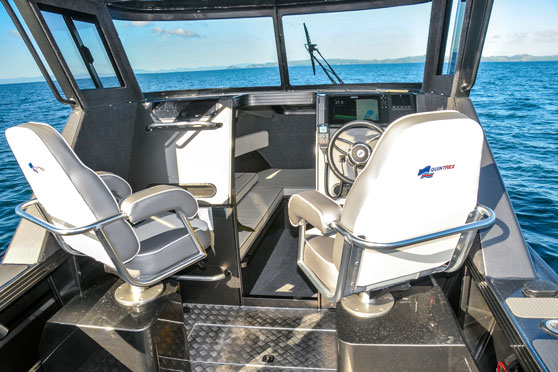
The seating includes two comfortable Ocean Pro adjustable units on box bases with internal stowage. These seats include built in grab-rails across the back and in fact there was no shortage of grabrails in any of the important spots. The hardtop overhangs the helm seats, providing shelter to the occupants.
A lockable glovebox is fitted on the passenger side, knick-knack trays on both sides of the dash, and rear-facing cockpit flood lights are mounted under the hardtop. An under-deck, floodable kill tank is sited between the helm seats.
Aside from the sealed, freedraining deck, the hull is lined or painted inside and out. Decentsized side pockets run along each side of the cockpit, offering toe space under and mid-thigh support for anglers along the top faces. The side shelves house a fuel filter on one side, and a wash-down pump system on the other.
The transom wall is a substantial design. Access to a tread-plate boarding platform and fold-down boarding ladder out back is through a swingdoor transom gate to starboard.
Batteries and isolation switching are protected up in the central transom wall, and to port is a livebait tank with viewing window.
Clever fishing fittings
There are several clever ideas that have been incorporated into the fishing fit-out of this boat. One is the design of the bait station mounted on the transom top.
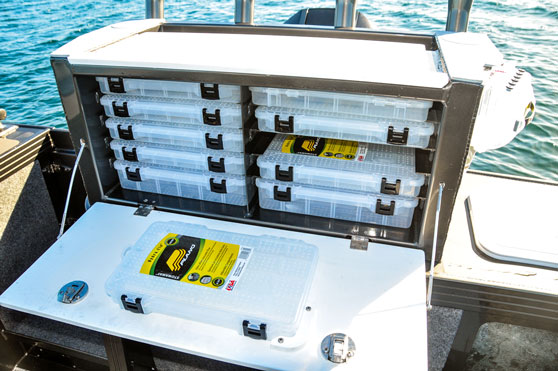
Incorporating ventilated Plano units, the main body holds eight decent-sized tackle trays, plus two that are bigger again. These are disclosed by opening a front-facing hatch. This forms a work table with brackets which will hold a tackle tray in place, so your gear does not go for a skate at the wrong moment. A clear plastic Plano leader dispenser is fitted to the outside of the bait station as well.
Other features include a cutting board top with a knife gutter behind that drains overboard; two cup holders; and four lined rod holders along the back edge – a reasonably protected position to carry rods while underway.
Mounted on the transom is a surface berley dispenser, with a pin mount that allows it to be removed for cleaning, but the cleverest design is the rocket launcher. Each of the half-dozen rod positions is separately attached to the hardtop and features a spring-loaded pin that allows the rod holder to swivel down and back for easy placement and removal of rigs from upstairs. Brilliant!
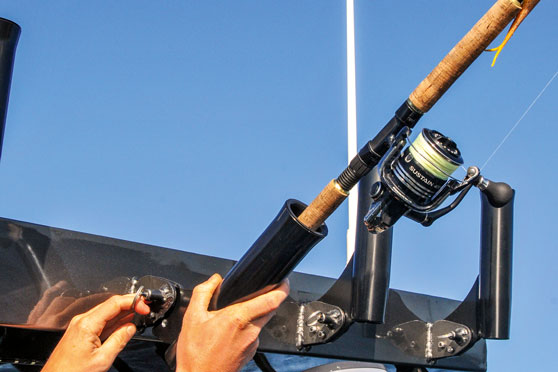
Along with these rod positions, there are four formal fishing rod holders along the gunwales, for a total of fourteen.
With stability, good footing, toe-room, flat gunwale faces, and plenty of space, the 690 was a good boat to fish from and Andrew and I couldn’t resist bouncing a few lures around, knocking over a couple of pannie snapper for dinner.
Trailering
The two Quintrex rigs are tall, imposing units on their Quintrexmade trailers. Using a substantial rolled alloy I-beam for the main ‘A’ frame, the trailer for this rig features tandem axles with mag wheels, five pairs of wobble rollers per side (plus keel-line rollers), a ‘catch and release’ bow hook, leaf-spring suspension, 1000kg manual winch, winddown jockey wheel and Hydrastar hydraulic trailer brakes. Tow weight is estimated at 2200kg.
You can’t refute Quintrex’s place as a pioneer of alloy boatbuilding. It is good to see the Aussie icon, already with a good reputation here for its smaller open boats, stepping up to the mark with a range of big, robust, well-made hardtops that have many of the features Kiwis see as important for boating and fishing here – and a few clever new ones!
|
|
This article is reproduced with permission of |

Fishing Reports Visit Reports
Raglan Fishing Report - 12/11/26
Big spring snapper. With the more settled weather over the last couple of weeks there’s... Read More >
Mercury Bay Fishing Report - 12/11/26
Snapper hit and miss. Most reports have been telling us it’s becoming more difficult to... Read More >
Northland Fishing Report - 12/11/26
The switch has been flicked on! Call it what you want, El Niño, global warming,... Read More >
Tauranga Fishing Report - 12/11/26
Snapper and kahawai in close. Again, we start on a positive note, with some nice... Read More >


Thursday 19 November 2026
Major Bites
 -
 -
Minor Bites
 - -
Friday 20 November 2026
Major Bites
 - -
Minor Bites
- - Popular Articles

Softbait Fishing - Part 1 - gear selection
John Eichlesheim writes an article about selecting the right equipment for softbait fishing... Read More >
Softbait fishing Pt 2 - tips and tricks
Techniques, tips and tricks of softbait fishing – getting the most from your soft baits.... Read More >

Surfcasting - setting yourself up
Gary Kemsley helps sort out the necessary gear for intending surf fishers.... Read More >

Squid - How to catch them
Squid fishing is a rapidly growing aspect of fishing - Paul Senior shares some hints and tips to get started.... Read More >
Comments
Latest Articles
Where, When and How to Find NZ's Gamefish Species
November 2026Knowing what species are available, when they’re around, and where they’re likely to show up can mean a memorable day on the water... Read More >
What Does Boat Insurance Cost in New Zealand?
November 2026Do you know how much boat insurance should cost and how insurers set premiums? This simple guide from Mariner Insurance makes it easy... Read More >
Using Satellite Data to Find Gamefish
November 2026As an ambassador for TIMEZERO and Furuno, Tony 'TK' Walker has an incredible wealth of information available for finding pelagics... Read More >
Yamaha CrossWave Review
October 2026Yamaha’s CrossWave has arrived in NZ and is generating plenty of hype from anglers wanting a premium hybrid between a small boat and a PWC... Read More >
Cubing for Yellowfin and Other Species
October 2026The cubing process Mark Kitteridge uses has been very successful on many occasions all over the Pacific in various destinations... Read More >