
Puma 4
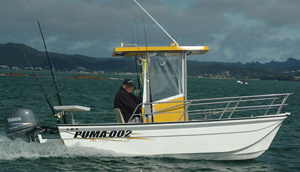 The Puma 4.0m is the brainchild of Paul France, a resident of Lemon Bay, near Paihia in the Bay of Islands.
Paul claims to have been conceived on a yacht and has been involved in yachting ever since. His ‘real job’ has been in media and broadcasting, but even this often had a marine angle – his involvement in the graphic systems for the America’s Cup is a case in point.
A lifelong experience with boats saw him try his hand at design. Some keen boaties may remember a previous creation of Paul’s, the ‘Lemon Bay Sled’, reviewed for sister magazine Boating New Zealand some years ago by John Eichelsheim. Although somewhat ugly, this aluminium hull’s predictable, safe performance, stability and excellent room for length had applications as a people and load carrier. A dozen of these hulls have now been made by contract builders, several of them going into survey for use by charter operators and government departments.
When France semi-retired to the Bay of Islands, he wanted ‘something to zip around the bay in’ besides a yacht. It had to be suited to loading and unloading people from the bow, dry-footed, to the beach, and for use as an estuarine and sheltered-water fishing boat for netting and line fishing.
The Puma 4.0m is the result – a smaller, but related, design to the Lemon Bay Sled, made in fibreglass instead of aluminium. Three have been built by contract builders in Whangarei so far, and Paul France and his buddy, ex-Taranaki resident Lester Perry, are still experimenting with various internal layouts. France calls it ‘the quad-bike of the sea’ and he is not far wrong.
Construction
 To get maximum internal space for length and improve stability in what is, after all, only a 13-footer, France went for a rectangular layout on a tri-hull. The hull is moulded in one piece, as is the deck, and they are joined at the gunwale. The glass thickness is 3-4mm and deck drainage is piped out astern. In the standard hull, the outlet is below water level, so can only be drained at sea by removing a deck bung when the hull is travelling on the plane. Because these hand-made boats are easy to customize, a free-draining deck version can be specified, and foam-filled gunwales are an option (a good idea as there are no in-built buoyancy chambers). Foam-filled gunwales will help the hull to float upright if swamped.
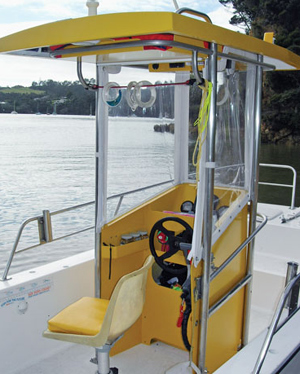
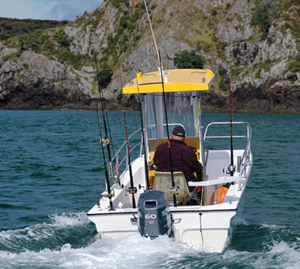
The original Puma was a simple centre-console layout, but subsequent versions have sported bimini tops, and the test model, belonging to Lester Perry, has an elaborate fishing layout. Putting weight topside like this raises the boat’s centre of gravity, and it is a tribute to the stability of the tri-hull that the centre console, with its bimini top, does not destabilize the boat to any great extent.
Power and performance
Recommended power range for the Puma is 30hp to 60hp. Engines are pod-mounted and the test boat had a 60hp Yamaha four-stroke on the back. With a single occupant and good sea conditions, 35 knots at 5600rpm is possible.
The good bit, with the price of fuel sky-rocketing, is the rig’s economy – it uses only about half a litre per nautical mile. For example, we left Opua, did the photo shoot, ran out to Oke Bay (three-quarters of the way to Cape Brett), fished there all day (drifting and regularly repositioning), and tried a few spots at Moturoa on the way home that night, all on 20 litres of gas! And that was with two adults and quite a bit of gear on board.
The underfloor gas tank holds 40 litres, giving a range of about 80 nautical miles, and is filled from a port on the gunwale.
All boats are a compromise. The Puma is built for load-carrying and work in sheltered inshore waters. It 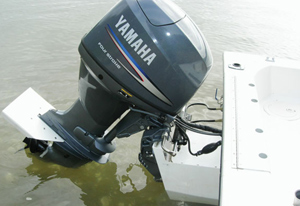 draws only 200mm (ideal for beaching and shallow water work) and once the outside hulls go in, is pretty stable (more so with a standard centre console without a bimini).
The downside of a hull design that permits this is that it doesn’t like a head sea very much. The Puma travels very well downhill, its three hulls tracking dead-straight. Half-a-metre of head sea saw us dropping back to near-displacement speeds to get a comfortable ride.
Although Lester Perry has taken his small craft marlin fishing well offshore (he hooked up, too), this is pushing the limits of the craft’s design spec. To extend France’s earlier metaphor, quad bikes are not made for the open highway, either.
Anchoring
As a shallow-water design, anchoring systems are not high on the agenda. The test boat was fitted with a small, light fibreglass sprit, but this was a bit flexible and not ideal. A brass or stainless fairlead could be easily screwed to the bow and would do the job. Two large lockers are built into the bow; either would do for warp stowage. For deeper work, a simple sliding float could be used to raise the anchor without raising a sweat.
Layout
 Lester Perry has (for a boat of this size anyway) extensively customised the test boat. There is a well-made set of side and bow rails (largely for when kids are aboard). This does interfere a little with boarding and disembarking over the bow, but would be easily cured with a little redesign.
As mentioned, there are two large stowage lockers in the bow, and a moulded step doubles as a seat. Decking has a moulded non-skid finish.
The test boat has an elaborate centre-console. This has a pipework frame around it, which supports an overhead bimini, clears and overhead stowage. The console itself had lots of built-in stowage, as well as mounting the hydraulic steering, instruments and electronics, and housing the two batteries and an isolation switch.
In addition to the Yamaha instrumentation and throttle/shift, a Raymarine DS500X sounder is fitted, along with a Lowrance handheld H2O GPS. Some of the switching, lights and communication gear was mounted overhead, under the bimini. Aerials, navigation and riding lights are mounted on top of the bimini.
The console gives good shelter to the helmsman, who is seated on a pedestal-mounted bucket seat. A further seat is moulded into the stern, and lifts to allow access to the inside of the hull, the fuel filter, plumbing and bilge pump.
There is more – suffice to say that this is one tricked-out little boat.
Fishability
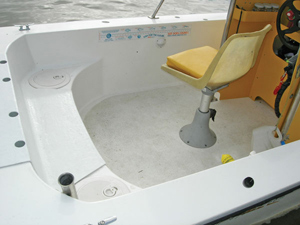 The Puma is stable for its size (it’s easy to forget it is only a four-metre hull) and offers good footing.
The test boat, as you will have gathered, has been extensively fitted out for fishing by Paul France’s mate and collaborator, Lester Perry.
His initial intention was to use it as a net boat for chasing flounder in the estuarine regions of the Bay of Islands. Its shallow draft is ideal for setting drag nets, and Les can lift the engine and pole the boat through the shallows at night, spearing flounder. But the boat is used for much more than that.
I thought I had done well fitting 14 rod holders into my 360 Mac, until I saw the 18 holders Lester has in the Puma. And he reckons he needs a couple more! Still, you can never have enough rod holders. This betrays Les’s interest in line fishing. He has two jack mackerel-sized livebait tanks built in under the stern seat, and a tray which drops in under the same seat to store bait. A custom-built chilly bin fits along one side of the console to store the catch, the weight countering the torque of the engine.
I thought that this boat, with its shallow draft and open bow, would be ideal for working close along the shoreline, so after some unsuccessful bait fishing, I convinced Les to drift along the rocks so I could cast some soft-plastics. It paid off with a whole bunch of snapper, kahawai and a nice dory brought to the boat. Equipped with a standard console, without the bimini, it would make a great fly-casting boat for freshwater work as well, especially with the bow platform extended aft.
Trailering
 The Pumas are carried on modified Brooker trailers, with a couple of longitudinal benches added that fit between the hulls. This makes for easy, self-centring loading.
The trailer is built from galvanised box section, with a single axle and leaf-spring suspension. A centre roller supports the bow. A tow weight was not available, but this is not a heavy rig and should be an easy tow for an average family sedan.
All in all
For calm inshore water and estuarine work, this is a neat little boat. Pumas can be supplied as hull and deck mouldings only (allowing internal fit-out before assembly) or in a wide range of custom fit-outs.
Certainly a niche-market boat, but well worth looking at for those who can see the potential fitting their needs.
Specifications
Material fibreglass
Hull length 4.1m
Beam 1.8m
Recommended horsepower 30-60hp
Fuel capacity 40 litres
Trailer customized Brooker
Standard centre console, drivers seat, 6 rod holders, fwd stowage.
Hull and interior mouldings only
(not assembled) $9,950
Basic package
(40hp Yamaha 2-stroke) $27,950
Price as tested $36,175
Test boat courtesy of Lester Perry
maha 2-stroke) $27,950
 |
This article is reproduced with permission of |
Fishing Reports Visit Reports
Outer Hauraki Gulf Fishing Report 17/09/26
Spring wind the handbrake. Spring is starting to make its presence felt in the outer... Read More >
Top of the South Fishing Report - 17/09/26
Early snapper in Tasman Bay. Well, spring is finally here, and the days are getting... Read More >
Bream Bay Fishing Report - 17/09/26
Good snapper catches reported. After Tangaroa turned off the fish tap for a month or... Read More >
Bay of Islands Fishing Report - 17/09/26
Pacific bluefin tuna for the lucky few. The last fortnight has seen more fishable days... Read More >


Friday 25 September 2026
Major Bites
 - -
- - Minor Bites
 - -
- - Saturday 26 September 2026
Major Bites
- - Minor Bites
- - Popular Articles

Softbait Fishing - Part 1 - gear selection
John Eichlesheim writes an article about selecting the right equipment for softbait fishing... Read More >
Softbait fishing Pt 2 - tips and tricks
Techniques, tips and tricks of softbait fishing – getting the most from your soft baits.... Read More >

Surfcasting - setting yourself up
Gary Kemsley helps sort out the necessary gear for intending surf fishers.... Read More >

Squid - How to catch them
Squid fishing is a rapidly growing aspect of fishing - Paul Senior shares some hints and tips to get started.... Read More >
Comments
Latest Articles
Spearfishing Tips & Tricks
September 2026The South Seas Spearo team provide some salient advice for spearfishers about how to get the most out of their time in the salt this season... Read More >
New Fishing Tackle - Spring 2026
September 2026Check out these hot new products, fresh out this spring... Read More >
NZ Saltwater Fly Fishing Seasons
September 2026Sandflats and mudflats are beautiful fish-rich habitats that are particularly suited to fly fishing... Read More >
How to Catch Sea-run Trout
September 2026One area Greg Morton returns to time again to hunt sea-run and estuary brown trout is the coastal stretch from Christchurch to Southland... Read More >
Garmin Force Kraken + LiveScope Review
September 2026Garmin’s Force Kraken trolling motor and LiveScope sonar system enable positioning, tracking, and targeting fish with a high level of precision... Read More >