
Image Pontoon 7.08m Open

Sam Mossman trials a pontoon design from Southland manufacturer Image Boats, and finds they build ’em tough down there.
Aluminium boat manufacturer Image Boats hails from the Deep South – Invercargill to be exact. Principal Dean Wilkes has a background as a sheet-metal engineer. He got into boat building during a working holiday in Australia, and after returning to New Zealand he worked for Gough Brothers, producing big ferries and commercial boats, before putting in time with several well known South Island trailer-boat-building companies.
Sixteen years ago he started his own firm, Image Boats, which now employs ten people and has turned out 148 hulls to date, including monohulls and pontoon designs. I have run a few of Image’s big customised monohulls in the past, and found them to be robust, well finished and good performers at sea.
In this case I caught up with Dean Wilkes just after the Auckland On Water Boat Show to try out a seven-metre pontoon hull. As is often the case around the spring equinox period, the weather was pretty patchy, with squally periods and associated wind, interspersed with odd patches of sun as we headed out from Auckland’s Westhaven Marina.
From whoa to go
Possessing a decent beam and a pontoon configuration, the big Image had excellent stability and load-carrying ability. A chequerplate deck offers good footing in the large open cockpit. The bottom is 5mm plate and the pontoons and topsides are 3mm.
The sea-keeping of this rig was pretty decent, with a 17-degree deadrise at the transom. It travelled softly, with hardly a drop of water hitting the 5mm toughened glass ‘screens (the side windows are 4mm). The pontoon design provides a high level of buoyancy – 1575L – which will support 1575kg. With an engine weight of 231kg and a hull weight of 875kg, this gives an excess of buoyancy
above the rig weight of 469kg. The shape of the pontoon sides sees plenty of this buoyancy positioned in the top of the gunwales, floating the boat upright should it ever get swamped.
The powerplant, one of Suzuki’s DF200ATX four-stroke, 200hp outboards, was notably quiet. At the dock, with the engine at idle, I could not hear it running, the water from the telltale being the only tip-off.
This engine gives performance levels normally associated with six-cylinder engines, but uses a big block, in-line, four-cylinder design. This configuration helps reduce the weight to a very reasonable 231kg for the long-shaft model. Fuel capacity is 250 litres in an underdeck tank, with the fuel port located on the outside of the transom, in case of spillage. This gives a maximum range of about 480 kilometres.
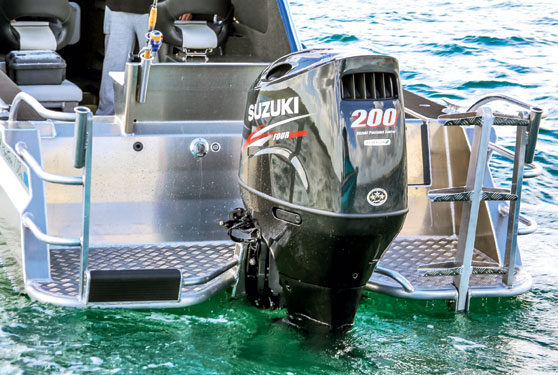
Other nice features of the big Suzuki are a smooth and responsive fly-by-wire throttle/shift which, along with the Seastar hydraulic steering, make the boat pleasant to helm. Troll Mode is a separate rocker-switch control which allows the engine revs to be adjusted in 50rpm increments for trolling.
Performance - Suzuki DF200ATX 18.5" Prop
| Revs | Speed KPH | Fuel LPH |
| 1000 | 10 | 2.6 |
| 2000 | 21 | 11.5 |
| 3000 | 32 | 15.2 |
| 4000 | 44 | 23.0 |
| 5000 | 49 | 29.0 |
| 6000 | 64 | 57.0 |
| 6700 | 69 | 68.0 |
Specifications
| Material: | aluminium |
| Configuration: | pontoon, open-back hardtop |
| LOA: | 7.08m |
| Beam: | 2.36m |
| Bottom thickness: | 5mm |
| Pontoon thickness: | 3mm |
| Freeboard: | 735mm |
| Deadrise: | 17 degrees |
| Recommended hp: | 140-200hp |
| Test engine: | Suzuki DF200ATX |
| Prop: | 18.5" pitch |
| Fuel capacity: | 250L |
| Trailer: | aluminium, Image Boats |
| Tow weight: | 1.725 tonne approx. |
| Key-turn packages from: | $100,000 (Suzuki DF150TX) |
| As tested: | $119,695 |
Looking good
Pontoons tapering to the bow give the boat a stylish look. The bow rails are substantial but low level, so they can be easily reached when handling the boat in the surf. A heavy-duty bollard is fitted on the bow, as is a Lewmar anchor capstan, which feeds the warp and chain through the foredeck into an anchor well. This well can be accessed through a hatch in the forward bulkhead if necessary.
The anchor is permanently mounted on a substantial fairlead and the capstan is controlled from the helm. The best access to the bow is through the hatchway in the forecabin roof, but a non-slip finish used around the sides makes that an option, too.
The forecabin can sleep three adults with berth in-fills fitted. They are not far above deck level, and a step-down allows comfortable sitting with plenty of headroom. Side shelves supplement stowage space.
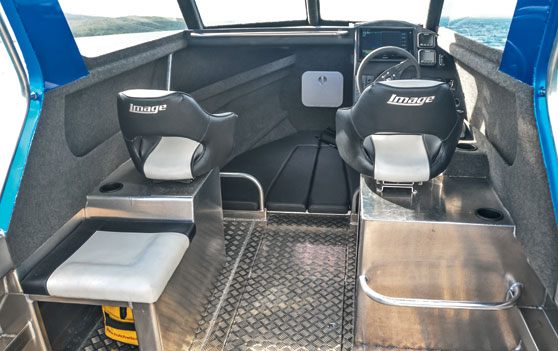
Out in the wheelhouse there is a decent-sized dash with marine carpet lining (this cuts internal reflection on the windscreen as well as stopping items from sliding around), a rear lip, and two-thirdswidth grab rail. The helm console is vinyl-finished, and a Garmin GPSmap 7412xsv, Garmin 100i VHF and Suzuki instrumentation are flush-mounted here, along with the usual switching and controls.
Seats are swivelling sliders mounted on seating units that feature internal stowage. The passenger side also has a rear-facing bench seat designed to accommodate a chilly bin underneath.
Between the seats, two hatches in the tread-plate deck give access to storage holds. The open-backed hard-top has grab rails under the top and at each rear edge.
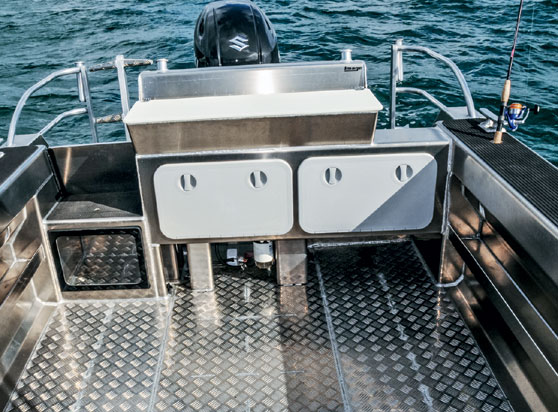
The cockpit is decent sized and drains to a sump under the transom, fitted with an 800gph bilge pump. Side shelves run the full cockpit length, with toe space below and flat gunwale faces providing upper-thigh support when fishing. The gunwale tops are covered with Deck Tread panels, making them comfortable perches when fishing.
Substantial bollards are welded in astern, and a transom step through with drop-in door is fitted on the helm (starboard) side. Tread-plate platforms can be found over the transom, with a fold-down T ladder on the starboard side.
Fishing fit-up
The stability afforded by a pontoon configuration, along with tread-plate decks and a flat-faced gunwale with toe room below, make the Image 7.08 an excellent fishing and diving machine. This particular boat was set up with the transom step-through and dive ladder on the helm side – ideal for diving, as this affords the helmsman good vision when approaching divers in the water and enabling the best access for boarding.
However, stand-up game fishing demands forward chase with the angler on the helm side so the skipper can see the line and avoid running over it. For this situation, a solid transom on the starboard side – where the angler can rest his backside – is safer. Depending on the priorities, game fishers might like to consider shifting the boarding facilities to the port side to allow for easier stand-up fishing. Image is happy to customise its boats.
The stern platforms have partial cages with a rod holder fitted to each side, so they also make useful fishing positions that give good clearance around the outboard.
Other fishing fittings include four gunwale rod holders that pass right through the pontoons to preserve buoyancy. The pontoon welds are all pressure tested in the factory. A rocket launcher on the hard-top features a further six rod positions.
The bait-station on the transom features a further two rod holders, a knife slot, and a cutting board that hinges back to disclose stowage space underneath. A live-bait tank is fitted under the transom step-through, and an auxiliary engine bracket is built onto the port side boarding platform.
On the road
Image Boats makes its own trailers. The 7.08 model rides on a tandem-axle model made from aluminium, gusseted on the joints for extra strength, and with benches rather than rollers supporting the hull.
It is an easy drive-on, drive-off proposition, and also features leaf-spring suspension, hydraulic brakes, spare wheel, dual coupling, and a dual-ratio manual winch. The rig’s tow weight is around 1.725 tonnes.
All in all
Image Boat’s 7.08m open hard-top pontoon boat has a good combination of design features that Kiwi fishermen and divers will find attractive. It looks and performs well, has plenty of fishingfriendly cockpit space, and also brings to the party the pontoondesign characteristics of being stable at rest, having a decent load-carrying capacity, and the safety feature of plenty of reserve buoyancy carried high in the gunwales. Add to this the shelter and comfort of a hardtop, and you have a winner.
|
|
This article is reproduced with permission of |

Fishing Reports Visit Reports
Outer Hauraki Gulf Fishing Report 17/09/26
Spring wind the handbrake. Spring is starting to make its presence felt in the outer... Read More >
Top of the South Fishing Report - 17/09/26
Early snapper in Tasman Bay. Well, spring is finally here, and the days are getting... Read More >
Bream Bay Fishing Report - 17/09/26
Good snapper catches reported. After Tangaroa turned off the fish tap for a month or... Read More >
Bay of Islands Fishing Report - 17/09/26
Pacific bluefin tuna for the lucky few. The last fortnight has seen more fishable days... Read More >


Sunday 27 September 2026
Major Bites
 -
- Minor Bites
 -
-  -
- Monday 28 September 2026
Major Bites
- - Minor Bites
- - Popular Articles

Softbait Fishing - Part 1 - gear selection
John Eichlesheim writes an article about selecting the right equipment for softbait fishing... Read More >
Softbait fishing Pt 2 - tips and tricks
Techniques, tips and tricks of softbait fishing – getting the most from your soft baits.... Read More >

Surfcasting - setting yourself up
Gary Kemsley helps sort out the necessary gear for intending surf fishers.... Read More >

Squid - How to catch them
Squid fishing is a rapidly growing aspect of fishing - Paul Senior shares some hints and tips to get started.... Read More >
Comments
Latest Articles
Spearfishing Tips & Tricks
September 2026The South Seas Spearo team provide some salient advice for spearfishers about how to get the most out of their time in the salt this season... Read More >
New Fishing Tackle - Spring 2026
September 2026Check out these hot new products, fresh out this spring... Read More >
NZ Saltwater Fly Fishing Seasons
September 2026Sandflats and mudflats are beautiful fish-rich habitats that are particularly suited to fly fishing... Read More >
How to Catch Sea-run Trout
September 2026One area Greg Morton returns to time again to hunt sea-run and estuary brown trout is the coastal stretch from Christchurch to Southland... Read More >
Garmin Force Kraken + LiveScope Review
September 2026Garmin’s Force Kraken trolling motor and LiveScope sonar system enable positioning, tracking, and targeting fish with a high level of precision... Read More >