
Image 8.75m Custom
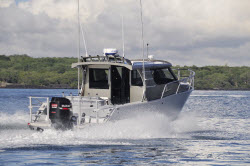 Dean Wilkes, a sheet-metal engineer by trade, is the owner of Invercargill-based Image Boats.
He started his boat-building career working on a giant cat in Australia 26 years ago before returning home to continue in the field. As is the way of these things, after stints with Stabicraft, Gough Brothers (building ferries and other commercial craft) and Kiwi-Kraft, he formed his own company, Image Boats, around a decade ago.
These days his Invercargill factory employs seven personnel and hull 100 is currently in build. He has always designed boats for his often challenging local conditions, and the first Image hulls were for paua divers, with others built for mussel farms and commercial fishermen. This experience with building for difficult conditions translated into a 10.5m boat that was recently delivered to an Alaskan customer.
Don’t get the idea that Image only builds rugged commercial craft though. The majority of his boats are beautifully finished recreational boats, including the magnificent 8.75m Absolute, built for Napier customer Peter Hurring recently. Peter owns a Napier paint and panel business, had his own ideas on what he wanted out of his new boat and wanted to do the final finishing work himself. He is a keen fisherman who, besides fishing his local waters in Hawkes Bay, tows his boat to Waihau Bay and Whitianga, as well as doing coastguard work, stay-away trips on Lakes Taupo and Rotorua and to Mahia with his wife and four kids.
Consequently Absolute is a mix of a strongly-built, well-equipped fishing boat with comfortable live-aboard facilities and a high level of finish – with some interesting features incorporated.
Dean and Peter had the boat up in Auckland for the recent Hutchwilco Boat Show, so I took the opportunity to take it for a run.
Construction
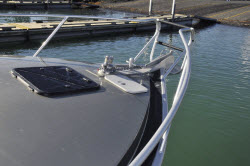 Image Boats are built to ‘survey’ standard. This big 8.75m hull features 6mm bottoms, 4mm sides, 3mm topsides and 4mm chequerplate decks. The hull is supported by four full-length beams and a flat plate fully seam-welded above the keel, forming a strong triangular section. A keel cap is available as an option. The down-turned chines are butted up and fully seam-welded inside and out. Laterally, there are four main bulkheads in addition to the collision bulkhead in the bows (forming the anchor locker) and the transom assembly. Reserve buoyancy models are available on request.
No planing strakes are required on this 18-degree deadrise (at the transom) hull, and the finish is very smooth. Dean Wilkes is proud of the fact that this has been achieved without the use of any bog. Owner Peter Hurring has done the paint work himself, along with the internal finishing.
Power and performance
 At 8.75m (9.0m LOA) and approximately 3300kg, Absolute pretty much straddles the gap between trailer boat and launch. Rated for 250-400hp engines, the test boat was pushed by a DF300 (hp) Suzuki four-stroke outboard with a Permatrim fitted. This is getting towards the current horsepower limit for outboard power, with – off the top of my head – only the Yamaha 350hp and Merc’s Verado 350hp having more power.
Even so, the big Image is not over-powered by the 300hp Suzuki. In a flat sea run with four adults aboard the rig turned out a top-end performance of 53kph (28.7 knots) at 5500rpm. Given that the ‘book’ top-end rev range is 5700-6300 for this engine, the 18.5-inch pitch prop is probably a bit coarse for optimum performance. Dean and Peter already knew this, intending to drop to a 17-inch pitch model, which may turn out a few more knots. Those with a greater ‘need for speed’ will have to look at twin outboards or an inboard option.
Cruising speed at 4600rpm was 40kph (21.7 knots). Over an extended trip the boat used 905 litres of fuel while travelling 687 kilometres, a reasonable 1.32 litres per kilometre. Fuel capacity is a whopping 500 litres.
With the size of the rig and the modest speed, helming the Image 8.75m was more like driving a launch than the type of performance normally associated with a trailerboat. It was a calm day when we took the test boat for a run in the Hauraki Gulf, and I had to rely on the swells created by passing shipping to get some idea of the hull’s performance. As befits a boat of this size and weight, it cut through the man-made turbulence softly, indicating a sea-kindly boat that would eat up the miles, even in rough conditions, without beating up the crew. In it’s new home waters of Hawkes Bay, this kind of performance is appreciated as some of the ‘hotspots’ are 30nm or more offshore, and if the weather cuts up a bit it can be a long and painful run home if your hull does not handle the slop well at speed.
The Sea Star hydraulic steering was nice to use and all-round vision was good through the curved safety-glass windows; side sliders allow for ventilation.
Anchoring
 Access around the cabin sides to the bow has been taken care of with a non-skid finish, grab rails and substantial bow rails all adding to the security of anyone taking this path. The other option is through the hatch in the forecabin roof.
The anchoring is taken care of by a permanently mounted Sarca anchor and Lewmar capstan, which is controlled from the helm. A Decktread panel protects the foredeck from chain-flogging, and a substantial aluminium bollard is fitted for mooring and tie-off duties. A hatch gives access through the foredeck into the anchor well and this area may be reached through a hatch in the collision bulkhead in the bow as well.
Another useful aspect of the bow layout is a fold-down ladder incorporated into the bow rail; handy for dropping and embarking crew on reasonably steep-to beaches while keeping the prop out in deeper water.
Layout
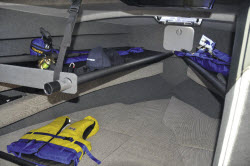
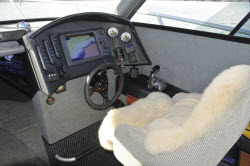 As mentioned, the internal fit-out and paint job was a labour of love by owner Peter Hurring. The forecabin is fully lined and sleeps two (or three with the berth infill added), with two more via pipe berths above.
The table in the wheelhouse can be lowered to form another berth, allowing Peter, his wife and four kids to do stay-away trips. Back in the forecabin a toilet is fitted under the centre berth with a drop-screen for privacy. Stowage consists of under-berth space and two levels of side shelving. Cabin lights are fitted and there is hatch access into the back of the console.
The wheelhouse boasts a large dash tray with marine carpet lining, a back lip and a two-thirds-width grab-rail. The helm layout is particularly smart, curving around in a mini ‘Starship Enterprise’ fashion. The helmsman sits in a comfortable upholstered swivelling seat that would not be out of place in your lounge, set on top of a fridge.
 Electronic needs are well served by a Furuno Navnet 3-D multi-function unit. This is fitted with two through-hull transducers of 1500 and 2500 watt capacity. Other electrics include a TV and underwater camera system to keep the kids amused, and a remote-controlled spotlight on the hardtop. (To help keep power levels up to scratch, a solar panel is set on top of the roof, which can be accessed by a rung ladder from either side. An inflatable tender is also stored there when required).
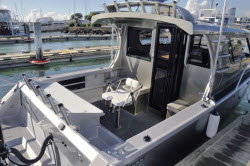
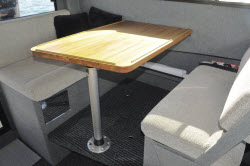
On the passenger side are two bench seats with a nice wooden table between them. The forward seat has a reversible rolled backrest that can be used facing forward when travelling and facing aft when sitting at the table. Both units have internal stowage space and shelf space along the cabin side.
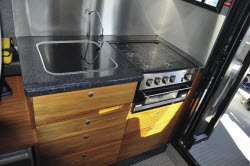
The galley unit is classy, like the rest of the finish, featuring a stainless splash-back, four-burner gas stove with small oven/griller, stone bench top, freshwater sink unit with hot and cold water (the freshwater tank holds 120 litres), and six drawers/cupboards underneath.
One of the most striking features is the magnificent rimu ceiling in the wheelhouse – a rare feature in an aluminium boat, adding a nice ‘warm’ feeling to it. But practicality has not been ignored even here, with grab rails attached to aid passenger movement when underway.
The rear of the cabin features a sliding window behind the galley, a drop-window behind the passenger bench seat and a bi-fold rear door with stay, all of which aid ventilation and communication between the helm and the cockpit.
Out in the cockpit, two bench seats are built against the rear cabin bulkhead. One houses a decent-sized freezer, the other a gas bottle for the stove and hot water heater. A pull-out shower nozzle, behind a hatch in the gunwale, offers a freshwater rinse-down. Grab rails are plentiful under the hardtop and around the door and cabin sides.
The cockpit sole is chequerplate with tube matting over the top. It is sealed and drains to a sump under the transom wall; from here water is removed by two 2000gph bilge pumps, one fitted with a float switch. Low-level cockpit lighting is fitted for night work. Five heavy mooring cleats are fitted around the sides.
Stowage is aided by two under-deck holds and dual-level side shelves around a metre long. There is further stowage space in the transom locker, which also houses the boat’s twin-battery system. The transom wall also has a sink unit set into the top of the starboard side and a transom step-through to port with drop door. Over the transom are two large boarding platforms with Decktread finish. They are surrounded by rails which include fold-down boarding ladders.
Stern fittings include: trim-tabs; a sacrificial anode; water intakes; and an underwater camera that feeds to a TV screen inside.
Fishability
 Despite its obvious good looks and high quality of fit-out, this boat is a hard-core fishing machine at heart. The cockpit provides a roomy, stable work platform, with good footing, top-of-the-thigh support on the gunwale faces, and plenty of toe room. Livebait tanks are built into the boarding platforms, which are surrounded by rails, making them useful fishing spots. The wide gunwales are Decktread-covered, creating more useful fishing perches and insulating the alloy surface, which otherwise freezes your butt – or fries it.
There are rod holders aplenty: four through-gunwale positions; five more on the back of the large bait-station/filleting table; a further four in the rear faces of the portafino stern; and six in the rocket launcher on the hardtop. The bait-station reveals another couple of holders when removed.
Gunwale-mounted outriggers have been added, along with an Extreme game chair with armrest holders, drop-down back and adjustable gimbal. Two tackle lockers are built into the sides, keeping terminal tackle to hand.
Divers have not been overlooked either. The two large boarding platforms have non-skid finishes and the cages around them convert to boarding ladders with grab rails on each side. Once aboard, a freshwater shower cuts the salt.
Trailering
The trailer was made by Image boats: a gusseted aluminium cradle A-frame model with tandem axles and leaf-spring suspension. Designed for drive-on, drive-off launching and retrieval, it has two long side benches and seven skid plates. Other features include: a wind-down jockey wheel; Carlisle hydraulic braking system; dual-ratio manual winch; and submersible LED lights. Tow weight for the rig is 3420kg.
All in all
A great boat, which straddles the line between a new-age launch and a trailerboat. It is strongly built, and its sea-keeping appears to be very good. The finishing – in this case completed by the owner – is excellent, and likewise the layout bridges the gap between comfortable stay-away and hard-core fishing machine. Image is happy to customise its craft and designs, with reserve buoyancy available.
Specifications
Material: aluminium
Configuration: enclosed hardtop
LOA: 9.0m
Beam: 2.80m
Bottom 6mm
Sides 4mm
Topsides 3mm
Deadrise 18°
Recommended hp 250-400hp
Test engine Suzuki DF300 4-stroke
Prop 18.5-inch pitch
Fuel capacity 500 litres
Trailer Image boats
Tow weight 3420kg
Price as tested $258,000
Base key-turn package (300hp Suzuki) $160,000
Test boat courtesy of Peter Hurring.
 |
This article is reproduced with permission of |
Fishing Reports Visit Reports
Outer Hauraki Gulf Fishing Report 17/09/26
Spring wind the handbrake. Spring is starting to make its presence felt in the outer... Read More >
Top of the South Fishing Report - 17/09/26
Early snapper in Tasman Bay. Well, spring is finally here, and the days are getting... Read More >
Bream Bay Fishing Report - 17/09/26
Good snapper catches reported. After Tangaroa turned off the fish tap for a month or... Read More >
Bay of Islands Fishing Report - 17/09/26
Pacific bluefin tuna for the lucky few. The last fortnight has seen more fishable days... Read More >



Friday 25 September 2026
Major Bites
 - -
- - Minor Bites
 - -
- - Saturday 26 September 2026
Major Bites
- - Minor Bites
- - Popular Articles

Softbait Fishing - Part 1 - gear selection
John Eichlesheim writes an article about selecting the right equipment for softbait fishing... Read More >
Softbait fishing Pt 2 - tips and tricks
Techniques, tips and tricks of softbait fishing – getting the most from your soft baits.... Read More >

Surfcasting - setting yourself up
Gary Kemsley helps sort out the necessary gear for intending surf fishers.... Read More >

Squid - How to catch them
Squid fishing is a rapidly growing aspect of fishing - Paul Senior shares some hints and tips to get started.... Read More >
Comments
Latest Articles
Spearfishing Tips & Tricks
September 2026The South Seas Spearo team provide some salient advice for spearfishers about how to get the most out of their time in the salt this season... Read More >
New Fishing Tackle - Spring 2026
September 2026Check out these hot new products, fresh out this spring... Read More >
NZ Saltwater Fly Fishing Seasons
September 2026Sandflats and mudflats are beautiful fish-rich habitats that are particularly suited to fly fishing... Read More >
How to Catch Sea-run Trout
September 2026One area Greg Morton returns to time again to hunt sea-run and estuary brown trout is the coastal stretch from Christchurch to Southland... Read More >
Garmin Force Kraken + LiveScope Review
September 2026Garmin’s Force Kraken trolling motor and LiveScope sonar system enable positioning, tracking, and targeting fish with a high level of precision... Read More >