
Finlay Escape 5900 Boat Review
It is said, “All boats are compromises,” and indeed, it is a difficult thing to incorporate all the aspects that might be required in a single hull, as by altering one aspect of a design to achieve a required characteristic, you may detrimentally affect another.
There are general desirable properties for trailerboats: a soft, dry ride, robust construction, positive buoyancy, good stability, safety, good looks and ease of towing, launching and retrieving.
Fishermen and divers have further needs: easy access to and from the water and tank stowage for divers, more stowage for fishing equipment, rod holders, fishing electronics, bait and insulated catch storage, perhaps a livebait tank. Room to fish, which may include casting, is another requirement. As just stated, it is not easy to incorporate all these things into a single design, but a boat I recently trialled – the Finlay Escape 5900 – has the potential, with a bit of customising, to tick all the boxes.
Finlay Boats was started only a year or so ago by Grant Finlayson. After serving 20 years in the Navy as a marine electrical engineer he spent time in the commercial fishing and superyacht industries before moving down to Timaru. He had long had it in mind to get into building recreational boats and joined forces with New Zealand boat design maestro Scott Robson. Robson designed two sizes of pontoon boats for Finlayson, the 5900 and a 6300, with a variety of deck and cabin options. With three guys on the factory floor, the fledgling company has built and sold eight hulls to date – a good start and when I saw the test boat I could immediately see the attraction.
On the water
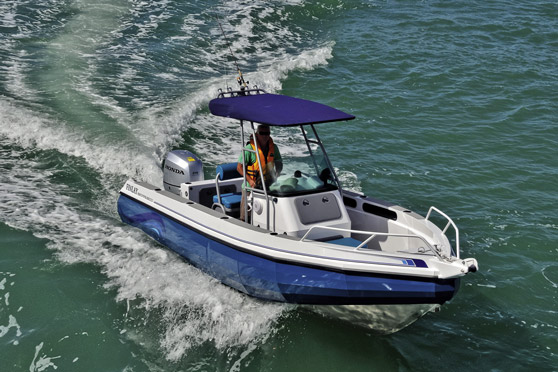
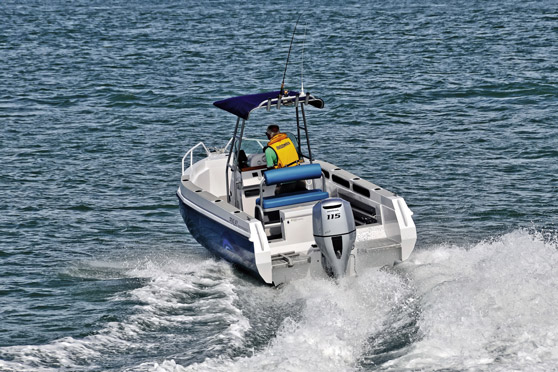 The test boat was the Finlay Escape 5900, a 5.9m (6.295m overall) pontoon hull in centre-console configuration. While some may prefer the hardtop or cuddy versions, as a fisherman I am a great fan of centre consoles because they open up the bow area to fishing, which is especially useful for casting lures or flies. Other ‘likes’ at first glance were high (top of thigh) gunwales, more subtle pontoon curves than is usual, a chunky ‘muscular’ look and a great-looking paint job.
The Timaru-built boat was in Auckland with a view to being displayed at the Hutchwilco New Zealand Boat Show this month and I grabbed the opportunity to meet with Grant Finlayson and spend the afternoon putting the Escape 5900 through its paces.
It was a nice sunny afternoon, but with a stiff northerly wind set against a run-out tide, the Waitemata had built into a typical steep, short chop of up to three-quarters of a metre. Add to this the wakes of numerous boats and ships and it was a good test of the performance of any trailerboat, especially a centre console.
I fully expected a wetting but was pleasantly surprised when I found that the Escape was a very dry boat, courtesy of high sides, modestly rising sheerline and down-turned chines formed by the pontoons. Trim the bow up just a little and hardly a drop came aboard, even with 15 knots of wind on the beam.
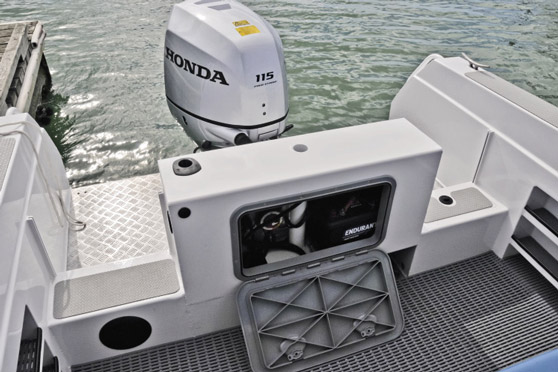
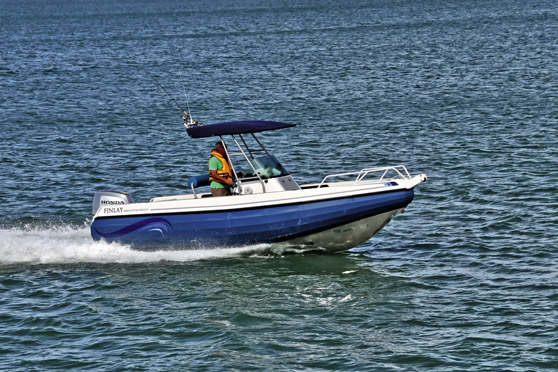 Just as welcome was the quality of the ride. The hull lifts onto plane easily, rides exceptionally softly and is a pleasure to helm. In the slop we travelled very comfortably at 40.2kph (21.7 knots). In a calm lee I gave the rig a quick squirt and the 115hp Honda easily pushed the boat up over 64.4kph (34.8 knots) at 6000rpm. There is probably a bit more speed available by fiddling with the trim. Pretty good for a 15-inch pitch prop and a relatively modest-sized engine for the size of the hull. Steering is hydraulic and the underfloor tank has a 180-litre capacity.
The nuts and bolts
The pontoon construction is a bit more complex than usual, with five folds vertically and five separate chambers per side, which – added to two further sealed buoyancy chambers under the deck – gives a massive 1470kg of buoyancy over rig weight. The pontoons taper to the bow which helps the look of the hull. The deadrise is quite deep at 20.5 degrees (helping to produce the soft ride) but the pontoons give considerable stability, making for a great fishing platform.
Construction is based on a 10mm keel bar, with 5mm bottoms, 4mm sides 2.5mm pontoons and 3mm decks and console. Welds are left unground for maximum strength and an Altex paint system provides an excellent finish to the hull, with the Bimini frame powder-coated.
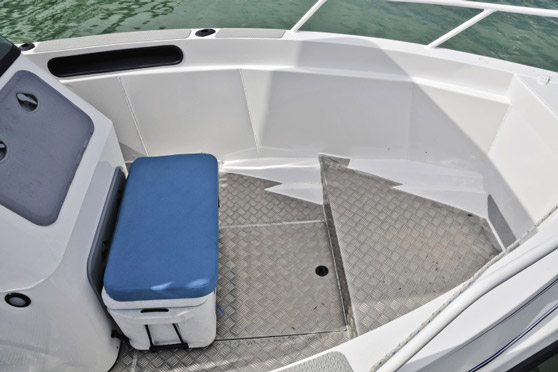 Access to the bow for anchoring is simple with the centre-console configuration. The hatched anchor well has considerable capacity. Bow rails, a sturdy fairlead and a bollard are fitted; an anchor winch is an option. A raised casting platform gives maximum space in the bow and a sealed treadplate deck runs all the way to the stern, draining to a sump under the transom fitted with a 750gph bilge pump.
Stowage room can sometimes be at a premium in centre consoles, but there is plenty in the Finlay with under-deck holds fore and aft, three levels of side shelving and two levels of shelving in the console itself. The start battery is housed in the transom wall locker, while the house battery is in the console itself – both well protected positions.
The console is a decent size, but even with the Bimini frame mounted on the outside there is still plenty of space to move freely to the bow. Retro ‘dial’ instrumentation is fitted in a raised fibreglass housing on the dash along with the sounder and throttle/shift. The VHF radio, sound system, switching, 12-volt charging outlet and other controls are all recessed into the console fascia. A nice kauri trim has been fitted to the back of the dash.
Lighting includes navigation lights, a light under the bimini, a rear-facing flood for the cockpit and four low-level blue lights for inerior illumination at night.
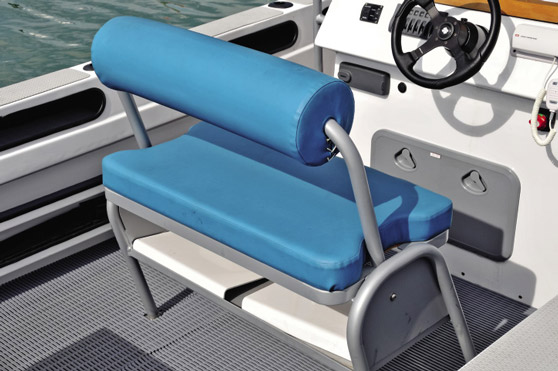
Forward seating is provided by an aftermarket chilly bin with an upholstered top, positioned in front of the console. The main seat at the helm will take two people and features a reversible back with a shelf underneath. This position is protected by a polycarbonate ‘screen. The transom wall has two step-throughs with removable drop doors (one at each side), treadplate boarding platforms behind, grab rails and a fold-down ‘T’ boarding ladder.
Fish ‘n’ dive
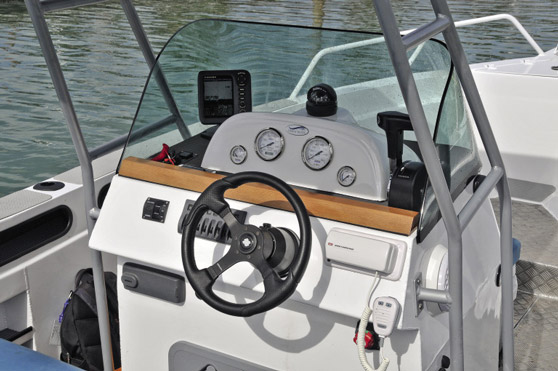 The basics are all there for a good fish and dive machine, with excellent stability, good footing (aided by Flexi-Rib matting), toe space along the cockpit sides, and a forward casting platform.
This rig had nine through-gunwale rod holders, a four-position rocket launcher and a modest live-bait tank under the port transom step-through. A central transom mount takes a bait station (several models are available). Divers are catered for with the boarding ladder, platforms, grab rails and transom step-through. The stern under-deck hold will take dive tanks.
Findlay Boats can cater for specific requirements since they specialise in custom layouts.
On the road again…
Finlay Boats make their own trailers and they look to be heavy-duty with substantial galvanising. They are essentially tandem-axle, A-frame style with an entry bay, but interestingly the side frames have been made from single lengths of steel rolled into pleasing curves without welds.
Suspension is zinc-protected leaf-springs and other fittings include eight pairs of wobble rollers per side, bow platform, galvanised steel guards with steps, hydraulic braking and park brake, dual safety chains, mag wheels, keel entry roller, wind-down jockey wheel, dual-ratio manual winch and submersible LED lights. Tow weight for the rig is about 1720kg dry.
Overall, I was very impressed with this rig. It is well powered with the Honda 115hp, travels exceptionally well – soft and dry – looks good, is nicely finished and appears well built. The boat comes standard with a great many items (including four lifejackets) and a very comprehensive manual. Add the safety aspects of stability, reserve buoyancy and load-carrying ability afforded by the pontoon construction to the fishing potential of the centre-console configuration, and Finlay Boats have produced a winner in the Escape 5900.
 Specifications
Material: aluminium
Configuration: pontoon centre
console
LOA: 6.295m
External beam: 2.31m
Internal beam: 1.86m
Bottom: 5mm
 Sides: 4mm
Pontoons: 2.5mm
Topsides: 3mm
Deadrise: 20.5 degrees
Test engine: Honda 115hp
Prop: Solas 15-inch pitch
Fuel: 180 litres underfloor
Trailer: Finlay tandem axle
Tow weight: 1720kg dry
Price as tested: $95,000
Test boat courtesy of Finlay Boats, Timaru.
|
|
This article is reproduced with permission of |

Fishing Reports Visit Reports
Tauranga Fishing Report - 28/05/26
Tarakihi on the bite Trips are few and far between at this time of year,... Read More >
Canterbury Fishing Report - 28/05/26
Fresh and salt turning it on! It is not very often I get to say... Read More >
Bay of Islands Fishing Report - 28/05/26
Lures paying dividends We finally had a break in the SE winds that have been... Read More >
Manukau/West Coast Fishing Report - 28/05/26
Snapper and gurnard in the harbour The weather has finally taken a turn for the... Read More >


Major Bites
Minor Bites
Major Bites
Minor Bites
Popular Articles

Softbait Fishing - Part 1 - gear selection
John Eichlesheim writes an article about selecting the right equipment for softbait fishing... Read More >
Softbait fishing Pt 2 - tips and tricks
Techniques, tips and tricks of softbait fishing – getting the most from your soft baits.... Read More >

Surfcasting - setting yourself up
Gary Kemsley helps sort out the necessary gear for intending surf fishers.... Read More >

Squid - How to catch them
Squid fishing is a rapidly growing aspect of fishing - Paul Senior shares some hints and tips to get started.... Read More >
Comments
Latest Articles
The Export NZ Fishing Competition Announces Season Winners
June 2026Another exciting season of The Export NZ Fishing Competition – has come to an end, and we’ve just announced our prize winners... Read More >
History of Zane Grey's Fishing in NZ
June 2026One hundred years ago, the trajectory of big game fishing in NZ changed forever with the arrival to its shores of one man - Zane Grey... Read More >
BBQ'd Gurnard with Citrus and Herb Butter
May 2026This is a pretty ‘cheffy’ recipe, featuring a sauce that is definitely one to impress guests with, but it's fairly easy to cook... Read More >
Mackenzie Country Trout & Tahr
May 2026The Mackenzie Country winter months of June, July, and August herald the main spawning time for canal trout... Read More >
The Hutchwilco NZ Boat Show Official Guide - 2026
May 2026This year, The Hutchwilco New Zealand Boat Show returns bigger than ever as New Zealand's ultimate boating and fishing showcase... Read More >