
FC560 Cuddy Cabin Review
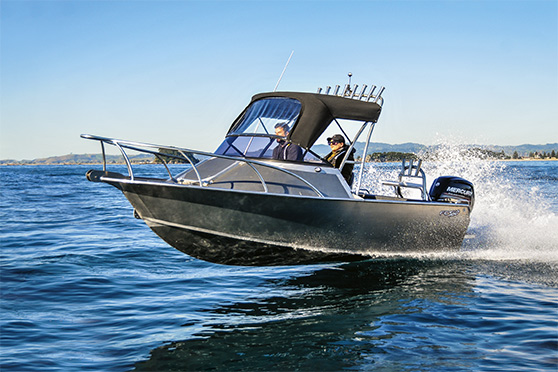
We are fortunate in this country to have the chance to live ‘the Kiwi dream’. Tucked away down at the bottom of the Pacific, New Zealand was one of the last decent-sized, habitable landmasses to be settled by humans. Our population levels are relatively low (although this is changing fast) but there is still easy public access to plenty of beaches, rivers, lakes and harbours for various forms of aquatic recreation.
You need to cut the cloth of your Kiwi dream according to your means, of course. While not everyone can afford big, expensive craft capable of trips to distant destinations and offshore spots, there are plenty of sheltered inshore coastal waters and lakes, and plenty of affordable watercraft. The enjoyment is still there, and it also means there is a good market in New Zealand for small- to medium-sized boats.
Enter Ross Christensen. He has an engineering background, a passion for fishing, diving and boat-racing, and even back in 2011 had been involved in selling and servicing trailer boats for over 20 years. He perceived a need for aluminium boat packages that were practical and good quality. Teaming up with a reputable aluminium boat designer, he founded FC Boats with these goals in mind. The first FC boats produced set the local small-boat market on its collective ear. The impressive ride, stability, dryness, reserve buoyancy, strength and value-for-money really impressed Kiwi fishos.
The factory has expanded since 2015 to meet demand for the increasing range of FC hulls, now designed and made in Hamilton. Ross’ son, Max Christensen, joined the family business after completing a trade certificate in general engineering, and also brought a passion for game fishing. He has grown the team, and added a new purpose-built finishing and rigging bay, which has allowed the core factory to expand.
A recent innovation of the FC team was to re-design the transom construction of some models, replacing the old cut-out stern with a transom wall that has internal stowage behind three hatches (including an off-the-deck battery locker) with the engine mounted on an outboard pod. This has several advantages, such as the extra stowage and easy provision of a boarding platform, as well as being easier and quicker to build and rig. A good example of the new stern design is the FC560, and as I had never tested this model, I arranged to meet Max, his right-hand man Josh Horan and Marketing Manager Jacinta Fox at Tauranga to take one for a run.
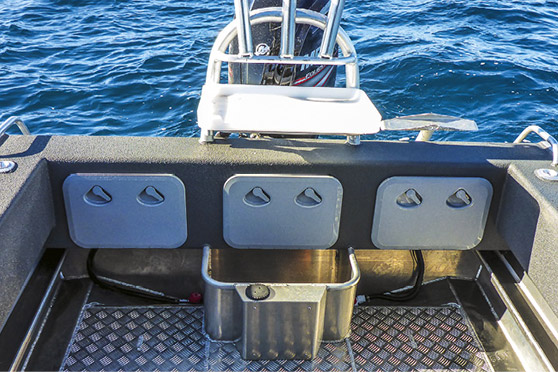 The re-design of the transom construction replaces the old cut-out stern with a transom wall that has internal stowage behind three hatches.
Stem to stern
Along with the new transom design, the FC560 Cuddy construction includes the usual features of the FC range: wide, over-hanging gunwale tops that help keep the boat a dry rider; a self-flooding ballast tank on the keel line with a shut-off valve that can retain water ballast when on plane which provides considerable stability; and large volume foam-filled gunwales that, with the addition of underdeck sealed chambers, supply plenty of reserve buoyancy.
The foredeck is a decent size and finished with a black spray-on non-skid finish. There is an anchor fairlead, substantial bow rails, bollard, and non-hatched anchor well. The anchor is most easily worked through the forward hatch.
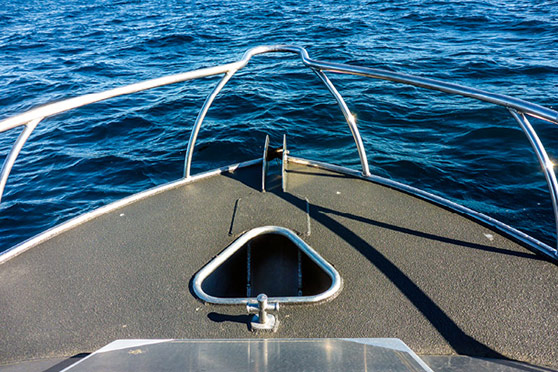 The anchor is most easily worked through the forward hatch.
The helm position is sheltered by a removable, fold-down canopy with a clear panel to allow forward visibility for the helmsman. The frame also supports an eight-position rocket-launcher. A decent-sized dash tray is lined with a dark marine carpet, which cuts internal reflection on the polycarbonate ‘screen and also prevents items stowed on the dash from sliding around. A grabrail is fitted for the passenger.
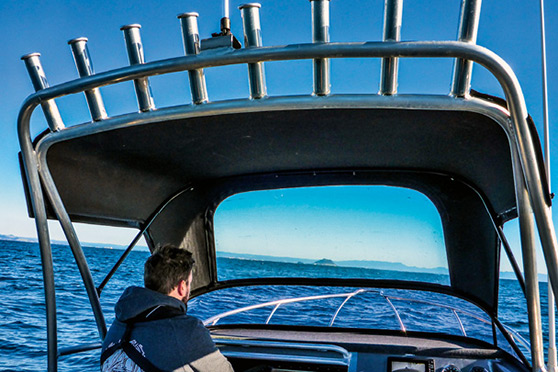 The helm position is sheltered by a removable, fold-down canopy with a clear panel to allow forward visibility for the helmsman.
Forward of the helm position, the fore-cabin had been left clear for gear stowage – no berths are fitted, although side shelves are. Pipe footrests also act to stop gear from sliding astern when the boat is underway.
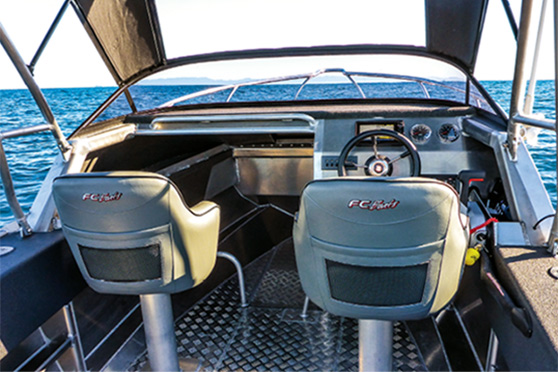 The fore-cabin had been left clear for gear stowage. Pipe footrests also act to stop gear from sliding astern when the boat is underway.
Electronics are a Garmin Echomap Plus 75SV, providing sonar and GPS in a single package, and a GME GX700B VHF handles the communications.
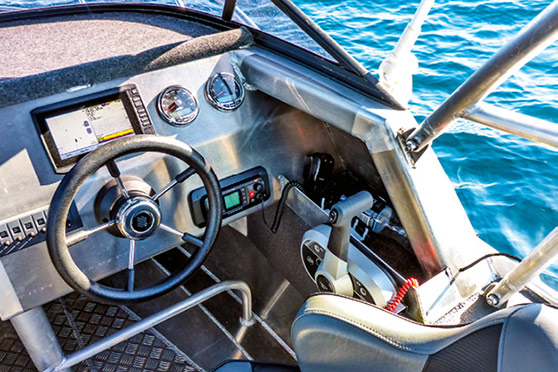 Electronics are a Garmin Echomap Plus 75SV, providing sonar and GPS in a single package, and a GME GX700B VHF handles the communications.
The gunwale faces and tops are flat and wide. They are good to sit on while fishing and nice to brace yourself against, giving mid-thigh support when working a fish. Under the gunwales, shelving runs along each side of the cockpit which is handy for storing rods, poles, gaffs and so on. The deck is sealed and made of aluminium tread plate for good footing. It drains to sumps under each side of the transom wall; both of which are fitted with a 500gph bilge pump to remove any water.
Sited centrally under, and protruding forward from the transom wall, is a live bait tank, well-suited to house jack mackerel. The bung can be removed to fill it and change the water and it can be fitted with a venturi pick up. The fuel port (with a guard to protect the fuel line) is fitted on the front of the live bait-tank and fills the 115-litre underfloor fuel tank.
Atop the transom is a mounting arch which carries a removable bait-board (drained overboard), three rod holders and a towing point. Three more through-gunwale rod holders are in fishing positions along each gunwale, for a total of 17.
Over the transom wall is a full-width tread-plate boarding platform. Fuel, steering and electrical connections to the outboard must be allowed for though, and the port side is most useable, so a fold-down ‘T’ boarding ladder is fitted there, along with grab rails on each side.
This sounds like a lot, but the test boat had not been heavily optioned, allowing any potential buyer to retrofit it. FC Boats offer a wide range of custom options.
On the water
I have always been very impressed with the sea keeping of FC hulls and Max reckoned the new stern design has further improved the performance of the FC560. Not having run a 560 with the previous stern design, I can’t offer an opinion on this, but I can say that the test boat performed very well indeed. The design features I have previously mentioned, added to the 18-degree deadrise (variable to a fine entry), substantial 5mm bottom plates (adding more weight down low) and wide down-turned chines, make this hull stable and dry.
It was a nice winter day and we launched the test boat (and a camera boat) at Tauranga’s Sulphur Point ramp, running down the harbour, out of the entrance and out to Okaparu Reef near Motiti Island. Conditions were not so nice outside the harbour entrance with a confused head-sea of about a metre giving the 560 a good try out, which it handled well with no crash-bang and very little spray. After a bit of fishing, we headed back. The sea had settled a bit and it was lovely boating, the 560 angling smoothly downhill and across the swells.
Back inside the harbour we ran some performance trials and with a strong run-out tide, did series running with and against the stiff current, averaging the figures to get a fair result . Recommended power is 90-115hp for this boat. The test rig was powered by a Mercury 90hp four-stroke CT with an Enertia 17” pitch prop. This produced a maximum speed of 37mph (about 32 knots or 60kph) at 6000rpm with Max and I aboard, which is the top-end of the recommended rev range according to the engine’s manufacturer. So, a very decent performance and a good prop match. The steering is an Ultraflex T73 Anti-feedback rotary system which controls the Merc 90 smoothly and easily.
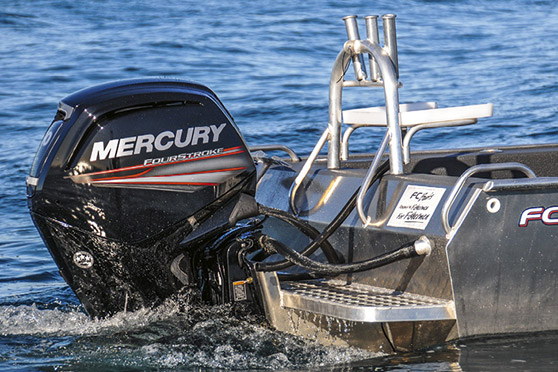 The test rig was powered by a Mercury 90hp four-stroke CT which produced a maximum speed of 32 knots (60kph).
On the road
The rig has a tow weight of approximately 875kg, a reasonably easy tow for, say, a 2.4litre diesel. It is carried on a single-axle voyager trailer with zinc-protected leaf-spring suspension. Other trailer features are a spare tire, dual-ratio manual winch, wind-down jockey wheel, submersible LED lighting, and four pairs of wobble rollers per side.
All in all
You get a lot of boat for your buck with the FC560 Cuddy Cabin. For its class it gives an excellent performance: dry and soft riding. With large foam-filled gunwales added to sealed chambers under the deck, the safety aspects are well catered for. The ride and stability of this hull are impressive: the fine entry and wide, down-turned chines are a part of this, while the 5mm bottom plates and the self-flooding ballast tank help lower its centre of gravity.
Add FC Boat’s understanding of what fishos want and need in a boat and you can have an excellent fish and dive rig, easily towed and launched, for a very decent price.
Specifications
Material: aluminium
Configuration: cuddy cabin
LOA: 5.7m
Beam: 2.25m
Deadrise: 18-40-degree variable
Hull: 5mm
Sides: 4mm
Rec hp: 90-115hp
Test engine: Mercury 90hp 4-stroke CT
Propeller: Enertia 17” pitch
Gunwale height: 670mm
Draft: 450mm
Tow Weight: 875kg approx.
LOA on Trailer 7.1m
Fuel Capacity 110 Litres
Price as tested: $58,670
Packages from: $49,995
Test boat courtesy of: FC Boats
Performance
Hull: FC560
Outboard: Mercury 90hp four-stroke CT
Prop: Enertia 17” pitch
Crew: two adults
Revs Speed Fuel
(RPM) (mph) (l/hr total)
1000 3.60 1.95
2000 6.50 5.25
3000 11.75 10.00
4000 23.00 13.65
5000 31.00 22.35
6000 37.00 32.50
NB: performance measured in Tauranga Harbour. Speed and fuel figures were measured with and against current and averaged.
|
|
This article is reproduced with permission of |

Fishing Reports Visit Reports
Tauranga Fishing Report - 28/05/26
Tarakihi on the bite Trips are few and far between at this time of year,... Read More >
Canterbury Fishing Report - 28/05/26
Fresh and salt turning it on! It is not very often I get to say... Read More >
Bay of Islands Fishing Report - 28/05/26
Lures paying dividends We finally had a break in the SE winds that have been... Read More >
Manukau/West Coast Fishing Report - 28/05/26
Snapper and gurnard in the harbour The weather has finally taken a turn for the... Read More >


Major Bites
Minor Bites
Major Bites
Minor Bites
Popular Articles

Softbait Fishing - Part 1 - gear selection
John Eichlesheim writes an article about selecting the right equipment for softbait fishing... Read More >
Softbait fishing Pt 2 - tips and tricks
Techniques, tips and tricks of softbait fishing – getting the most from your soft baits.... Read More >

Surfcasting - setting yourself up
Gary Kemsley helps sort out the necessary gear for intending surf fishers.... Read More >

Squid - How to catch them
Squid fishing is a rapidly growing aspect of fishing - Paul Senior shares some hints and tips to get started.... Read More >
Comments
Latest Articles
The Export NZ Fishing Competition Announces Season Winners
June 2026Another exciting season of The Export NZ Fishing Competition – has come to an end, and we’ve just announced our prize winners... Read More >
History of Zane Grey's Fishing in NZ
June 2026One hundred years ago, the trajectory of big game fishing in NZ changed forever with the arrival to its shores of one man - Zane Grey... Read More >
BBQ'd Gurnard with Citrus and Herb Butter
May 2026This is a pretty ‘cheffy’ recipe, featuring a sauce that is definitely one to impress guests with, but it's fairly easy to cook... Read More >
Mackenzie Country Trout & Tahr
May 2026The Mackenzie Country winter months of June, July, and August herald the main spawning time for canal trout... Read More >
The Hutchwilco NZ Boat Show Official Guide - 2026
May 2026This year, The Hutchwilco New Zealand Boat Show returns bigger than ever as New Zealand's ultimate boating and fishing showcase... Read More >