
Everyman 595 Centre Console
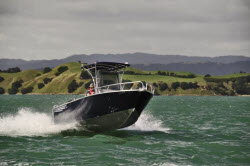 Everyman Boats is the result of a partnership between builder/designer Nigel Langdale and his cousin and partner, Russell Spires, who handles the marketing.
Nigel has been building aluminium boats for 17 years, starting at Ramco and then contract boat-building for a number of years. Six years ago he set up his own company in the Waikato under the name TA (for Te Awamutu) Boatshed, launching the Everyman range three years later. Everyman proved a successful concept and their 685SF won the People’s Choice Award at the 2009 Waikato Boat Show.
Now renamed Everyman Boats, the company works from a manufacturing facility in Frankton, Hamilton. Building is handled by Nigel and Richard Brough, who also built boats for Ramco for six years, and they turn out two hulls a month between them. A dealer network is being developed, and includes Bensemann Boating in West Auckland and Silverdale Marine to the north of Auckland. Currently other sales are handled direct from the factory.
The Everyman 595 Centre Console Detour tested here is owned by Richard Wickett, who lives in Clevedon, south of Auckland, and we launched the boat at the nearby Maraetai Boat Club ramp on a blustery early April morning.
Construction
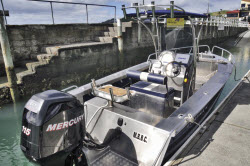 This aluminium hull features a 5mm bottom and transom, 4mm sides and decks, and a 4mm chequerplate cockpit sole. Structural support is supplied by six longitudinal bearers and three lateral bulkheads (plus the transom), along with six further cross-members. The keel-line and chines are fully seam-welded internally, then back-gouged before the external seam welds are added. The bimini top is constructed, in this case, from stainless pipe.
The welding is solid and workman-like, mostly left unground for maximum strength. This hull features painted sides, the smooth glass-like finish highlighting how very fair the hull is. A rough calculation gave a reserve buoyancy of approximately 110kg.
Power and performance
 The design of the 595 features a fine entry, variable to a 15° deadrise at the transom, with modest down-turned chines. This is a beamy hull with plenty of wetted surface and no planing strakes are required.
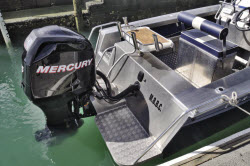
Recommended power is 90-130hp, and the test boat was pushed by a Mercury 115hp four-stroke outboard spinning a 20-inch pitch prop. On test day, conditions (15 to 20-knot winds) were not ideal for a top-end speed test, but we achieved 60kph (32.4 knots) at 5900rpm. Given that this is a fairly fine-pitched prop and the engine’s maximum revs are listed at 5800-6400, there is probably a little more speed to be had, but it is fair to say that 115hp is sufficient power for normal use.
Fuel capacity is 120 litres in an underfloor tank. The fuel port is on the outside of the transom, keeping any fuel spillage out of the hull.
As mentioned, it was a bit breezy on test day, averaging about 15 knots and picking up to over 20 at times. The waters around Maraetai, in the southern part of the Hauraki Gulf, are shallow and currents can run strong, pushing up a steep chop of over a metre in places as we travelled across the bay to Sandspit Channel.
Although a 15° hull may be considered to have a fairly flat bottom, and you might expect a flat-bottomed hull to pound, this definitely was not the case with the Everyman 595. With a combination of fine entry, wide beam and downturned chines, the hull handled the steep chop very well, being a soft and remarkably dry rider – especially for a centre-console with 15-20 knots of wind on the bow quarter. The added bonus is that with the beam and the relatively flat deadrise aft, this is a stable hull, both underway and at rest, something we appreciated whilst having a quick fish in sloppy conditions out in the channel.
A decent sized ‘screen on the console gives reasonable shelter for two. The steering is a Hy-drive Admiral hydraulic unit, which performs well, and the boat will turn on a dime.
Anchoring
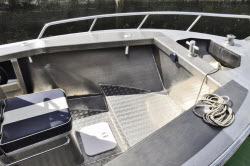
By their nature, centre-consoles give easy access to the bow, and the Everyman 595 is no exception. A chequerplate platform provides a good spot to work the anchor – there is a decent-sized open-topped anchor well in front, and the Quick anchor capstan is operated by pressing a conveniently-placed switch with your knee. A substantial bollard handles tie-off duties, and a split bow-rail dropping hard either side of the fairlead constrains the warp without the need for fiddly locking pins.
Layout
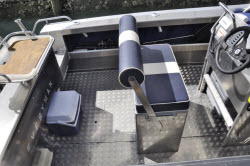
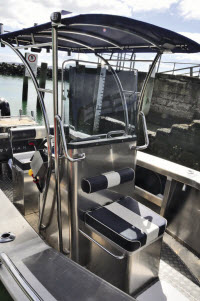 The sealed chequerplate deck drains to a sump under the transom wall, from where water is removed via an 1100gph bilge pump. Hatches in the floor give access to storage holds in the bow and stern. An upholstered seat with backrest is built into the front of the console with grab-rails on each side, and a hatched plastic tank underneath provides stowage (owner Richard Wickett uses this to store his catch in).
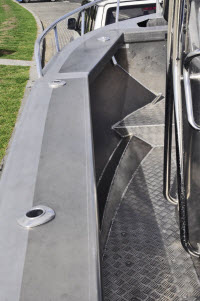
Despite a generous-sized centre console and the mounts for the bimini top, the beam of the boat still allows easy walk-around access – the whole point of having a centre-console.
The console itself, as mentioned, features a stainless pipe bimini top, which supports forward- and rear-facing lights, navigation lights and aerials, as well as the canvas bimini itself. A decent-sized dash tray is handy for odds and ends, and the console also accommodates the steering, throttle/shift, grabrails, instrumentation and switching and electronics (a Lowrance HDS10 GPS/sounder and LVR250 VHF). There is room to stow a chilly-bin or other box underneath, behind the removable footrest. Further stowage is inside the helm bench seat, which also has a backrest that can be reversed when facing astern (as when fishing at anchor).
Large side pockets (about 2.5m long) add to stowage space and are wide enough to take dive tanks if necessary. The transom wall features a step-through on the port side, as well as a shelf that houses the two batteries and isolation switching behind a dome-on cover. Over the transom is a chequerplate boarding platform with grab rails and fold-down ladder.
Fishability
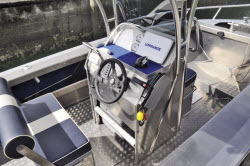 Centre-consoles are made for fishing, with the full walk-around configuration opening up the bow space for use, especially when drifting and casting. The stability of this hull is excellent, and good footing is provided by the chequerplate decking. Wide gunwale tops make a handy perch while bait fishing, and the rear two-thirds of the hull feature flat gunwales faces, giving top-of-the-thigh support with toe room beneath when fishing on your feet. Up in the bow, the chequerplate platform is as useful for casting from as it is for working the anchor.
Four alloy through-gunwale rod holders are set along each side of the hull, with the rear two having gimbal-pin orientations suited to trolling if required. A removable bait-station in the centre of the transom provides an extra four rod holders. This unit provides a good spot for cutting baits and filleting modest fish (it drains overboard), is fitted with towel hooks, and can be removed to fit a ski-pole. A further four rods can be stored in a rocket launcher on the bimini top, and there is space for more in the side pockets.
A plumbed live-bait tank built into the transom step-through should accommodate 10-12 mackerel.
 Owner Richard Wickett and his wife are keen on bottom fishing and sometimes set a long-line. They mostly fish the southern Hauraki Gulf or out of Whangamata for snapper, kahawai and kingfish. On test day, although it was rough, windy and the middle of the day, we dropped the pick and Richard slipped a berley bomb over the side for a short time. A school of XOS kahawai dropped into the trail almost immediately, and we had a hectic half-hour or so of non-stop action on cut and soft-plastic baits. Richard is very fond of kahawai kokoda (ceviche) and it suited him to take a few of these big guys home.
The stability of the boat showed its advantages in the sloppy conditions, and the centre-console configuration proved ideal when dealing with the fast surface runs of these active fish as they circled the boat. Overall, an excellent boat to fish from at anchor, and it should be even better for drift and cast-fishing (although the wind did not permit us to utilise this technique on the day).
Trailering
 The 595 was carried on a Voyager cradle A-frame A17 single-axle trailer with zinc-protected leaf-spring suspension. This trailer is fitted with five pairs of wobble rollers per side, a manual dual-ratio winch, wind-down jockey wheel, dual coupling and spare wheel. The boat comes on and off the trailer easily (in fact it has to be restrained while the hook is removed when launching). Tow weight of the rig is 1380kg.
All in all
The Everyman 595 is a very useful and good-looking fishing boat. The construction is robust and the level of finish is excellent. Good use of space is made in the layout, making it an easy craft to fish from. It is stable, travels well, and is a dry, soft rider. Everyman Boats pay attention to detail and are willing to customise to owners’ requirements. In short, it ticks all the boxes – what more could you want in a coastal sportfisher?
Specifications
 Configuration: centre console
Material: aluminium
LOA: 6.02m
Beam: 2.35m
Bottom: 5mm
Sides and topsides: 4mm
Deadrise: 15°
Hull weight: 560kg
Tow weight: 1380kg
Recommended HP: 90-130hp
Test engine: Mercury 115ph four stroke
Prop: 20” pitch
Price as tested: $72,468.00
Base key-turn price: $52,705.00
(Mercury 90hp 2 stroke)
Test boat courtesy of Richard Wickett.
 |
This article is reproduced with express permission of
written by Sam Mossman - 2011 Originally published in New Zealand Fishing News |
Fishing Reports Visit Reports
Outer Hauraki Gulf Fishing Report 17/09/26
Spring wind the handbrake. Spring is starting to make its presence felt in the outer... Read More >
Top of the South Fishing Report - 17/09/26
Early snapper in Tasman Bay. Well, spring is finally here, and the days are getting... Read More >
Bream Bay Fishing Report - 17/09/26
Good snapper catches reported. After Tangaroa turned off the fish tap for a month or... Read More >
Bay of Islands Fishing Report - 17/09/26
Pacific bluefin tuna for the lucky few. The last fortnight has seen more fishable days... Read More >


Friday 25 September 2026
Major Bites
 - -
- - Minor Bites
 - -
- - Saturday 26 September 2026
Major Bites
- - Minor Bites
- - Popular Articles

Softbait Fishing - Part 1 - gear selection
John Eichlesheim writes an article about selecting the right equipment for softbait fishing... Read More >
Softbait fishing Pt 2 - tips and tricks
Techniques, tips and tricks of softbait fishing – getting the most from your soft baits.... Read More >

Surfcasting - setting yourself up
Gary Kemsley helps sort out the necessary gear for intending surf fishers.... Read More >

Squid - How to catch them
Squid fishing is a rapidly growing aspect of fishing - Paul Senior shares some hints and tips to get started.... Read More >
Comments
Latest Articles
Spearfishing Tips & Tricks
September 2026The South Seas Spearo team provide some salient advice for spearfishers about how to get the most out of their time in the salt this season... Read More >
New Fishing Tackle - Spring 2026
September 2026Check out these hot new products, fresh out this spring... Read More >
NZ Saltwater Fly Fishing Seasons
September 2026Sandflats and mudflats are beautiful fish-rich habitats that are particularly suited to fly fishing... Read More >
How to Catch Sea-run Trout
September 2026One area Greg Morton returns to time again to hunt sea-run and estuary brown trout is the coastal stretch from Christchurch to Southland... Read More >
Garmin Force Kraken + LiveScope Review
September 2026Garmin’s Force Kraken trolling motor and LiveScope sonar system enable positioning, tracking, and targeting fish with a high level of precision... Read More >