Fishing Techniques from a Jetski

One of the great advantages of a jetski is versatility. Depending on your location and conditions, a jetski can be used for everything from casting softbaits and bait fishing over shallow structure to livebaiting and trolling for pelagic species in deeper water offshore.
And New Zealand has no shortage of fish species to target. Snapper, kahawai, trevally, gurnard, and blue cod all make great inshore targets, while kingfish and even tuna and marlin can realistically be pursued from a properly equipped jetski by the more adventurous anglers. The key is adapting your technique to suit the species, habitat, and conditions on offer.
The good news is that many of the most effective fishing techniques are also among the easiest to manage from a jetski.
From bait fishing and softbaiting to jigging, trolling and livebaiting, this guide explores some of the most effective ways to target New Zealand fish from a jetski.
Softbaiting: the jetski angler's bread and butter
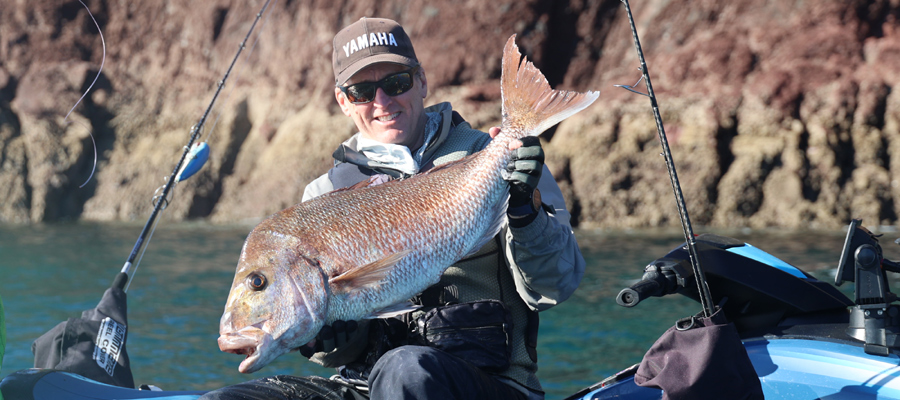
If there is one fishing technique that seems almost purpose-built for jetskis, it’s softbaiting.
Softbait gear is compact, relatively clean, easy to carry and doesn't require much equipment beyond a rod, reel, a selection of jig heads and a handful of plastics. They also allow an angler to cover a lot of water – a major advantage when you're prospecting unfamiliar ground.
The combination of a highly manoeuvrable and stealthy platform, and a single angler who can quickly change position, makes a jetski particularly effective for working coastlines, rocky structure, weed edges, drop-offs, and shallow reefs around New Zealand.
A jetski can quickly move between likely-looking areas, while front-mounted rod holders allow spare outfits to be carried safely and kept within easy reach. A handful of softbaits and jig-heads can cover a surprisingly broad range of fishing situations and water depths, and can be swapped out easily. There's no need to fill the ski with tackle. Drifting along with softbaits is ideal when you don't know exactly where the fish are. Work likely-looking structure, watch the sounder, and move when the action disappears.
Compared with bait fishing, softbaiting produces very little mess – an important consideration when your fishing platform also happens to be your seat! And perhaps most importantly, they catch fish, especially popular species like snapper, kahawai, trevally, and blue cod.
When choosing tackle for jetski fishing, shorter rods generally make more sense. A long rod can be awkward around the ski and increases the risk of high-sticking the rod when a fish gets close or changes direction beside you.
A responsive spin outfit in the light-to-medium range makes an excellent all-round setup. Match braid and leader strength to the likely fish rather than automatically going heavy. Lighter line and smaller jig heads generally produce more bites from a larger range of species, particularly in shallow or clear water, but there is a trade-off when a trophy fish turns up!
Jig-head weight is another important consideration. Use the lightest head that will still get your lure to the desired depth and maintain contact with it. Going too heavy can kill the action and reduce your bite rate; going too light can make it difficult to stay in touch with the lure, particularly in current or deeper water. Maintaining close contact with your line rather than having a large belly of line out will enable you to see and feel bites and respond accordingly.
A selection of jig-head weights gives you the flexibility to adapt, while carrying multiple spools or spare reels loaded with different line strengths can save considerable hassle.
There are two basic techniques when softbaiting. The most popular is to cast ahead of the drift direction or directly at structure, and then let the lure free-fall to the bottom. Once it touches down, work it back with a sequence of twitches as you lift the rod upwards, then retrieve the slack line as the rod is dropped back down. Simply repeat this through the water column. A lot of strikes tend to happen on the drop, so look for any unusual movement that might indicate a bite.
Don’t be afraid to fish your softbait close to the bottom – sure you’ll end up losing some gear, but a lot of the better snapper will stay deeper amongst the rocks and kelp. Sometimes fish will engulf your softbait and you can’t miss them, other times they will nibble away at the rear end of your lure and you will need to time your strike to perfection. Generally speaking, fish should come back for a couple of cracks and you will usually hook them sooner or later.
The second most effective technique, particularly over deeper, sandy areas, is to simply drop your softbait to the bottom and let your drift do all the work as your soft-bait enticingly bounces along the seafloor.
Kabura-style lures and microjigs
Kabura-style and microjig lures are another excellent option for jetski anglers, particularly when fishing deeper structure or targeting snapper.
Carry a range of weights and colours so you can adjust to depth, current and light conditions. The heavier the current, the more weight you'll generally need to maintain contact with the bottom.
Microjigs deserve a place in the tackle box, too. A couple of compact micro-jigs worked on a relatively light outfit can be deadly on snapper, trevally, kahawai and other opportunistic feeders, and these lures are easy to cast, too.
A spare rod already rigged with a micro-jig or kabura is worthwhile. It means you can switch techniques without stopping to re-rig when you spot a school of bait or marks on the sounder.
Bait fishing
For all the advantages of modern lure fishing, there are times when it is hard to go past a good piece of bait.
A pilchard is a classic option, particularly for snapper, trevally and kahawai, while a freshly-caught offering like a jack mackerel makes an excellent bait when targeting larger predators.
The downside is obvious: bait fishing on a jetski can get messy. The solution is preparation.
If you're taking frozen baits, cut them before leaving home and pack them ready to fish. That means less time handling a knife, bait, and blood while sitting on the ski.
Keep rags or disposable cloths handy and clean your hands before touching the throttle, controls, electronics or other equipment. Remember that on a jetski, a tidy fishing area is a safer fishing area.
Jigging
A jetski is surprisingly capable when it comes to jigging.
Larger jigs and heavier tackle can be used for kingfish, snapper, and even deepwater species like hapuku and bass, with mechanical, high-speed and slow-pitch techniques all having their place. Which technique works best depends on the target species, depth, current and the type of structure you're fishing.
Kingfish are the obvious target. Find structure like a prominent point, reef, or pinnacle with bait and current, and a jig can be an extremely quick and effective way of getting a lure in front of them.
The important consideration from a jetski is what happens after the bite. A big kingfish is not particularly interested in your carefully considered fishing platform. It may take off around the ski, underneath it or directly away from you, and suddenly you have a lot less room to manoeuvre than you would on a boat.
Keep the rod under control, maintain your balance and avoid high-sticking. Be particularly conscious of where the fish, leader and hooks are at all times. A bonus of fighting powerful fish from a ski is that they will tow you around, meaning it is easier to maintain a line angle over the top of a fish – this helps reduce the chances of getting reefed!
Topwater fishing

Topwater fishing is absolutely worth trying from a jetski.
A jetski gives you the ability to cover plenty of coastline and investigate surface activity quickly, while the relatively low profile can sneakily put you close to the action.
Rocky headlands, shallow reefs, current lines, and areas where surface-schooling fish like kahawai, trevally, and maomao are present are all worth investigating.
Stickbaits are particularly practical from a jetski. They require less physical movement than working poppers, which is useful when your casting and working space is restricted.
Cast around likely structure and work the lure with a rhythm that allows you to maintain balance and keep the rod under control. If a fish follows without committing, resist the temptation to overwork the lure. Often a change in cadence or a brief pause is enough to trigger the bite.
As with all jetski fishing, keep your casting area clear and be aware of your surroundings. A flying lure and a passenger behind you are not a particularly good combination.
Trolling
Trolling is another useful technique, particularly when searching for large, pelagic fish, and in recent years keen jetski anglers have accounted for striped marlin, yellowfin tuna, and southern bluefin tuna in New Zealand.
The biggest limitation is fuel consumption. Trolling for gamefish at around 6–7 knots can sit the ski in an awkward spot, making it relatively inefficient over long periods.
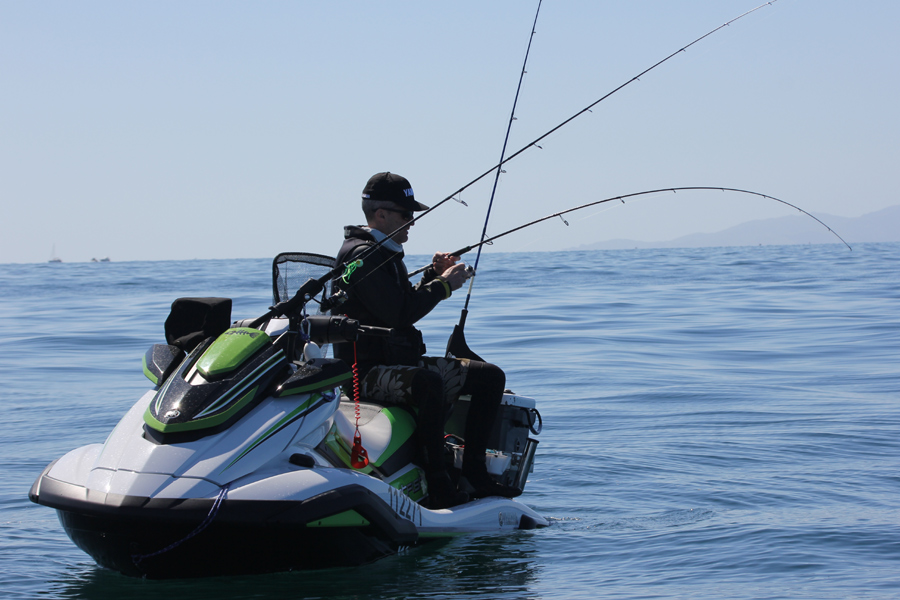
It goes without saying that there’s a strong argument for keeping trolling simple from a jetski. Two rods is plenty. Running multiple lines from a jetski can quickly become complicated, particularly if you get simultaneous strikes.
Trolling can also be an effective technique to snag more modest fare. Smaller diving lures, softbaits and other compact offerings can be trolled for species like smaller tuna, kingfish, kahawai, and even snapper.
And don't overlook trolling the humble black and gold Toby or rainbow Tasmanian Devil at the lake for trout!
Livebaiting
Livebaiting from a jetski opens the door to exciting kingfish angling, although there are a few issues to work through on the ski.
A sabiki rig or tiny jig is all that's required to catch many common livebait species. Look for bait schools on the sounder or around structure, catch what you need, and get it into the water as quickly as possible.
Keeping livebait healthy can be challenging on a jetski because space is limited, so attaching the livie and sending it back out where you caught it is the easiest option. It’s not a bad option either – where there’s bait, there should also be predators!
A dedicated livebait tank with a pump is the ideal solution where the ski allows it. Otherwise, a simple bucket can work for short periods, provided the water is changed regularly.
Livebaits can be slow-trolled around promising territory, dropped down with some weight directly to sign on the fishfinder, allowed to drift under a balloon, or simply cast back into the bait school and allowed to swim naturally.
Deepwater fishing
Deepwater fishing is where jetski fishing starts to get properly adventurous.
Hapuku, bass and bluenose can all be targeted from suitable locations. But deepwater fishing comes with significantly greater demands in terms of weather, range, equipment, and personal safety.
Deepwater fishing should only be undertaken when conditions are suitable for the ski, the angler, and the distance involved.
A forecast that looks manageable close to shore can be a very different proposition miles offshore. Swell, wind direction, current, and the time required to return should all factor into the decision-making process. If conditions deteriorate, being offshore on a jetski leaves considerably less margin for error than being in a larger boat.
Deepwater tackle needs to be matched to the depth and target species. Heavy braid, appropriate leaders and strong hooks are essential, while an electric reel can make deep drops considerably more practical. Carry enough line capacity for the depth you're fishing, plus additional capacity to accommodate a long drop and a powerful fish moving away from you.
Hapuku, bass and bluenose can all require substantial tackle, particularly around rugged structure where you need enough stopping power to keep a hooked fish out of the rocks.
Swordfish are another proposition entirely and should be considered an advanced offshore pursuit, requiring specialised tackle, knowledge and a very suitable weather window.
As with all fishing, location is everything. Modern sounders make it much easier to identify pins, drop-offs, foul ground and other features likely to hold fish. Look for changes in depth, isolated structure, and areas where bait or fish marks appear on the sounder.
Deepwater fishing is often as much about managing your drift as finding the fish. Wind and current can move a jetski considerable distances, so keep an eye on your chartplotter and understand how quickly you're moving across the bottom. If you're consistently drifting away from productive structure, reposition before dropping again.
Accurate dropping is important, too. If the fish are holding tight to a pinnacle or ledge, being even a short distance away can make the difference between bites and nothing.
The ultimate advantage
Perhaps the biggest weapon a jetski angler has is stealth and mobility. This is where having a small selection of pre-rigged outfits and a plan to focus on a handful of proven techniques really pays dividends.
A jetski can cover water quickly, slip into shallow areas that larger boats can't reach, and reposition with very little fuss. That makes it an outstanding prospecting platform.
Common questions
What fishing techniques work from a jetski?
Softbaiting, bait fishing, jigging, trolling and livebaiting. Softbaiting is the one that suits a jetski best: compact, clean, and only a rod, reel, jig heads and plastics.
What New Zealand species can you catch from a jetski?
Inshore targets include snapper, kahawai, trevally, gurnard and blue cod. Kingfish, tuna and marlin are realistic from a properly equipped ski for more adventurous anglers.
Why is a jetski good for softbaiting?
It is manoeuvrable and stealthy, so one angler can move quickly between coastline, rocky structure, weed edges, drop-offs and shallow reefs.


Sunday 29 November 2026
Major Bites
 -
 -
Minor Bites
 - -
Monday 30 November 2026
Major Bites
- - Minor Bites
- -