Tigerfish in Zimbabwe
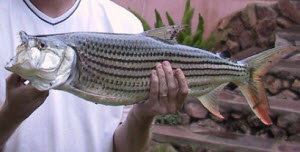
There are many great fishing destinations throughout the world, but few offer the opportunities found in Zimbabwe to cast a line for tiger fish surrounded by African game, including crocodiles, lions, water buffalo, elephants and hippopotami.
It was July and Nicki and I had a four-day canoeing safari down the Zambezi River, with the opportunity for a fish along the way. The Zambezi is Africa’s fourth-largest river winding over 2700km from Zaire to Mozambique and emptying into the Indian Ocean.
The first day of our safari, Nicki and I were packed ready for the 5:00am start. A message was received advising that our bus had broken down and would be five minutes late. It transpired that this was an African five minutes as our bus arrived at 8:00am. After travelling for five minutes we confronted a police roadblock.
Our drivers promptly swapped seats and the new driver provided all the necessary paperwork to the police officer, except for one minor document – a driver's licence! The police chief was summoned and boarded the bus and a long lecture ensued. After many promises by the driver to obtain a licence, we continued.
After travelling north from Harare for seven hours, we arrived at Chirundu, our put-in point. This region of the Zambezi is world famous as a hotspot for tiger, bream and vundu fishing.
Although July is winter on the Zambezi, the daytime temperatures are similar to a New Zealand summer. However, the temperature drops significantly once the sun sets. July to September is the best time to travel weather-wise: not too hot and with minimal rain. Unfortunately, these are not the best fishing months. Those are in the unbearably hot months of October and November, when tigers aggressively attack the lures. They are also attracted to strip baits of fish such as bream. It’s not uncommon to hook into 30 tigers a day.
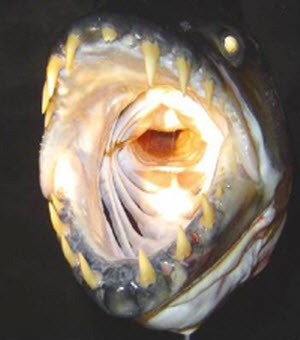
With this information I was ready. I had bought with me a telescopic spinning rod, a Shakespeare long-cast reel spooled with 1Okg mono, and a selection of Mepps and Shad Rap lures. The lures had six inches of black wire protecting my line from the Tiger’s razor-like teeth.
The signs of great fishing became obvious as we started our journey downstream. Lodges were hidden amongst the bush near the river's edge with their guides fishing some superb-looking water. I spoke to a guide who shared his day’s success: six tigers ranging from four to seven kilos, all caught on strip baits.
Unfortunately, due to our delayed start, fishing was not on the agenda. We had less than two hours to reach an island for the night's camp and paddling the Zambezi in the dark can be hazardous to one's health. The guides told us we camp on islands as lions and hyenas can’t swim. With the sun setting behind us, we arrived at our camp and promptly pitched our tents on the sand.
During the night Nicki and I were kept awake by hippos feeding on the grass just behind our tent. The still night air was full of the singing choruses of lions and hippos and the laughing cackles of hyenas. They sounded just inches from us. Nevertheless, we felt secure in our sleeping bags as our guides had told us we were on an island safe from lions and other animals of prey.
The next morning, as we travelled downstream, it became apparent that we had not made it to the designated island, but had camped on the mainland! No wonder those animals sounded so close!
The local Zambians were up early catching plenty of fish. They fish either from the banks of the river or from wooden mokoros (dugout canoes). The biggest cause of death to anglers is when they wade into the river and a hungry crocodile decides it’s dinnertime. There is one crocodile for every 21 metres of the river, with specimens up to four metres in length. The good news is that in winter they only eat once every six weeks.
Our guide, Peter, promised that our breakfast stop would be at one of his favourite fishing holes. No sooner was our canoe on the bank, and my line was out. What a great spot. A fast, deep run – prime tiger country. First cast, WHAM! A tiger started to head for Mozambique.
I knew from the weight on my rod that this fish was about 1.5kg. As I bent down to pick up my first tiger, the pressure came off the hook – my first quick release.
Next cast, WHAM! This time the line screamed even faster from my reel, then went slack. For the next five minutes I continued this process every cast. There were tigers dancing all over the surface of the river. I changed my treble hooks to singles and cast my line again. Another tiger hooked, and this time I successfully landed it. Before breakfast, I had hooked 20 tigers of 1-1.5kg and only landed one. What I had been told was true. Tigers have mouths like rocks.
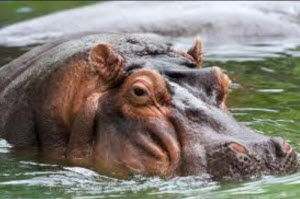
The rest of the da y was spent avoiding hippos. Behind every island and around every bend, pods of hippos lay submerged beneath the water as if waiting to ambush us as we cruised by. Hippos, although they are herbivores, kill more people than any other animal in Africa. They are very protective of their territory. Our guides had named several of these beasts. Names such as Mad Max and Psychotic Simon – it is wise to give these creatures a wide berth.
Our third day was spent drifting through Mana Pools National Park, which has an abundance of big game, including cape buffalo, lion, elephant, hippos and crocodiles, all congregating along the river banks for food and water. It is possible to glide just metres away from these animals.
I sighted what I considered to be a fantastic fishing hole and I convinced Nicki to paddle past a couple of young bull elephants protecting the fishing spot. However, their charging proved more persuasive to her than my need to fish, and gentle forward strokes changed to lightning back-strokes.
Our last night’s camp was at Peter’s number one fishing hole. He told me tales of night fishing with strips of mice and how he had hooked huge tigers that had straightened out his 9/0 hooks.
Inspired by these tales another member of our group, Ian, and I decided to drift-fish using Shad Rap lures. Every time Ian and I would cast under or behind a submerged log, WHAM! We would hook-up. These Tigers wouldn’t risk letting an easy dinner of Shad Rap get away. Their fight was equivalent to that of a 2.5kg fresh-run rainbow in a strong current in the Tongariro.
The tigers would either drop our lures or shake free when lifted into the canoe. Ian and I dropped about 30 tigers of 1-2kg between us in two hours of full-on fun. I concluded that tigers are prehistoric feeding and fighting machines genetically adapted to their environment with rock-like mouths. I realised my rod was too soft, not allowing me to set the hook.
The final day involved floating downstream through crocodile country, viewing crocodile, buffalo and elephants at close range and avoiding the ever-present hippos. The highlight of the day was the crocodile that launched itself from the bank aiming for Peter's canoe. The croc only missed by a couple of inches.
Fishing the Zambezi is far more than another fishing destination. It is an African wilderness and wildlife adventure. I recommend this destination to anyone looking for a truly wonderful fishing experience. I'll be back armed with sharper hooks and a stiffer rod.
A Blast From The Past!
|
February 1998 - by Andrew Perring |


Monday 16 November 2026
Major Bites
 -
 -
Minor Bites
 - -
Tuesday 17 November 2026
Major Bites
- - Minor Bites
- -