
Fishing in Guam
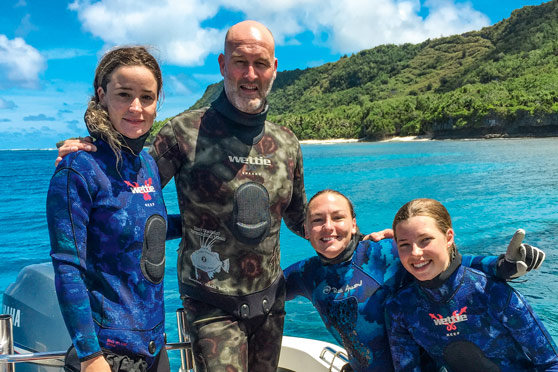
Where is Guam? It’s a question many people have asked me upon saying I’d been there recently.
To answer that question, it’s an island in the middle of the Pacific close to the Marshall Islands that’s slightly larger than Great Barrier Island. Getting there is not straightforward. It’s accessed by flying, say, to Taiwan, then flying four hours back in the direction you came, towards New Zealand.
Guam is an American air force base. In July, 1944, one of the biggest-ever gatherings of American Naval forces bombarded it solidly for two days before American troops stormed its shores to take it from the Japanese, who had occupied it since 1941. The local native people, the Chamorro, had suffered many atrocities.
I was in Guam with the NZ Spearfishing Team for the Inter-Pacific Spearfishing Champs, a yearly event that has teams from New Caledonia, Tahiti, Australia, Hawaii, Guam and New Zealand. We were the defending champions, having won it in 2016 here in New Zealand.
In these events, we generally try to arrive two weeks beforehand so we can scout the areas marked out as potential competition zones, and learn about the local fish and where they live. It turned out we were one of the first teams to get there and we made the most of that advantage.
The water temperature in Guam was around 28 degrees with visibility up to 30 metres – conditions as good as you could ask for. However, Guam is heavily fished, as there are no real rules, and pretty much anyone can sell fish. We were told it got heavily spear-fished at night by scuba divers.
Once we got into the swing of things, it was soon evident the fish were spooky and lived in two zones: very shallow or very deep. The middle ground, which is 10 to 25 metres deep, was barren and almost a waste of time diving.
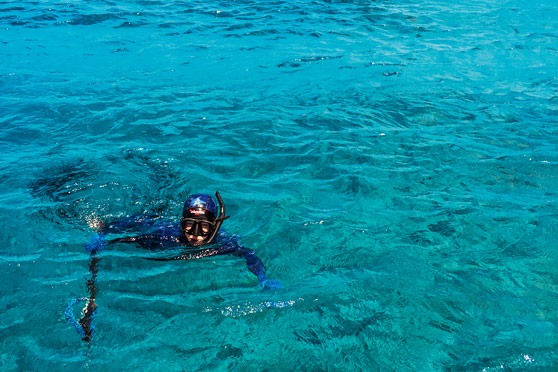
Both our men’s and women’s teams were capable of deep diving – deeper than any of the other teams in some cases. What we had to do was practice the art of spearing the types of fish here, as often they react differently to ours.
We had the use of two ex-navy boats – solidly built, as you can imagine, with twin outboards, so perfect for our needs.
Our scouting went reasonably well, with the boys pulling some great fish out of depths up to 44m. While working such depths comes with risks, we mitigated them as much as possible by spearing in pairs.
The girls worked over 30m down, and pulled one or two good fish, but found more on top of the reef in shallower water. This diving also had its challenges, because you had to be careful not to get smashed on top of jagged reefs by the swell.
A big challenge was fish identification. Each day someone saw a new species of fish, and we’d have to work out if it was on the target list. One fish shot during the competition had never been seen before by the locals. It was a member of the surgeon fish family, which is common in tropical waters.
We ate fish most days, with our favourite being baked parrot fish. However, dogtooth tuna turned out to be some of the best sashimi you will ever eat!
Many of the fish also have hidden dangers we had to watch out for, such as razor-sharp blades at the base of their tail or sneaky spines in spots you wouldn’t expect them. As I found out, they are very painful until the poison wears off. So much to learn!
We also discovered two of the five areas we had been given were pretty productive, with good fish out deeper. In one area, the coral ran out to around 25m before dropping vertically to over 45 metres.
Lying on the edge of the drop-off was really exciting: there were all sorts of fish swimming along the edge and just over the side. If you lay still for long enough, some would swim into range; others stayed over the edge, meaning we had to sneak over and down the face to try and get within range. It was great to watch the team members working down deep – this is what they train for at this level.
One of the risks free-divers face by diving to these depths is decompression sickness, or ‘the bends’ as many know it. Very few know or understand that you can get bent when snorkelling. Unfortunately, you can when diving at this level; many free-divers around the world have suffered it repeatedly and pay a heavy price as they age. We are only now beginning to understand the dangers and are putting things in place to work with them.
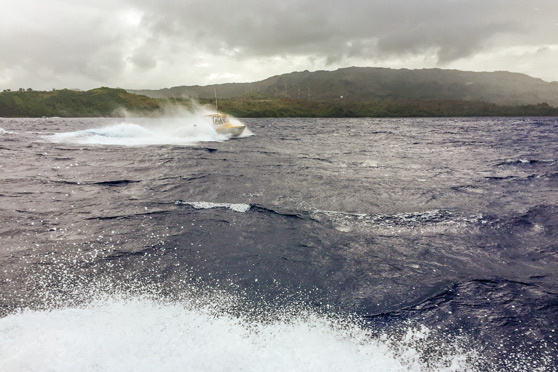
Come competition time, the weather turned foul. It was a real shame, as this meant we had to dive the rough-weather zone, which was not very exciting compared to the other areas. Consequently, most of the teams had explored this area the least!
Over the two days our men’s team was truly amazing, pulling in a great catch to beat New Caledonia and Guam, who dive coral all year round, and putting them second behind the Tahitian team. This was a very special feat, showing we have some of the very best divers in the Pacific.
Our ladies team worked really hard to take out third place behind the Aussies, second, and the leading Tahitian team. Again, a good effort, as our youngest member only turned 16 while Guam. She will be a real force to be reckoned with in the future! Next year it’s Hawaii – and already we’re looking forward to it!
|
|
This article is reproduced with permission of |


Friday 23 October 2026
Major Bites
 - -
- - Minor Bites
 - -
- - Saturday 24 October 2026
Major Bites
 - -
- - Minor Bites
- - 