Destination: Iceland
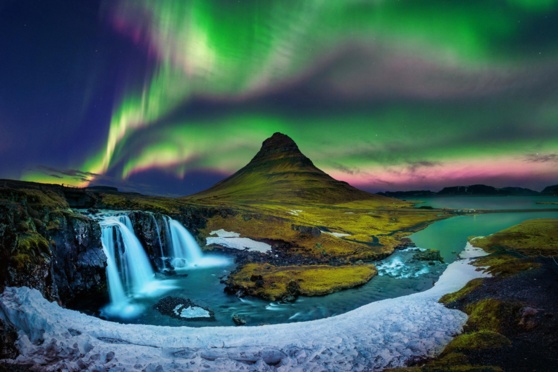
I pinched myself with the thought of seven days in Iceland, the land of fire and ice, catching large fish under the magical aurora borealis. I had one nagging question though: would Iceland deliver on my dream to catch quality brown trout (Salmo trutta)? It’s a pertinent question on any fishing trip, but especially so when travelling to the other side of the globe.
Coming off the back of guiding and fishing for trout in the central North Island, I counted myself fortunate for the call-up to share this journey with good Slovak friends Jozef and Michal – both excellent anglers with experience fishing in Iceland for large sea trout. Nothing is gained without mustering the courage to put your hand up for new adventures, and I knew this could potentially be the fly fishing trip of a lifetime.
The trip
After a gruelling flight to Europe from Auckland, I began my adventure in the Liptovský Hrádok province of Slovakia. I was delighted to catch up with friends I'd made competing in previous world fly fishing championships as a New Zealand representative. It was super fun using lightweight equipment (10-foot-plus, 2-3 weight rods) to catch trout (brook, rainbow, and brown), grayling, and hucho hucho (Danube salmon), although at that stage I did not fully comprehend the size of the fish that might lie ahead in Iceland.
After adjusting to the time difference a week later, three of us set off driving to Poland, before flying five hours from Kraków to Reykjavík, the capital city of Iceland. In anticipation of my trip, I spent hours researching the high-latitude conditions of Iceland and watching YouTube clips of extreme weather and anglers throwing casts into head winds. All my assumptions came true as we were greeted by the blast of cold subpolar oceanic winds at the airport terminal. We all had mixed emotions with anticipation for the week ahead as we settled into our B&B that night. For reassurance, I rechecked my tackle, Gore-Tex clothing, and my warmest New Zealand possum and merino woollies.
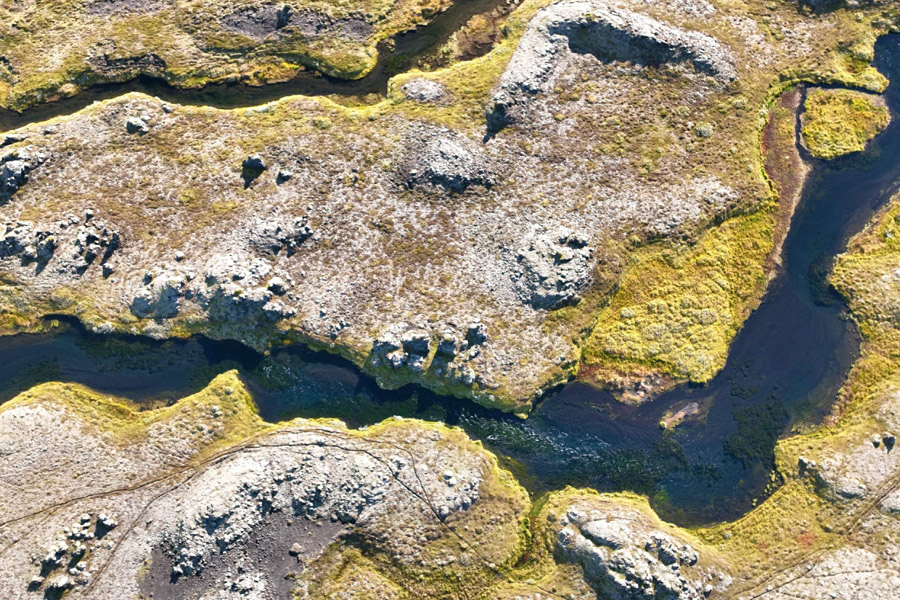 With a backdrop of mountains and glaciers, Iceland boasts a wealth of rivers.
Morning came quickly and, in stark contrast to the night before, we were greeted by warm sun, clear blue skies, and superb Icelandic vistas. The notable change from the lush greenery of New Zealand was the rocky lava field landscape, void of trees. Previously settled by Vikings, this isolated Nordic island offers diverse and wild landscapes, attracting many tourists each year, including fly fishers.
We set off southeast from Reykjavík to the Skaftafell region, stopping on the way at one of the many magnificent waterfalls – Seljalandsfoss – where you can walk behind the 200-foot, volcanic glacier-fed wonder. We drove along the highway with a distant view of the large glacier Vatnajokull, Europe's largest glacier covering more than 8% of Iceland. So much of Iceland consists of steep highlands and table mountains, supported by the backdrop of glaciers. Iceland has over 55 rivers, some fed by these glaciers. As the water flows from the highlands to the sea, it is naturally filtered, and it is no surprise this climate supports healthy trout, salmon, and char.
Fishing begins
For the first part of our trip, we stayed in quaint, bungalow-style accommodation backing onto a picturesque lowland lake called Víkurflóð, close to the rivers near Kirkjubæjarklaustur. On arrival, we were greeted by the local border collie (we hoped he would lead us to the best spots on the lake, but found he got jumpy with every cast). The lake was calm with little wind and mirrored the magical sky, all augmented by the backdrop of Vatnajokull. Michal and I covered the likely margins of the lake, casting damsel imitation streamers. After catching a few nice-sized brown trout (around 2-3lb), we had hope for larger fish in the days ahead on the rivers.
For the next few days, Jozef organised private access to target one of the remote spots that was a feeder river running from the main river system near Skaftárhreppur. Large mounds of volcanic lava surrounded us as we drove our 4x4 across a few bumpy tracks to our destination. The target this time were large sea-run brown trout, otherwise known as sea trout. Sea trout spend part of their life in the ocean and part of it in fresh water. In the past, these fish have been treated as a catch-and-kill species, with other countries seeing a steady population decline. In Iceland, with the support of the angling community practising catch and release, these sea-run brown trout have endured well, forming arguably one of the best sea trout fisheries in the world.
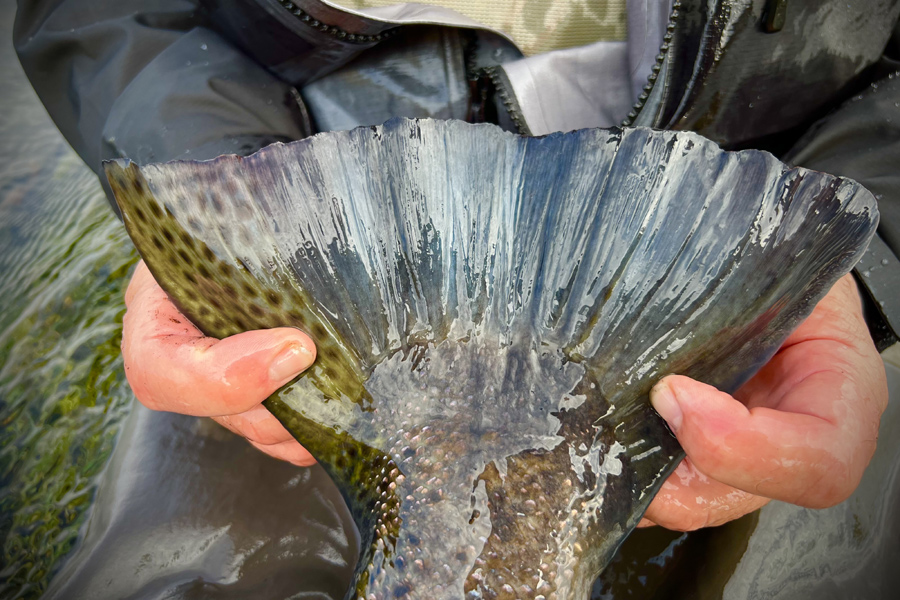 Iceland’s sea-run fish are clearly equipped for the ocean with enormous, paddle-like tails.
Alongside sea-run browns, Iceland is home to ‘ice age’ brown trout, believed to have been landlocked at the end of the last ice age some 10,000 years ago, when the ice melted away. As we fished our chosen stretch of water, we found a few concentrated places with fish of spectacular size. We exchanged duties, from net boy to angler extraordinaire, in great excitement between each of our fish caught, and we landed some large sea-run browns and brown trout around the 15-20lb mark. We also shared each other’s anguish with a few that got away.
Sea trout tactics
Fish settled in a few deeper pools among submerged lava rock and sandy bottoms, making visible shadows swaying back and forth amongst the weeds in the cold, clear water.
The most effective tackle proved to be 9’, 7-weight fly rods, helping play fish away from the razor-sharp underwater lava rock in the fast-moving current. Both sink tips and straight sinking lines were needed to get to the required depth quickly, and we found short, sharp pulls attracted grabs sometimes, while mixing it up with slow draws, and hanging mid-current worked at other times. We used cone-headed ‘meat’ flies, such as sex dungeons and large marabou streamers.
Sometimes we revolved flies to keep the takes fresh or give the impression we knew what the fish were going to eat. Largely, the ocean-going fish would eat small bait fish. There was a need for a finger guard, as a positive grab during a line strip meant holding line securely because of the size of the fish. The makeup of the water creatures in Iceland was primarily chironomids, scuds, caddis, char, and stickleback – one of the few vertebrate species endemic to Iceland.
We were all equipped with various patterns to try. Our river held both sea-run and ‘original’ browns. Holding the sea-run fish was something else, as you had to stretch your grip around their enormous, paddle-like tails – these fish were clearly equipped for the ocean. A few fish we landed were just under one metre long, unbelievable in size and muscle mass. The sea-run browns had a majestic look, ‘painted’ from head to tail in hues of pearly, steel blue like I’ve never seen before, matched with cobalt blue fins. A few fish hooked demonstrated acrobatics, jumping out of the river and landing with a powerful and angry thud, throwing water skywards.
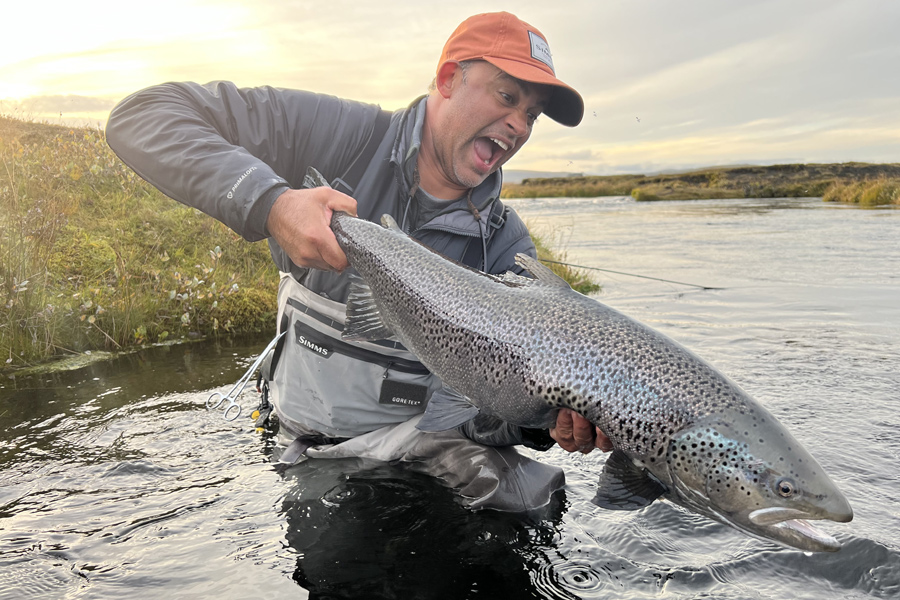 Rob with a solid Icelandic sea trout. Note the pearly, steel blue hues.
After each fish was landed and released carefully, it was good practice to check our hooks and leaders for abrasions. As the sun went down after each day, we gladly celebrated our catches and memories with an evening Scotch.
New waters
After a few days catching fish one can only dream about, our minds moved to fishing new waters. We travelled to the Selfoss region, where houses sit at the feet of hills and geothermal energy is harnessed. Our beat was surreal as we fished next to a golf course with surrounding steaming geysers. The stream held sea trout and brown trout. Due to the small size of the water, I used lighter setups, and the plan was to spot fishy water quickly as we had paid for access to fish for only a limited time. Three of us spread out and covered different sections of the stream. The water had a milky, snow-melt look to it and visibility was limited. Small brown trout were easy to catch using silver beaded Euro nymphs tied on size 14 jig hooks. Alternatively, I tied up some traditional midge patterns. One was called a Krokurinn, which is a bit of a go-to in Iceland, and it worked well.
After fishing upstream thoroughly and pulling some nice-looking small fish, I hit a small feeder creek emptying into a run with my relatively light tippet. Bang! I hooked an aggressive and large sea trout that took off. Unexpectedly, this small water held some monsters like what we were accustomed to days earlier. We spent a few more days exploring the same stream and caught some beautiful-looking fish. Michal and I nymphed up one section that looked like a volcanic playground, both catching a few lovely, golden-looking browns marked with spots from head to tail. We both sight-fished for these fish that stood out as they weaved their way upstream amongst the light green weed. Other beats consisted of fishing beneath small, picturesque waterfalls, and walking downstream alongside a local reserve looking for likely fish-holding water.
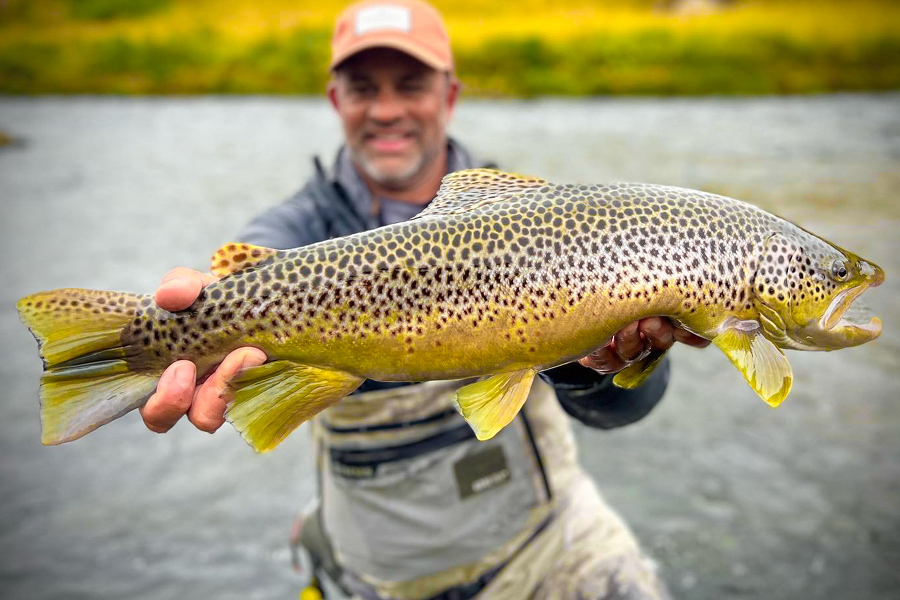 On the final day, Rob targeted a small rising brown with an elk hair caddis dry with success on one of the many tussock-lined lowland lakes. This lake is dubbed the Banana Lake because the brown trout are yellow in colour, like bananas.
On our final day we fished one of the many tussock-lined lowland lakes. Jozef called this lake the Banana Lake because the brown trout were yellow in colour, like bananas. Equipped with dry flies, midge, and damsel patterns, we fished the glassy, still lake. The feeling as we cast out floating lines was that these fish had seen it all before. I targeted a small rising brown with an elk hair caddis dry with success, but the rest of the time we covered the lake throwing all our fly patterns for no response. During lunch, Jozef launched his drone for an inspection, only to spot a good-sized ‘banana’ trout sitting well out of casting distance in the middle of the lake. Well, that figures!
Unfortunately, Atlantic salmon were not in season for our visit, and by all accounts this is a bit on the extravagant side of the budget. I did hear the salmon entered the rivers not feeding naturally, and strategies used included skating tube flies for an induced take. Additionally, I was excited about the idea of the beautiful-looking Arctic char; however, time limited the possibilities.
Final word
All in all, Iceland was a fantastic experience and the fly fishing, scenery, and the privilege of seeing the Northern Lights made the journey well worth it. Fisheries are largely private waters, with tour operators like Fish Partner supporting a number of guides. The two seasons for sea trout are April/May when fish return to sea, or August/October when fish move into the rivers to spawn. Be prepared for all weather conditions and don’t underestimate your own fly patterns – they will work.
The country is well worth exploring, English is widely spoken, and the people are friendly. It can be an expensive country to visit because of its isolation, reliance on imported goods, and import tax. Fresh supermarket produce can be limited – we survived on a diet of lamb meatballs and potatoes whilst avoiding the local dishes like fermented shark (hákarl).
Overall, when you mix a trip with superb scenery, a new culture, and good friends, the icing on the cake is to catch these magnificent fish and realise how grateful you are to be a fly fisher.
- Words and Images by Rob Vaz


Monday 14 September 2026
Major Bites
 - -
- - Minor Bites
 -
-  -
- Tuesday 15 September 2026
Major Bites
- - Minor Bites
-  -
-