
Why gamefish tagging is so important
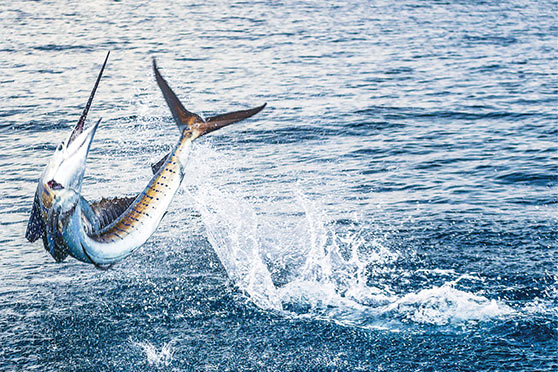
In gamefishing circles, the tagging of fish is a common subject for discussion. New Zealand Fishing News put a few frequently asked questions to John Holdsworth, a scientist with Bluewater Marine Research, who manages the tagging programme…
What is the significance of the conventional tagging programme, given so few tags are returned?
The detailed information recorded on tag cards is used to help describe important recreational fisheries for billfish, pelagic sharks and kingfish.

A marlin with a satellite tag, programmed to pop off after a set period. When it floats to the surface, it releases its information to researchers.
Landed catch alone provides a less complete and probably biased record of what is caught. Over 95% of data on pelagic sharks comes from gamefish tag cards each year and over 50% of striped marlin catch information. Many fishers feel better about releasing trophy-sized kingfish if they can record their capture through the tagging programme.
Recapture information is also useful for species where enough fish are tagged per year to provide a reasonable number of recaptures. There have been about 100 New Zealand-tagged striped marlin recaptured, all around the SW Pacific, but not beyond, with seven recaptures in 2016 alone.
Tagging has shown that kingfish can cross the Tasman, but most adult fish around offshore islands are resident. We are still looking for the connection between small inshore kingfish and offshore habitats.
Should we concentrate on funding just a handful of satellite tags each year since the information they produce is surely far more valuable than a conventional tag return?
There have been a number of successful satellite-tagging projects on billfish, sharks and tuna in New Zealand. They provide details of depth and temperature preferences, often with detailed movement, but they have their limitations. Large tags are hard to keep on the fish and many tracks are short-term due to early detatchment.
They are expensive to buy and retrieving data from satellites is costly. They are also not suitable for smaller fish. To get statistically valid results, a minimum of six tags a year are need per species. They will continue to be used in one-off programmes with specific objectives, until the size and cost of tags comes way down.
Overseas, a ‘caught’ fish is one where the crew or angler has their hand on the trace/leader, but in most NZ competitions it is only a ‘caught’ fish when the tag goes in and is photographed. Why the difference?
When prizes are involved there needs to be evidence of capture. The trend in New Zealand is to require a photo of the fish with the tag in it. Some of the overseas competitions have a dedicated observer on board to verify capture. This is not practical or needed in New Zealand competitions.
Can you give us a brief history of tagging in NZ and its importance in maintaining billfish as a recreational species?
The early 1980s saw a rapid drop-off in marlin catches and the then-New Zealand Big Game Fishing Council became more active in management and conservation of their target fish. This led to a government moratorium on commercial fishers taking billfish, which now stands as a permanent regulation.
The successful introduction of a commercial ban on taking marlin required the council to introduce and promote tagging and releasing marlin and sharks with a target of at least 50% release by our anglers.
Tagging supported conservation and provided valuable research data about the fish themselves, about which much is still conjecture. This tagging programme was extended and now includes kingfish and very recently tunas. Council representatives frequently attend working groups on fisheries management and make numerous government submissions during the year in support of our members’ wishes to enhance their fishing.
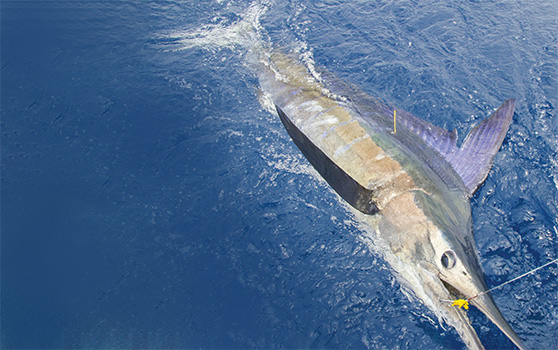
If this marlin is recaptured and the tag recovered, it will provide vital information about its movements.
The council also saw a need for more targeted research to assist and justify its claims to Government around our more sought-after fish. While lobbying Government for new and continuing fisheries research is ongoing, specific studies that will have the most benefit to us are unlikely to be funded by the crown. To undertake these studies, Council formed the NZ Marine Research Foundation.
Officially launched in 1999, the NZMRF has financed some very noteworthy projects for kingfish and striped marlin, which are, in its opinion, the two most important fish to gamefishing in New Zealand.
Is tagging fish conventionally still practised overseas?
In the counties that have been tagging for a long time it is still practised, but some fisheries just release fish. It is often up to individual skippers’ and/or boat owners’ personal philosophies as to whether fish on their boats are tagged or simply released.
|
|
This article is reproduced with permission of |

Recent Forum Posts Visit Forum

Trailer wheel clamp
in The Boat Shed1 hour ago
krow
I like the SAS wheel clamp. I've had no issues with the lock....

Shane Jones
in Fisheries Management4 hours ago
Fish Addict
The recreational sector can expect no favours from politicians. They know all too well who butters their bread and it ain't the recs. No different over...

Foton tunland v9
in The Briny Bar4 hours ago
Ho Dee
not fishing related and delete if required but was wondering if any has one of these or someone who has just wanting so e real world...

Bluefin Tuna at the cavs.
in The Briny Bar51 hours ago
smudge
Despite my years of fishing I haven't really fished many places, my focus has always been on Auckland's west coast and out toward Great Barrier. I...
Casting gloves
in Popper and Topwater Fishing96 hours ago
Mc Tool
100 bucks for a lure 😬. Watching one of them flying over the horizon without the line attached would be " character building " for sure...
I thought Id post some nice photo's , join...
in The Briny Bar147 hours ago
Alan L
That is a very cool pic Krow.The Far North is very cool, the Far far North even cooler. Mint looking day.Alan...

Mc Tools berley mincer
in The Briny Bar154 hours ago
SaltyC
Good size, they scrap well. Got an 18kg one up in Vava'u back a few years ago fishing off squeaky Going's boat. That was quite a...

Out with the "Twelves"
in Fishing Reports208 hours ago
Pcj
I should be able to get out end of October. The nephew been out virtually every weekend over winter and has done well. It seems the...
Manukau Harbour & West Coast fishing
in Fishing Reports216 hours ago
smudge
Nice work Schecter, I think snapper may be around sooner than you think. Well I am hoping so...
Whangarei Harbour report.
in Fishing Reports648 hours ago
krow
180 +m is where I've had to be lately. A lot less low foul around these parts and some of it shallower that looks like Tarakihi...
Popular Articles

Softbait Fishing - Part 1 - gear selection
John Eichlesheim writes an article about selecting the right equipment for softbait fishing... Read More >
Softbait fishing Pt 2 - tips and tricks
Techniques, tips and tricks of softbait fishing – getting the most from your soft baits.... Read More >

Surfcasting - setting yourself up
Gary Kemsley helps sort out the necessary gear for intending surf fishers.... Read More >

Squid - How to catch them
Squid fishing is a rapidly growing aspect of fishing - Paul Senior shares some hints and tips to get started.... Read More >
Fishing Reports Visit Reports
Outer Hauraki Gulf Fishing Report 17/09/26
Spring wind the handbrake. Spring is starting to make its presence felt in the outer... Read More >
Top of the South Fishing Report - 17/09/26
Early snapper in Tasman Bay. Well, spring is finally here, and the days are getting... Read More >
Bream Bay Fishing Report - 17/09/26
Good snapper catches reported. After Tangaroa turned off the fish tap for a month or... Read More >
Bay of Islands Fishing Report - 17/09/26
Pacific bluefin tuna for the lucky few. The last fortnight has seen more fishable days... Read More >
Comments