
Whitebait Secrets

Hearing of some interesting research being carried out in a north Auckland town, Sam Mossman wandered down to the facility with camera and pen to check it out.
The Mahurangi Technical Institute was initially focused on aquaculture and maritime training, running its first course back in 1989. Director Paul Decker grew up on a farm in Queensland, and it soon became clear where his interests lay. By the time he was 10 years old he was stocking the farm ponds on the property with native fish. Aquaculture became a lifelong obsession which has taken him to many parts of the world, ending up in New Zealand.
Over 30 years ago, Paul Decker started the Mahurangi Technical Institute based at Warkworth, a small town about an hour’s drive north of Auckland. In 2013, he was granted a Winston Churchill fellowship to visit the UK’s leading freshwater hatcheries to learn techniques for the captive production of rare freshwater fish and their preparation for release into conservation restoration projects.
Much of the Mahurangi Technical Institute was incorporated into the New Zealand Maritime School at Auckland’s Manukau Polytechnic in 2011 and the fish research and aquaculture aspects moved into the control of an iwi consortium. It is now referred to as Premier Marine Technology or Manaki Whitebait. The institute’s research on whitebait has turned up some fascinating findings that have dispelled many previously widely held misconceptions.

The institute's research on whitebait has turned up some fascinating findings.
The original aim of this research into whitebait was tied to rebuilding native fish populations in degraded streams which had been restored to health, and the mitigation of damage caused by construction programs. The first contract was for stream protection and restoration connected with the Johnson Tunnel construction near Puhoi, north of Auckland.
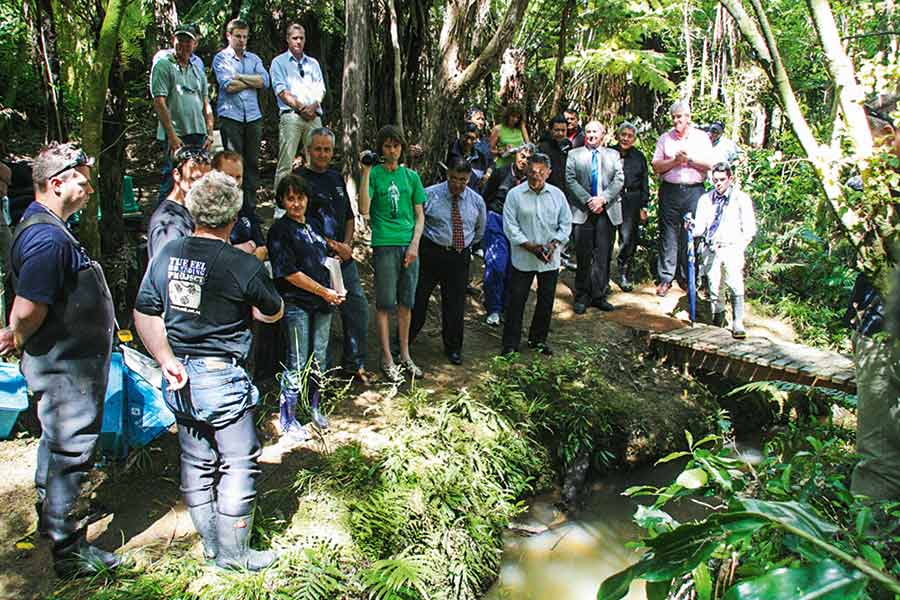
The original aim of this research was tied to rebuilding native fish populations in degraded streams.
NZ whitebait are the juveniles of five species of the Galaxiid family. Galaxiids are confined to the southern hemisphere and were named for the supposed similarity of their speckled bodies to a galaxy of stars. There are about 26 species internationally, although only five are migratory. They are considered one of the most geographically widely distributed freshwater fish on our planet
The species’ juveniles that make up what we consider to be whitebait are: inanga, koaro, banded kokopu, giant kokopu and shortjaw kokopu. Of these, inanga, okaro and banded kokopu make up the bulk of the whitebait catch with inanga being the most common. Inanga and giant kokopu prefer lowland marshes and sluggish waters while koaro, banded kokopu and shortjaw kokopu prefer forest streams and higher altitudes. This spreads the species over a number of different habitats.
Before you can breed any type of fish you need to know a lot about their lifecycles and biology. In the case of our galaxiids, the adults spawn up the rivers and estuaries, and their eggs hatch and drift out to sea. The larval fish form schools and travel the coastal waters living on zooplankton until the time comes for them to re-enter freshwater to complete the lifecycle to adults.
Home away from home
All that many Kiwis know about whitebait is: add to beaten egg, sizzle, crunch, yum. But there is much more to it than this. For example, whitebait do not ‘home’ on the freshwater habitats where they were hatched, as many think. Nor do they enter just any old freshwater they detect while cruising along the coastline. They are, in fact, very sensitive to the pheromones released by other members of their species and will only enter fresh water where they detect them. Makes sense – if there is already a population of their species present, then it must be a decent habitat for them and a good place to settle down. This behaviour keeps the genetics of the stock well mixed, too.
The flipside, though, affects stream restoration projects. It doesn’t matter how pristine a restored waterway may become; unless there are the appropriate native fish in the stream releasing their ‘smell’ into the water, wild populations will never re-establish themselves as they are not attracted to habitat there.
So, it turns out that it is necessary to be able to breed galaxiids in captivity to produce the numbers of these fish required to kick-start the reestablishment of wild populations. The first restocking with fish bred at the Institute was in 2009 in a stream near Orewa, north of Auckland.
Old wives’ tales
Paul told me that their research had proven that it was a myth that galaxiids only spawn in stream-side grass and the eggs will only hatch during the next spring tides a month later. Spawning can happen this way, but with only about a 5% success rate, as sun-exposed galaxiid spawn are easily killed by UV light.
“They can spawn in salt water too, but our best results – about 95% egg survival – are in plain old fresh water”, Paul said. “The eggs are very sticky – covered in ‘nature’s superglue’ – and secrete this sticky substance for about five days. This will anchor the eggs to anything they touch and prevents them from being washed out to sea. The highest hatching and survival rates are at 24 days after being laid, but again, there is some variation.
“They live off their yoke sacs for three days after hatching while they float down to the marine environment. After that they live on zooplankton.”
Down on the farm
Alongside the restoration work, a ten-year study has been looking at the commercial aspects of whitebait farming. As well as establishing a new business, if successful, whitebait farming can take some pressure off the wild stocks.
The institute has successfully bred all five species of NZ galaxiids in captivity and continues to do so for restoration projects, but it is the giant kokopu that has proved most interesting from a commercial perspective. This species can reach half a metre in length, several kilos in weight, and live for up to 30 years. While the more common inanga spawn once and die, giant kokopu spawn once a year and survive, so can be developed into captive breeding stock that supply eggs every year. Starting with a stock of 50 wild fish and applying controls on spawning time like temperature and light, the institute has spread the spawning season of their breeding stock of giants right out and now has 50,000 breeding giant kokopu that spawn at all times of the year, and so can provide a steady and constant supply of whitebait.

By applying controls on spawning time like temperature and light, the institute has spread the spawning season of their breeding stock.
Another attraction of giant kokopu as a commercial species is that they have a much better food conversion factor (to whitebait stage) than the other species. As the research is approaching completion, the institute breeding program is approaching 1:1 – a kilo of fish produced for every kilo of fish food expended. This is pretty much the holy grail of aquaculture.
The farmed fish seem to thrive on a mix of ground shrimp and prawn shells (waste from supermarkets and prawn farms) and mealworm larvae. The adults eat these ingredients made into fish pellets.
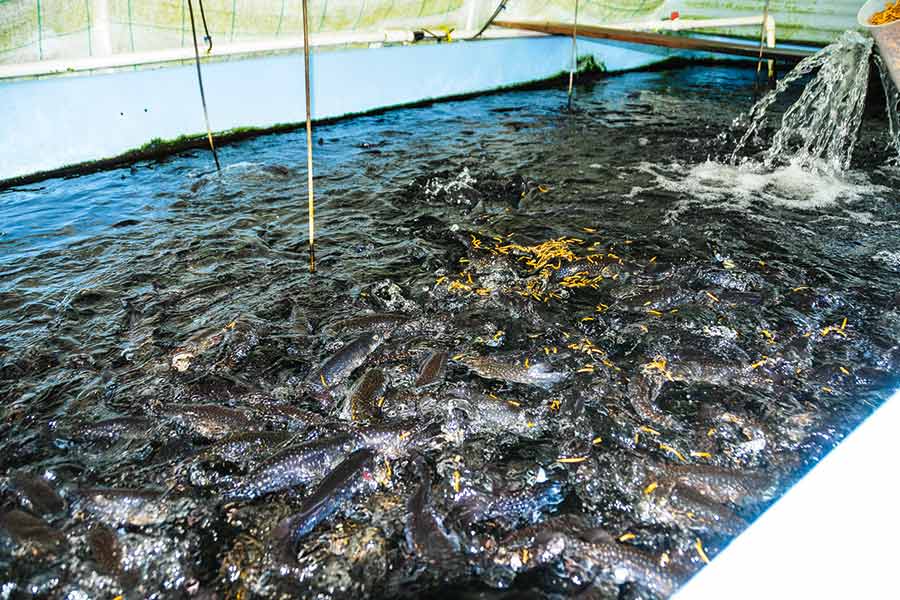
Feeding time for the adult giant kokopu.
The larval fish are apparently very good climbers (except for inanga) and there were initial problems with them climbing out of their tanks and ending up on the floor. That was until one of the staff noticed that they would not climb over black plumbing fittings for some reason. Maybe this colour creates a thermal barrier? The jury is still out, but the addition of a back stripe around the top of the tanks has certainly kept the larval fish in their tanks. This colour aversion could have important applications to the design of fish passes and fish ladders in rivers.
Chill out
Before you can eat ‘em, there is the necessity of killing the whitebait. As in some other types of aquaculture, dropping them in an ice slurry proved quick and effective, and was also the beginnings of an unbroken ‘cold chain’ from live fish to the restaurant. In a freshwater ice-slurry the result was good, but expert chefs thought the taste was a little ‘fishy’. The institute tried a saltwater slurry (without telling the chefs) and the result was,“We don’t know what you have done, but we will pay double if you can get them all to taste like that!”
This is interesting as it may have a bearing on the way wild whitebait taste. Do the ones netted from river mouths (essentially from saltwater) taste better than the ones netted further up the rivers in freshwater?
The future of whitebait farming
Our galaxiids are one of the few new species in freshwater aquaculture and have a three-month cycle from spawning to harvest. With the spawning timing now spread throughout the year, a continuous (weekly) harvest can be produced so there is a steady supply for the commercial market.
The process developed has many advantages. The cycle is organic with no chemicals or antibiotics involved and the whole fish is consumed, so there is no processing and little waste material (what there is is easily processed). The water used can be recycled and produces about 100kg of whitebait per cubic metre per year.
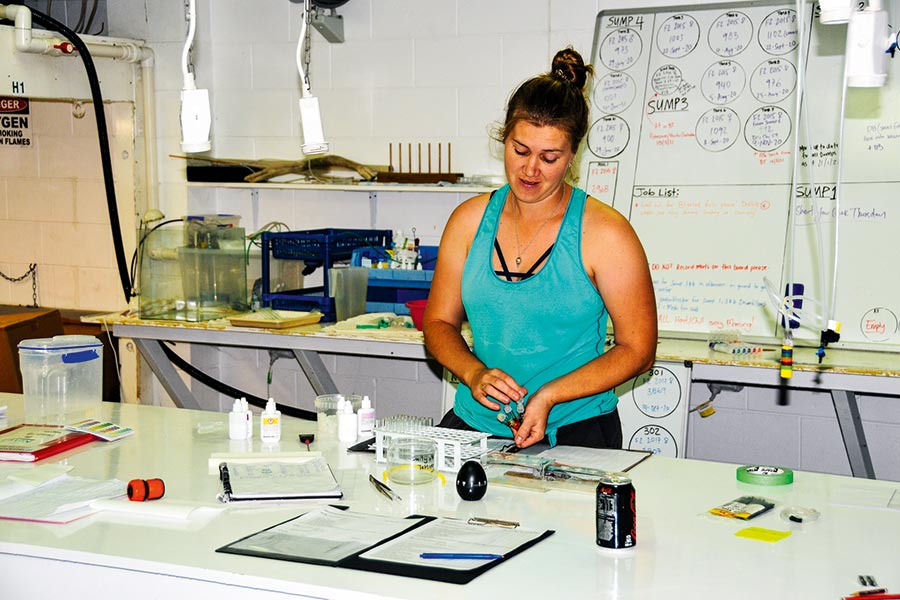
Manaki Whitebait employs a dozen staff at the moment and have not started serious commercial production yet.
With the research side of it pretty-much finished, the market testing is underway. The institute has produced over two tonnes of whitebait in the process of development and over the next 12 months will be scaling up their production facility to be able to produce commercial quantities. In round figures, whitebait are worth about $100 per kilo. Manaki Whitebait employ a dozen staff at the moment and have not started serious commercial production yet, so there is the potential for worthwhile rural employment throughout the country. Demand is high and the economics look good. I would say that the future of whitebait farming looks bright.

June 2021 - Sam Mossman
New Zealand Fishing News Magazine.
Copyright: NZ Fishing Media Ltd.
Re-publishing elsewhere is prohibited
Recent Forum Posts Visit Forum

Trailer wheel clamp
in The Boat Shed49 minutes ago
krow
I like the SAS wheel clamp. I've had no issues with the lock....

Shane Jones
in Fisheries Management3 hours ago
Fish Addict
The recreational sector can expect no favours from politicians. They know all too well who butters their bread and it ain't the recs. No different over...

Foton tunland v9
in The Briny Bar3 hours ago
Ho Dee
not fishing related and delete if required but was wondering if any has one of these or someone who has just wanting so e real world...

Bluefin Tuna at the cavs.
in The Briny Bar50 hours ago
smudge
Despite my years of fishing I haven't really fished many places, my focus has always been on Auckland's west coast and out toward Great Barrier. I...
Casting gloves
in Popper and Topwater Fishing95 hours ago
Mc Tool
100 bucks for a lure 😬. Watching one of them flying over the horizon without the line attached would be " character building " for sure...
I thought Id post some nice photo's , join...
in The Briny Bar146 hours ago
Alan L
That is a very cool pic Krow.The Far North is very cool, the Far far North even cooler. Mint looking day.Alan...

Mc Tools berley mincer
in The Briny Bar153 hours ago
SaltyC
Good size, they scrap well. Got an 18kg one up in Vava'u back a few years ago fishing off squeaky Going's boat. That was quite a...

Out with the "Twelves"
in Fishing Reports207 hours ago
Pcj
I should be able to get out end of October. The nephew been out virtually every weekend over winter and has done well. It seems the...
Manukau Harbour & West Coast fishing
in Fishing Reports215 hours ago
smudge
Nice work Schecter, I think snapper may be around sooner than you think. Well I am hoping so...
Whangarei Harbour report.
in Fishing Reports647 hours ago
krow
180 +m is where I've had to be lately. A lot less low foul around these parts and some of it shallower that looks like Tarakihi...
Popular Articles

Softbait Fishing - Part 1 - gear selection
John Eichlesheim writes an article about selecting the right equipment for softbait fishing... Read More >
Softbait fishing Pt 2 - tips and tricks
Techniques, tips and tricks of softbait fishing – getting the most from your soft baits.... Read More >

Surfcasting - setting yourself up
Gary Kemsley helps sort out the necessary gear for intending surf fishers.... Read More >

Squid - How to catch them
Squid fishing is a rapidly growing aspect of fishing - Paul Senior shares some hints and tips to get started.... Read More >
Fishing Reports Visit Reports
Outer Hauraki Gulf Fishing Report 17/09/26
Spring wind the handbrake. Spring is starting to make its presence felt in the outer... Read More >
Top of the South Fishing Report - 17/09/26
Early snapper in Tasman Bay. Well, spring is finally here, and the days are getting... Read More >
Bream Bay Fishing Report - 17/09/26
Good snapper catches reported. After Tangaroa turned off the fish tap for a month or... Read More >
Bay of Islands Fishing Report - 17/09/26
Pacific bluefin tuna for the lucky few. The last fortnight has seen more fishable days... Read More >
Comments