
Using Large Saltwater Flies to Catch Big Snapper
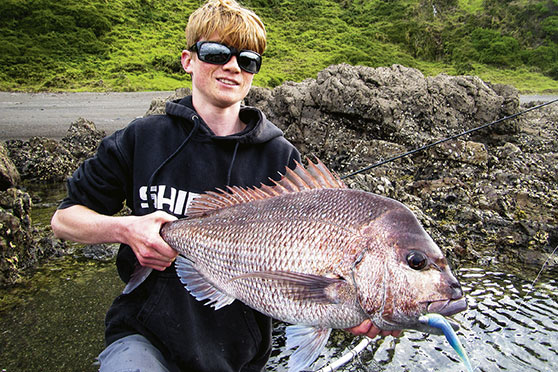
The fact that snapper will eat big lures – sometimes even very big lures – is widely understood by a lot of people. This wasn’t always the case. Indeed, throwing seven inch or even ten inch artificials around in the hope of catching twelve- to twenty-inch fish would have been considered slightly bonkers once upon a time. Craig Worthington considers whether bigger really is better…
I was one of those who took a long time to acknowledge this fact. As a habitual fly fisher my basic instincts were dominated by thoughts of small flies and ‘matching the hatch’. As a result, I favoured small flies in my formative years as a saltwater fly fisher.
The only trouble was, in those early days I never caught big snapper. I could catch any number of small snapper up to thirty centimetres in length, but bigger fish continually eluded me. It was not until I progressively started using bigger and bigger flies that I started catching bigger and bigger snapper. Now my biggest snapper flies are getting up to a size where they can be difficult to cast.
The soft-plastics boom of recent years has only served to reinforce this “bigger is better” idea. Some of the soft-plastics used successfully on snapper these days are in fact so large that I have to now question whether my largest flies are indeed large enough. Placing my largest flies beside some of these monster soft-plastics makes them seem very small indeed. I am starting to think I should be using flies so big that they go beyond the “too big to cast” boundary.

Some of Craig's snapper flies are truly large, but the success of big soft-baits on snapper suggests that they could be even larger.
Certainly, there is no question that any snapper over 30cm could eat a massively big fly if they wanted to. The dentistry that snapper carry in their mouths is fully capable of crunching down on just about anything. They are a biting and chewing species that are unlikely to ever choke on their food. They are not a ‘swallower’ and are not put off by large food items. If they want to they can have an exploratory chew on just about anything.
A friend of mine who was diving at the Poor Knights told me about accidentally disturbing a large pink maomao that had been asleep in a crack on a ledge. The fish awoke in a startled state and was immediately pounced upon by a horde of snapper. The unfortunate pink maomao disappeared in a cloud of pink scales and maomao blood. Snapper of all sizes that had been quietly cruising around mere moments before were now ferocious killers ripping and tearing that hapless pink maomao to pieces right in front of my diver friend’s face. Needless to say he quietly left the area before the local bronzies got in on the act.
It was a good example of how snapper can become absolute monstrous killers at a moment’s notice and that any fish in distress is fair game. Snapper effectively are the piranhas of the New Zealand seas. The size of the prey does not matter to snapper and, to this end, it would seem that the size of your lure or fly does not matter either.
What I am struggling to answer is whether the benefits of increasing my snapper fly sizes even more will out-weigh the negative aspects of trying to move such a large fly through the air? Do larger lures truly catch more fish than smaller lures? Is lure/fly size a significant strike producing factor in itself?
The ongoing success of big soft-baits on snapper of all sizes would suggest that this is the case. Bigger does indeed seem to be better.
Lessons from overseas
The same sort of thought processes and questions have been going on with fly fishers overseas who fish for species that show preferences for large bodied lures. These fly fishers have started making large flies that combine bulk with a strong and lightweight construction. They are flies that emulate the action seen in large hard-body and soft-bait lures while still being light enough to cast with a fly rod.
One fly of this type has been named the “Game-Changer”. It is a long, fish-shaped fly with a bulky body that has a tail wiggle probably better than any soft-bait you’ll ever see. Across the Tasman it has been scoring significant catches on species like murray cod, mulloway and barramundi – all large mouthed fish that have a preference for eating large prey. The in-roads this fly has been making into traditional lure fisheries has been quite revolutionary.
It has really rammed home the fact that, for some species, size really does matter.
|
|
This article is reproduced with permission of |

Recent Forum Posts Visit Forum

Shane Jones
in Fisheries Management16 hours ago
Tzer
Far cry to the twats at Liegasea/NZSFC were proposing of 5 Tarakihi person in their submission for the central management area and this is what our...

Bluefin Tuna at the cavs.
in The Briny Bar36 hours ago
smudge
Despite my years of fishing I haven't really fished many places, my focus has always been on Auckland's west coast and out toward Great Barrier. I...

Casting gloves
in Popper and Topwater Fishing81 hours ago
Mc Tool
100 bucks for a lure 😬. Watching one of them flying over the horizon without the line attached would be " character building " for sure...
I thought Id post some nice photo's , join...
in The Briny Bar132 hours ago
Alan L
That is a very cool pic Krow.The Far North is very cool, the Far far North even cooler. Mint looking day.Alan...

Mc Tools berley mincer
in The Briny Bar139 hours ago
SaltyC
Good size, they scrap well. Got an 18kg one up in Vava'u back a few years ago fishing off squeaky Going's boat. That was quite a...

Out with the "Twelves"
in Fishing Reports193 hours ago
Pcj
I should be able to get out end of October. The nephew been out virtually every weekend over winter and has done well. It seems the...
Manukau Harbour & West Coast fishing
in Fishing Reports201 hours ago
smudge
Nice work Schecter, I think snapper may be around sooner than you think. Well I am hoping so...

Whangarei Harbour report.
in Fishing Reports633 hours ago
krow
180 +m is where I've had to be lately. A lot less low foul around these parts and some of it shallower that looks like Tarakihi...
Whangarei Harbour Scallops
in Fisheries Management743 hours ago
Pcj
Reopening WhangÄ쳌rei Harbour to recreational scallop fishingTÄ“nÄ쳌 koeFisheries New Zealand is seeking feedback from tangata whenua, stakeholders, and the public on whether WhangÄ쳌rei Harbour should be...
SNA1 Recc fishing cops the blame.
in Fisheries Management839 hours ago
Tzer
What Liegasea won’t tell you is that some of their own fisheries contractors were co-authors of this study for fear of being called hypocrites, one of...
Popular Articles

Softbait Fishing - Part 1 - gear selection
John Eichlesheim writes an article about selecting the right equipment for softbait fishing... Read More >
Softbait fishing Pt 2 - tips and tricks
Techniques, tips and tricks of softbait fishing – getting the most from your soft baits.... Read More >

Surfcasting - setting yourself up
Gary Kemsley helps sort out the necessary gear for intending surf fishers.... Read More >

Squid - How to catch them
Squid fishing is a rapidly growing aspect of fishing - Paul Senior shares some hints and tips to get started.... Read More >
Fishing Reports Visit Reports
Outer Hauraki Gulf Fishing Report 17/09/26
Spring wind the handbrake. Spring is starting to make its presence felt in the outer... Read More >
Top of the South Fishing Report - 17/09/26
Early snapper in Tasman Bay. Well, spring is finally here, and the days are getting... Read More >
Bream Bay Fishing Report - 17/09/26
Good snapper catches reported. After Tangaroa turned off the fish tap for a month or... Read More >
Bay of Islands Fishing Report - 17/09/26
Pacific bluefin tuna for the lucky few. The last fortnight has seen more fishable days... Read More >
Comments