
Understanding Crayfish
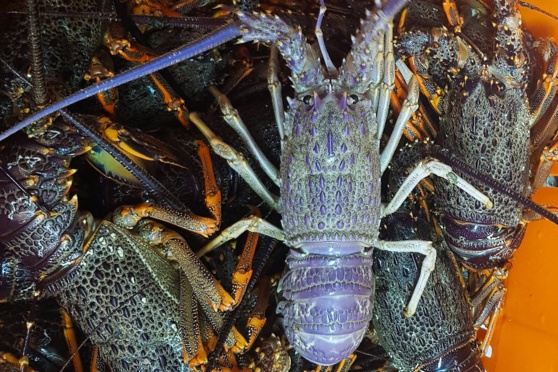
Crayfish (koura) are an iconic NZ seafood species – aside from being one of the tastiest morsels in the ocean, they’re also very intriguing critters with amazing lifecycles. If you want to regale family or friends with fascinating cray facts next time you’re diving, potting, or cooking up a crayfish banquet, then read on to discover more from the experts at the CRA 2 Rock Lobster Management Company.
What is a crayfish?
New Zealand has two common species of crayfish (or more correctly, rock lobster): the red rock lobster (Jasus edwardsii) and the packhorse rock lobster (Sagmariasus verreauxi). The red rock lobster is more common and found right around NZ, making it an important catch for both recreational and commercial fishers. The red rock lobster is typically dark red/orange above, and paler orange below, but the colours can pale to a purple and creamy yellow in some deeper waters.
The body is spiny, especially on the head. They can weigh up to 8kg and reach lengths of about 60cm (excluding the feelers). The easiest method to distinguish males from females is by looking at the fifth walking leg. In females, the fifth legs have claws that are used to tend to the eggs under their tails during the spawning season. Males do not have this claw; their fifth walking leg ends as a single point. Females also have two rows of pleopods on their tails to hold their eggs, while males only have a single row.
.jpg)
Pueruli look like cute wee transparent lobsters. During the pueruli stage they do not feed but instead survive on fat stores.
Where do they live?
The red rock lobster is found around our country, on seamounts in the Tasman Sea and along the coast of southern Australia. Ubiquitous in NZ waters, they are found from the Three Kings Islands in the north all the way to the Auckland Islands in the south and the Chatham Islands in the east.
They are also found on shallower seamounts to about 300 m depth throughout New Zealand’s Exclusive Economic Zone. The red rock lobsters found at the Auckland Islands are the southernmost rock lobsters in the world. Very small crays usually shelter alone in small cracks or holes.
As they grow, they become more gregarious and can be found in groups of 50 or more in coastal areas where there is plenty of cover. This behaviour helps to protect them from predators. Once they become sexually mature their willingness to share lodgings varies seasonally, especially for males. During the day, rock lobsters are normally found in rock crevices (dens), which provide shelter from predators, storms, and the sun. They generally leave the dens around dusk to forage for prey, returning just before dawn and staying in the safety of crevices during the day.
.jpg)
Crayfish are at the mercy of ocean currents during their leaf-shaped larvae stage.
What do they eat?
Crays eat a wide variety of bottom-dwelling life, with a preference for shellfish, crabs, kina and other sea urchins, starfish, seaweeds, and small fish. They generally hold the prey with their front legs and crush it in their mandibles (or mouthparts).
How do they breed?
Female lobsters can only mate when their shells are soft (i.e., within a few weeks of moulting). Red rock lobsters moult as early as late February in southern waters, but not until late June in warmer northern waters. Crays are selective about mates; large males prefer to mate with large females and females also prefer the largest male available.
Successful reproduction requires mature male and female lobsters of similar size. Large males become aggressive during the mating season, which usually results in one male per den. Females are also less likely to shelter together during mating when they are competing for the large males. Once a mate has been selected the lobsters begin courtship which may last just a few minutes or several days.
When they are ready to mate, they rear up, belly to belly and embrace before toppling over with the female uppermost. The male then deposits a sperm package onto the belly of the female. The sperm package begins to break apart immediately, so the female rapidly starts to squeeze out her eggs. Normally, she will cling to a rock face head up and form a brood chamber with her tail.
.jpg)
Females carrying eggs occur in the greatest numbers from April to October.
Eggs are fertilised as they pass through the sperm package before attaching to the long hairs on the pleopods, under the tail. Females carrying eggs occur in the greatest numbers from April to October, though a few are found during any month of the year. Females bear eggs only once each year and most mature females carry eggs during the egg-bearing season.
At this stage the female is “in berry”, and safe from fishing as it’s illegal to harvest crays in berry. The number of eggs carried depends on the size of the female, and ranges from about 125,000 to well over half a million! Hatching usually occurs at daybreak during spring on the deeper edges of reefs.
When her eggs hatch, the female stands on the tips of her legs with her tail held upright into the water current. She vigorously beats her pleopods for a few seconds, which releases a swarm of the spider-like first larval stage into the water.
.jpg)
The CRA 2 industry has undertaken a significant amount of tag-recapture work that has collected growth data throughout CRA 2.
The data collected for the stock assessment models for CRA 2 (the rock lobster fishery that extends from Te Arai in the north, through the Hauraki Gulf and the Bay of Plenty, to East Cape in the south) indicated recruitment pulses in 2015 and 2018 and these are consistent with the marked rebuild in abundance that was seen in the last CRA 2 stock assessment done in 2022.
How do they grow?
Crayfish larvae will drift in the water for 12-15 months, growing through many stages to around a few centimetres in length before returning to inshore areas to settle on the seafloor as pueruli. Pueruli look like cute wee transparent lobsters. During the pueruli stage they do not feed but instead survive on fat stores. Because of the long larval life, youngsters may end up a considerable distance from where they started. Larvae hatched in one area may be retained in that area by local eddy systems, carried to other areas by currents, or lost to New Zealand entirely. Pueruli that successfully reach the shore settle into small holes and crevices on shallow reefs.
.jpg)
Within 2-3 weeks pueruli moult into the juvenile stage and start to feed. Juveniles mature and become adults after 4-5 years.
Within 2-3 weeks pueruli moult into the juvenile stage and start to feed. Juveniles mature and become adults after 4-5 years. Crays have a hard shell and to grow they must shed this shell and replace it with a bigger one. Before moulting, a crayfish will grow a new layer of exoskeleton and start to remove calcium from the old shell. When a cray is ready to moult, the membrane between the carapace and the tail splits, allowing it to pull itself out of its old shell.
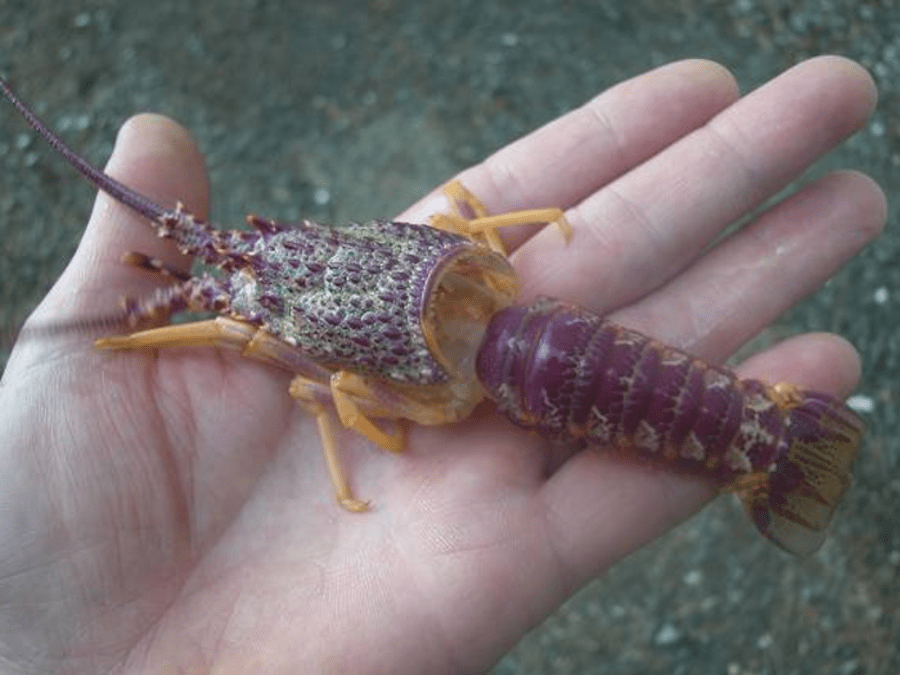
This process of shedding the shell occurs frequently in small lobsters (every 4-6 weeks) when they are growing rapidly. It usually occurs once a year in adult lobsters.
Next, the crayfish takes up water and uses it to swell up and enlarge the new shell. It then re-deposits the stored calcium from its body into the new shell, which hardens it. This process of shedding the shell occurs frequently in small lobsters (every 4-6 weeks) when they are growing rapidly. It usually occurs once a year in adult lobsters.
The amount of growth is dependent on the size of the cray, sea temperature, and food availability. Red rock lobsters reach legal size in 5-10 years and may live for over 30 years. Females from most areas around NZ breed at least once before reaching the minimum legal size. The CRA 2 industry has undertaken a significant amount of tag-recapture work that has collected growth data throughout CRA2.
The recapture rate of tags has been around 15% over the years. From the data collected, growth is reasonably consistent across the CRA 2 area. Growth rate slows as lobster tail width gets larger, with the fastest rate of growth usually occurring below the minimum legal sizes for both males and females.
Do they migrate?
Extensive tagging of NZ red rock lobsters has been conducted in many areas. Although most tagged adults stay close to their release site, long-distance movements have been recorded. In spring and early summer, some juveniles migrate against the prevailing current. It is believed these migrations help counter the effect of downstream larval drift. Adult lobsters undertake seasonal inshoreoffshore movements associated with moulting, breeding and feeding.
.jpg)
From the tag recapture data available for CRA 2 stock area, very few tagged crays have moved to other stock areas, and only modest movement has been observed within CRA 2. Keep your eyes peeled for the next instalment of this series, where we’ll share our expert advice on how to set pots for crays!

August 2023 - CRA 2 Rock Lobster Management Company Ltd
Copyright: NZ Fishing Media Ltd.
Re-publishing elsewhere is prohibited
Recent Forum Posts Visit Forum

Offshore Power Boats - Gulf Harbour 17 Oct
in The Briny Bar3 hours ago
Phantom Menace
The course goes anti-clockwise and turns around the little island (Kotanui / Frenchmans Cap) just off Gulf Harbour. That turn should make for interesting viewing -...

Manukau Harbour & West Coast fishing
in Fishing Reports38 hours ago
smudge
Thats a great catch Schecter, big fish. I'll post up a report from off the coast a bit later on...


Garmin vs Lowrance
in The Boat Shed131 hours ago
Roscoe C
Hi folksI'm looking at upgrading the electronics on my Stabi 1450. I've currently got a Lowrance Eagle 7 which I'm not especially impressed with. In particular...

Shimano 3500 baitrunner
in Buy Sell Trade or Exchange267 hours ago
0nlanders_Nz
Hello, I have come across to on the cash converters website search fishing reels $35 on there...
Manu bay boat ramp
in The Boat Shed272 hours ago
610gc
Hey teamhas any one tried the Manu bay boat ramp since the repairs?Is it any better to use?thank you ...

Out with the "Twelves"
in Fishing Reports276 hours ago
Telecaster
Popped out at about 3:30pm yesterday with a mate, usual zone and method. 10 snapper and 5 gurnard. The biggest snap we got (55cm) was definitely...
Wanted 10500 fin-nor reel
in Buy Sell Trade or Exchange323 hours ago
0nlanders_Nz
I am looking for a fin-nor 10500 fishing reel if any one has, please message me...
Wanted to Buy
in Buy Sell Trade or Exchange346 hours ago
honestbruce
Seen your post and that would work but its not up my alley or ability to make one. Dont have the means to manufacture here in...

Popular Articles

Softbait Fishing - Part 1 - gear selection
John Eichlesheim writes an article about selecting the right equipment for softbait fishing... Read More >
Softbait fishing Pt 2 - tips and tricks
Techniques, tips and tricks of softbait fishing – getting the most from your soft baits.... Read More >

Surfcasting - setting yourself up
Gary Kemsley helps sort out the necessary gear for intending surf fishers.... Read More >

Squid - How to catch them
Squid fishing is a rapidly growing aspect of fishing - Paul Senior shares some hints and tips to get started.... Read More >
Fishing Reports Visit Reports
Canterbury Fishing Report - 01/10/26
Freshwater season underway. Wow, it’s October already, and our freshwater season is underway, and the... Read More >
Top of the South Fishing Report - 01/10/26
Snapper about but not yet firing. It’s certainly nice to see daylight savings upon us... Read More >
Hauraki Gulf Fishing Report 01/10/26
Big reds in the shallows. The weather has made getting out on the water challenging... Read More >
Bay of Islands Fishing Report - 01/10/26
Snapper moving in. A few Pacific bluefin are still gracing the weigh stations with last... Read More >
Comments