
Understanding Bite Times

While fish don’t keep to a strict feeding schedule, they have been known to pick up or put down their utensils around key moon, tide and light phases. Nick Jones looks into bite times, explaining how they work and when they’re most likely to improve your fishing.
I tend to think of ‘bite times’ as any period when fish are feeding aggressively; however, there are many anglers around the globe who follow formal bite times according to the ‘solunar calendar’. So, what is this bizarre thing, and does it really affect fishing in NZ?

What is the solunar theory/calendar?
The solunar (sol for sun and lunar for moon) theory is a hypothesis that animal and fish activity changes according to the location of the moon and sun relative to their bodies. The theory was documented by John Alden Knight in 1926, although hunters and fishermen have followed similar calendars for centuries. For example, the Maori fishing calendar has been used in Aotearoa since ancient times as Maori (and numerous other Pacific peoples) discovered that angling was better or worse on certain days of the lunar cycle.
Anyway, this chap Knight picked 33 environmental factors and tested whether each factor influenced the behaviour of fish. All but three of these factors were rejected – the remaining three being the sun, the moon and the tide. Of course, tides have a huge influence on saltwater fishing and are caused by the gravitational pull of the moon and to a lesser degree the sun. However, Knight’s research found that rather than simply the tides themselves, the relationship of the moon, sun and earth’s relative positions affected the level of fishy activity due to nature responding to gravitational forces.
He concluded that the major bite time (i.e. when fish are supposedly most active) is when the moon is directly overhead or directly underfoot, and there is a minor bite time (i.e. when fish are more active than normal) at moonrise and moonset. Generally, there are four bite times during a 24-hour period – two major bite times and two minor bite times. Sometimes there are only three because a lunar day is 24 hours and 50 minutes long. Although the length of bite times vary, as a general rule of thumb, major bite times last about two hours and minor bite times last about one hour.
In addition, his solunar calendar shows that major and minor bite times are best when there is a full moon or a new moon, and weakest when there is a quarter moon or a three quarter moon – apparently because the combined gravitational force of the moon and the sun is strongest when both are directly above or directly below our heads.
The solunar theory has been the subject of many scientific studies. One interesting experiment I came across involved a United States biologist who flew live saltwater oysters over 700km inland to Chicago. He then placed them in tanks removed from sunlight. For the first week they continued to open their shells according to the high tides from their ocean home. But by the second week, they had adjusted the opening of their shells to when the moon was directly overhead or underfoot in Chicago (i.e. the solunar major bite time).
Do solunar bite times influence fishing in NZ?
The timing of solunar bite times varies in relation to the tidal cycle’s location. For example, in the Hauraki Gulf the major bite time begins two hours before low tide, whereas on the Manukau Harbour it begins one hour after high tide. The bulk of my experience is fishing for snapper and kingfish in the Hauraki Gulf, so I only feel qualified to comment on these species in this area.
For snapper in the gulf, I think it’s definitely worth following the major solunar bite times as I’ve experienced many days where the snapper came on the bite a couple of hours before low tide – as if someone has flicked a fishy switch. I even know some well-respected anglers who only bother fishing out from Auckland during the major solunar bite time. But of course, there are some well-respected anglers who think it’s a load of bollocks too!
I find that often the snapper on Auckland’s east coast feed hard on either side of a tide change, be it high tide or low tide, while there tends to be a slow period of inactivity at slack tide. However, the very best way to predict a good time to be snapper fishing in the Gulf is knowing when the fish were on the chew the day before heading out, then adding on an hour for the progression of the daily tide cycle.
In terms of the solunar theory proposing that bite times are strongest during full and new moons, my opinion on snapper is mixed. In my experience, workup fishing is often very productive leading up to full and new moons. This could be attributed to growing tidal ranges given spring tides occur during the full and new moon. Snapper and baitfish tend to be more active when the current is flowing, and lures or baits have more action in moving water. However, the fishing is often terrible for one or two days right on the full moon – a phenomenon experienced by many fishers! Proposed reasons for this include the fact that fish have already had multiple days of feeding hard which can’t be sustained, right through to the full moon glow facilitating nocturnal feeding leading to less activity during the day.
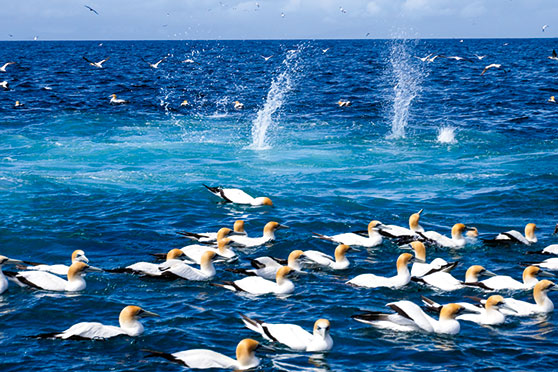
Workup action often intensifies leading up to the new and full moons, which is consistent with the solunar theory - although right on the full moon the fishing can die off.
For kingfish in the gulf, I haven’t noticed any correlation between the Solunar bite times and good fishing. Sunrise is the best time for topwater fishing, while the action at the spots we fish with livebaits seems to be governed primarily by the tides – some fire up on slack tide, many are best on the outgoing tide and there are also a few areas where we prefer to fish the incoming tide. And as with snapper, often the worst days to be fishing for kings are the day of the full moon and the following day.
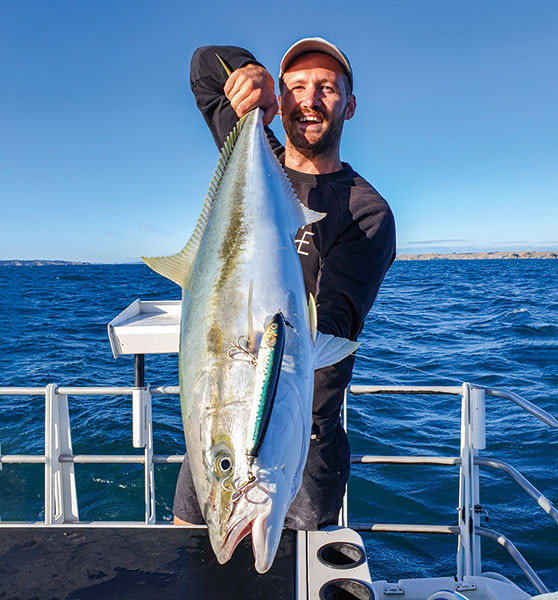
The right time of day or tide is the key for targeting kingfish in the Hauraki Gulf - not the solunar bite time.
In summary, my advice is simply to go fishing when you can – fishing is as much science as it is smoke and mirrors. After all, it’s the mystery and intrigue associated with saltwater fishing that keeps us coming back for more. But do keep bite times in mind, and if you notice some patterns at your regular haunts you can add them to your list of factors that increase your chances of having a great day.
|
|
This article is reproduced with permission of |

Popular Articles

Softbait Fishing - Part 1 - gear selection
John Eichlesheim writes an article about selecting the right equipment for softbait fishing... Read More >
Softbait fishing Pt 2 - tips and tricks
Techniques, tips and tricks of softbait fishing – getting the most from your soft baits.... Read More >

Surfcasting - setting yourself up
Gary Kemsley helps sort out the necessary gear for intending surf fishers.... Read More >

Squid - How to catch them
Squid fishing is a rapidly growing aspect of fishing - Paul Senior shares some hints and tips to get started.... Read More >
Fishing Reports Visit Reports
Manukau/West Coast Fishing Report - 15/10/26
Big spring snapper in 60 metres. The El Niño weather pattern isn’t going to be... Read More >
Rotorua Fishing Report - 15/10/26
Solid start to the season! The Rotorua lakes have all started the season well, and... Read More >
Tutukaka Fishing Report - 15/10/26
Big snapper in shallow. Things remain relatively quiet on the fishing front out of Tutukaka,... Read More >
Tauranga Fishing Report - 15/10/26
Bait and temperature on the rise. It’s been great to get out and see some... Read More >
Comments