
Troutfishing in Heavy Water

Andrew Harding shares a story about a troutfishing trip in heavy water...
It’s a sound that can bring an angler to their knees – the relentless pelting of precipitation on a backcountry hut’s tin roof the night prior to hitting a favourite river, exacerbated by the thunderous sound of boulders rolling down rapids. It happens with alarming regularity around the start of New Zealand’s standard trout fishing season, commencing at the start of October each year, and is the cause of many a sleepless night for anglers.
A positive mindset goes a long way when fishing; my absolute pet hate is fishing with negative anglers. Personally, I proudly lump myself into the category of being eternally positive when it comes to fishing. The rain will always clear, the jetboats will pass without spooking the trout, and the river won’t be a raging torrent of mud come daybreak.
Does it work? Not very often at all… But after 35 years of slogging over a fairly high proportion of New Zealand’s premier trout habitat, I’ve come to realise that high and dirty water doesn’t necessarily equate to bad fishing. In fact, more often than not, it can be the catalyst for sensational fishing and fist-pumps all round.
Thirty years ago, on a cold frosty morning on the banks of the Tongariro, at a pool known as ‘The Poutu’ I had the displeasure of meeting a grumpy old bastard by the name of Ron Horton (Horty).
Horty was different. After a split from his wife, he chucked in the farming life and moved to Turangi to live out his later years doing what he loved – fly fishing, or, more precisely: chasing big browns. Big migrating brownie jacks really spun Horty’s wheels. He never believed in catch and release and every time I landed one when fishing with him, a booming voice would echo out over the valley for all of Turangi to hear, “KEEP THAT BASTARD, ANDREW!” I still hear that voice to this day, even though Horty sadly passed away several years ago.
As with so many riverside encounters, strangers become friends. Our friendship blossomed and Horty fast became the grandfather I never had while growing up. Horty taught me many things, like how to rent a small digger to alter stream mouth rips and make them go straighter (I always wondered why he did this in the dark of night…); that undersized paua were called “cocktail paua” (a delicacy on the barbecue at Horty’s); how to winch trout in with 20lb tippet, “Nothing less!”; and lastly, one of his rare, actually factual, words of wisdom that has stuck with me to this day: “When the river is dirty, whack on the biggest, darkest streamer you can, on the largest hook you can find!”
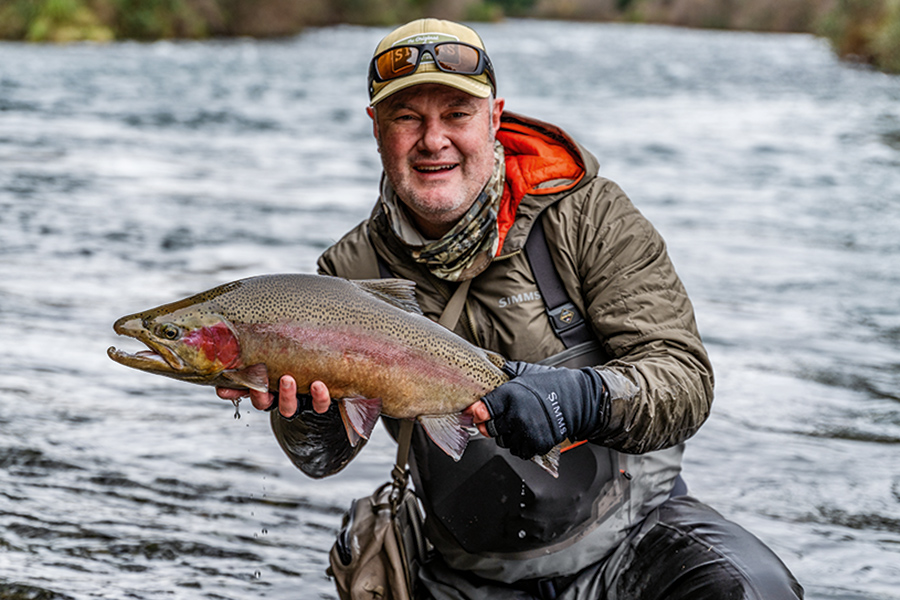
A 7.5 jack from a rising Tongariro River.
Horty liked big flies and big gear, anything less than a nine-weight was a toy for millennials to play with. I still question the legality of the flies he used, but he was old and he didn’t care – he did what the hell he wanted. Like the day he drove his ride-on mower from Turangi to the Blue Pool down the middle of state highway 1 at 10kph to go fishing, because his 1976 brown vinyl roof Holden Statesman was in the shop… but that’s another story.
The Tongariro flooded often back in those days, far more than it does now, and Horty illustrated to me time and time again that the days when there was not another angler on the river due to high flows were the best time to target big migratory browns. He would swing these huge, monstrous black streamers on a shortened, old-school lead shooting head into the margins, so close to the shore the fly would end up on dry land on many occasions, but boy did it work! Flows of 100+ cumecs and mud-like clarity were best, and it wasn’t just the Tongariro where this method worked. The Whanganui, TT, Waiotaka and Waimarino, when in flood, all felt the wrath of Horty and his massive ‘big black flies’.
We would often ring Horty prior to making the five-hour slog north from Wellington. We quickly came to realise that when Horty said the river was “crystal” it would, more often than not, be absolutely filthy. We quickly wised up to never ask him for a river status report ever again, made easier with the arrival of river flow graphs on this new-fangled internet thing.
The large browns – often into double figures – would smash Horty’s 10cm+ long streamers right under the rod tip, mostly because his arthritis prevented him from casting into what he liked to term “the back paddock” anymore. It took me quite some time to warm to Horty’s methods, but I adopted them, just as any young fella would glean such wisdom from an old timer.
In mid-August 2022 I found myself in Turangi for 10 days with a couple of mates. The forecast was mostly fine, however any fine long-term forecast from New Zealand’s Met Service makes me skeptical and, sure enough, after two fine days and dozens of fish, the heavens opened up and the three of us endured five days straight of the Tongariro flowing between 70 and 160 cumecs!
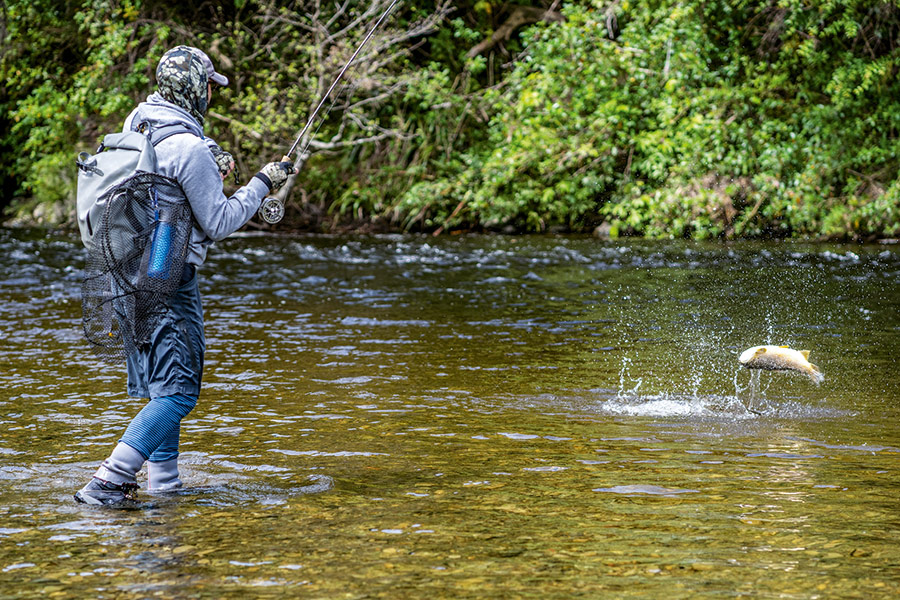
Peter de Boer brings a Hutt brown to the shore in dirty water.
Now, 160 cumecs, while not a damaging flood, is substantial enough to dislodge small trees, change shingly pools and drive the average angler to the pub. Had I not had the pleasure of meeting Horty all those years ago, I would’ve simply packed up and gone home! But no – Dan, Darryl, and I hit the river every day, an eerily empty river at what is normally the busiest time of the year. We swung Horty-style flies from dawn to dusk and were rewarded with plenty of rainbows; no browns, however. I guess my flies weren’t ‘Horty-enough’! The fishing? Fantastic. A real triumph over adverse conditions.
River visibility could be measured in centimetres, the margins just clear enough to see the toes of your boot when ankle deep (this was a measure Horty taught me of what he deemed “fishable”), but the trout saw the flies, or more so I suspect, picked up on the swinging flies’ vibrations in the water. We weren’t using fancy sinking lines, just the staple kiwi six-weight gear, sink-tips and even full floating lines – all that was required as the fish weren’t deep.
And why would they be? When a river floods, fish are highly concentrated into the softer water in the margins. As when a river loses flow in high summer conditions, there are only a few places fish can congregate. Trout won’t expend any more energy than is necessary and in high flows, they will happily feed on dislodged creepers and caddis in the shallows and never pass up the opportunity to snatch at a huge Horty-style streamer swung in front of their nose.
The hookups? Often savage in nature. There’s no subtle plucking of the fly, just good ‘ol smash and grab! Of course, tippet size is a moot point in these conditions, you could use 40kg fluorocarbon game trace and it would have no effect on your hookup rate! And boy, is it fun. Reading water and thinking like a trout is paramount – any soft water margins off to the side of a main current will hold fish in dirty water.
Another fantastic method for tackling dirty rivers, where permitted of course, is using Rapala-style lures retrieved into the margins. Casts don’t need to be long at all and the floating Rapala CD7 in ‘Brown Trout’ pattern is an absolute favourite. Here, the floating lures can be ‘worked’ ever-so-slowly along edges, the stop/start retrieve making the lure dive and re-surface in the most enticing way. As with swinging large streamers, the takes can send you to A&E if you have a weak ticker, so be warned!
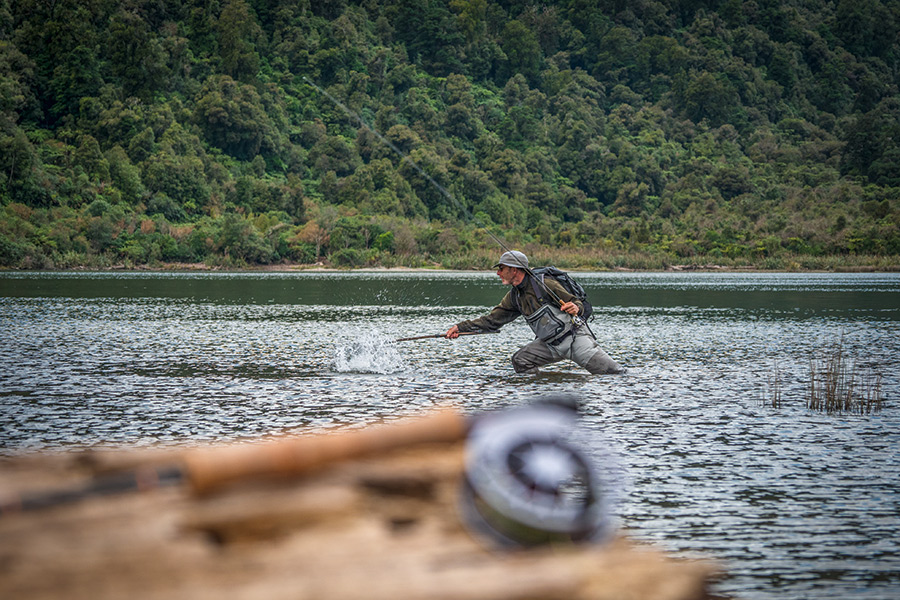
Blind fishing small dirty inflows on a small South Island lake in terrible weather.
Many years ago, on one of our month-long South Island campervan sojourns, Dan and I planned to fish up the Crooked River, which is the main tributary of Lake Brunner. The Crooked can be a fickle beast, at times absolutely loaded with fish and at others, seemingly barren. Heavy overnight rain pelted the roof of the campervan and by morning, arriving at the river, our worst fears were realized – she was huge and BROWN! The fly rods were promptly stowed away and out came the spin sets. Armed with floating CD7 lures and two-kilo braid, we ventured only a few hundred metres to the side of the main road bridge when a passing fishing guide stopped for a yarn. Having cancelled with his client that day, we discussed the state of the fishery, where the best pies were locally and, of course, that topic on every coaster’s agenda: 1080 (in a rather animated fashion!).
As we chatted, I fired random casts along the edges, twitching the CD7 towards the shore when WHACK! Right at my feet I was connected to the largest Crooked fish I had ever seen! A stunning 6.5lb, hooked-jawed, golden-spotted migrating brown. The fish were running! Old mate was gobsmacked, having only minutes earlier told me the river was too dirty for fishing and we were “wasting our time”. I slid my fish back into the murk and then Dan proceeded to hook up not 10 metres away – another beautifully-marked Crooked brown hit the deck. Well, of course old mate rushed back to his ute, grabbed his fly rod, and in his haste to get amongst the action, trips over and breaks his new Sage at the butt section… bugger!
Then there are lakes… I love fishing lakes. It’s a whole new world regarding reading water. The more inclement the weather and the more persistent the rain, the better for fishing still waters. Flat calm? Look elsewhere. There’s something quite special about being rugged-up in marginal weather firing Woolly Buggers on floating lines, wading around the mouths of rapidly rising, normally dry side-streams entering a lake. The action is often amazing, with the trout feasting on dislodged insects and getting more excited than a kid with a fist-full of candy floss, the cold and wet taking a back seat to this unique experience.
There are always options, so don’t be perturbed by flooded rivers this coming season, learn to use these conditions to your advantage and adapt. Think like “Horty” and you may just come away with a day to remember when everyone else stayed home.

October 2022 - Andrew Harding
New Zealand Fishing News Magazine.
Copyright: NZ Fishing Media Ltd.
Re-publishing elsewhere is prohibited
Popular Articles

Softbait Fishing - Part 1 - gear selection
John Eichlesheim writes an article about selecting the right equipment for softbait fishing... Read More >
Softbait fishing Pt 2 - tips and tricks
Techniques, tips and tricks of softbait fishing – getting the most from your soft baits.... Read More >

Surfcasting - setting yourself up
Gary Kemsley helps sort out the necessary gear for intending surf fishers.... Read More >

Squid - How to catch them
Squid fishing is a rapidly growing aspect of fishing - Paul Senior shares some hints and tips to get started.... Read More >
Fishing Reports Visit Reports
Raglan Fishing Report - 12/11/26
Big spring snapper. With the more settled weather over the last couple of weeks there’s... Read More >
Mercury Bay Fishing Report - 12/11/26
Snapper hit and miss. Most reports have been telling us it’s becoming more difficult to... Read More >
Northland Fishing Report - 12/11/26
The switch has been flicked on! Call it what you want, El Niño, global warming,... Read More >
Tauranga Fishing Report - 12/11/26
Snapper and kahawai in close. Again, we start on a positive note, with some nice... Read More >
Comments