
Troutfishing After Rain & Storms

The sound of heavy or even light rain pitter-pattering against the windshield of your car as you head off to your fishing destination is at the very least disheartening, but it doesn’t always spell disaster as Sam Boothroyd points out.
Pulling up to your favourite river or piece of water to find it discoloured, brown or starting to ‘turn’ is for most people the cherry on the top of the cake of disappointment. The usual call is to beat a hasty retreat back to the cosy confines of four walls and a sofa, with our tails between our legs. However, a bit of rain and murky water doesn’t have to be the end of your fishing trip. If you’re willing to brave the weather and conditions, it can often pay off big time as I’ve recently started to discover.
In river environments, feeding is dictated by a whole variety of factors such as food availability, water clarity, oxygen levels, temperature and even lighting, and all of this differs from fish to fish. Trout are picky and inconsistent buggers when it comes to the what, where and when of feeding, as most experienced anglers appreciate. The fact that the environment controls the feeding pattern of trout, however, does give us an advantage as anglers. If we understand the conditions, we can often predict when the best chance of catching a fish will be.
For example, as every angler knows no matter what they target, the golden hours of sunlight and sunrise are prime times for most species of fish who use the lower light levels to hunt and feed. So, fishing in the evening and morning is a common method to increase your chances of hooking up. Fishing during the whitebait run or the cicada bonanza are other ways of increasing your chances as food availability is high, so the trout are in a feeding frenzy.
Because trout are so unpredictable and picky, using their habitat’s predictable cycles is something successful anglers do often without even thinking. Rainfall is another one of these cycles which, while unpredictable in its timing and intensity, is predictable in the ways it affects rivers and therefore the trout that live in them. Rainfall increases the amount of oxygen in the water which typically results in more activity from the trout in every way. It also creates moody skies, murkier water and darkened light levels which make trout more predatory and the increase in flow often causes prey to be dislodged and forced downstream to waiting trout. Essentially, that pitter patter of rain that might put you off going for a fish is exactly what makes the trout go on the feed.
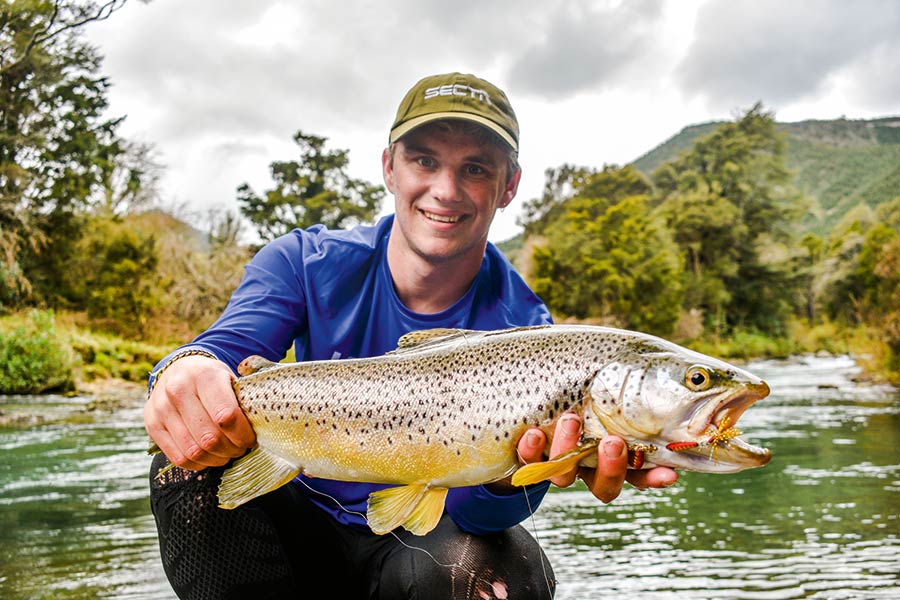
When conditions are less than perfect, lures that put up plenty of 'noise' are more likely to be detected.
How dirty is too dirty
When you turn up to your river after or even during rainfall, it’s often too easy to decide that the water is simply too dirty to fish. However, in my mind, if I can see the bottom right up against the bank or on a shallow rapid, the water is fishable to some extent. Once you’ve made the decision to fish or at least give it a go, you need to rig up and pick an area that looks likely.
Trout, like most fish, have a lateral line which senses movement in the water and in particular the vibration of their prey, and in our case the lure. While trout are more commonly a predator that rely on sight, they can also use their lateral line to detect potential food. The fact that trout will be able to sense vibration but also rely on their sight gives us a huge clue as to what we can trick them into biting.
I have found that Mepps blade-style lures with their twisting spoons are the perfect candidate for rainy days. My personal favourite is the Black Magic Spinmax in the brighter colours. Not only does this style of lure chuck out a lot of vibration but it also allows you to fish areas a lot slower than your normal spinner, which can make a massive difference in dirty water.
Using brightly coloured soft-baits or even Rapala style bibbed minnows will also work efficiently as they can be worked slowly. My favourite colour for dirty water has to be pink as it replicates the colour of dislodged worms and grubs.
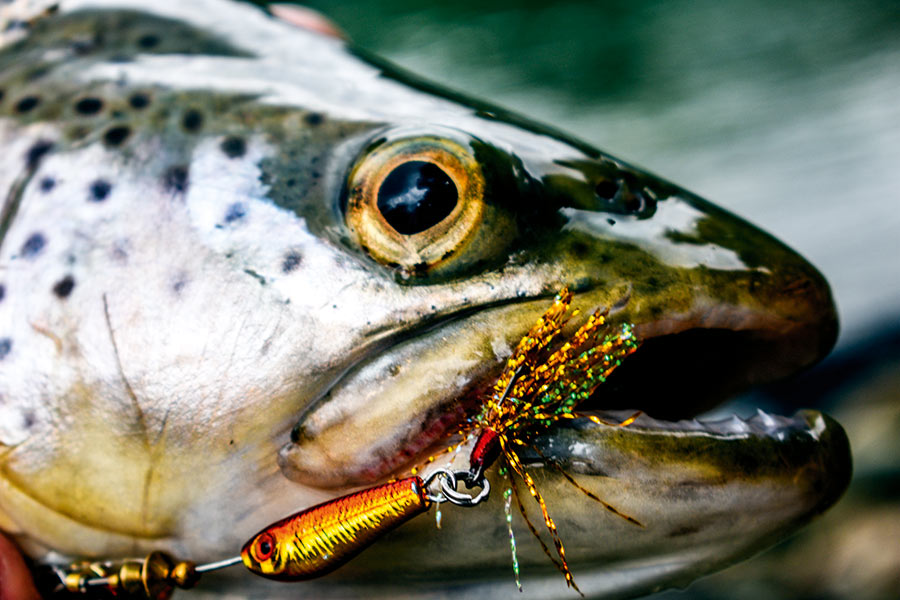
When the water conditions are murky, trout use their lateral lines to detect vibration and movement.
Finding the trout
During heavy flow and water discolouration, trout can act and sit in completely different spots in the river compared to when the flow is lower and clearer. When the water is clear, and the flow is low, trout tend to sit near areas of high flow such as below or above rapids where food is being brought to them. Extra flow and discolouration force fish into slower moving bodies of water with less current where they sit and wait for food to pass by. Look for eddies or any structure that breaks up the flow; for example, trees protruding from the bank, boulders and rocks in the river, or even just areas between rapids where the flow is much slower.
Looking for where the current isn’t as strong can often lead to the fish. When it is raining or has rained but the water is still relatively clear, fishing like you normally would in faster flowing areas is hugely successful. When the water is murky, covering ground is your best chance of hooking a trout. Often in murkier water, the fish will act out of instinct if a lure is put in front of its nose, so there is little point casting in the same area over and over as the fish will have had a go if it was there or will just continue to ignore it. Fishing the whole river including the lapping water at your feet is important; trout tend to sit right up against the riverbank in these kinds of conditions.
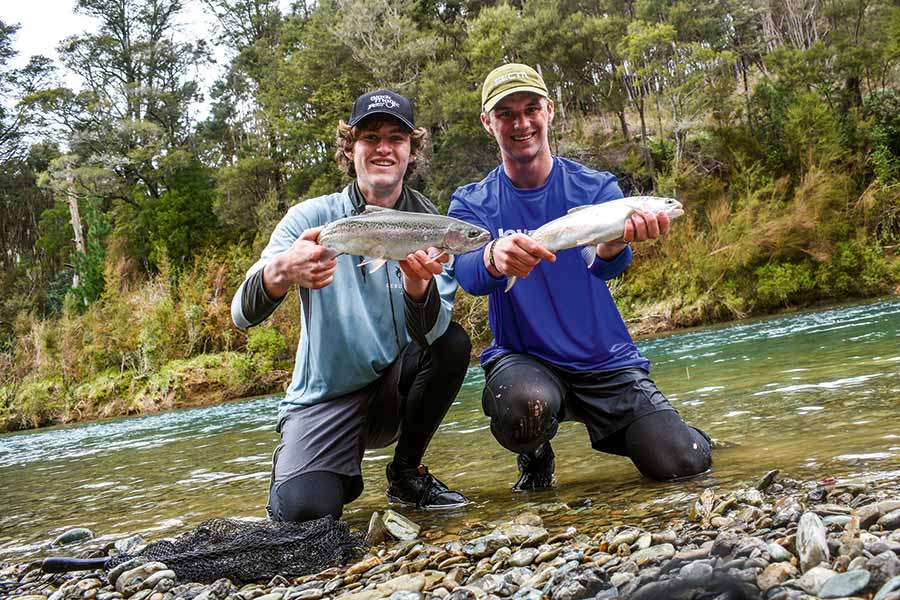
Epic double hook-ups in close quarters just as the water started to discolour.
Recently, I’ve had some awesome success in rivers in the top of the South during or after heavy rainfall. My first experience of success on a wet day after being trapped in by looming clouds came from a trip down to the famous Motueka located in the Tasman region.
Arriving at my chosen spot, I found the river to be mud brown with the outline of the riverbed barely recognisable. After deciding to give it a shot with no expectations of seeing any signs of trout let alone catching one, I began fishing a slow-moving section of water with a flamingo pink Spinmax lure.
As I watched my lure flutter downstream alongside the bank, a bronze flash followed by the ecstatic scream of my reel broke the mundaneness of the afternoon. A stunning 4lb brown trout had engulfed the little spinner so close to the bank that within seconds of it hooking itself, it had quite literally jumped onto the bank next to me.
This began my newfound passion of chasing dirty water trout and I started having an unusual amount of success. The dirty water and increased flow all caused by the rain seemed to send the trout into a feeding frenzy which is something we can very easily take advantage of. My next experience was and will be for some time the most intense trout fishing session of my life.
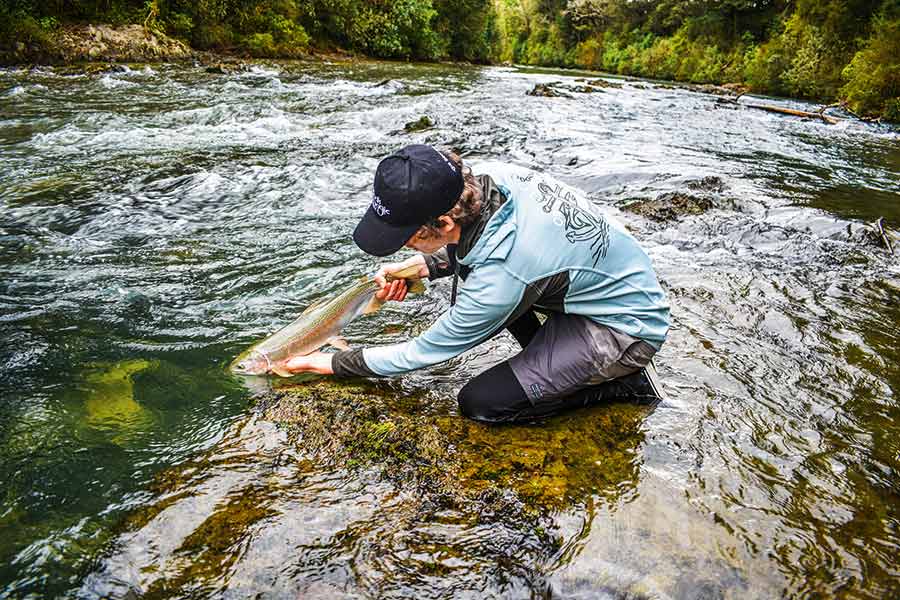
A nice rainbow released to fight another day.
After a long drive in almost torrential rain with conversation almost impossible against the onslaught of water droplets, we arrived at the river. To our pleasant surprise, we found the water to be an eerie blue, but we knew too well that the rain would soon turn it into a disturbing brown. Using only Spinmax lures, we made our way upstream catching a total of 15 trout as the water slowly became dirtier and dirtier, with a few personal bests thrown in amongst the lot. This confirmed my theory that rain means trout and hungry ones at that.
During or after intense rainfall can be a dangerous time. Ensure you watch and read the river at all times; be wary of rising levels and increased flows that could potentially sweep you away.
Dress for the occasion. It is usually a cold exercise so keeping warm and dry is vital for the best enjoyment. I have found that being warm and dry don’t always mean the same thing and wearing breathable insulated clothing, such as a face protector and polyprops or thermals, will keep you toasty on the river, even if wading around. If you’re keeping to the bank, a good waterproof is essential.
So next time you see grey clouds looming over you, don’t run back to the comfort of your house – grab your rod and some warm clothes instead and head for the river!

January 2022 - Sam Boothroyd
New Zealand Fishing News Magazine.
Copyright: NZ Fishing Media Ltd.
Re-publishing elsewhere is prohibited
Recent Forum Posts Visit Forum

Shane Jones
in Fisheries Management15 hours ago
Tzer
Far cry to the twats at Liegasea/NZSFC were proposing of 5 Tarakihi person in their submission for the central management area and this is what our...

Bluefin Tuna at the cavs.
in The Briny Bar35 hours ago
smudge
Despite my years of fishing I haven't really fished many places, my focus has always been on Auckland's west coast and out toward Great Barrier. I...

Casting gloves
in Popper and Topwater Fishing80 hours ago
Mc Tool
100 bucks for a lure 😬. Watching one of them flying over the horizon without the line attached would be " character building " for sure...
I thought Id post some nice photo's , join...
in The Briny Bar131 hours ago
Alan L
That is a very cool pic Krow.The Far North is very cool, the Far far North even cooler. Mint looking day.Alan...

Mc Tools berley mincer
in The Briny Bar138 hours ago
SaltyC
Good size, they scrap well. Got an 18kg one up in Vava'u back a few years ago fishing off squeaky Going's boat. That was quite a...

Out with the "Twelves"
in Fishing Reports192 hours ago
Pcj
I should be able to get out end of October. The nephew been out virtually every weekend over winter and has done well. It seems the...
Manukau Harbour & West Coast fishing
in Fishing Reports200 hours ago
smudge
Nice work Schecter, I think snapper may be around sooner than you think. Well I am hoping so...

Whangarei Harbour report.
in Fishing Reports632 hours ago
krow
180 +m is where I've had to be lately. A lot less low foul around these parts and some of it shallower that looks like Tarakihi...
Whangarei Harbour Scallops
in Fisheries Management742 hours ago
Pcj
Reopening WhangÄ쳌rei Harbour to recreational scallop fishingTÄ“nÄ쳌 koeFisheries New Zealand is seeking feedback from tangata whenua, stakeholders, and the public on whether WhangÄ쳌rei Harbour should be...
SNA1 Recc fishing cops the blame.
in Fisheries Management838 hours ago
Tzer
What Liegasea won’t tell you is that some of their own fisheries contractors were co-authors of this study for fear of being called hypocrites, one of...

Popular Articles

Softbait Fishing - Part 1 - gear selection
John Eichlesheim writes an article about selecting the right equipment for softbait fishing... Read More >
Softbait fishing Pt 2 - tips and tricks
Techniques, tips and tricks of softbait fishing – getting the most from your soft baits.... Read More >

Surfcasting - setting yourself up
Gary Kemsley helps sort out the necessary gear for intending surf fishers.... Read More >

Squid - How to catch them
Squid fishing is a rapidly growing aspect of fishing - Paul Senior shares some hints and tips to get started.... Read More >
Fishing Reports Visit Reports
Outer Hauraki Gulf Fishing Report 17/09/26
Spring wind the handbrake. Spring is starting to make its presence felt in the outer... Read More >
Top of the South Fishing Report - 17/09/26
Early snapper in Tasman Bay. Well, spring is finally here, and the days are getting... Read More >
Bream Bay Fishing Report - 17/09/26
Good snapper catches reported. After Tangaroa turned off the fish tap for a month or... Read More >
Bay of Islands Fishing Report - 17/09/26
Pacific bluefin tuna for the lucky few. The last fortnight has seen more fishable days... Read More >
Comments