
Trailer maintenance 101
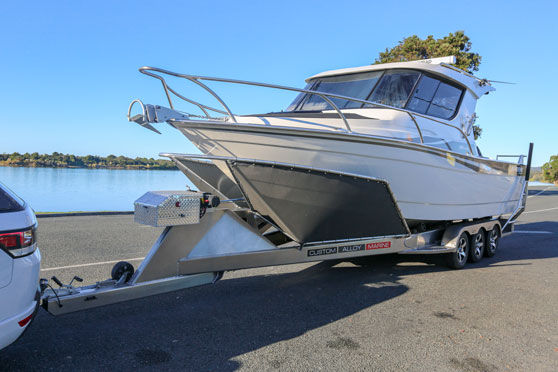
One of the things that concern the manufacturers of quality trailers is the issuing of three-year Warrant of Fitness for new product. Repeatedly submerging a boat trailer over that period with no maintenance or checks is a recipe for disaster.
While some will see the three-year WoF as a good thing, in the terms of trailer longevity and performance, it has the potential to go very wrong.
“Formerly the six-month WOF checks would pick up things like bearing play and bearing seal failure, loose wheel nuts and coupling issues, along with light and brake operation,” Steve says.
“Being dropped into salt water on a regular basis, especially if the trailer’s not washed down effectively afterwards, is asking for trouble.”
A lot of corrosion can take place in three years, so is important to regularly check your trailer to ensure trouble-free operation.
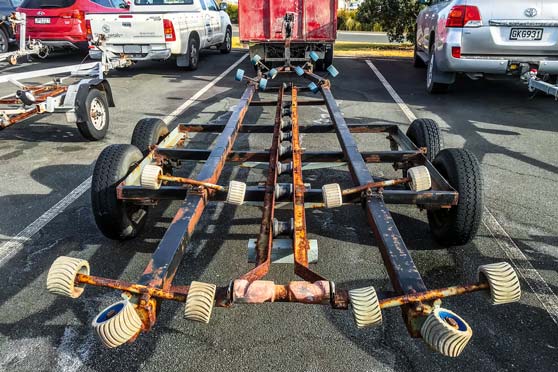
Because boat trailers are immersed in salt water and sometimes parked in harsh conditions, serviceable items can deteriorate significantly between uses.
“Trailers should be inspected and serviced every six months. If you don’t feel confident servicing or checking your trailer, you should take it to an automotive mechanic or the dealer you purchased it from. Failure to service your trailer may affect warranty claims.”
New Zealand Fishing News put some common queries to Steve…
Q: My boat loads unevenly, tilting to one side of the trailer.
A: Quality trailers are made symmetrically – both sides are identical so the boat should load level on the trailer unless either the trailer is on an angle when retrieving the boat, or the boat’s cargo or equipment is loaded unevenly, i.e. the boat has more weight on one side than on the other.
If the boat ramp is not parallel to the waterline, this will contribute to the boat being loaded unevenly. The effect of this can be offset by skewing the trailer on the ramp until the chassis is at right angles to the waterline.
If the boat is loaded unevenly, it will also contribute to the boat being retrieved unevenly. The effect of this can be offset by turning the outboard motor toward the lighter side. This is very effective on smaller craft, but less effective on larger vessels with larger load discrepancies. For larger boats, you may have to review how the boat is loaded and possibly redistribute the load to balance the deck. Sometimes passengers can stay on board when a boat is being retrieved at the ramp.
Wind and current also contribute to a boat being loaded incorrectly. There is not a lot you can do to combat the forces of nature, but it will assist greatly if the trailer is angled either into the wind or into the current.
Q: Is there any better coating than zinc galvanising for a boat trailer?
A: Galvanising is the best form of protection for your boat trailer. Galvanising is cathodic protection, just like an anode on your outboard motor, so the galvanising will slowly deteriorate sacrificially, protecting the steel. You can expect anywhere between 5 and 15 years of protection for your trailer if used in salt water. The better you look after your trailer the longer it will last. Chlorides are extremely corrosive to zinc and sea water is full of them. Re-galvanising can be undertaken before any structural damage to the chassis or components occurs.
If you flush the inside of the trailer and wash it immediately after each use, it will last a lot longer than if you simply take it home and leave it to the elements. If you use an automotive wash and wax it will assist in dispelling the chlorides and there are other specialty products like Salt-Away that also assist in protecting the galvanising.
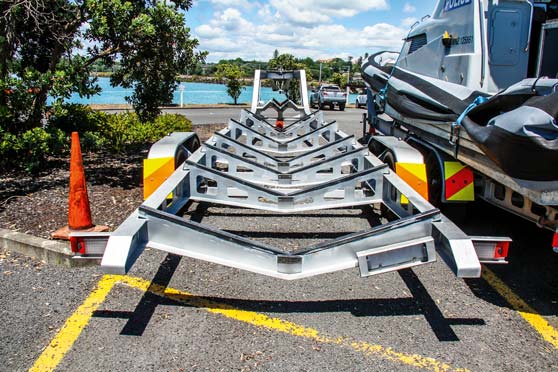
Painting or powder-coating over galvanising is called a duplex coating. Generally duplex coatings applied correctly extend the life of galvanised coatings four times, but one drawback with boat trailers is that you cannot easily completely coat the inside of the trailer so the extended life is not easily achievable. There are anticorrosive products that you can spray on the inside, but care must be taken to ensure that there is no environmental harm from the leaching of such products. A suitable coating to apply to the inside of your trailer chassis is CorrosionX, a food-grade product that offers effective protection and is not detrimental to marine life.
The cost of additional corrosion prevention can be more expensive than the long-term benefit, especially if you are intending to keep your boat/trailer for less than 10 years. It is recommended you spend a bit of extra time washing the trailer with a suitable wash and wax detergent.
Q: What are the laws regarding brakes on light trailers?
A: Within NZTA’s guide to safe towing, it states that brakes are not required where the gross laden weight of a trailer is 2,000kg or less.
Tow vehicles fitted with OEM or certified tow bars will state maximum towing weights with and without trailer brakes. These maximum tow weights will be in accordance with the vehicle manufacturer’s maximum limits.
The current NZTA requirement for trailers fitted with brakes is that when towing, the tow vehicle and trailer travelling at 30 kilometres per hour must be able to stop within seven metres.
A 200 series Toyota VX Land Cruiser can tow a braked Certificate of Fitness trailer weighing up to 4,000kg with upgrades or up to 3,500kg without using a suitable braked WOF trailer, but manufacturer’s specifications limit towing any trailer without brakes to a maximum weight of 750kg.
Insurance companies may elect not to pay out on claims for accidental damage to either the tow-vehicle or trailer/boat where an unbraked trailer weight is in excess of the manufacturer’s specifications, regardless of whether it can stop within seven metres at 30 kmph.
Q: If there is a need to fit brakes, what are the requirements?
A: Light trailers are defined as trailers not exceeding 3,500kg GVM (Gross Vehicle Mass) or in other words the combined weight of the trailer, boat, motor, fuel and onboard equipment being towed.
Hydraulic over-ride brakes or mechanical (cable) brakes are legal up to 2,500kg GVM. These are brakes that are mechanically actuated by the tow coupling’s forward movement when the towing vehicle brakes. The maximum of 2,500kg GVM applies whether one axle or two axles are braked.
Trailers that exceed 2,500kg and have a GVM of 3,500kg or less must have electric-hydraulic brakes (both axles) that have in-cab brake controllers/adjusters.
If the GVM of a trailer exceeds 3,500kg the trailer must be certified to CoF standards and so must the tow vehicle, both together as a combination.
|
|
This article is reproduced with permission of |

Recent Forum Posts Visit Forum

Shane Jones
in Fisheries Management2 hours ago
Fish Addict
The recreational sector can expect no favours from politicians. They know all too well who butters their bread and it ain't the recs. No different over...

Foton tunland v9
in The Briny Bar2 hours ago
Ho Dee
not fishing related and delete if required but was wondering if any has one of these or someone who has just wanting so e real world...

Trailer wheel clamp
in The Boat Shed3 hours ago
Pcj
Doesnt dry out like crc.I use it on my trailer lock...

Bluefin Tuna at the cavs.
in The Briny Bar49 hours ago
smudge
Despite my years of fishing I haven't really fished many places, my focus has always been on Auckland's west coast and out toward Great Barrier. I...
Casting gloves
in Popper and Topwater Fishing94 hours ago
Mc Tool
100 bucks for a lure 😬. Watching one of them flying over the horizon without the line attached would be " character building " for sure...
I thought Id post some nice photo's , join...
in The Briny Bar145 hours ago
Alan L
That is a very cool pic Krow.The Far North is very cool, the Far far North even cooler. Mint looking day.Alan...

Mc Tools berley mincer
in The Briny Bar152 hours ago
SaltyC
Good size, they scrap well. Got an 18kg one up in Vava'u back a few years ago fishing off squeaky Going's boat. That was quite a...
Out with the "Twelves"
in Fishing Reports206 hours ago
Pcj
I should be able to get out end of October. The nephew been out virtually every weekend over winter and has done well. It seems the...
Manukau Harbour & West Coast fishing
in Fishing Reports214 hours ago
smudge
Nice work Schecter, I think snapper may be around sooner than you think. Well I am hoping so...

Whangarei Harbour report.
in Fishing Reports646 hours ago
krow
180 +m is where I've had to be lately. A lot less low foul around these parts and some of it shallower that looks like Tarakihi...
Popular Articles

Softbait Fishing - Part 1 - gear selection
John Eichlesheim writes an article about selecting the right equipment for softbait fishing... Read More >
Softbait fishing Pt 2 - tips and tricks
Techniques, tips and tricks of softbait fishing – getting the most from your soft baits.... Read More >

Surfcasting - setting yourself up
Gary Kemsley helps sort out the necessary gear for intending surf fishers.... Read More >

Squid - How to catch them
Squid fishing is a rapidly growing aspect of fishing - Paul Senior shares some hints and tips to get started.... Read More >
Fishing Reports Visit Reports
Outer Hauraki Gulf Fishing Report 17/09/26
Spring wind the handbrake. Spring is starting to make its presence felt in the outer... Read More >
Top of the South Fishing Report - 17/09/26
Early snapper in Tasman Bay. Well, spring is finally here, and the days are getting... Read More >
Bream Bay Fishing Report - 17/09/26
Good snapper catches reported. After Tangaroa turned off the fish tap for a month or... Read More >
Bay of Islands Fishing Report - 17/09/26
Pacific bluefin tuna for the lucky few. The last fortnight has seen more fishable days... Read More >
Comments