
Towing and trailer regulations

A reader recently brought what appeared to be rather confusing regulations concerning the use of safety chains with breakaway brake systems to the magazine’s attention. John Eichelsheim navigates through the regulations to determine what’s legal and what’s not.
Breakaway brakes are compulsory for trailers with a gross laden weight between 2500kg and 3500kg. They are a legal requirement, because once a trailer exceeds 2500kg it becomes difficult to restrain via safety chains should it become disconnected from the tow vehicle.
Such a heavy object flailing around behind the vehicle could easily send it out of control or roll it over with potentially tragic consequences. It’s therefore far safer for all road users for the trailer to break free of the vehicle and have its brakes applied automatically. This allows the tow vehicle a better chance to stop safely.
To cite the regulations, breakaway brakes should ensure …under all conditions of use … that, if the trailer is unintentionally disconnected from its towing vehicle, the brake will automatically and immediately apply and remain applied for at least 15 minutes.
From the NZTA Website August 2023 - check the NZTA website for the latest rules and regulations.
.png)
Increasing numbers of large trailer boats weigh over 2500kg, but many more boat and trailer combinations fall just under 2500kg, where the rules say breakaway brakes are not required.
Trailers with gross laden weights of between 2000kg and 2500kg require a service brake of some sort, acting on both wheels of at least one axle. The braking system is generally indirect: i.e. activated by the driver applying the tow vehicle’s brakes. Override brakes are the most common type, but the braking system may also be direct.
But boat and trailer combos close to 2500kg, once loaded with fuel, gear and equipment, often have a gross laden weight well over 2500kg. To be legal on the road (and covered by insurance), such combinations must be fitted with direct-acting breakaway brakes activated by the driver of the tow vehicle, usually vacuum operated or pneumatic over hydraulic systems.
Trailers of between 2000kg and 2500kg must also be fitted with a pair of safety chains that cross over – unless equipped with breakaway brakes.

And here’s where things start to get interesting: many trailers over 2500kg with compulsory breakaway brakes are also equipped with safety chains. However, the rules clearly state that anything preventing the breakaway system automatically and immediately applying the trailer brakes when the trailer is disconnected from the tow vehicle render the trailer unwarrantable and by extension effectively uninsured.
When the trailer is decoupled from the tow vehicle and ‘breaks away’, the automatic trailer brakes are activated. A short length of stainless-steel wire cable usually connects the trailer and tow vehicle. Disconnecting the cable, as happens when the trailer uncouples from the vehicle, triggers the automatic brakes.

Since safety chains are designed to restrain the uncoupled trailer and keep it connected to the tow vehicle, they generally prevent a breakaway brake system from activating, and for this reason they are not a requirement. Since chains generally prevent breakaway brakes functioning properly, trailers with breakaway brakes and chains should in most instances be rejected for a Warrant of Fitness (WoF), but as our reader points out, there are plenty of 2.5- to 3.5-tonne trailer-boat combos with a current WoF certificate that are fitted with both breakaway brakes and chains, so there appears to be some confusion.
An unfortunate possible outcome, should such a trailer be involved in an accident, is that the insurance company could refuse liability, even though it has a current Warrant of Fitness.
While it seems some Warrant of Fitness issuing agents are unsure, the regulations pertaining to breakaway light trailer brakes and safety chains are set out quite clearly in the NZ Transport Agency’s Guide to safe loading and towing for light vehicle.
In the table under the column ‘Gross laden weight of trailer 2500kg and up to 3500kg,’ it states a breakaway brake is required but safety chains are not (see table). The guide can be downloaded from the agency’s website: www.nzta.govt.nz.
Further clarification is available from the NZ Transport Agency in their guide to WoF and CoF vehicle inspections, trailers, emergency brake and breakaway brakes. In Note 4 pertaining to breakaway brakes, section 28, it states: A breakaway brake, if fitted, must be tested, but is not required to be functional on a trailer with a laden weight of 2500kg or less that is fitted with one or two compliant safety chains, as required in Table 5-1-1.
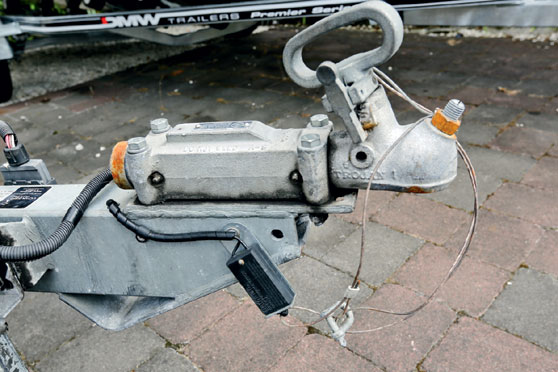
However, breakaway brakes must be fitted to trailers 2500kg up to 3500kg, and tested in order for the trailer to get a WoF. Safety chains are “not required” since they will likely interfere with the proper operation of the breakaway brake system.
The wording of the law should probably read chains are ‘not permitted’ instead of ‘not required’ to reduce confusion.
It might be also prudent for readers towing boats fitted with breakaway brakes and chains to check whether their rigs are legal and therefore covered by insurance.
Selecting a tow vehicle
Owners of large trailer boats need to ensure their tow vehicle is up to the task and legally able to tow the boat and trailer combination. If the trailer’s gross laden weight is approaching the upper limit of 3500kg, this becomes even more important.
There are quite a few vehicles with 3.5 tonnes (braked trailer) as their maximum towing weight, including several popular utilities (see list on previous page). But this figure can be misleading. If driving with a Class 1 car licence, the gross combined mass (GCM) of the trailer and tow vehicle must not exceed six tonnes.
Most vehicle manufacturers supply a maximum towing capacity for vehicles. They also display the vehicle’s gross vehicle mass (GVM), which includes its maximum payload. For instance, a vehicle may have a kerb (tare) weight of 2000kg and a GVM of 3000kg. That leaves 1000kg for payload, but that’s quickly soaked up by modifications such as roof racks, bull bars, winches, storage systems and tool boxes – even before you add passengers, fishing gear and supplies.
How much weight you can actually tow depends on the combined weight of the tow vehicle and the trailer it’s towing (gross combined mass, or GCM). Typically a utility vehicle will only be able to tow its maximum braked trailer weight with a light load, or it will exceed its design limits for weight.
For example, let’s take the popular Ford Ranger (or Mazda BT50) utility with a 3500 braked trailer tow rating and say we want to tow 3500kg. Subtract 3500kg from the maximum GCM of 6000kg and 2500kg is the maximum the Ranger can weigh if towing 3500kg. As the Ranger’s tare (kerb) weight is 2200kg, 2500kg less 2200kg leaves just 300kg for payload. Four people at 75kg each is already 300kg without any gear. The Ranger’s kerb weight wouldn’t even include a towbar.
If the Ranger is at its GVM legal limit (3200kg) – which wouldn’t be too unusual when setting off on a fishing expedition – then the equation looks like this: 6000kg minus 3200kg means a tow capacity of 2800kg, which is the maximum the trailer can weigh.
Bottom line is if you work off the GCM, then you can only tow 3500kg in a Ranger if you have no more than 300kg of load on the truck, or if the truck is at GVM, you can tow no more than 2800kg.
There’s more. Axle loads need to be taken in account too, and these are affected by the load transferred to the tow vehicle as down force on the towball. Most manufacturers give a maximum allowable down force at the towball, which may be less than 10% of aggregate trailer mass (ATM), a rough guide for tongue weight, which for a trailer of 3500kg is 350kg. The correct amount of down force may well be greater than the allowed amount for the vehicle.
|
|
This article is reproduced with permission of |

Recent Forum Posts Visit Forum

Trailer wheel clamp
in The Boat Shed56 minutes ago
Mc Tool
either crc long life or 556 marine are way better ...

Shane Jones
in Fisheries Management5 hours ago
Tzer
From what I see too even commercial in WA aren’t getting any favours from politicians there. I think here our advocacy groups like Liegasea aren’t doing...

Foton tunland v9
in The Briny Bar16 hours ago
Ho Dee
not fishing related and delete if required but was wondering if any has one of these or someone who has just wanting so e real world...

Bluefin Tuna at the cavs.
in The Briny Bar62 hours ago
smudge
Despite my years of fishing I haven't really fished many places, my focus has always been on Auckland's west coast and out toward Great Barrier. I...
Casting gloves
in Popper and Topwater Fishing107 hours ago
Mc Tool
100 bucks for a lure 😬. Watching one of them flying over the horizon without the line attached would be " character building " for sure...
I thought Id post some nice photo's , join...
in The Briny Bar158 hours ago
Alan L
That is a very cool pic Krow.The Far North is very cool, the Far far North even cooler. Mint looking day.Alan...

Mc Tools berley mincer
in The Briny Bar166 hours ago
SaltyC
Good size, they scrap well. Got an 18kg one up in Vava'u back a few years ago fishing off squeaky Going's boat. That was quite a...

Out with the "Twelves"
in Fishing Reports220 hours ago
Pcj
I should be able to get out end of October. The nephew been out virtually every weekend over winter and has done well. It seems the...
Manukau Harbour & West Coast fishing
in Fishing Reports228 hours ago
smudge
Nice work Schecter, I think snapper may be around sooner than you think. Well I am hoping so...

Whangarei Harbour report.
in Fishing Reports660 hours ago
krow
180 +m is where I've had to be lately. A lot less low foul around these parts and some of it shallower that looks like Tarakihi...
Popular Articles

Softbait Fishing - Part 1 - gear selection
John Eichlesheim writes an article about selecting the right equipment for softbait fishing... Read More >
Softbait fishing Pt 2 - tips and tricks
Techniques, tips and tricks of softbait fishing – getting the most from your soft baits.... Read More >

Surfcasting - setting yourself up
Gary Kemsley helps sort out the necessary gear for intending surf fishers.... Read More >

Squid - How to catch them
Squid fishing is a rapidly growing aspect of fishing - Paul Senior shares some hints and tips to get started.... Read More >
Fishing Reports Visit Reports
Outer Hauraki Gulf Fishing Report 17/09/26
Spring wind the handbrake. Spring is starting to make its presence felt in the outer... Read More >
Top of the South Fishing Report - 17/09/26
Early snapper in Tasman Bay. Well, spring is finally here, and the days are getting... Read More >
Bream Bay Fishing Report - 17/09/26
Good snapper catches reported. After Tangaroa turned off the fish tap for a month or... Read More >
Bay of Islands Fishing Report - 17/09/26
Pacific bluefin tuna for the lucky few. The last fortnight has seen more fishable days... Read More >
Comments