
The value of NZ recreational fishing
As recreational anglers we have always known that our fishing generates an industry of activity and value to the New Zealand economy. But there was no easy way to describe it or put a dollar value on the collective spending. The riddle has now been solved with the production of the 136-page report for the New Zealand Marine Research Foundation: Estimating Marine Recreational Fishing’s Economic Contributions in New Zealand – Technical Steps.
LegaSea spearheaded the fundraising effort, publicising the research and generating broad public support through the ‘What’s Fishing Worth?’ campaign. After two years’ work, the New Zealand Marine Research Foundation has successfully delivered a report defining the significant contribution that recreational fishing makes to the New Zealand economy.
Now the results need to be shared with decision makers, resource managers, the general public, and especially those generous people who have helped to fund this valuable project.
What follows are extracts from the report, detailing the most important results. The full version will be available publicly after it has been peer-reviewed and a paper published in an appropriate scientific journal.
Recreational Fishing generates value
Obviously there is a whole lot more to recreational fishing than just the dollar value, but until now recreational fishers’ contributions to the national coffers have not been calculated. However, given the growing interest in fishing and the marine environment, it is critical that conservative resource management decisions are made, because having abundant fisheries and a vibrant recreational fishing industry is important to all New Zealanders.
The recreational fishing considered in this project is divided into two categories: fishing by resident anglers and fishing by tourist anglers.
Resident Kiwi marine anglers
- About 600,000 Kiwis fish in the sea annually
- Shore-based fishers spend, on average, $710 per annum
- Boat fishers’ average spend is $1800 per annum
- The proportion of the main two types of angling is 65% boatbased fishers and 35% land-based fishers
- The overall average spend by resident marine fishers is $1400 per annum.
Tax take
The new insights provided by the economic study show New Zealand receives around $136 million in GST revenues and $52 million in personal income tax annually from the recreational fishing industry. Through these mechanisms recreational fishers are ‘paying their way’, contributing not only to the cost of fisheries management but also to the greater common good.
Tourist spending and growth potential
Considering the total number of annual visitors to New Zealand and the rich resources our nation is blessed with, there is significant potential growth in recreational and sport-fishingrelated tourism.
- Around 109,000 international tourists participate in a recreational marine fishing experience in New Zealand.
- Around 39,000 of these people hire a charter boat for their fishing.
- Around 28,000 visitors come specifically for saltwater fishing, with the balance adding fishing to their other activities.
- These tourists bring in signicant new revenues to New Zealand, approximately $89M annually. As a result, New Zealand’s economy, as measured in GDP, is $68M greater and 1,100 fulltime jobs are supported. With careful management of our marine resources, there is potential to increase these visitor numbers.
Tourists spend millions
- Over 100,000 international tourists fish in New Zealand waters each year
- Each international visiting marine fisher spends an average of $815 per year on marine-fishing activities
- Visiting fishers who come specifically to fish spend $2,800 per trip
- Visiting fishers who fish, but travel for other reasons, spend $130 per fishing day • International visitors spend $89 million on marine-fishing activities each year
- This activity supports 1,100 full-time jobs
- International visitor spending adds $68 million in GDP to New Zealand’s economy.
Results by region and species
Each region possesses unique natural amenities and recreational fishing opportunities for marine fishers. In this study, the country has been split into three fishing regions.
Direct spending on marine fishing by resident and visiting fishers, by region

Results by species
Breakdowns are also offered on the contributions of various species nationally (and also by the three regions in the full report). These species categories were selected on the basis of having sufficient survey data available to conduct a robust, statistical analysis. Spending on other popular species such as tarakihi and gurnard probably fall in the range between kingfish and hapuku (groper) and bass, but there was insufficient survey data on fisher spending to enable reliable species estimates to be calculated. It is no surprise that the spending associated with snapper fishing, at $403 million, is the highest amongst the seven categories selected. This is spending by New Zealand residents only.
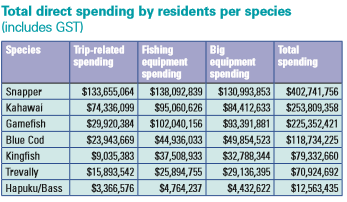
Spending estimates by species are not mutually exclusive; many fishers pursue a variety of species during any one outing and some anglers fish in multiple regions to target the same species.
The value chain of recreational fishing
But direct spending is only part of the economic value of recreational fishing. The full technical report for this survey details that, on an annual basis, more than 700,000 people – residents and international visitors – fish in the sea. When these people spend money, their expenditures change hands as businesses re-spend the dollars on employees, supplies and operating expenses, creating ripple effects through the economy. These must be added to the direct spending figure to give a true figure representing the overall value of recreational fishing.
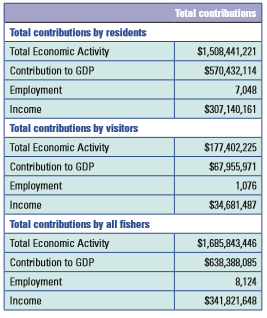
This extra economic activity generates $638 million in Gross Domestic Product (GDP) and also $342 million in salaries, wages and small business profits. It also adds a conservative $188 million in tax revenues to help keep New Zealand functioning. In comparison, arts-related industries, for example, generate around $410 million of value-added value, or GDP, per annum.
Total economic contributions of marine fishing by residents and visitors (net GST and import adjustments)
Definitions
Four economic contribution measures are used in the table:
Total Economic Activity, or Output: represents the value of annual industry production for all the industries affected by the purchases made by marine fishers.
Gross Domestic Product (GDP): another term used for GDP is value-added. It represents the difference between the industries’ or establishments’ total output and the cost of its intermediate inputs.
Employment: reflects saltwater fishing’s contributions to full-time employment.
Income: represents the contribution to New Zealand’s household income.
Economic information is critical
Saltwater fishing is one of the most popular outdoor activities in New Zealand. But recreational fishing is more than just the excitement of the catch, putting food on the table, or a peaceful and sometimes adventurous escape. It is the foundation of an industry – one that is comprised of retailers, manufacturers, wholesalers and support services, each working to help ensure a fisher will enjoy their day on the water. And, when viewed collectively through comprehensive research, the contribution of the marine recreational-fishing industry to New Zealand’s economy is significant.
Resource-use comparisons
- Commercial fishing takes over 90% of the landed catch
- About 90% of all landed seafood, by value, is exported (the balance supplies our domestic market) • The annual commercial-fishing export receipts total about $1.3 billion (excluding aquaculture) using 73% of the landed catch
- Recreational fishing comprises about 6% of landed catch
- About $1.7 billion in total spending or economic activity is created by recreational fishers taking just 6% of the national catch to feed family and friends.
The roots of the economic activity originate from the fisher who, for example, buys ice for the chilly bin or bait for the end of the line before travelling to the coast to fish. This spending by local fishers and keen travellers who take the opportunity to go marine fishing while visiting the country stimulates economic activity, which in turn multiplies their dollars spent, generating significant economic impact for New Zealand. Beginning with the $946 million spent annually by more than 700,000 fishers, these dollars circulate through the national economy, supporting 8,000 jobs, stimulating $1.7 billion in total economic activity, contributing $638 million in Gross Domestic Product and $342 million in salaries, wages and small business profits, while adding nearly $188 million in tax revenues to help keep New Zealand functioning. Clearly the positives of recreational fishing reach far beyond the water’s edge and into the lives of all New Zealanders.
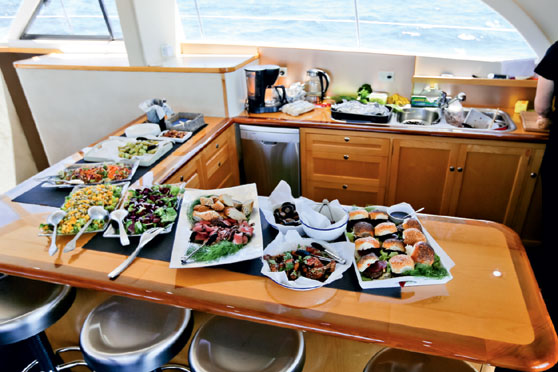
Economic information is critical for explaining why recreational fishing and marine stewardship are important to all New Zealanders. Quantifying the magnitude of the recreational marinefishing industry raises awareness for marine fisheries in the larger public and political arena. Results from this project can be used to inform discussions about how to institute better conservation policies, secure new partners and resources for conservation initiatives, and ultimately boost the long-term health and productivity of marine fisheries.
|
|
This article is reproduced with permission of |

Recent Forum Posts Visit Forum


Saltwater Flyfishing Gear
in Buy Sell Trade or Exchange6 hours ago
Kevin.S
Continuing my big clear out I'm also getting rid of my salt fly gear as it isn't getting used, here's a rough list Sage Xi2 890-4, Airflo...
FC 595 For Sale
in Buy Sell Trade or Exchange59 hours ago
Kevin.S
I have reluctantly decided to sell my boat. It really is not getting enough use to justify keeping it. It is a 2016 FC 595 with...

Manukau Harbour & West Coast fishing
in Fishing Reports99 hours ago
smudge
That's a great catch Schecter! Kayak fishers do it so much harder than anyone else. It would be an absolute pleasure to hand over the $5k...

Knife sharpeners
in The Briny Bar146 hours ago
krow
I'm about to order a couple from Amazon. Check your PM Smudge...
1989 Evinrude 90hp V4
in The Boat Shed147 hours ago
bricker
Inherited the above outboard on a boat - is in very good order with little use. The serial number is A1351974. Is there a way of...

Auckland Yakkers
in Yak Yak Yak225 hours ago
BananaBoat
Out from Mission bay this evening. Went to the red marker by Mission & Kohi. Never fished this area beforeHad a quick looksie for some structure....
Yellowfin
in The Briny Bar242 hours ago
krow
I heard there were Yellowfin East of the chicks yesterday but I'd suggest this is unusual this late in the season as the water is cooling....

Mac'nificent Autumn Fishing....Mokau!
in Fishing Reports269 hours ago
Snappa Geoff
Thankyou for the replies guys... Tagging some bigger fish is a good idea Krow! but it doesn't interest me enough to get involved....

Popular Articles

Softbait Fishing - Part 1 - gear selection
John Eichlesheim writes an article about selecting the right equipment for softbait fishing... Read More >
Softbait fishing Pt 2 - tips and tricks
Techniques, tips and tricks of softbait fishing – getting the most from your soft baits.... Read More >

Surfcasting - setting yourself up
Gary Kemsley helps sort out the necessary gear for intending surf fishers.... Read More >

Squid - How to catch them
Squid fishing is a rapidly growing aspect of fishing - Paul Senior shares some hints and tips to get started.... Read More >
Fishing Reports Visit Reports
Tauranga Fishing Report - 28/05/26
Tarakihi on the bite Trips are few and far between at this time of year,... Read More >
Canterbury Fishing Report - 28/05/26
Fresh and salt turning it on! It is not very often I get to say... Read More >
Bay of Islands Fishing Report - 28/05/26
Lures paying dividends We finally had a break in the SE winds that have been... Read More >
Manukau/West Coast Fishing Report - 28/05/26
Snapper and gurnard in the harbour The weather has finally taken a turn for the... Read More >
Comments