
Techniques for releasing fish caught from deep water
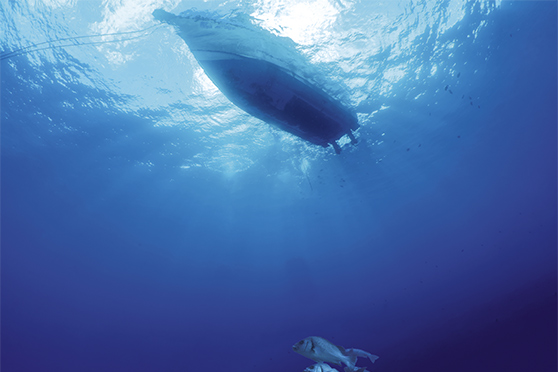
Releasing many types of fish is problematic if they have been hooked in deep water. John Eichelsheim reviews the science and comes up with some ‘best practices’ to reduce the mortality rate from barotrauma…
Fish pulled to the surface from deep water often find themselves unable to swim down to a comfortable depth when released. The change in pressure as they ascend through the water column results in barotrauma – pressure shock caused by gases expanding inside their bodies as the water pressure reduces. Barotrauma can leave fish incapacitated and often mortally injured.
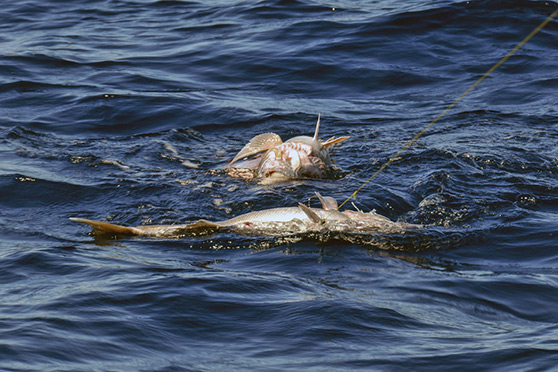
Barotrauma can leave fish incapacitated and often mortally injured.
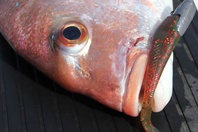
Barotrauma in fish is indicated by bulging eyes, distended bellies (where gas from the swim bladder has escaped into the abdominal cavity), intestines protruding from vents and stomachs bulging out of mouths.
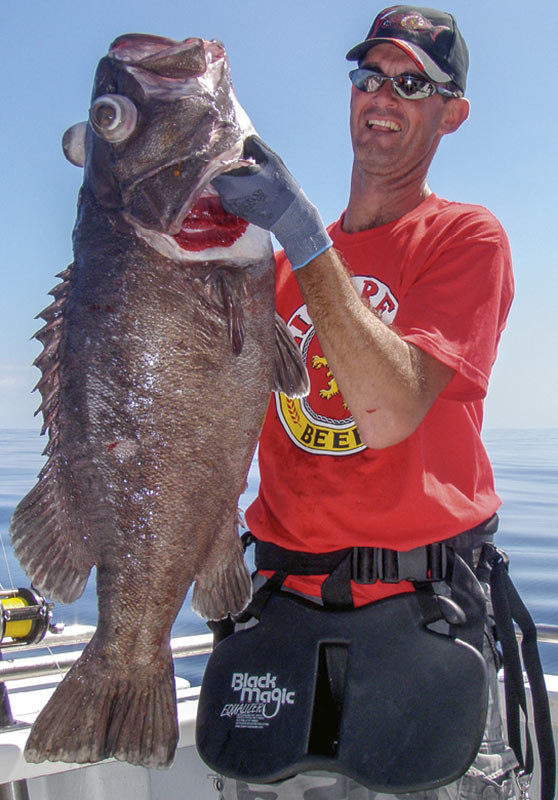
Barotrauma in fish is indicated by bulging eyes and distended bellies.
In severe cases, decompression can cause scales to stand up and the fish’s skin to hiss or fizz as expanding gas escapes.
Even fish drawn from modest depths can suffer the effects of sudden decompression.
Schooling snapper in the middle and outer regions of the Hauraki Gulf are the target of thousands of Auckland anglers chasing work-ups year-round, but especially in spring. Work-up fishing action can be furious and limit bags can be achieved in no time.
Human nature being what it is, it’s sometimes hard to call it quits when the fishing is good, even after the catch limit is reached. But releasing unwanted/excess snapper doesn’t guarantee their survival. They are often badly affected by barotrauma, and unable to swim back to the bottom.
Even when snapper look fine and swim away strongly, which smaller fish are especially prone to do, they may not survive.
Blowing up
The swim bladder is a bony fish’s organ of buoyancy control which is inflated and deflated using gas from the bloodstream. Some bottom-dwelling species don’t have swim bladders as they never leave the seafloor. Sharks and related species control depth hydrodynamically by swimming, and some species also use their livers for fine-tuning buoyancy.
Most bony fish, including snapper, can regulate gas in their swim bladders so that they can move through the water column when seeking food, but only a few species can make swift vertical movements without suffering ill effects.
As a fish moves towards the surface, water pressure decreases and gas inside its swim bladder expands. It normally compensates by re-absorbing gas into its bloodstream, or, in those fish species with swim bladders that connect to their mouths, by burping or venting gas from the mouth.
But when a hooked fish is hauled upwards through the water column on a line it can’t reabsorb gas in its swim bladder quickly enough, which can stretch the bladder to its elastic limit or rupture it.
The expanding swim bladder exerts pressure on and displaces internal organs. This can result in severe, sometimes fatal, internal injuries, and gas-filled ‘floaters’ unable to swim away from the surface become easy meals for seabirds and other predators.
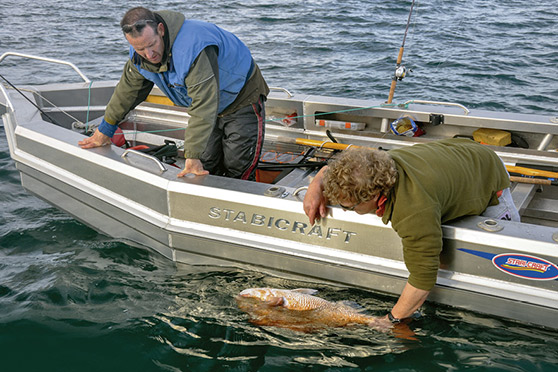
Barotrauma can result in gas-filled 'floaters' unable to swim away from the surface.
Drawing a fish to the water’s surface from a depth of 20 metres causes the gas volume in its swim bladder to expand three-fold.
In some studies, venting fish by puncturing the swim bladder with a hollow (hypodermic) needle to release the gas improved post release survival in fish suffering decompression. Venting makes affected fish less buoyant so they can swim down by themselves. However, venting is an invasive technique that can cause infection and may damage other organs.
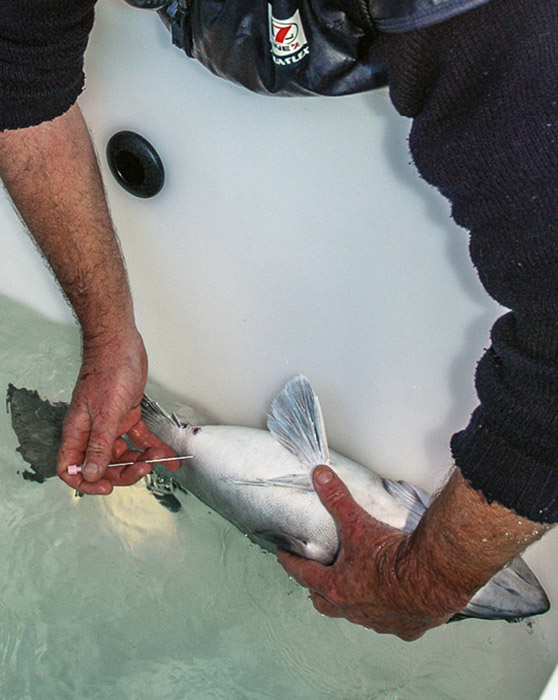
In some studies, venting fish by puncturing the swim bladder with a hollow (hypodermic) needle to release the gas improved post release survival in fish suffering decompression.
Is slow the go?
Like many anglers, I always thought bringing fish to the surface slowly let them adjust to changes in water pressure.
It would appear not.
As overseas studies have shown, in most cases the pressure differential overwhelms a fish’s natural buoyancy system and even a slow ascent is too fast for them to make adjustments. In some tests fish took many days to achieve neutral buoyancy after being brought to the surface from 30m.
Bringing a fish to the surface slowly can make subsequent release easier, but that’s often because the swim bladder has ruptured during the ascent. This is indicated by a burst of bubbles from the fish’s mouth, commonly seen as a hooked fish nears the surface.
With the pressure relieved, fish often swim down again, but may have sustained crushing injuries to organs and probably need functioning swim bladders to maintain equilibrium. Their subsequent survival can’t be guaranteed.
Post-release mortality
The degree of barotrauma a fish suffers depends on the depth at which it is hooked, its species and how soon it is returned to a comfortable depth.
Many deep-water species, like hapuku, can’t be successfully released under normal circumstances, so any fish boated must be retained.
A number of studies around the world have researched post-release mortality for various species of fish.
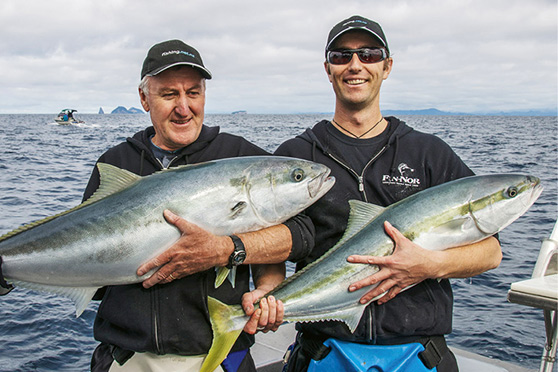
Kingfish is one species that copes well with changing water pressure.
Research in Alaska using pacific cod showed that swim bladders ruptured by decompression sealed up and functioned normally within 24 hours. Those fish were taken from water between 32 and 127 metres deep, tagged, released and monitored between two days and 1.5 years. Survival rates were above 70%.
One of the most relevant studies for New Zealand fishers was undertaken in 2007 for the Government of Western Australia Department of Fisheries.
It examined the relationship between depth of capture and post-release survival of snapper. The study also examined the influence of hook type (circle or J-hook) and hook placement.
The results appear relevant to New Zealand snapper fisheries in deeper water, including parts of the Hauraki Gulf.
In the Australian study, 699 snapper were captured by line from a variety of depths and caged in Shark Bay, Western Australia. Overall, 65.4% of the caged snapper survived.
Researchers found the most important factor affecting release mortality in snapper was depth of capture. In the majority of cases, the cause of death was barotrauma.
Post-release mortality of snapper brought up from less than 30m was low (3.4%), but increased to a higher rate at both 45m and 65m (69%). Mortality due to hook-injuries was low because less than 2% of snapper swallowed the hook, with circle hooks swallowed less often than J-hooks.
In this study, venting did not improve snapper survival.
The West Australian study clearly showed that the depth at which fish were captured had the biggest effect on their post-release mortality rates. Almost 70% of snapper taken at depths exceeding 45m did not survive release, which seems to fit with anecdotal evidence from fishers and divers in New Zealand.
However, more than 30% of these snapper did survive, including ‘non-swimmers’ – snapper so badly affected by barotrauma they were unable to swim at the surface – so release may still be justified in some circumstances, especially if fish release best practice is adhered to.
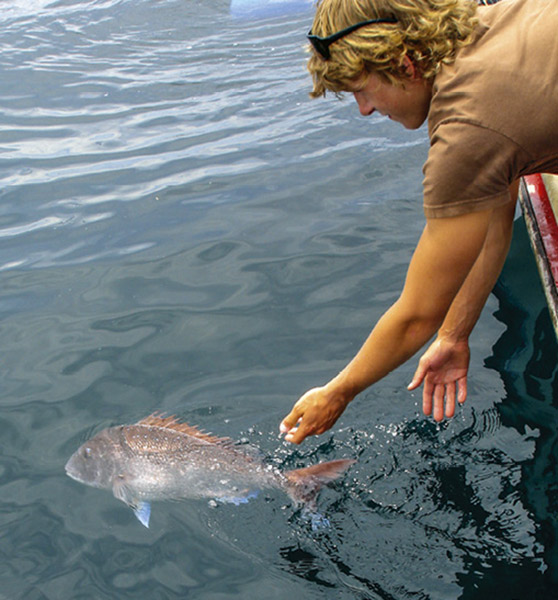
If you are quick with your release, fish may be able to swim down for enough to negate the worst effects of sudden decompression.
Deep water releases
As per above, a clear proportion of fish caught in moderately deep water do survive subsequent release, so in some circumstances it may be a viable option. But how do we give those fish the best chance at survival?
As detailed above, winding them to the surface slowly doesn’t do a lot of good, but we know releasing them as quickly as possible with minimal handling does. If you are quick with your release, fish with swim bladders that are still inflating may be able to swim down far enough to negate the worst effects of sudden decompression.
Another strategy is to help fish descend to a safe depth where they can overcome the effects of decompression.
Research on rockfish in the USA has shown excellent survival rates for fish affected by barotrauma when they were quickly lowered into deeper water using release weights – some of their subjects even had bulging eyes and other signs of severe barotrauma.
Release or drop weights, also called fish descending devices, are simple tools comprising a heavy weight, a stout line and an inverted barbless hook, usually attached to the weight but sometimes to the line.
Typically, the hook is passed through the lower jaw of the fish and the weight is allowed to plummet into the depths, taking the fish with it. Once it reaches the desired depth, a sharp jerk on the line is enough to free the fish. Bigger fish require heavier weights to get them down.
There are several commercial release weights available online, but they’re easy enough to make. Simply invert a large, barbless hook and fix it to a heavy hapuku sinker with a self-tapping screw.
Depth is the key
All the research I could find seems to agree that post-release mortality increases with the depth of water at which the fish was captured. The results suggest snapper fishers should refrain from catch and release in water deeper than 30m, unless they use a release/drop weight or similar tool.
Fortunately, many of the charter boats working the Hauraki Gulf in 30-50m depth recognise the issue, insisting their clients keep the first seven legal-sized snapper they catch and stop fishing after that.
|
|
This article is reproduced with permission of |

Recent Forum Posts Visit Forum

Nice photo
in The Briny Bar4 hours ago
Mc Tool
actually 3 different ones No4 mk1 , No1 mk3 and a No5 jungle carbine...

Out with the "Twelves"
in Fishing Reports6 hours ago
Pcj
I should be able to get out end of October. The nephew been out virtually every weekend over winter and has done well. It seems the...

Manukau Harbour & West Coast fishing
in Fishing Reports14 hours ago
smudge
Nice work Schecter, I think snapper may be around sooner than you think. Well I am hoping so...
Mc Tools berley mincer
in The Briny Bar208 hours ago
Mc Tool
The update is that some neighbourhood kids arrived with a 5 hoss 2 stroke mercury that didnt go .........and yeah ...badly side tracked ( it really...

Whangarei Harbour report.
in Fishing Reports446 hours ago
krow
180 +m is where I've had to be lately. A lot less low foul around these parts and some of it shallower that looks like Tarakihi...
Whangarei Harbour Scallops
in Fisheries Management556 hours ago
Pcj
Reopening WhangÄ쳌rei Harbour to recreational scallop fishingTÄ“nÄ쳌 koeFisheries New Zealand is seeking feedback from tangata whenua, stakeholders, and the public on whether WhangÄ쳌rei Harbour should be...

SNA1 Recc fishing cops the blame.
in Fisheries Management652 hours ago
Tzer
What Liegasea won’t tell you is that some of their own fisheries contractors were co-authors of this study for fear of being called hypocrites, one of...

here is one for you Tonto
in The Work-Up694 hours ago
Tonto2
Boat maintenance happening as we speak, hoping to get into late November...
Fish Bat, Waddie, Priest - Blackwood (Sold)
in Buy Sell Trade or Exchange735 hours ago
smudge
Puriri is the stuffs alright...
Rod building gear for sale
in Rod Building793 hours ago
Buggar-me
There may be some photos or items i missed....
Popular Articles

Softbait Fishing - Part 1 - gear selection
John Eichlesheim writes an article about selecting the right equipment for softbait fishing... Read More >
Softbait fishing Pt 2 - tips and tricks
Techniques, tips and tricks of softbait fishing – getting the most from your soft baits.... Read More >

Surfcasting - setting yourself up
Gary Kemsley helps sort out the necessary gear for intending surf fishers.... Read More >

Squid - How to catch them
Squid fishing is a rapidly growing aspect of fishing - Paul Senior shares some hints and tips to get started.... Read More >
Fishing Reports Visit Reports
Tauranga Fishing Report - 17/09/26
Tarakihi fishing well out wide. Perhaps we start with a positive glance at the coming... Read More >
Raglan Fishing Report - 17/09/26
Snapper schools moving shallower. The start of spring is here, and we are seeing better... Read More >
Canterbury Fishing Report - 03/09/26
Whitebait season underway. Spring is here, and along with it, the good old Canterbury nor-Wester!... Read More >
Bream Bay Fishing Report - 03/09/26
Fishing hard, weather conditions trying. Cold winds and lots of rain have made for testing... Read More >
Comments