
Surfcasting in Dunedin

I recently had an opportunity to spend some time in my home town of Dunedin. It was there and in the surrounding areas that I’d taken my first steps in land-based saltwater fishing: on the harbour wharves, off the Otago Peninsula cliffs, and on the open beaches.
Since leaving Dunedin I’d done precious little surfcasting or rock fishing there, something that has grated on me because my memories of fishing there 15-20 years ago are of some very productive sessions. So on a recent trip I was determined to visit some old fishing haunts and make up for some lost time.
It turns out the fish are still there, but I was also reminded of the challenges of the sea, weather, terrain and fish habits in this very southern surfcasting outpost.
On arrival at the airport I was greeted with 30°C and a blazing hot sun. A strong nor’wester was blowing – a very helpful offshore wind in these parts – so I set about organising myself for some trumpeter and blue cod fishing from the cliffs near Cape Saunders.
Early the next morning I was on the road and heading there. However, I was greeted by a road closure, making my spot inaccessible, so I had to go to a Plan B. Because of the water depth, often in excess of 20m, the cliff spots can fish well during the day, but other spots around town can be hard going until the light fades. With this in mind, I tottered back home to work out what Plan B should be.
In the end it didn’t take much thought: I decided to head up to my first regular surfcasting spot just north of Oamaru (an hour or so north of Dunedin), introduced to me by my old fishing buddy Toby Wilkes when we were students.
The beaches around Oamaru are of the very steep, stone and gravel variety. In fact, you will struggle to find beaches anywhere else that slope so quickly down to the water.
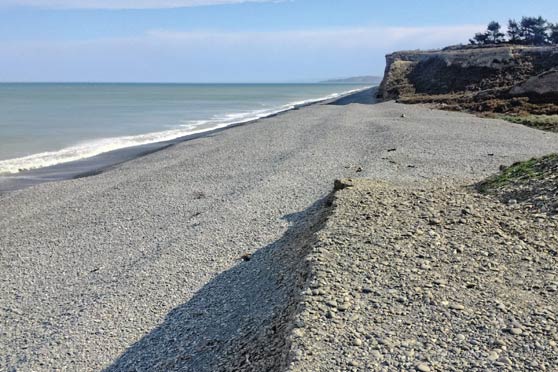
The main beach berms are made up of large, smooth stones which give way to a mix of gravel and sand in the tidal zone, but it is a very tough, abrasive environment in which to fish, so you need to come prepared with no-nonsense tackle. On the upside, the depth of water beside the beaches makes it easy to cast into deep, fish-holding water – so long as the swell isn’t up.
It takes tough fish to survive in this environment, particularly when the regular heavy swells that sweep up from the south are added in, and tough they are. Non-scale species are dominant, sharks in particular, and some grow to extremely large sizes. Overall the species mix reflects the southerly latitude – almost exactly 45° south – and the southerly current running up the South Island’s east coast.
Target species on these beaches are spotty shark (known as rig in this neck of the woods), elephantfish, and large tope and sevengill sharks. In my student days equipped with cheap gear, I was dealt to a number of times by big sevengillers.
Less desirable species include skate, red cod, spiny dogfish and carpet sharks. These can be voracious and make your efforts to catch the target species extremely frustrating, but more about that shortly.
I returned in October, a bit early because the best fishing is usually in summer and autumn. However, the conditions were good, with flat seas and a hot nor’wester blowing offshore. I literally hadn’t been to the place in 15 years, but it basically looked the same, except for some added erosion of the coastal cliffs, which had taken away part of the access road.
What struck me the most was the steep nature of the beach. I’ve fished a lot of steep beaches right around New Zealand, but none that compare to those in North Otago. This, combined with the uninterrupted view out to the open sea of the Southern Pacific, gives these spots a real X-factor and a sense that anything might happen.
My bait selection was squid, paddle crabs and mussels. Traditional fish baits such as pilchard or trevally are quickly snaffled by spiny dogfish in this part of the country; my selection was based on baits that don’t appeal to them quite so much. In theory, using them might help my baits stay in the water long enough for something more desirable to show some interest.
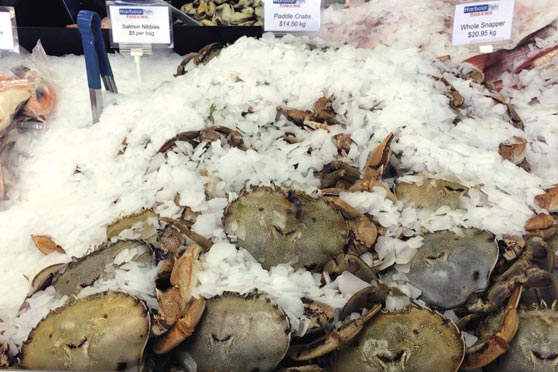
Squid is not a bait I use much when surfcasting in the North Island, but it is very effective in the South Island, particularly for elephantfish. Paddle crabs were another strategically-selected bait; again they are not very attractive to spiny dogfish, but are excellent on spotty sharks and also taken by elephantfish. While not easy to find, I’d happily chanced on some at a Dunedin fish supply before driving north.
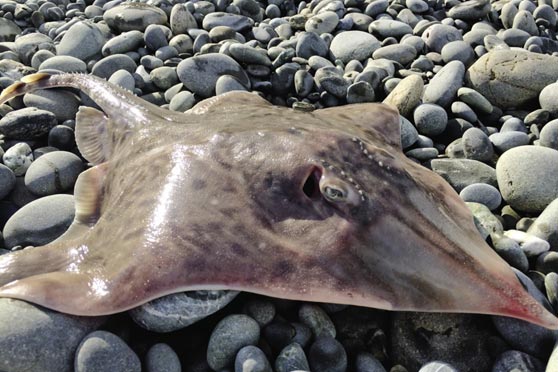
My first cast arced out into slightly discoloured but flat sea, and had barely hit the bottom when it was hit by a large rough skate – a really prehistoric looking non-scale species that’s common in the south. It’d taken a nicely-presented squid bait intended for elephantfish, and I hoped it wasn’t going to be one of those days when the undesirables take over. After this I focused on using crab baits, banking on their ability to keep the undesirables at bay for longer. The result was two hours of excellent spotty shark/rig fishing, with the highlights being 9kg and 10kg specimens that gave me a real run around in the wash. They used the slope of the beach against me, and both fights took up a good 10 minutes.
With some nice spotty sharks in the bag (well, actually returned to the surf), I turned my attention to sevengill sharks, making up some very big squid baits. Ultimately I had no luck with them, but the exercise did demonstrate the voracious nature of spiny dogfish. Even the smallest specimens seemed able to reduce a big bait to nothing in moments – and hook themselves on large hooks in the process.
The trick is to prepare round or ‘steak’ baits that spiny dogfish cannot get their mouths around. This really slows them down. By comparison, traditionally presented fillet baits which hang from the hook give them an edge to gnaw away at. Despite my best efforts though, the spiny dogs won the day.
About this time a southerly front made its impact felt. The temperature dropped and rain suddenly fell. I packed up and returned to the car, which told me the temperature had dropped to 12°C; only a few hours earlier it had been a blazing 31°C. It’s like that down there!
Southerlies are a real enemy of the fisherman this far south, packing a real sting and driving up the swell in no time at all. This limits days on the water and helps to keep the fishery healthy.
OVERALL, this is really rugged surfcasting that appeals to me because of: the unique mix of species (quite different to the North Island); the plentiful nature of the fishery; and the genuine opportunity to play some really big fish on surfcasting gear. It may not appeal to everyone, but if that’s the case then the immortal words of Fred Dagg come to mind: “We don’t know how lucky we are.”
Recent Forum Posts Visit Forum

Shane Jones
in Fisheries Management13 hours ago
Tzer
Far cry to the twats at Liegasea/NZSFC were proposing of 5 Tarakihi person in their submission for the central management area and this is what our...

Bluefin Tuna at the cavs.
in The Briny Bar33 hours ago
smudge
Despite my years of fishing I haven't really fished many places, my focus has always been on Auckland's west coast and out toward Great Barrier. I...

Casting gloves
in Popper and Topwater Fishing77 hours ago
Mc Tool
100 bucks for a lure 😬. Watching one of them flying over the horizon without the line attached would be " character building " for sure...
I thought Id post some nice photo's , join...
in The Briny Bar128 hours ago
Alan L
That is a very cool pic Krow.The Far North is very cool, the Far far North even cooler. Mint looking day.Alan...

Mc Tools berley mincer
in The Briny Bar136 hours ago
SaltyC
Good size, they scrap well. Got an 18kg one up in Vava'u back a few years ago fishing off squeaky Going's boat. That was quite a...

Out with the "Twelves"
in Fishing Reports190 hours ago
Pcj
I should be able to get out end of October. The nephew been out virtually every weekend over winter and has done well. It seems the...
Manukau Harbour & West Coast fishing
in Fishing Reports198 hours ago
smudge
Nice work Schecter, I think snapper may be around sooner than you think. Well I am hoping so...

Whangarei Harbour report.
in Fishing Reports630 hours ago
krow
180 +m is where I've had to be lately. A lot less low foul around these parts and some of it shallower that looks like Tarakihi...
Whangarei Harbour Scallops
in Fisheries Management740 hours ago
Pcj
Reopening WhangÄ쳌rei Harbour to recreational scallop fishingTÄ“nÄ쳌 koeFisheries New Zealand is seeking feedback from tangata whenua, stakeholders, and the public on whether WhangÄ쳌rei Harbour should be...
SNA1 Recc fishing cops the blame.
in Fisheries Management836 hours ago
Tzer
What Liegasea won’t tell you is that some of their own fisheries contractors were co-authors of this study for fear of being called hypocrites, one of...
Popular Articles

Softbait Fishing - Part 1 - gear selection
John Eichlesheim writes an article about selecting the right equipment for softbait fishing... Read More >
Softbait fishing Pt 2 - tips and tricks
Techniques, tips and tricks of softbait fishing – getting the most from your soft baits.... Read More >

Surfcasting - setting yourself up
Gary Kemsley helps sort out the necessary gear for intending surf fishers.... Read More >

Squid - How to catch them
Squid fishing is a rapidly growing aspect of fishing - Paul Senior shares some hints and tips to get started.... Read More >
Fishing Reports Visit Reports
Outer Hauraki Gulf Fishing Report 17/09/26
Spring wind the handbrake. Spring is starting to make its presence felt in the outer... Read More >
Top of the South Fishing Report - 17/09/26
Early snapper in Tasman Bay. Well, spring is finally here, and the days are getting... Read More >
Bream Bay Fishing Report - 17/09/26
Good snapper catches reported. After Tangaroa turned off the fish tap for a month or... Read More >
Bay of Islands Fishing Report - 17/09/26
Pacific bluefin tuna for the lucky few. The last fortnight has seen more fishable days... Read More >
Comments