
Surfcasting at Dawn
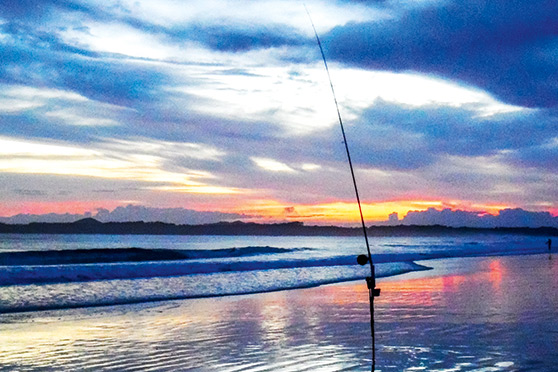
First light is often the most productive and peaceful time to fish, writes Gary Kemsley. He shares why he loves fishing this time of day and discusses how he makes the most of the dawn window.
There is something about fishing at dawn that is difficult to explain. There are the smells of the impending day – smells that are gone straight after daylight. There is the promise that the sun will rise, even though it may be as dark as the proverbial ‘inside of a cow’. The stars can shine bright enough to camouflage the first light on the horizon. Distant hills slowly reveal their ridge lines in hues that differ depending on how far they’re away.
Sounds are unhindered by daytime distractions – the breaking waves are sharp, powerful and loud. They can surprise you, too, when they arrive in the dark, smashing into the beach in front of you. Gulls start their food search in the dark. You may hear them but not see them. They can see and smell their way about in the dark though, so you need to cover baits left with your gear.
In the pre-dawn darkness, your tip lights, red and green, will stand proud, still and silent. There is no wind, no bites, or anything else to make them move, but you know it will happen soon. This dark to daylight period is undeniably amazing. The fish will come – they always do. The only thing that can spoil a personal and intimate dawn snapper session is a rogue lemonfish (smoothhound) that will take a bait and demand fifteen minutes of your time to land it. Your dawn window only lasts about 20 to 25 minutes so you can do without struggling with a big lemonfish (unless you want one).
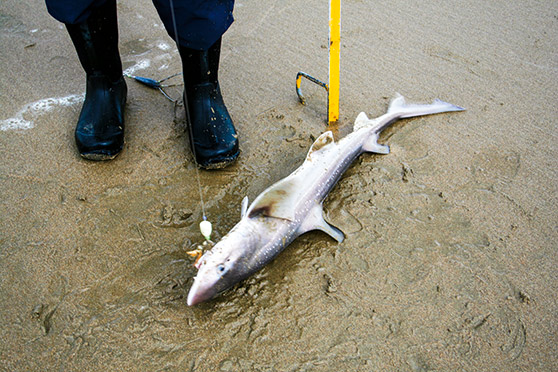
Lemonfish or rig can be tasty, sporty and accomodating but can also be annoying, taking up fishing time when snapper are around.
Baits of anchovies and octopus will keep the lemonfish off your hooks until the school snapper you are after arrive. Once the lemonfish disappear you can go back to a crab or prawn bait. This way, you will be better prepared for the snapper that come racing in on their dawn raid for bleary-eyed crabs and sleepy molluscs. This happens just as the light is forcing back the night. The snapper come quick, like school kids in a lolly shop. It’s a real hit and run job, and if you’re fishing two rods, both will likely bend over. Land one fish, change traces and cast back out before bringing in the second. That way you may get a third as you play the second fish. It’s all go, and you had better be ready because the snapper will soon be gone.
The horizon will slowly reveal itself. Light from the sun will soon disclose any swell heading past your beach. Small humps to us could mean huge swells offshore. A flat horizon is what we look for, although some low-slung cloud bank could fool you before the day really starts to lighten up. Watch for the sky colour as the light strengthens. The old saying, ‘red sky in the morning, sailors warning’ is worth considering.
You will miss a lot of this though because you will be in the middle of a major bite time, no matter what the tide is. I like to be ready an hour before daylight arrives. You need to prepare for this early bite. Every minute you waste with your line out of the water during the bite time could cost you a fish, or at least the chance to catch one. I like to have plenty of traces baited up and ready for action. This way, after I land a fish, I can quickly replace the trace and get my line back out to the strike zone immediately. I can deal with the landed fish while the baits are in the water, or when all the action has finished.
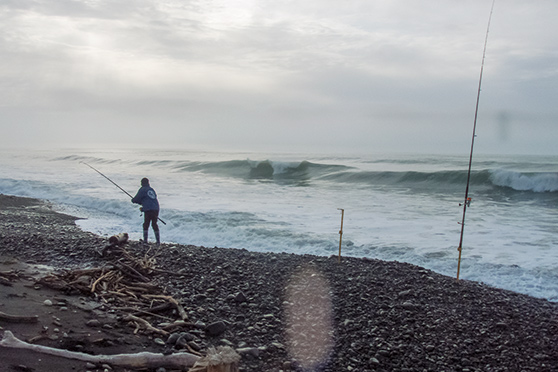
As the light strengthens the bite begins at Mohaka Beach.
The one thing that you can be pretty sure of is that any feeding period will finish when the first sunray hits the water’s surface. There are exceptions of course: some days the fish keep on biting for ages after the sun is up, and other days the fish never show up at all. The deeper the water you are fishing, the more chance there is that the fish will hang on a bit longer. Heavy overcast conditions or even rain will help hold the snapper in close. They feel secure in low light situations. Conversely, when the sun jumps up over the horizon and bright rays stretch out over the water, the fishing will cease early, so you had better be ready for a short bite time.
What gear to use?
I like pulley rigs and short traces for early morning fishing. Traces up to 30cm are good. I don’t mind a bit of bling such as sequins and fluoro beads but don’t overdo it. There seems no reason to overdo the bling as the fish are generally feeding hard and will find the baits anyway. The pulley rig system allows for casts to distant holes that traditional rigs won’t reach. On shallow beaches, it is great to have this option. A single hook is ideal as baits can be small and compact and no big or double hooks are required. Confident biters like snapper will hook themselves whether you are holding the rod or not. I use 4/0 to 6/0 circle hooks. Use your bait to hide the hook and just leave the point showing. Baits should be lashed to the hooks with bait elastic.
I like heavy breakout sinkers as they help set the hook before you reach the rod. The resistance breakout sinkers offer as they pull away will be enough to panic your fish and send it running. The circle hooks will turn in the corner of the mouth, securing your fish. Make up your traces on 24kg hard mono, or better still, fluorocarbon. I make a point of using new hooks each outing. When you consider the other costs involved, the cost of a new hook is virtually nothing.
Be picky with your bait. Fresh is best, but fresh frozen also works. For my morning snapper, I like octopus, crayfish or skipjack tuna for bait. If I am fishing two rods, one will have octopus on the hook and I will cast it out and leave it there. With the other rod, I will try my other baits till I find what they want, or at least until they start biting. As I said, be prepared with multiple traces baited up and ready to go. If you are lucky, you may have a very intense and successful period of fishing just before and after the sun rises, and you will want a variety of pre-baited rigs at your disposal.
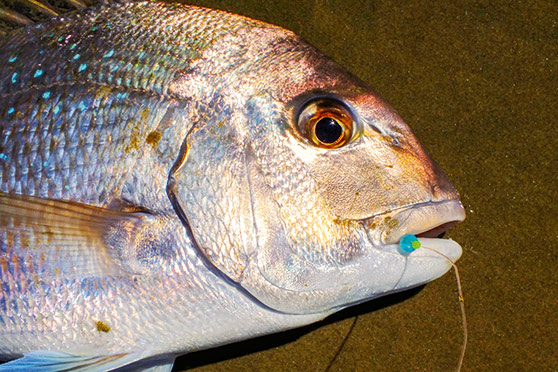
Octopus, skipjack tuna and crayfish are among the writer's favourite snapper baits.
Selecting your spot on the beach is important too. Just rocking up to the water and casting out may see you missing the dawn action. On a sandy beach, there are innumerable spots. Look for deeper water in the corners where the sand meets the rocks. You could also find a spot where a rip is running from the beach straight out to sea and cast to the edges of it.
Any spot where the waves are backing off within your casting range is worth trying as this indicates deeper water. Darker coloured water also indicates deeper water and is worth fishing. Try and get a look at your beach the day before you fish and mark the spots you are going to try. Remember, it will be dark when you arrive. Something as simple as a stick in the sand dunes at the back of the beach will help you locate your possie in the morning darkness.
If you fish through the dawn and catch nothing, have a good look at your spot. Is it deep enough? Is there a reason for the fish to be there? Would it be better at a different tide? Were you casting to the right spot? Learn from your time on the beach. After you’ve analysed any unsuccessful fishing, just lay back in the morning sun and realise that you are in the best place on earth and others are now heading off to work. You are a winner anyway.
|
|
This article is reproduced with permission of |

Recent Forum Posts Visit Forum

Bluefin Tuna at the cavs.
in The Briny Bar6 hours ago
smudge
Despite my years of fishing I haven't really fished many places, my focus has always been on Auckland's west coast and out toward Great Barrier. I...

Casting gloves
in Popper and Topwater Fishing51 hours ago
Mc Tool
100 bucks for a lure 😬. Watching one of them flying over the horizon without the line attached would be " character building " for sure...
I thought Id post some nice photo's , join...
in The Briny Bar102 hours ago
Alan L
That is a very cool pic Krow.The Far North is very cool, the Far far North even cooler. Mint looking day.Alan...

Mc Tools berley mincer
in The Briny Bar109 hours ago
SaltyC
Good size, they scrap well. Got an 18kg one up in Vava'u back a few years ago fishing off squeaky Going's boat. That was quite a...

Out with the "Twelves"
in Fishing Reports163 hours ago
Pcj
I should be able to get out end of October. The nephew been out virtually every weekend over winter and has done well. It seems the...
Manukau Harbour & West Coast fishing
in Fishing Reports171 hours ago
smudge
Nice work Schecter, I think snapper may be around sooner than you think. Well I am hoping so...

Whangarei Harbour report.
in Fishing Reports603 hours ago
krow
180 +m is where I've had to be lately. A lot less low foul around these parts and some of it shallower that looks like Tarakihi...
Whangarei Harbour Scallops
in Fisheries Management713 hours ago
Pcj
Reopening WhangÄ쳌rei Harbour to recreational scallop fishingTÄ“nÄ쳌 koeFisheries New Zealand is seeking feedback from tangata whenua, stakeholders, and the public on whether WhangÄ쳌rei Harbour should be...

SNA1 Recc fishing cops the blame.
in Fisheries Management809 hours ago
Tzer
What Liegasea won’t tell you is that some of their own fisheries contractors were co-authors of this study for fear of being called hypocrites, one of...

here is one for you Tonto
in The Work-Up852 hours ago
Tonto2
Boat maintenance happening as we speak, hoping to get into late November...
Popular Articles

Softbait Fishing - Part 1 - gear selection
John Eichlesheim writes an article about selecting the right equipment for softbait fishing... Read More >
Softbait fishing Pt 2 - tips and tricks
Techniques, tips and tricks of softbait fishing – getting the most from your soft baits.... Read More >

Surfcasting - setting yourself up
Gary Kemsley helps sort out the necessary gear for intending surf fishers.... Read More >

Squid - How to catch them
Squid fishing is a rapidly growing aspect of fishing - Paul Senior shares some hints and tips to get started.... Read More >
Fishing Reports Visit Reports
Outer Hauraki Gulf Fishing Report 17/09/26
Spring wind the handbrake. Spring is starting to make its presence felt in the outer... Read More >
Top of the South Fishing Report - 17/09/26
Early snapper in Tasman Bay. Well, spring is finally here, and the days are getting... Read More >
Bream Bay Fishing Report - 17/09/26
Good snapper catches reported. After Tangaroa turned off the fish tap for a month or... Read More >
Bay of Islands Fishing Report - 17/09/26
Pacific bluefin tuna for the lucky few. The last fortnight has seen more fishable days... Read More >
Comments