
Stillwater trout
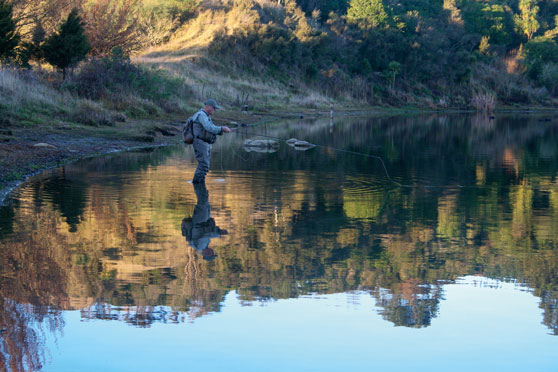
I was at the edge of a small lake in the central North Island. It was hot and it was still – not the best conditions for still-water trout fishing.
Sitting on the back of my truck, I set up my gear. My rig was determined by several factors, including: the water depth; the water clarity; local prey items; and the technique I planned to use. I knew that conditions would change while I was there, and that I would need to change with them for the best results.
I started with a ‘truck and trailer’ rig, consisting of a Whitlocks damsel (green) on the dropper and a small black Woolly Bugger 40cm back on the point. The idea here was to make the Woolly Bugger look like a cockabully chasing a damsel nymph.
Looking over the lake I could see little in the way of damsel fly movement, but knew that would come later in the day when it was really hot. That would have the trout jumping right out of the water as they tried to catch the adult flies that hovered and dipped over the water. Earlier in the day, it was more likely that damsel nymphs would be moving into the shallows and heading for the reed beds, where they eventually crawl out and hatch in the sun.
The movement of nymphs isn’t always visible, but you can bet it’s going on. When wading out in the water, you can see them swimming by like little fish as they head for the shoreline reeds. Some nymphs will even use you to climb out and hatch on.
I chose a 3kg tapered leader, three metres long. To that I added more 3kg tippet material (fluorocarbon of course), left a tag for the Damsel nymph, and tied the Woolly Bugger on the end. This was a well proven, deadly combination.
My chosen outfit was a 9’ (2.74m), 7-weight Redington Vapen rod, attached to a Redington Delta 7 reel carrying 100m of 15kg micron backing and a WF-7-Floating Rio Gold fly line. The 7-weight would give me castability later on, when the wind came up, but still allow a subtle presentation when things were still.
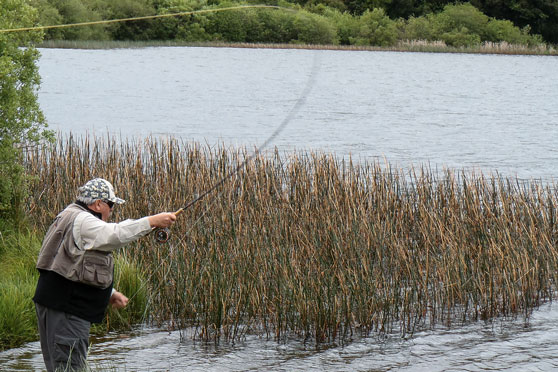
I watched for as long as I could stand it before easing down to the stony shore. There had been no sign of life. You need to be in the right mindset for this type of fishing. Unlike river fishing, where you can see exactly where a fish may lie (e.g. just out from the main current or sheltered behind a rock), still-water fishing is more about fishing the spot and waiting for the fish to come to you, rather than going to them.
To select your fishing spot, be very aware that trout are creatures of habit, particularly brown trout. In still waters they often have beats, sometimes a couple of hundred metres long. They will cruise that stretch of lake edge repeatedly all day – or until a bigger/stronger trout turns up and drives them away (I have found that large dogs and small children have the same effect!).
A repetitive cruiser provides a great target for you. Hide yourself in bankside bushes and watch and wait. If not 100 percent ready to make a cast, let the trout pass, and note how long it takes to return from the other direction. Then, as the brownie cruises up, be ready to drop your fly/flies in front, where they can be seen, but not so close you scare the fish.
These fish are opportunistic, so fly choice is not too important. Remember, though, that this is the trout’s territory; it may have cruised this edge 20 times before being spotted by you. It will know everything there is to know about the beat and will be wary of anything out of place. Consequently, don’t move when the trout is in sight, but be ready to twitch your fly to get its attention – not too much, just sufficient to give life to the fly.
If, however, you find that there is bad light for spotting fish, set yourself up so you are casting along a weed bed edge or underwater drop-off. Now you need to be patient and just make the best casts you can to place the flies in an area where you expect the trout to pass.
That was my situation in the glassy-calm of a misty morning. On the plus side, I knew the area well from visits over the years, including the fact that an invisible weed bed extended out to the right of a reed bank, where the bankside shallows dropped to deeper waters. I had caught many trout just by fishing my flies along and over the drop-off.
My first cast was too far right and came back with a streamer of weed. The second was better, so I let the flies sink a metre before starting a jerky retrieve that gave life to the flies. At one point I felt momentary weight, which could have been the weeds again, or may have been a fish. So I cast again and sank the flies. After stripping a metre of line to straighten it, I came up tight to a feisty 1kg rainbow, which came off the third time it cleared the water.
I cast again. Sink. Wait. Right, start the retrieve. All the time I was imagining what the flies were doing. Then I saw the floating line’s wake lines suddenly ‘V’ as a fish pulled it down. Upon lifting the rod, a nice 54cm rainbow took to the air. So how did I know its length? Well, a few minutes later I was taking its photo!
In the process, I noticed the trout was fin-clipped. This is how the Fish & Game people monitor trout growth in lakes (provided we send in details of our catches). I noted the details and went back to the fishing.
Upon returning, I missed a fish first cast by not expecting it. It left a nice big swirl though, helping me gather my concentration.
A short time later, I hooked another as the fog lifted and the first breezes of the day came through, accompanied with bright sunshine. Both fish were on the damsel fly, so off came the Woolly Bugger and on went a small Hamills Killer. The damsel had earned the right to stay.
The Hamills went on to claim two more fish in short order – one was also clipped, the other unmarked.
The breeze was coming up and things were changing, so I did, too. While the damsel was retained, on went another metre of fluorocarbon and a lightly weighted green midge pupa fly. I also added a bright orange indicator three metres up the leader (I know some readers will hate that, but my eyes are not what they used to be, and I can still cast way out). The indicator is invaluable, allowing me to hook many fish I might otherwise never have known were there.
By this stage the breeze was a steady right to left across the bay and towards the reedy corner drop-off. I cast well right, straightened the line, the allowed my flies to get down a metre or more, then twitched them back with my rod tip lowered and following the line. Three casts in and I was starting to doubt my choice of technique, when the indicator disappeared and I lifted into a solid 54cm fish (a keeper).
Another hour passed, and I was close to leaving. I hadn’t touched another fish despite a couple of fly changes. Last resort time.
Removing the flies and indicator, I tied on a green, very sparkly Woolly Bugger. That might wake them up. It did – firstly, another of those little 35cm fish that managed to jump off like the first one, and later the fish of the day, a fat hen rainbow of 51cm. Interestingly, that fish took the Woolly Bugger as it was sinking; a good reason to always straighten the line after casting.
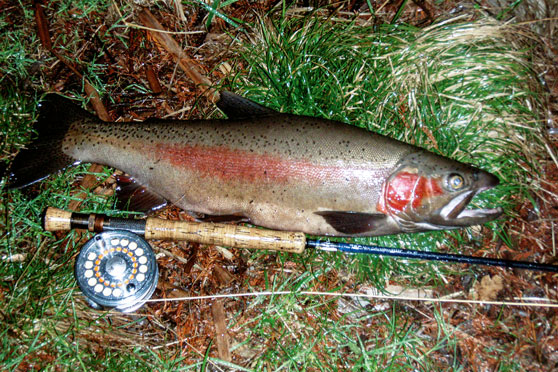
Well, that was my day and I was well pleased with the results. It had been interesting, tactical fishing that required some thought, reminding me why I love still-water fishing.
|
|
This article is reproduced with permission of |

Recent Forum Posts Visit Forum

Trailer wheel clamp
in The Boat Shed3 hours ago
krow
I like the SAS wheel clamp. I've had no issues with the lock....

Shane Jones
in Fisheries Management5 hours ago
Fish Addict
The recreational sector can expect no favours from politicians. They know all too well who butters their bread and it ain't the recs. No different over...

Foton tunland v9
in The Briny Bar6 hours ago
Ho Dee
not fishing related and delete if required but was wondering if any has one of these or someone who has just wanting so e real world...

Bluefin Tuna at the cavs.
in The Briny Bar53 hours ago
smudge
Despite my years of fishing I haven't really fished many places, my focus has always been on Auckland's west coast and out toward Great Barrier. I...
Casting gloves
in Popper and Topwater Fishing97 hours ago
Mc Tool
100 bucks for a lure 😬. Watching one of them flying over the horizon without the line attached would be " character building " for sure...
I thought Id post some nice photo's , join...
in The Briny Bar148 hours ago
Alan L
That is a very cool pic Krow.The Far North is very cool, the Far far North even cooler. Mint looking day.Alan...

Mc Tools berley mincer
in The Briny Bar156 hours ago
SaltyC
Good size, they scrap well. Got an 18kg one up in Vava'u back a few years ago fishing off squeaky Going's boat. That was quite a...

Out with the "Twelves"
in Fishing Reports210 hours ago
Pcj
I should be able to get out end of October. The nephew been out virtually every weekend over winter and has done well. It seems the...
Manukau Harbour & West Coast fishing
in Fishing Reports218 hours ago
smudge
Nice work Schecter, I think snapper may be around sooner than you think. Well I am hoping so...
Whangarei Harbour report.
in Fishing Reports650 hours ago
krow
180 +m is where I've had to be lately. A lot less low foul around these parts and some of it shallower that looks like Tarakihi...
Popular Articles

Softbait Fishing - Part 1 - gear selection
John Eichlesheim writes an article about selecting the right equipment for softbait fishing... Read More >
Softbait fishing Pt 2 - tips and tricks
Techniques, tips and tricks of softbait fishing – getting the most from your soft baits.... Read More >

Surfcasting - setting yourself up
Gary Kemsley helps sort out the necessary gear for intending surf fishers.... Read More >

Squid - How to catch them
Squid fishing is a rapidly growing aspect of fishing - Paul Senior shares some hints and tips to get started.... Read More >
Fishing Reports Visit Reports
Outer Hauraki Gulf Fishing Report 17/09/26
Spring wind the handbrake. Spring is starting to make its presence felt in the outer... Read More >
Top of the South Fishing Report - 17/09/26
Early snapper in Tasman Bay. Well, spring is finally here, and the days are getting... Read More >
Bream Bay Fishing Report - 17/09/26
Good snapper catches reported. After Tangaroa turned off the fish tap for a month or... Read More >
Bay of Islands Fishing Report - 17/09/26
Pacific bluefin tuna for the lucky few. The last fortnight has seen more fishable days... Read More >
Comments