
Sticking with Barbless Hooks

Barbs make hooks stick – in a fish’s jaw, but also in an unlucky angler’s flesh! John Eichelsheim looks at the positives of using barbless hooks.
Barbed hooks are more difficult to dislodge from a fish’s mouth, which is why fish hooks have had barbs for hundreds of years.
Bigger hooks have bigger barbs and the larger the barb relative to the size of the hook, the better the hook holds fish. On the flip side, a big hook with a large barb requires considerable force to punch through a fish’s jaw, but once buried past the barb, a fish is unlikely to shake the hook.
One of the biggest changes in fishing tackle during my lifetime is the almost universal adoption of chemically sharpened hooks for most styles of fishing. Chemically sharpened hooks not only tend to be sharper than old-style mechanically sharpened hooks, they’re also lighter gauge with less prominent barbs. These modern hooks are easier to set, but with their smaller barbs, they don’t hold quite as well. It’s trade-off: better penetration or better holding.
Personally, I always go for better penetration – once the fish is hooked, I’ll figure out how to keep it on the line.
Carbon steel, chemically sharpened hooks are stronger for their gauge than the older stye tempered steel hooks, which makes them easier to disguise in baits or lures, another property advantageous to the angler. The type of hook point makes a difference to a hook’s holding qualities too, with curved-in points holding best, but many of the popular hook styles have needle or hollow points.
These points are designed for easier penetration, but they don’t offer any holding advantages. Large hooks sometimes have knife points that slice through tissue to deeply bury the hook point well past the barb.
While a barb can prevent the hook falling out, it can also do a lot of damage to the fish. That’s why more and more anglers, particularly those practising catch and release, use barbless hooks. Indeed, there’s a good argument for using barbless hooks all the time, since they do far less damage to unwanted or juvenile/undersize fish which might otherwise suffer severe hook injuries.
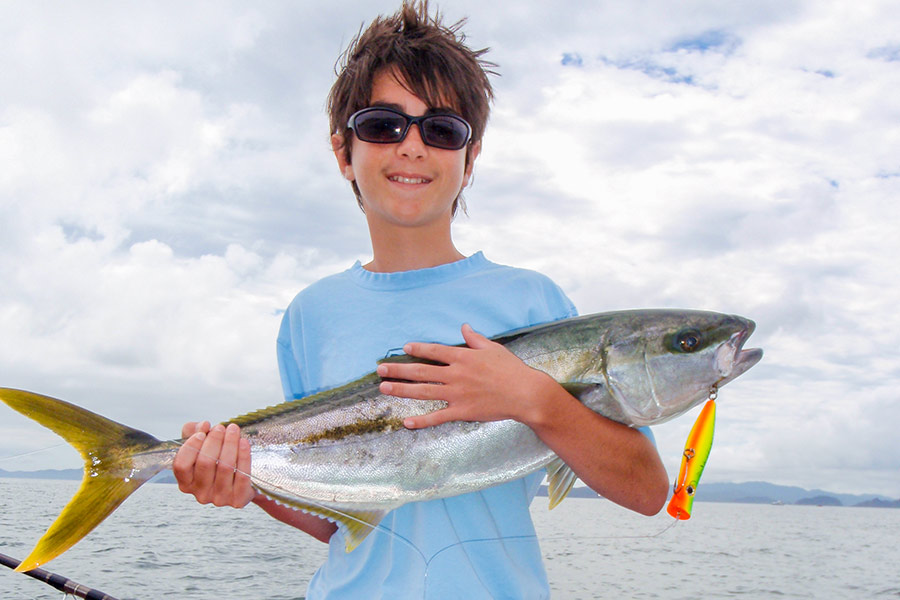
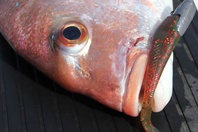
Barbless hooks make releasing undersized fish easier and safer - for both angler and fish.
Many fishing tournaments around the world mandate fishing with barbless hooks only. That means fish don’t suffer major hook trauma and, after measuring/weighing, they can be released in healthy condition.
But what about the potential of losing a fish because a barbless hook falls out? Yes, it’s probably true a few more fish are lost using barbless hooks (though you may hook more…), but if you keep good tension on the line, the hook won’t fall out. Keeping a working bend in the rod is simply good fish-fighting technique.
Fish that jump, or fish that change direction suddenly, are trickier to stay connected to with barbless hooks. Fly fishers have a certain advantage because thick fly lines suffer so much drag through the water, they maintain a certain amount of tension on the fish no matter what the angler does with the rod.
Regardless of the tackle, when a fish jumps the traditional response is to ‘bow’ the rod, lowering the tip towards the water to protect the line from shock loads when the fish re-enters the water. I’m uncertain bowing is of much benefit when fishing barbless hooks; however, keeping the rod tip low to the water (while retaining a good rod bend) seems to discourage fish from jumping. It also keeps more line in the water (as does applying side pressure with the rod) so there’s always a little bit of line drag to help hold the hook in place.
Barbless hooks are becoming more generally available, but they are still not common. Fly fishers can choose from a good selection of sizes and styles, but the rest of us have less choice. That said, topwater fishers can now buy BKK heavy-duty barbless hooks, which are ideal for lure fishing applications.
But for most anglers wanting to fish barbless, it comes down to modifying standard hooks. Fortunately, rendering hooks barbless is easy enough. Filing off the barb is one method, though that destroys any corrosion-resistant coating the hook may have, but the easiest way is to simply squash the barb using a pair of pliers. This works for hooks of any style or size.
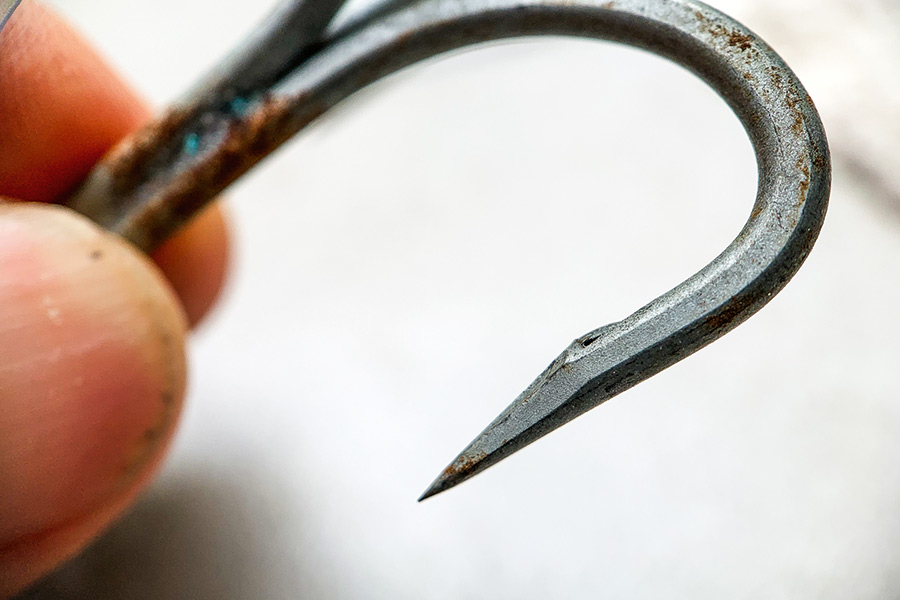
Barbs can either be filed off or crushed with pliers.
Using pliers leaves a very low barb, or at least a slightly thicker section where the barb was – but even a hook with an imperfectly flattened barb is easier to remove (from a fish or some part of your anatomy) than one that’s unmodified.
Anyone who fishes a lot will one day find themselves impaled on a fish hook. Fly fishers regularly hook themselves (or their fishing companions) while fly-casting, especially in windy conditions, but anyone casting a lure or bait is at risk. Lures armed with treble hooks carelessly left on the deck can be stepped on (a good reason to wear shoes when fishing) and unhooking fish always carries the risk of embedding a hook in your hand.
Lures with multiple hooks are the most dangerous, especially when some of those hooks are attached to a large, lively fish fighting for its life. Most hook injuries happen when anglers are attempting to boat a fish by grasping the lure or else during the unhooking process, whether the fish is in the water, on shore or inside the boat. Even single hooks attached to thrashing, slippery fish can cause injury.
Topwater fishing for kingfish has become very popular. Most topwater lures – stickbaits, poppers and similar – have multiple hooks: a pair of singles or trebles, or combinations of both. Fish are regularly hooked on one set of hooks only, so removing hooks from powerful fish like kingfish is fraught with danger since the lure’s other hooks are exposed, ready to catch the unwary.
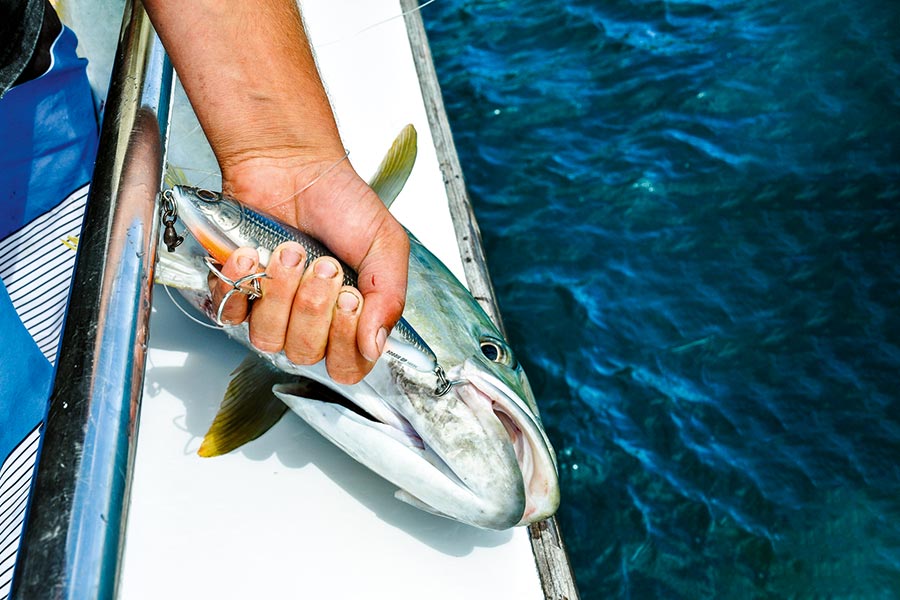
Treble hooks pose a greater threat to fingers when unhooking fish.
As you can imagine, it’s all too easy to catch a hook in some part of your body, usually your hand, while attempting to control and unhook an out-of-control kingfish. And guess what? Having your body attached to the same lure as a struggling fish is not a pleasant experience! With large powerful gamefish, it can even be fatal. More than one angler or wireman has been dragged underwater to their death by a big tuna, marlin, or shark after snagging a hook or becoming entangled in the line.
For my own and others’ safety, I always flatten the barbs on my topwater lures, and any other lures with multiple hooks, whether singles or trebles. One day I know I’m going to hook myself. I know it won’t be fun, but at least with flattened barbs I should be able to remove the hooks quickly, no surgery required. With barbed hooks, that’s not always the case.

April 2021 - John Eichelsheim
New Zealand Fishing News Magazine.
Copyright: NZ Fishing Media Ltd.
Re-publishing elsewhere is prohibited
Recent Forum Posts Visit Forum

Shane Jones
in Fisheries Management12 hours ago
Tzer
Far cry to the twats at Liegasea/NZSFC were proposing of 5 Tarakihi person in their submission for the central management area and this is what our...

Bluefin Tuna at the cavs.
in The Briny Bar32 hours ago
smudge
Despite my years of fishing I haven't really fished many places, my focus has always been on Auckland's west coast and out toward Great Barrier. I...

Casting gloves
in Popper and Topwater Fishing76 hours ago
Mc Tool
100 bucks for a lure 😬. Watching one of them flying over the horizon without the line attached would be " character building " for sure...
I thought Id post some nice photo's , join...
in The Briny Bar127 hours ago
Alan L
That is a very cool pic Krow.The Far North is very cool, the Far far North even cooler. Mint looking day.Alan...

Mc Tools berley mincer
in The Briny Bar135 hours ago
SaltyC
Good size, they scrap well. Got an 18kg one up in Vava'u back a few years ago fishing off squeaky Going's boat. That was quite a...

Out with the "Twelves"
in Fishing Reports189 hours ago
Pcj
I should be able to get out end of October. The nephew been out virtually every weekend over winter and has done well. It seems the...
Manukau Harbour & West Coast fishing
in Fishing Reports197 hours ago
smudge
Nice work Schecter, I think snapper may be around sooner than you think. Well I am hoping so...

Whangarei Harbour report.
in Fishing Reports629 hours ago
krow
180 +m is where I've had to be lately. A lot less low foul around these parts and some of it shallower that looks like Tarakihi...
Whangarei Harbour Scallops
in Fisheries Management739 hours ago
Pcj
Reopening WhangÄ쳌rei Harbour to recreational scallop fishingTÄ“nÄ쳌 koeFisheries New Zealand is seeking feedback from tangata whenua, stakeholders, and the public on whether WhangÄ쳌rei Harbour should be...
SNA1 Recc fishing cops the blame.
in Fisheries Management835 hours ago
Tzer
What Liegasea won’t tell you is that some of their own fisheries contractors were co-authors of this study for fear of being called hypocrites, one of...
Popular Articles

Softbait Fishing - Part 1 - gear selection
John Eichlesheim writes an article about selecting the right equipment for softbait fishing... Read More >
Softbait fishing Pt 2 - tips and tricks
Techniques, tips and tricks of softbait fishing – getting the most from your soft baits.... Read More >

Surfcasting - setting yourself up
Gary Kemsley helps sort out the necessary gear for intending surf fishers.... Read More >

Squid - How to catch them
Squid fishing is a rapidly growing aspect of fishing - Paul Senior shares some hints and tips to get started.... Read More >
Fishing Reports Visit Reports
Outer Hauraki Gulf Fishing Report 17/09/26
Spring wind the handbrake. Spring is starting to make its presence felt in the outer... Read More >
Top of the South Fishing Report - 17/09/26
Early snapper in Tasman Bay. Well, spring is finally here, and the days are getting... Read More >
Bream Bay Fishing Report - 17/09/26
Good snapper catches reported. After Tangaroa turned off the fish tap for a month or... Read More >
Bay of Islands Fishing Report - 17/09/26
Pacific bluefin tuna for the lucky few. The last fortnight has seen more fishable days... Read More >
Comments