
Soft-Baiting Basics

Some days you don’t have time for a big strayline session, and at other times you can’t be bothered with the blood and guts that come with a messy bait session. This is where soft-baiting comes in handy – and there are times when it will actually out-fish bait! The average size will also be better too as you don’t tend to catch juvenile fish on soft-baits. As an added bonus, you don’t tend to gut hook fish, making catch and release an option.
Casting a soft-bait is very popular on both boats and kayaks. It’s also a cheap form of fishing to get into – a $100 soft-bait setup will get you started.
Soft-baiting can be successful almost anywhere: land-based, along sandy beaches, over reefs and in harbours. When I’m soft-baiting, I will often fish in depths from right up in the shallows out to around 30m. My favoured depth is 12-20m due to the gear we use and locations we fish. Soft-baiting can be done in deeper water too, but you may need to revisit your gear. A heavier jig head and potentially heavier tackle, depending on the target species, will be required.
When I’m fishing soft-baits, I like to use a purpose built soft-bait rod, which allows me to cast further, work the lure more effectively and detect bites! I like to use a small spinning reel anywhere from a 2000 to 4000 size, spooled with 10-20lb braid. It’s important to use braid as it has very little stretch, meaning you are more likely to feel any subtle touches from a fish. The lack of stretch also means you can put more movement into your lure. For example, with braid, if you move your rod tip 30cm, the lure will most likely move close to 30cm also. With mono, if you did the same, due to the stretch in the line the movement of the lure would be significantly less and certainly wouldn’t be as sharp. Braid is also much thinner in diameter compared to mono, which means it will have less drag through the water, possibly letting you use a lighter jig head. The thinner diameter also means that you will get more line on the spool, and you will be able to cast longer.
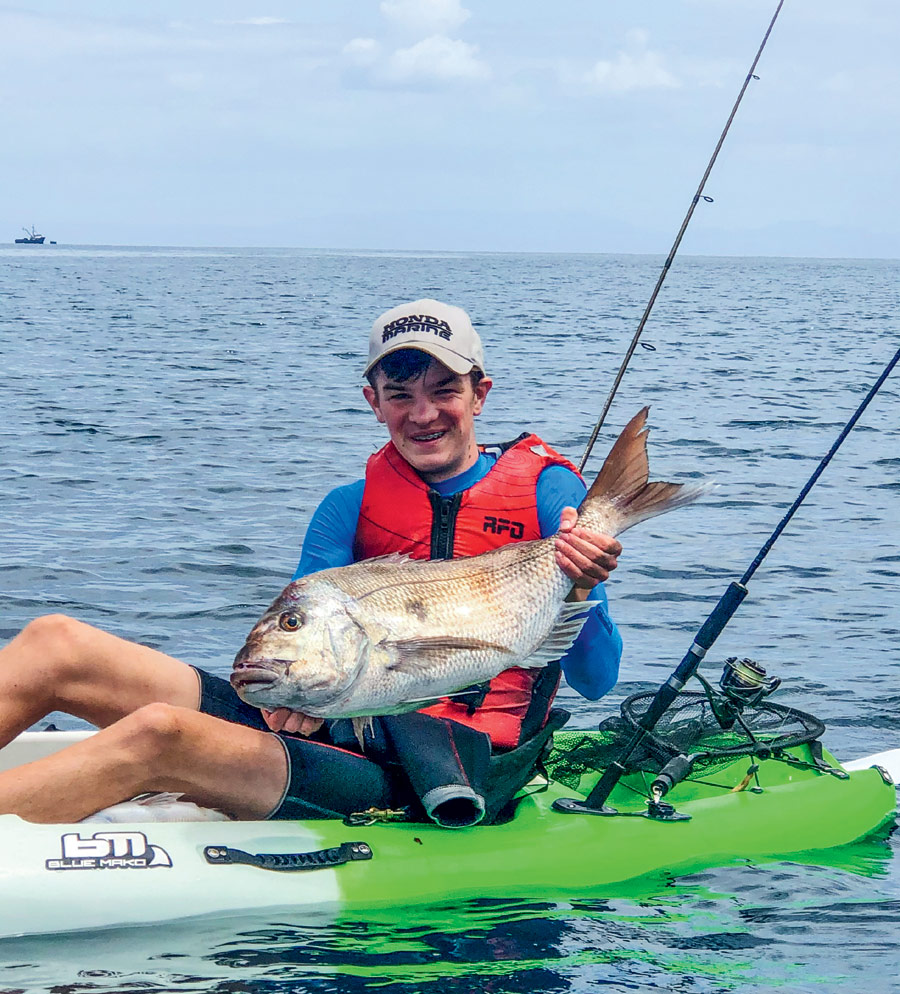
Fluorocarbon advantages
I like to use fluorocarbon leader as it provides a bit more abrasion resistance than other leaders, and it is apparently less visible to the fish. If I’m fishing over a sandy beach/clean bottom and the fishing is a bit slow, I’ll drop down as light as a 15lb fluorocarbon leader. If there’s one thing that I’ve learnt from my fishing experiences to date, it’s that using lighter lines and leader will definitely get more bites. However, the risk you take is having less strength and abrasion resistance to battle a big fish with.
If I’m fishing over a reef and there’s a likelihood of hooking a big fish, I’ll use a fluorocarbon leader as heavy as 30lb. This will give you a bit more protection from the reef and may be the difference between landing the fish and getting busted off.
To connect the braid to the leader, I like to tie an FG knot. The FG is definitely strong but can be a fiddly knot to tie. An alternative option that isn’t quite as strong is a four turn ‘overhand knot’. When tying the overhand knot, it’s important to pull both ends of your knot up evenly without leaving any ‘little bunches’ in the line. To improve the strength of this knot, I will first tie a Bimini Twist into the braid to double the line. The doubled braid will then match the diameter of the leader better, making for a more balanced connection. This knot isn’t quite as strong or effective as an FG but may save some time when the fishing is hot! I will then tie my jig head onto the leader with a Uni knot.
Jighead choices
Selecting your jig head weight in relation to the wind, drift speed, depth and lure size is important. A heavier jig head is ideally suited to deeper water, a faster drift, or a more ‘relaxed’ fishing style. A correctly weighted jig head can be used for a technique we call ‘dragging’. This is when you drop your soft-bait down into the strike zone and then work the lure with a series of twitches, without winding in between. As the boat drifts on, the lure will probably angle out behind the boat. Once this happens, let some line out to drop the lure back into the strike zone. When your line angle is too far away from the boat, wind in and start again. If ‘dragging’, you will need to use a jig head that is heavy enough to comfortably sink into the strike zone, but not so heavy that it drags hard along the bottom (and become a snag hazard!).
A lighter jig head is ideally suited to when you’re fishing shallower water, fishing with a slow drift speed, or if you are actively fishing your lure. Actively fishing your lure means casting ahead (or to the side) of the boat’s drift and letting it sink into the target zone before giving it a series of twitches, a couple of winds and then a brief pause to allow the lure to sink again. After you have cast out, make sure you keep in touch with the lure as it sinks as quite often you’ll get picked up ‘on the drop’. To do this, hold the line in between your fingers and if you feel the line speed up or stop, flick the reel into gear and strike!
As indicated above, soft-baits are best suited to being fished off a drifting boat. This helps you cover more ground and, more importantly, it gives your lure more movement, making it look more natural.
When soft-baiting, you will need to identify where the fish are holding in the water column and try to keep your lure in that zone. In the Bay Of Plenty, we typically try to fish the bottom quarter of the water column as this is where our target fish will often be. Some days your drift is just too quick to fish the chosen area effectively. In this scenario, we will tow a sea anchor behind the boat. This is basically a big parachute that will fill with water and dramatically slow your drift speed down.
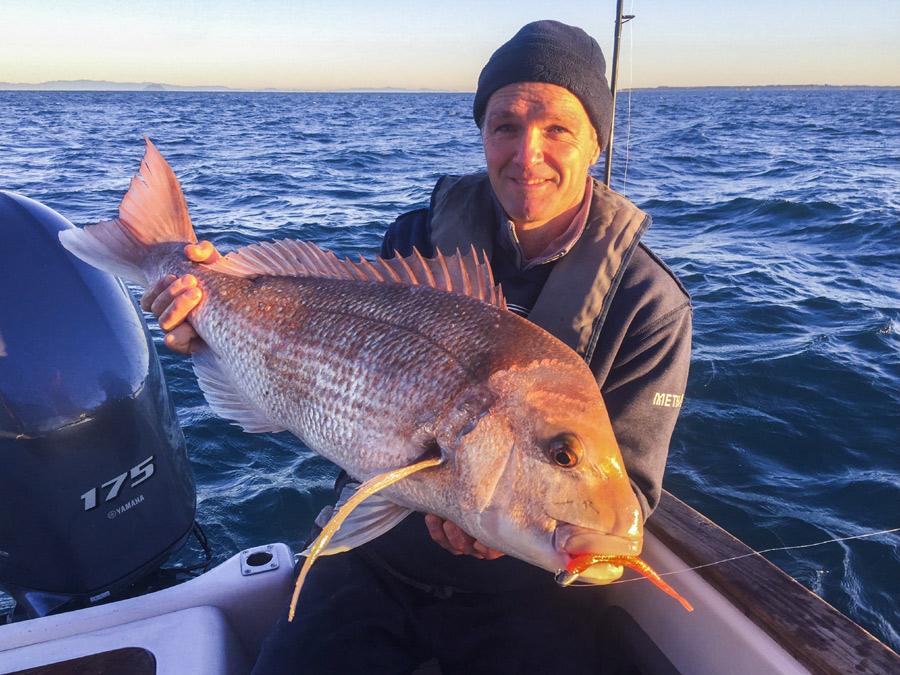
Big baits, bigger fish
If I’m targeting a bigger fish over a reef, I like to use a 7-inch ‘jerkshad’ or a ‘paddle tail’ style soft-bait, with the 7-inch ZMan ‘Atomic Sunrise’ being my current favourite option. However, when over the beach where we are less likely to come across bigger fish, I like to use a smaller 5-inch ‘jerkshad’ or a small curly/grub tail, which are also particularly effective on gurnard!
Soft-baiting can also be a very productive way of targeting kahawai. Anything small in black and white will be great for targeting these schooling fish. Casting around the edges of the school with a steady retrieve has been very effective for me. Something to consider is not casting your soft-bait into the middle of the school – this will spook the fish, causing them to go down and disappear.
Having soft-bait gear onboard as a backup option, if not as your first choice, is definitely worth the effort!
Recent Forum Posts Visit Forum

Trailer wheel clamp
in The Boat Shed2 hours ago
krow
I like the SAS wheel clamp. I've had no issues with the lock....

Shane Jones
in Fisheries Management5 hours ago
Fish Addict
The recreational sector can expect no favours from politicians. They know all too well who butters their bread and it ain't the recs. No different over...

Foton tunland v9
in The Briny Bar5 hours ago
Ho Dee
not fishing related and delete if required but was wondering if any has one of these or someone who has just wanting so e real world...

Bluefin Tuna at the cavs.
in The Briny Bar52 hours ago
smudge
Despite my years of fishing I haven't really fished many places, my focus has always been on Auckland's west coast and out toward Great Barrier. I...
Casting gloves
in Popper and Topwater Fishing97 hours ago
Mc Tool
100 bucks for a lure 😬. Watching one of them flying over the horizon without the line attached would be " character building " for sure...
I thought Id post some nice photo's , join...
in The Briny Bar148 hours ago
Alan L
That is a very cool pic Krow.The Far North is very cool, the Far far North even cooler. Mint looking day.Alan...

Mc Tools berley mincer
in The Briny Bar155 hours ago
SaltyC
Good size, they scrap well. Got an 18kg one up in Vava'u back a few years ago fishing off squeaky Going's boat. That was quite a...

Out with the "Twelves"
in Fishing Reports209 hours ago
Pcj
I should be able to get out end of October. The nephew been out virtually every weekend over winter and has done well. It seems the...
Manukau Harbour & West Coast fishing
in Fishing Reports217 hours ago
smudge
Nice work Schecter, I think snapper may be around sooner than you think. Well I am hoping so...
Whangarei Harbour report.
in Fishing Reports649 hours ago
krow
180 +m is where I've had to be lately. A lot less low foul around these parts and some of it shallower that looks like Tarakihi...

Popular Articles

Softbait Fishing - Part 1 - gear selection
John Eichlesheim writes an article about selecting the right equipment for softbait fishing... Read More >
Softbait fishing Pt 2 - tips and tricks
Techniques, tips and tricks of softbait fishing – getting the most from your soft baits.... Read More >

Surfcasting - setting yourself up
Gary Kemsley helps sort out the necessary gear for intending surf fishers.... Read More >

Squid - How to catch them
Squid fishing is a rapidly growing aspect of fishing - Paul Senior shares some hints and tips to get started.... Read More >
Fishing Reports Visit Reports
Outer Hauraki Gulf Fishing Report 17/09/26
Spring wind the handbrake. Spring is starting to make its presence felt in the outer... Read More >
Top of the South Fishing Report - 17/09/26
Early snapper in Tasman Bay. Well, spring is finally here, and the days are getting... Read More >
Bream Bay Fishing Report - 17/09/26
Good snapper catches reported. After Tangaroa turned off the fish tap for a month or... Read More >
Bay of Islands Fishing Report - 17/09/26
Pacific bluefin tuna for the lucky few. The last fortnight has seen more fishable days... Read More >
Comments