
Snapper Tagging Research

Josh Darby has returned plenty of big snapper over the years, but some fish are more special than others because of the stories they have to tell.
With variable winds forecast for the outer Hauraki Gulf, it wasn’t long before I managed to round up a crew. In this instance, it was my regular fishing buddy, Eli, and a new friend, Grant. Harking from Australia, Grant was basically brand new to fishing and I was keen to demonstrate to him that rugby’s not the only thing we have over the Aussies! I couldn’t have predicted the day would end with Grant capturing a 20lb Hauraki snapper, and – almost as rare – a recapture of a tagged fish.
The day started at 6am with Grant meeting me at the bottom of the driveway, coffee in hand. We picked up my FC535 fishing boat on the way through Orewa before meeting Eli at the Omaha boat ramp. As we launched, I felt what had initially been a slight SW breeze begin to rise and, sure enough, after passing Ti Point, we were met by some rather unpleasant conditions. Comfortable that we could still safely make the passage across the Jellicoe Channel, I aimed the bow at the northern end of Little Barrier.
Fishing here would provide ample protection from the 10-15 knot southwest breezes; however, we would have to tuck in quite close. This suited Eli and I just fine, given shallow water soft-baiting is our preferred method of fishing. Grant proved a good student and caught on quickly. After a few near misses resulting from mistimed casts, Eli and I eventually felt safe enough to come out from under cover and do some fishing of our own. The action was slow to begin with and by midday there were only a few pan sized snapper iced down in the Icey Tek. Grant had accounted for one of them that had jumped on his line during a hasty retrieve. Not exactly textbook, but his first snapper all the same.
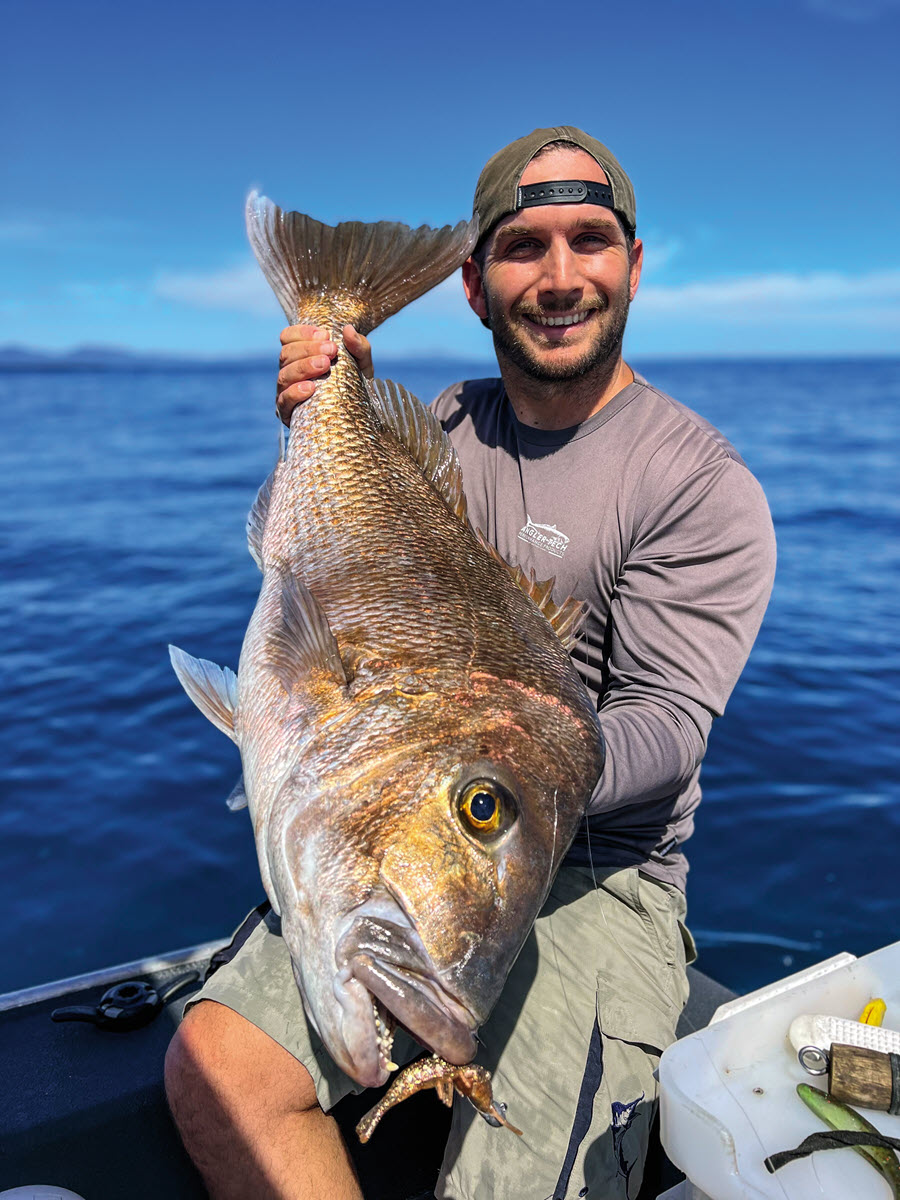
Josh with his Hauraki Gulf tagged 20lb snapper.
As the wind began to drop, I decided we would make our way out a little further to a shallow reef to try our luck. On arrival, the conditions had changed dramatically and we were met with a glassed sea disturbed only by the sporadic bubbling of kahawai and trevally schools breaking the surface.
We began to cast around these surface schools of fish and soon we were enjoying regular mid-water bites as we found that the snapper were predating amongst the schooling fish! The trick seemed to be: stick to light jig-heads (3/8-1/2 oz), and team them up with buoyant ZMan’s that slowed the descent rate. After casting into the middle of these surface schools of fish, it was simply a matter of keeping an eagle-eye on the belly of your line, watching for it to suddenly straighten, before striking. While most of the snapper were taking 5-10 metres down (in over 20 meters of water) there were a number of occasions where we hooked fish almost as soon as our soft-baits hit the water – unreal!
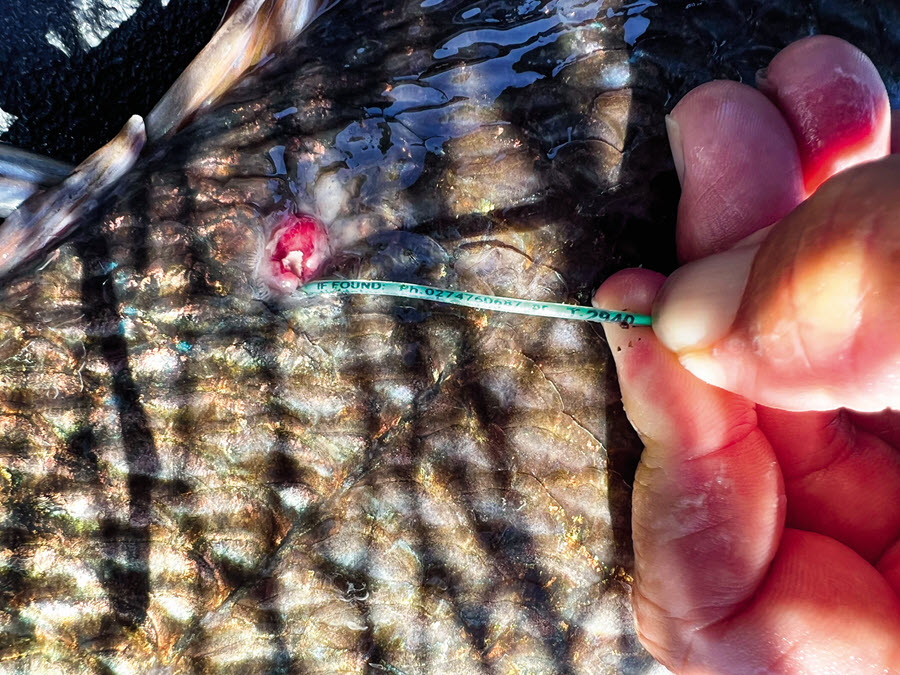
Details on the tag allowed Josh to find out when and where the snapper was originally tagged, and how much it had grown.
As the day went on the fishing once again slowed and I did something I often do when this happens – I went to the tried-andtrue Zman ShrimpZ. These shrimp imitation soft-baits have lots of dangly bits – legs, antenna, tail – that I think help to entice a bite when the fishing is slow. Sure enough, this soft-bait began to out-fish the other more traditional jerkshad-style tails. With the surface schools of trevally and kahawai continuing to bust up all around us, I decided to put my soft-bait rod down momentarily and quickly deploy a stick-bait in the hopes of enticing a marauding kingfish. Casting out, I began to methodically sweep my rod, causing my stick-bait to dart from side to side. I started to envisage and will a bow-wake to appear behind my lure. Alas, it wasn’t to be. As I began to place my stick-baiting combo back in a stern rod holder I suddenly noticed the tip of my rod begin to load up. Snapper or snag? I wasn’t exactly sure, so I quickly wound down and struck hard. Coming up tight, it felt like a snag. Despite an almighty bend in my rod, the rod-tip stayed put. There was a momentary pause, then I watched as braid began to exit my spool at a phenomenal rate.
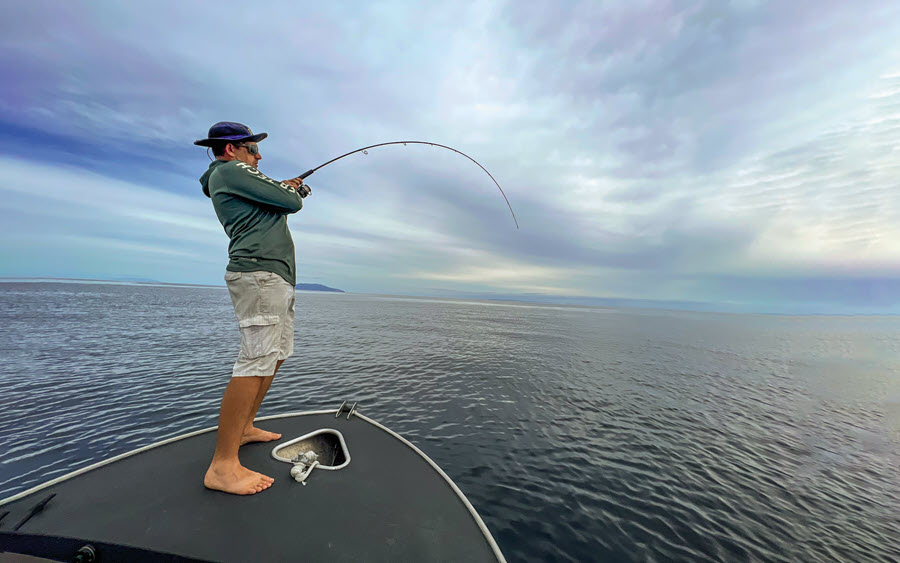
Fishing in 20 metres, it didn’t take long for the fish to find some kelp to bury itself in. Despite the predicament, I still felt reasonably confident we could free the fish. I was fishing a 30lb leader and had been in this situation numerous times before. Manoeuvring the boat, we managed to find an angle that allowed the fish to be pulled free. As soon as it released, I began to pump and wind, lightly clasping the spool at the bottom of my wind down to ensure no easy line was given that might allow the fish to bury itself back in the weeds. Fortunately, the runs began to slow and the large head shakes indicated we were hooked up to a snapper of some size. Grant jumped on the camera and began to get some footage as we all waited in anticipation for some colour to appear from the depths… and boy did it appear!
Immediately, Eli went for the net, which unfortunately was in a state of disrepair with some of the rubber attachment points worn through. This led to an incredibly tense moment as he lunged to scoop the net under the head of the snapper, only to have the netting slide up on itself, missing the target altogether! Silence fell over the three of us as the snapper dug back down momentarily before once again breaching the surface. This time, while holding the rubber netting to the frame, Eli successfully scooped up the snapper and we all breathed a sigh of relief.
With the fish boated, we set about getting a quick weigh and measure. Having recently purchased a Rapala weigh mat, we were able to undertake this quickly and soon we had confirmation that the snapper had broken the magic 20lb mark. Placing the snapper back in the water, it powered off before slowing and floating back to the surface. Fortunately, I carry a venting needle and so while Eli and I netted the fish, Grant was given instructions to locate it. While waiting, I noticed a long thin dark object protruding from the shoulder of the fish that I hadn’t spotted when we had initially boated it. Investigating further, I realised it was a tag. Sure enough, as I scraped at the growth, a set of numbers began to appear. I quickly got a few photos of this before venting the fish. It’s amazing how quickly venting seems to bring fish back to life and I’ve learnt to hold on tightly to the needle as the fish will often power off mid venting, as this one did.
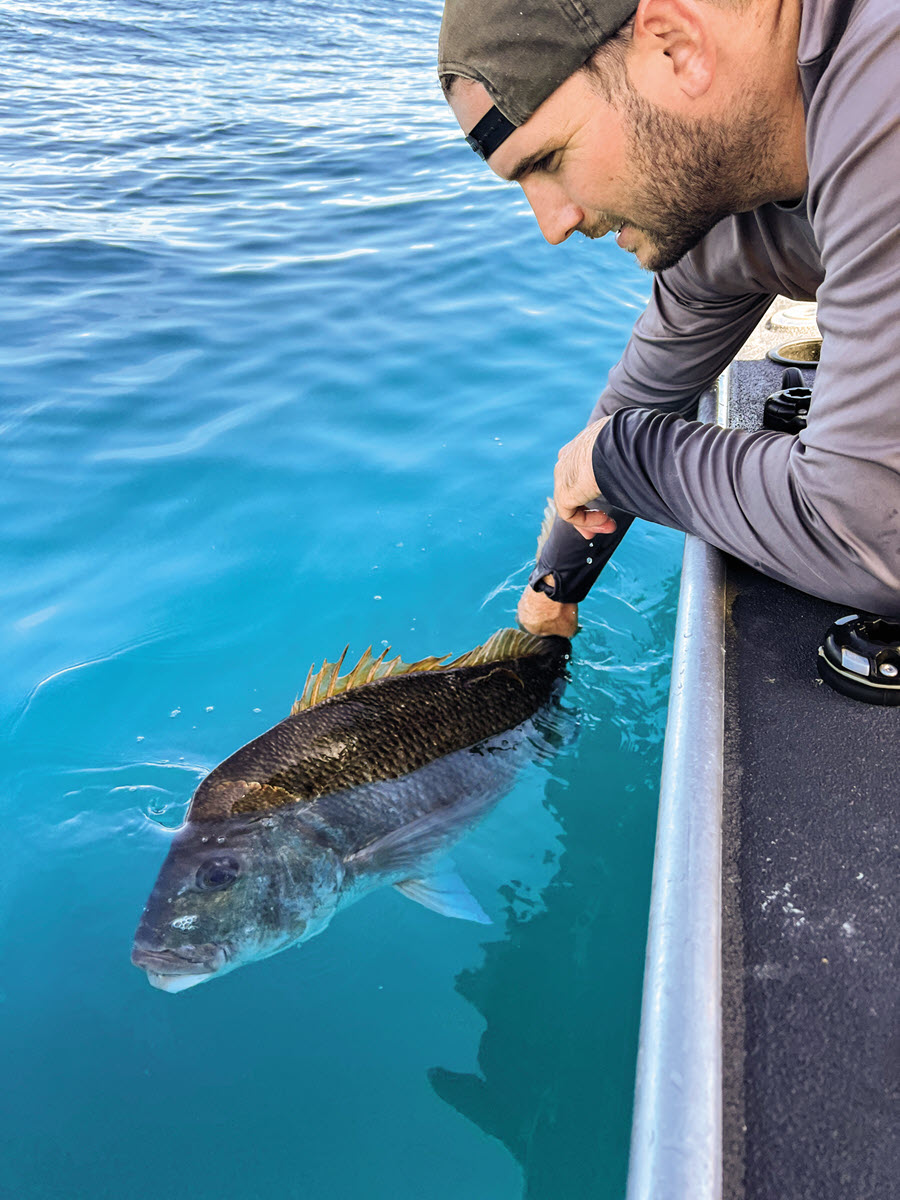
Released for the second time, so that another angler has an opportunity to catch it and further contribute to the research.
Having caught a tagged snapper once before, I knew the man to call. Scott Tindale runs the Tindale Marine Research Charitable Trust, which he has formed to promote and encourage conservation, environmental education, and research. The Marine Tagging Programme is one of the endeavours of the trust and it began in 2018 as a pilot study. Interestingly, the first recaught snapper from the pilot study was caught by a commercial trawler off the Taranaki coast after it had travelled 305km in 41 days from its original place of capture – the Kaipara harbour! I immediately got on the phone to Scott who was able to pass on the initial capture details. My snapper was first caught two and half years ago, had grown 1cm in this time, and had travelled a total distance of around 50 metres from its initial capture position!
More than satisfied with our day’s efforts, we began making our way back to the ramp. Grant was rapt at having got the hang of soft-baiting, and I was pleased at knowing that we had confirmed rugby isn’t the only thing we have over the Aussies. If you would like to get involved in the tagging program you can purchase a tagging kit and additional tags at off Scott’s Website – tindaleresearch. org.nz, on TradeMe, or by emailing [email protected] .
You can follow Josh’s fishing adventures on Instagram at @joshdarbyfishing
Recent Forum Posts Visit Forum

Trailer wheel clamp
in The Boat Shed41 minutes ago
610gc
Hey teamI have a wheel clamp like the one below on the boat trailer. its getting harder and harder to unlockI've sprayed it with CRC on...

Shane Jones
in Fisheries Management24 hours ago
Tzer
Far cry to the twats at Liegasea/NZSFC were proposing of 5 Tarakihi person in their submission for the central management area and this is what our...

Bluefin Tuna at the cavs.
in The Briny Bar44 hours ago
smudge
Despite my years of fishing I haven't really fished many places, my focus has always been on Auckland's west coast and out toward Great Barrier. I...
Casting gloves
in Popper and Topwater Fishing88 hours ago
Mc Tool
100 bucks for a lure 😬. Watching one of them flying over the horizon without the line attached would be " character building " for sure...
I thought Id post some nice photo's , join...
in The Briny Bar139 hours ago
Alan L
That is a very cool pic Krow.The Far North is very cool, the Far far North even cooler. Mint looking day.Alan...

Mc Tools berley mincer
in The Briny Bar147 hours ago
SaltyC
Good size, they scrap well. Got an 18kg one up in Vava'u back a few years ago fishing off squeaky Going's boat. That was quite a...

Out with the "Twelves"
in Fishing Reports201 hours ago
Pcj
I should be able to get out end of October. The nephew been out virtually every weekend over winter and has done well. It seems the...
Manukau Harbour & West Coast fishing
in Fishing Reports209 hours ago
smudge
Nice work Schecter, I think snapper may be around sooner than you think. Well I am hoping so...

Whangarei Harbour report.
in Fishing Reports641 hours ago
krow
180 +m is where I've had to be lately. A lot less low foul around these parts and some of it shallower that looks like Tarakihi...
Whangarei Harbour Scallops
in Fisheries Management751 hours ago
Pcj
Reopening WhangÄ쳌rei Harbour to recreational scallop fishingTÄ“nÄ쳌 koeFisheries New Zealand is seeking feedback from tangata whenua, stakeholders, and the public on whether WhangÄ쳌rei Harbour should be...
Popular Articles

Softbait Fishing - Part 1 - gear selection
John Eichlesheim writes an article about selecting the right equipment for softbait fishing... Read More >
Softbait fishing Pt 2 - tips and tricks
Techniques, tips and tricks of softbait fishing – getting the most from your soft baits.... Read More >

Surfcasting - setting yourself up
Gary Kemsley helps sort out the necessary gear for intending surf fishers.... Read More >

Squid - How to catch them
Squid fishing is a rapidly growing aspect of fishing - Paul Senior shares some hints and tips to get started.... Read More >
Fishing Reports Visit Reports
Outer Hauraki Gulf Fishing Report 17/09/26
Spring wind the handbrake. Spring is starting to make its presence felt in the outer... Read More >
Top of the South Fishing Report - 17/09/26
Early snapper in Tasman Bay. Well, spring is finally here, and the days are getting... Read More >
Bream Bay Fishing Report - 17/09/26
Good snapper catches reported. After Tangaroa turned off the fish tap for a month or... Read More >
Bay of Islands Fishing Report - 17/09/26
Pacific bluefin tuna for the lucky few. The last fortnight has seen more fishable days... Read More >
Comments