
Small boat fishing tips and tricks

For many years fishermen have been trying to get high – and I don’t mean by scouring the hills for Northland wonder weed. I mean literally high, as in greater elevation. It’s all about visibility: get more height and you get more vision – the higher you go, the further you can see and the further into the water you can see.
The great problem with this, of course, is that in a big, high boat, you’re totally exposed for all the world to see. And the higher your boat is, or the higher your fishing position within the boat is, the more exposed you become. This makes me wonder how much the extra height scares off any nearby fish. And does this aspect scare away fish that might have swum close by if you weren’t sitting up there in the sky like a human scarecrow? It stands to reason then, that big, high boats are not the best choice for exploring any shallow water fishing environment.
Small, low-level boats have all the advantages in this regard; they are little more than a hull in the water. Consequently, with the sun behind you in a small, low boat, it is possible to sneak right up on unsuspecting fish – all they see is a silhouette. Theoretically, the smaller and lower your boat, the better your shallow water fishing outcomes will be.
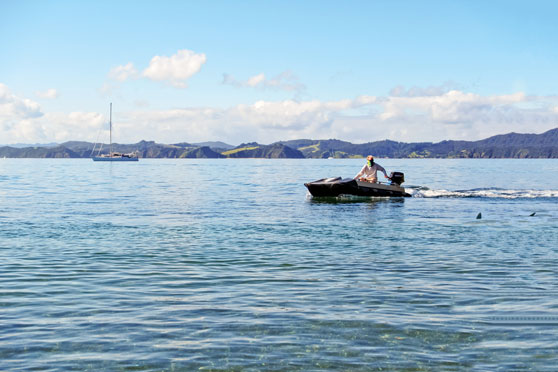
The lessons that kayak fishers deliver to us on a daily basis are worth learning – good kayak fishers are some of the most effective fishers there are in close. They are quiet and damned-near invisible on the water. Their hull size in relation to other fishing vessels is at an absolute minimum and their extremely low visual presence makes them about as stealthy as they can possibly be. They are, in effect, the ultimate fishing stealth craft: small, low, quiet, and not even an outboard motor to stir things up (most of the time, anyway). No wonder they catch fish.
The only downside is that if you want to fish out of them, you’ve got to spend long periods sitting on your bum!
Comfortably low
As you may have guessed, that’s why I am not a kayak lover. I get annoyed with being stuck in a sitting position for any extended period and quickly feel the urge to stand up and stretch my legs. Me and kayaks will never get along.
Hence, my recent fishing adventures in my new Zego Fly (see last month’s issue) have been something of a revelation. These trips have brought about a renewed appreciation of the benefits offered by lowlevel fishing boats and how a reduced visual presence on the water can make all the difference in many fishing situations.
In the Zego, I’m fishing low – almost as low to the water as a kayak – but I can stand up, stretch my legs, and cast from anywhere in the boat. Essentially, I’m staying low, staying hidden, but also staying comfortable.
Consequently, I’m out there more and putting in far more hours than I would ever put in on a kayak. I’m getting the chance to test out these ‘lowboat’ fishing theories to the max.
Previously I have fished out of a large six-metre aluminium boat with high sides and a prominent cuddy cabin and rocket launcher. This is a relatively big boat with plenty of ‘presence’ on the water. Fish notice it and react to it. The differences between it and my new, low-level fishing expected differences, but the degree of difference was a little unexpected.
I have now got fish swimming right up to the edge of the new low boat. Provided the outboard motor is turned off and the drift is quiet, the fish are swimming all around me. Most importantly, there are fish swimming and feeding within range of my saltwater flies.
This is massively beneficial for any fly fisher. I have written about the ‘tyranny of distance’ that all fly fishers face before today: fish must come within the range of our casts. Thirty metres is considered a big cast, while 15 to 20 metres is more common. Either way, the fish needs to swim very close to your position.
Consequently, anything that encourages fish in closer must improve your fly-fishing outcomes. Essentially, you want your boat to be almost invisible to the fish.
Hammerhead sharks are the biggest test.
Hammers are well known for their shyness, especially those ‘teenage’ medium-sized versions that are common throughout northern inshore waters during summer. There can be hundreds of them in the Hauraki Gulf, Bream Bay, Bay of Islands and Doubtless Bay during any given summer season, but their reaction to you always speaks volumes about the quietness of your boat and/or the fish-scaring visual presence you may, or may not, have on the water.
In my new low-lying stealth craft, the hammerheads are actually swimming right over to me. This says lots about how unobtrusive low boats can be on a quiet drift. Some of these hammerheads have even been cruising near me well within flycasting range.
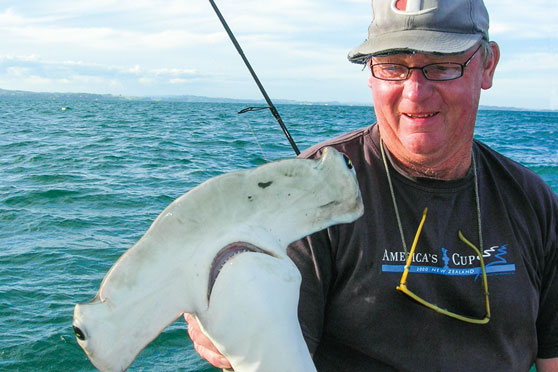
The last time it happened, I took the opportunity to try casting a fly at a few as they cruised past. Most spooked the minute the fly line started moving – these things really are skittish. But one unseen shark did come charging in out of nowhere to smash the popper-fly high up in the air, without finding the hook, before spinning around for another go. It bulged up behind the fly on the second attempt, but became suspicious at the very last minute and disappeared. Exciting stuff!
With a bit more work, it looked like catching freeswimming hammerhead sharks on fly could be a reality. I made a mental note to try more quiet drifts for hammerheads in the near-future.
Living with less visibility
Of course, the one negative aspect you will have to live with is that, with less height, you cannot see as well into the water or as far as from a high boat. This is the price you pay for fishing low, but with fish moving a lot closer to you, I feel it is an acceptable one.
The upshot is that instead of seeing fish, you have to instead analyse swirls, splashes, feeding birds and brief glimpses of fins. This is old-school waterreading and I love it. But that’s a whole other story…
|
|
This article is reproduced with permission of |

Popular Articles

Softbait Fishing - Part 1 - gear selection
John Eichlesheim writes an article about selecting the right equipment for softbait fishing... Read More >
Softbait fishing Pt 2 - tips and tricks
Techniques, tips and tricks of softbait fishing – getting the most from your soft baits.... Read More >

Surfcasting - setting yourself up
Gary Kemsley helps sort out the necessary gear for intending surf fishers.... Read More >

Squid - How to catch them
Squid fishing is a rapidly growing aspect of fishing - Paul Senior shares some hints and tips to get started.... Read More >
Fishing Reports Visit Reports
Manukau/West Coast Fishing Report - 15/10/26
Big spring snapper in 60 metres. The El Niño weather pattern isn’t going to be... Read More >
Rotorua Fishing Report - 15/10/26
Solid start to the season! The Rotorua lakes have all started the season well, and... Read More >
Tutukaka Fishing Report - 15/10/26
Big snapper in shallow. Things remain relatively quiet on the fishing front out of Tutukaka,... Read More >
Tauranga Fishing Report - 15/10/26
Bait and temperature on the rise. It’s been great to get out and see some... Read More >
Comments