
Small Baits Tips for NZ Inshore Species
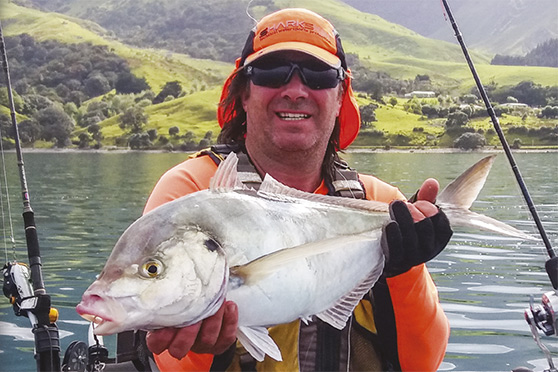
There is no doubt that some parts of the food chain are overlooked when it comes to fishing. Big baits (or lures) do not always equate to big fish suggests keen lure angler and kayaker Rob Fort…
Most anglers who use bait wouldn’t purchase a bag of cockabullies over pilchards, yet both have their place. It seems many smaller species can be overlooked despite being openly available for predatory fish to feed on.
An addiction to soft-bait use taught me many years ago that smaller lures can catch massive fish. It also dispelled the common myth of big bait equalling big fish. A move towards three and two-inch soft-bait sizes further reinforced this, forming an association that has been in place for well over a decade. As a result, tiny soft-baits, lures and jigs have consistently formed a large part of my fishing arsenal and have provided great results. For some anglers, this smaller fishing tackle is only just starting to be taken notice of.
Why go tiny?
Smaller fish make up an important part of the food chain and provide feed for a variety of fish species of many sizes. For some, tiny fish are just a snack which predators like snapper eat during the colder months of winter when their metabolisms slow. Certain situations, like when a barge harvests at a mussel farm, lead to smaller fish like blennies being caught up with the debris washing off the deck. This run- off forms a massive trail down-current, which predatory fish patrol as they look for a feed of tiny fish. When fishing in these situations, matching what is on offer (matching the hatch) brings a greater likelihood of success.
Tiny soft-baits, lures and jigs not only work well during colder months and the above situations but also when the fishing is slow. The smaller size may get a reaction from a fish that initially wasn’t that interested in striking.
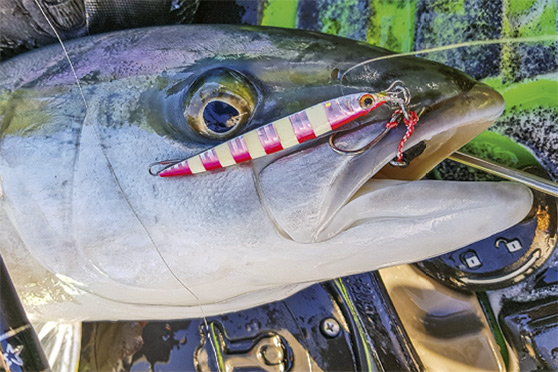
Pelagic predators like yellowtail kingfish are a welcome catch on tiny jigs and light tackle.
How small is tiny?
The smallest of tackle can do the damage. A sabiki rig, for example, can attract the interest of a large snapper – the only problem with this, however, is that the line it is made with is much too light and will usually be busted. Even lures as small as 30mm can have a place in the arsenal. In the case of a jig, the size often determines its overall weight so anything from seven to 40g falls into the tiny category.
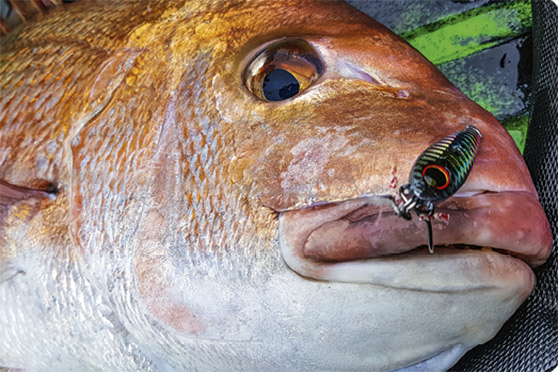
Big snapper love snacking on tiny bait replicas like this 28g Zest Gan jig.
Tiny styles and shapes
When considering which tiny creatures are on offer to our ocean’s predators, baitfish, crabs, shrimps and worms stand out the most. Soft-baits imitate this range of species the best out of all the commonly available tiny lures in stores. With shapes and sizes to suit nearly every situation, they provide near-perfect replicas of all the above species. Scented soft-baits are the best option as these are the most effective at catching fish. Minnows/jerk shads are the best for replicating baitfish and have enticed more than their share of snapper, and a few kingfish, too.
Small grub tails are another great option, offering that extra tail movement which makes them irresistible to many species. My personal favourite soft-bait to use when the fishing is slow and I am over sand is the Gulp! Crabby. Sometimes sending something slightly different down in front of the fish can really make the difference.
Micro jigs can also fall into the tiny category. These jigs come in various shapes and configurations that give them different actions and when worked properly, they are extremely effective.
Tiny hard-body lures are also taken by certain fish species and come in two types – bibbed and weighted. The bibbed lure dives down and swims provocatively as it’s drawn through the water. The weighted variety is designed to sink, which makes it suitable for casting; however, it can also be trolled like the bibbed version. General sizes range from three to four and a half inches and they often have a life-like shape and finish.
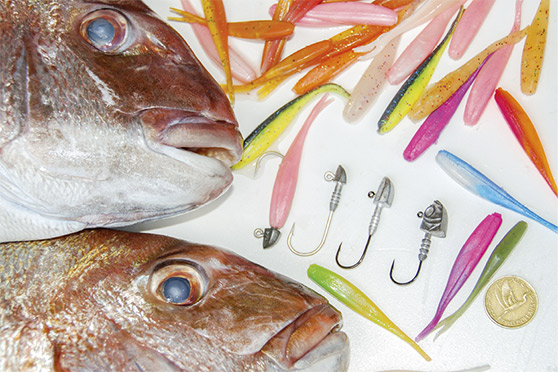
The three-inch minnow/jerk shad soft-bait has gained popularity since soft-baits entered the New Zealand market.
Creating the strike
In order to find success with all the above tackle, each offering must be presented in a way that is natural and to the predators’ liking. Smaller creatures tend to move erratically – baitfish, as we all know, can dart all over the place. Moving the tackle so it acts the same will give the best results and how the rod is moved will depend on the object being fished. Small soft-baits can be worked in a number of ways when cast or dropped straight down. Staying in touch with them as they descend is crucial to detecting any initial interest, and once on the sea floor they can be moved by twitching the rod tip and lifting it upwards (but not higher than forty five degrees).
When they are cast away from your position, it’s possible to work the tiny soft-bait back again by doing twitches and lifts of the rod, winding in the slack line as you drop the rod tip for the next lift. Tiny jigs can also be used in the same way and can be cast much greater distances, allowing the jig to be worked over a greater area. Jigs are equally effective when dropped directly down and can be worked by lifting the rod up fully then lowering it and allowing the jig to flutter as it falls. These jigs are designed for this style of fishing, which is known as the slow-pitch technique. The tiny micro jigs can also be worked up through the water column in a similar way. This is done by ing a quick turn of the reel’s handle, then pausing before making another wind of the handle.
Some micro jigs look so good that the fish will strike them even when sitting stationary. Lots of snapper have been caught this way, which shows just how much these smaller sizes can draw a strike. Hard body lures of both styles can also be actively fished by being cast and retrieved, and also work when trolled.
Finding success will require running them at the right speed and distance behind the vessel. Take the time to learn the best ways to present your soft-bait, jig or lure and don’t be afraid to vary your methods.
Where to use tiny tackle
There is no end to the places tiny baits can be used. With natural tiny fish found virtually everywhere there is water, any soft-baits, jigs and lures that replicate them can be utilized. This leaves the possibilities wide open – the only limit is our ability to discover and find the action. The size of your offering really does have an influence over your fishing success. Once you try the smaller sizes and put them in front of predatory fish, you’ll never look back. Changing things up can often mean changing things down, and sometimes this can be the difference needed to turn an average day into something special.
|
|
This article is reproduced with permission of |

Recent Forum Posts Visit Forum

Trailer wheel clamp
in The Boat Shed34 minutes ago
610gc
Hey teamI have a wheel clamp like the one below on the boat trailer. its getting harder and harder to unlockI've sprayed it with CRC on...

Shane Jones
in Fisheries Management24 hours ago
Tzer
Far cry to the twats at Liegasea/NZSFC were proposing of 5 Tarakihi person in their submission for the central management area and this is what our...

Bluefin Tuna at the cavs.
in The Briny Bar44 hours ago
smudge
Despite my years of fishing I haven't really fished many places, my focus has always been on Auckland's west coast and out toward Great Barrier. I...
Casting gloves
in Popper and Topwater Fishing88 hours ago
Mc Tool
100 bucks for a lure 😬. Watching one of them flying over the horizon without the line attached would be " character building " for sure...
I thought Id post some nice photo's , join...
in The Briny Bar139 hours ago
Alan L
That is a very cool pic Krow.The Far North is very cool, the Far far North even cooler. Mint looking day.Alan...

Mc Tools berley mincer
in The Briny Bar147 hours ago
SaltyC
Good size, they scrap well. Got an 18kg one up in Vava'u back a few years ago fishing off squeaky Going's boat. That was quite a...

Out with the "Twelves"
in Fishing Reports201 hours ago
Pcj
I should be able to get out end of October. The nephew been out virtually every weekend over winter and has done well. It seems the...
Manukau Harbour & West Coast fishing
in Fishing Reports209 hours ago
smudge
Nice work Schecter, I think snapper may be around sooner than you think. Well I am hoping so...

Whangarei Harbour report.
in Fishing Reports641 hours ago
krow
180 +m is where I've had to be lately. A lot less low foul around these parts and some of it shallower that looks like Tarakihi...
Whangarei Harbour Scallops
in Fisheries Management751 hours ago
Pcj
Reopening WhangÄ쳌rei Harbour to recreational scallop fishingTÄ“nÄ쳌 koeFisheries New Zealand is seeking feedback from tangata whenua, stakeholders, and the public on whether WhangÄ쳌rei Harbour should be...
Popular Articles

Softbait Fishing - Part 1 - gear selection
John Eichlesheim writes an article about selecting the right equipment for softbait fishing... Read More >
Softbait fishing Pt 2 - tips and tricks
Techniques, tips and tricks of softbait fishing – getting the most from your soft baits.... Read More >

Surfcasting - setting yourself up
Gary Kemsley helps sort out the necessary gear for intending surf fishers.... Read More >

Squid - How to catch them
Squid fishing is a rapidly growing aspect of fishing - Paul Senior shares some hints and tips to get started.... Read More >
Fishing Reports Visit Reports
Outer Hauraki Gulf Fishing Report 17/09/26
Spring wind the handbrake. Spring is starting to make its presence felt in the outer... Read More >
Top of the South Fishing Report - 17/09/26
Early snapper in Tasman Bay. Well, spring is finally here, and the days are getting... Read More >
Bream Bay Fishing Report - 17/09/26
Good snapper catches reported. After Tangaroa turned off the fish tap for a month or... Read More >
Bay of Islands Fishing Report - 17/09/26
Pacific bluefin tuna for the lucky few. The last fortnight has seen more fishable days... Read More >
Comments