
Skagit Fly Fishing Technique

The two most important laws of fly fishing are that you must be able to cast the fly to the fish and then present it in such a way that the fish wants to eat it, suggests veteran angler Herb Spannagl.
It does not matter what else you do well. You might be a great trout spotter, artisan fly-tier, fearless river crosser or be kitted out with the most expensive gear, but if you cannot accomplish those two essential feats all your other efforts will count for nought. What I am talking about is casting and line handling mastery, which in fly fishing are quite surprisingly underrated abilities. I have fished the Tongariro River since 1970, and over the years I’ve seen the frustration of those with limited casting skills; either not getting out to the fish, or worse, getting smacked around the ears by a heavy Tongariro bomb.
Unlike other propelled objects, a fly line only travels forward as long as it turns over. There are many casting styles to accomplish this but they all belong to one of two methods: overhead or spey casting. Every fly fisher should know what overhead casting is, so I need not describe it here. Spey casting is less understood. It’s principle characteristic is that the line, instead of stretching out on the back cast, forms a D-Loop that remains briefly anchored to the water.
Spey casting, with its long and colourful history in northern Europe, has in recent decades enjoyed a spectacular global revival, especially so in the United States. Anglers fishing for anadromous steelhead and pacific salmon have developed a casting style named after the Skagit River in Washington State. Like many things “American”, Skagit has eventually found its way to our trout fishing scene in New Zealand. Here, alongside the heavy promotion of double handed fly rods, Skagit-style streamer fishing has enjoyed a substantial following.
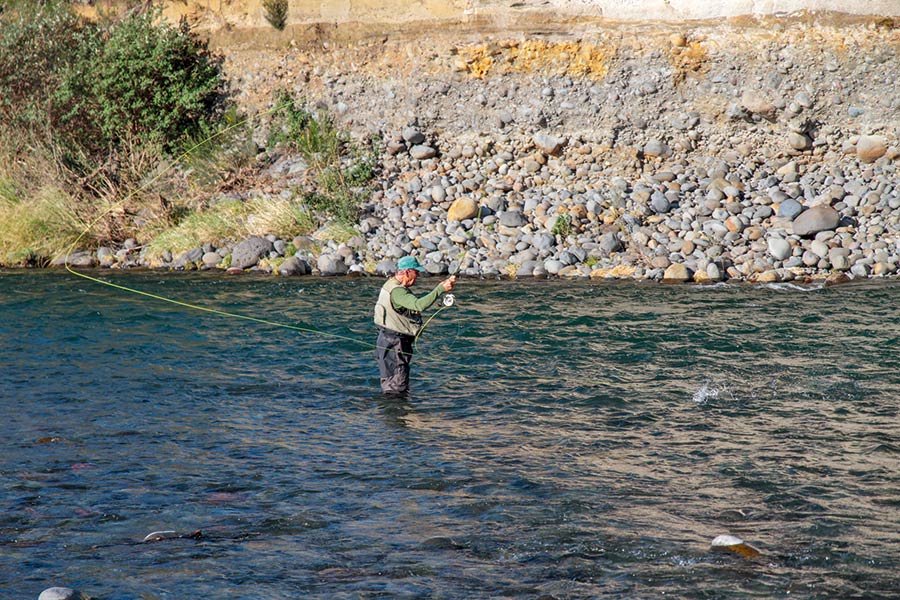
Shooting heads and spey casting techniques come in handy when the winter rush is on.
With the popularity of this style, my analysis is bound to be controversial and I anticipate that a vigorous defence force will rise up to confront my evaluation. I am a technical fly fisher and thus judge most aspects of this sport only on their technical merits. In other words, I ask myself: “Does this actually makes sense?” To put it bluntly, there are better ways than traditional Skagit to get flies down to deep-lying fish.
On the Tongariro, most Skagit outfits are used to target spawning-run rainbows. They do not feed and only occasionally intercept a fly, which must also be presented at depth.
A typical Skagit setup consists of a short but heavy floating section, which acts as the casting weight to propel an attached sinking tip and, at times, a weighted fly too. The thick floating head, heavy sinking tip, and weighted fly have to then be weight/mass balanced to cast well. The total casting payload can end up quite substantial and this demands a matched rod to deliver it. On the Tongariro I have seen many such outfits that are hugely out of proportion with the typical three-and-a-half-pound Taupō trout.
Apart from the accumulated weight of such an outfit, there are several other disadvantages of the Skagit system:
• The moment the floating head lands on the water, it becomes a hindrance because it impedes the sinking tip from sinking freely.
• The bulky, high-vis-coloured head skims unnaturally across the surface, and this has been shown to spook fish.
• The sustained anchor casts normally associated with Skagit are very noisy and lack the elegance of other fly casting techniques.
• In a river, the fastest water flows at the surface. This swings the floating Skagit head and the fly faster, with less time in front of fish than if it were in a slower current deeper down.
So what are the benefits of Skagit in New Zealand? The only one I can think of is that anglers do not require a back cast, so can fish in tight quarters.
Luckily, this can be done without having to take all the above handicaps on board. Scandinavian anglers use a range of sinking shooting heads to spey cast to trout and salmon. At the beginning of last winter, I fished at the Waimarino river mouths at Lake Taupō with several other anglers. After we all pulled out, I learned that one of them had fished with a triple-density shooting head made by Guideline of Sweden. I had a trial flick with this new line, which to my astonishment sailed out much further than I would have expected. Back home I did some research.
The Ultra-light Scandi 3D sinking shooting heads come in a range of sinking densities for fishing, from close to the surface, all the way to the bottom of deep and fast currents. However, they become less dense but heavier towards the back to conform with typical spey line design logic. This seeming contradiction has two purposes. As the casting weight is already built into the rear, it makes them spey cast really well. The same feature also delays the turnover, which makes for very long spey and overhead casts.
With this advanced design there is no need for a heavy floating Skagit head. They sink immediately when they hit the water. ULS 3D shooting heads only weigh 12-18g and are ideal for use with single-handed and short double-handed rods. Because of their light overall weight, they need to be cast with light, near frictionless mono shooting lines to achieve maximum distance.
Where will this trend go? Good ideas get picked up by competitors very quickly and this can be observed in the gradual transformation of the original Skagit system. We now see intermediate and even twin density Skagit heads and twin density iMOW tips, with sexy names coming ever-closer to the Scandinavian ULS integrated density sinking shooting heads. In the end, common sense will prevail and the battle between Skagit and Scandi will be largely geo-political name retention.
With absence of bed-altering floods in the last few years, willow seedlings are encroaching on almost every lower Tongariro gravel beach and are now big enough to make normal overhead casting difficult. I have tried to spey cast my normal, single density shooting heads but with limited results. Luckily, during the winter I got my hands on a couple of these new Scandinavian sinking shooting heads, which are marketed by Guideline as ULS 3D+ shooting heads, and are now imported by Sporting Life in Turangi.
My muscle memory is already programmed for the Tongariro roll cast set-up, and with a few refinements this has become my ‘go to’ method to easily spey cast 80-plus feet from both banks with my 9’ single hand rods. Surprisingly, with these short heads, anchor retentions become quite critical and far too often I could hear the anchor blowing out behind me. Maybe the problem is my single haul or the angle of the rod during the forward delivery cast. Regardless, I needed a solution. This came via an additional 1m tip I had initially made up to increase the sinking at the front of the line. This extra head length anchors the line much better and has massively improved my delivery casts.
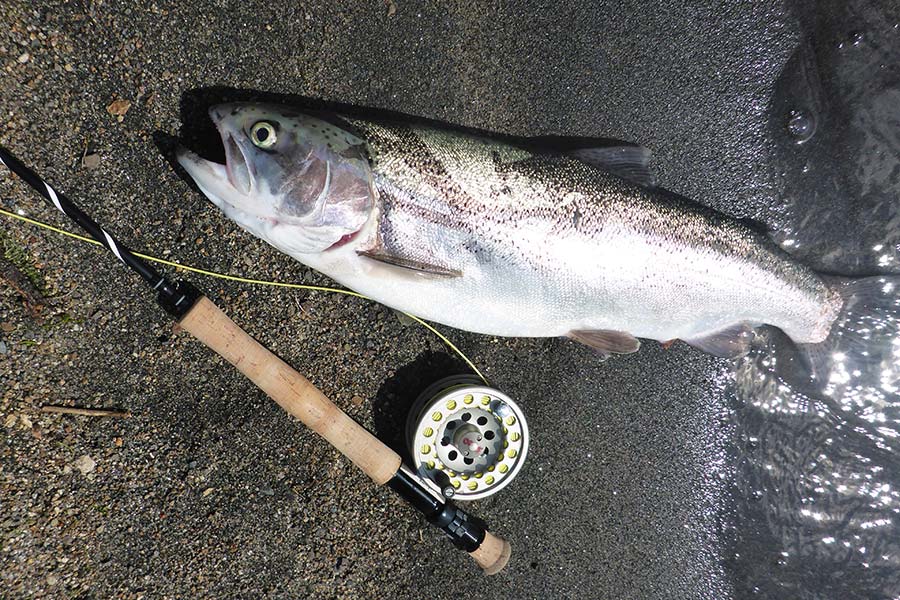
Herb is one of the pioneers of the Tongariro Roll Cast in New Zealand.
ULS heads are very versatile. Guideline videos show them casting these heads with a variety of spey casting styles and short double-handed rods.
Sadly, I am in the twilight of my fly fishing life. With what little that might be left, I did not expect to encounter something as innovative as this new fly line invention. During my last couple of trips I was keener to perfect my spey casting with these new ULS heads than actually catch lots of trout. This sounds crazy I know, but for me the magic of fly fishing is the journey rather than the destination. This new challenge makes me feel years younger and masks a lot of my normal aches and pains. I am already looking forward to the next winter rainbow runs in the Tongariro.

July 2022 - Herb Spannagl
New Zealand Fishing News Magazine.
Copyright: NZ Fishing Media Ltd.
Re-publishing elsewhere is prohibited
Recent Forum Posts Visit Forum

Shane Jones
in Fisheries Management2 hours ago
Tzer
From what I see too even commercial in WA aren’t getting any favours from politicians there. I think here our advocacy groups like Liegasea aren’t doing...

Trailer wheel clamp
in The Boat Shed9 hours ago
krow
I like the SAS wheel clamp. I've had no issues with the lock....

Foton tunland v9
in The Briny Bar12 hours ago
Ho Dee
not fishing related and delete if required but was wondering if any has one of these or someone who has just wanting so e real world...

Bluefin Tuna at the cavs.
in The Briny Bar59 hours ago
smudge
Despite my years of fishing I haven't really fished many places, my focus has always been on Auckland's west coast and out toward Great Barrier. I...

Casting gloves
in Popper and Topwater Fishing104 hours ago
Mc Tool
100 bucks for a lure 😬. Watching one of them flying over the horizon without the line attached would be " character building " for sure...
I thought Id post some nice photo's , join...
in The Briny Bar155 hours ago
Alan L
That is a very cool pic Krow.The Far North is very cool, the Far far North even cooler. Mint looking day.Alan...

Mc Tools berley mincer
in The Briny Bar162 hours ago
SaltyC
Good size, they scrap well. Got an 18kg one up in Vava'u back a few years ago fishing off squeaky Going's boat. That was quite a...

Out with the "Twelves"
in Fishing Reports216 hours ago
Pcj
I should be able to get out end of October. The nephew been out virtually every weekend over winter and has done well. It seems the...
Manukau Harbour & West Coast fishing
in Fishing Reports224 hours ago
smudge
Nice work Schecter, I think snapper may be around sooner than you think. Well I am hoping so...
Whangarei Harbour report.
in Fishing Reports656 hours ago
krow
180 +m is where I've had to be lately. A lot less low foul around these parts and some of it shallower that looks like Tarakihi...

Popular Articles

Softbait Fishing - Part 1 - gear selection
John Eichlesheim writes an article about selecting the right equipment for softbait fishing... Read More >
Softbait fishing Pt 2 - tips and tricks
Techniques, tips and tricks of softbait fishing – getting the most from your soft baits.... Read More >

Surfcasting - setting yourself up
Gary Kemsley helps sort out the necessary gear for intending surf fishers.... Read More >

Squid - How to catch them
Squid fishing is a rapidly growing aspect of fishing - Paul Senior shares some hints and tips to get started.... Read More >
Fishing Reports Visit Reports
Outer Hauraki Gulf Fishing Report 17/09/26
Spring wind the handbrake. Spring is starting to make its presence felt in the outer... Read More >
Top of the South Fishing Report - 17/09/26
Early snapper in Tasman Bay. Well, spring is finally here, and the days are getting... Read More >
Bream Bay Fishing Report - 17/09/26
Good snapper catches reported. After Tangaroa turned off the fish tap for a month or... Read More >
Bay of Islands Fishing Report - 17/09/26
Pacific bluefin tuna for the lucky few. The last fortnight has seen more fishable days... Read More >
Comments