
Seabird Safety

New Zealand has a reputation for being the ‘seabird capital’ of the world. Of the 360 species of seabirds worldwide, 86 breed in New Zealand and 36 breed only in New Zealand.
MPI is tasked with managing fishing interactions with seabirds from all sectors and minimising these wherever possible. MPI developed the National Plan of Action (NPOA) – Seabirds 2013 to guide the management approach and help create an environment where seabirds thrive without pressure from fishingrelated mortalities.
Working alongside MPI – and with many of the same goals – is the Southern Seabird Solutions Trust. This group is made up of members of the fishing industry, government departments, the recreational fishing sector and conservationists.
The trust works with commercial fishers, recreational fishers, associated agencies and industry to reduce harm to seabirds from fishing. Its motto, ‘conservation through cooperation’, expresses the trust’s desire to empower fishers using a cooperative and practical approach to seabird conservation. The trust also works internationally and runs projects that contribute to reducing the effects of fishing on seabirds in fisheries throughout the southern hemisphere.
Southern Seabird Solutions Trust was formed in July 2002 at a workshop of industry, environmental and government interests. While each organisation had a different mandate and interest, the goal of reducing harm to seabirds from fishing was held in common.
The core work of the trust is funded by five partners: MPI, Department of Conservation, Te Ohu Kaimoana (working on behalf of customary commercial and non-commercial fishing interests), Seafood New Zealand, and World Wildlife Fund New Zealand. The trust receives additional funding and significant support from industry groups, recreational fishing, and environmental organisations.
To date the trust has had significant success working with the commercial-fishing industry to promote its seabird safe fishing message. Innovative partnerships, such as those seen with commercial long-line fishers around the Coromandel Peninsula and North Cape, have resulted in much greater awareness.
So how does this all relate to recreational fishing? While information on seabird interactions with recreational anglers is limited, some species that are nationally vulnerable or declining (such as black petrels and flesh-footed shearwaters) may be at risk from recreational fishing practices.
Because of the large number of recreational anglers congregating in relatively small areas, such as the Hauraki Gulf and the Bay of Plenty, which also happen to be crucial feeding sites for seabirds, even a small rate of interaction between individual anglers and seabirds may have an impact on population levels.
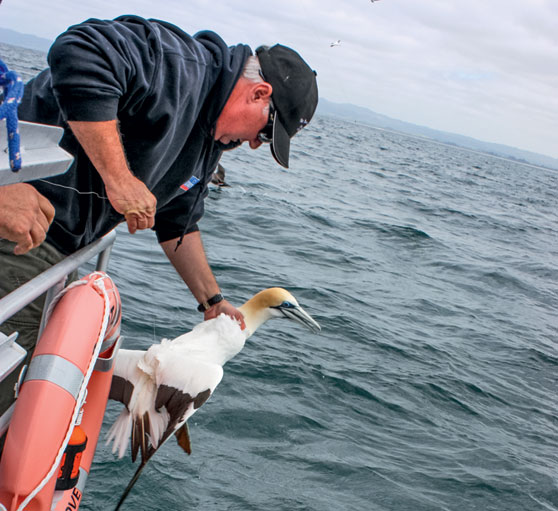
Another study indicates there may be tens of thousands of seabird captures by New Zealand recreational anglers each year. Even though this number of interactions is high, over three-quarters of birds recorded as being captured were released unharmed.
No-one wants to catch a seabird, and the trust believes anglers themselves are key to reducing this catch and making sure our seabirds are around in the future.
Anglers use seabirds to find fish, so are well acquainted with the birds’ feeding antics.
There is no ‘silver bullet’ that will stop seabirds being caught while fishing, but greater awareness, a caring attitude, and making some small changes to the way we fish can have a big and positive impact.
The trust has worked with charter skippers, anglers and seabird specialists to come up with four basic actions anglers can take to lessen the chance of catching a seabird:
- Fish tidy: Keep the deck clean and put bait scraps and fish waste in covered bins until hooks are out of the water;
- Fish fast: Seabirds mostly fish within six metres of the surface, so the quicker you can get your hook and bait out of this zone when dropping (and retrieving) your lines the better;
- Berley well below the birds: Sink your berley containers deep to avoid attracting birds;
- Deter or distract birds from your gear: For example, spray a deck-hose or water-gun towards the birds if they are going for your bait. If you have other techniques that you think might work, please contact the trust at [email protected]
MPI is working closely with the trust to help spread their seabird safe fishing messages. In May this year the MPI recreational-fishing team shared a stand at the Hutchwilco Boat Show in Auckland. Together they handed out thousands of pamphlets outlining seabird-safe fishing messages and had many conversations with keen recreational anglers.
MPI plans to maintain this relationship, as we really believe in the effectiveness of this work. You can look on our compliance Facebook site over the next few months for Southern Seabird Solutions Trust messages. For more information on the trust, visit www.southernseabirds.org.
|
|
This article is reproduced with permission of |

Recent Forum Posts Visit Forum

Shane Jones
in Fisheries Management15 hours ago
Tzer
Far cry to the twats at Liegasea/NZSFC were proposing of 5 Tarakihi person in their submission for the central management area and this is what our...

Bluefin Tuna at the cavs.
in The Briny Bar34 hours ago
smudge
Despite my years of fishing I haven't really fished many places, my focus has always been on Auckland's west coast and out toward Great Barrier. I...

Casting gloves
in Popper and Topwater Fishing79 hours ago
Mc Tool
100 bucks for a lure 😬. Watching one of them flying over the horizon without the line attached would be " character building " for sure...
I thought Id post some nice photo's , join...
in The Briny Bar130 hours ago
Alan L
That is a very cool pic Krow.The Far North is very cool, the Far far North even cooler. Mint looking day.Alan...

Mc Tools berley mincer
in The Briny Bar138 hours ago
SaltyC
Good size, they scrap well. Got an 18kg one up in Vava'u back a few years ago fishing off squeaky Going's boat. That was quite a...

Out with the "Twelves"
in Fishing Reports192 hours ago
Pcj
I should be able to get out end of October. The nephew been out virtually every weekend over winter and has done well. It seems the...
Manukau Harbour & West Coast fishing
in Fishing Reports199 hours ago
smudge
Nice work Schecter, I think snapper may be around sooner than you think. Well I am hoping so...

Whangarei Harbour report.
in Fishing Reports632 hours ago
krow
180 +m is where I've had to be lately. A lot less low foul around these parts and some of it shallower that looks like Tarakihi...
Whangarei Harbour Scallops
in Fisheries Management742 hours ago
Pcj
Reopening WhangÄ쳌rei Harbour to recreational scallop fishingTÄ“nÄ쳌 koeFisheries New Zealand is seeking feedback from tangata whenua, stakeholders, and the public on whether WhangÄ쳌rei Harbour should be...
SNA1 Recc fishing cops the blame.
in Fisheries Management838 hours ago
Tzer
What Liegasea won’t tell you is that some of their own fisheries contractors were co-authors of this study for fear of being called hypocrites, one of...
Popular Articles

Softbait Fishing - Part 1 - gear selection
John Eichlesheim writes an article about selecting the right equipment for softbait fishing... Read More >
Softbait fishing Pt 2 - tips and tricks
Techniques, tips and tricks of softbait fishing – getting the most from your soft baits.... Read More >

Surfcasting - setting yourself up
Gary Kemsley helps sort out the necessary gear for intending surf fishers.... Read More >

Squid - How to catch them
Squid fishing is a rapidly growing aspect of fishing - Paul Senior shares some hints and tips to get started.... Read More >
Fishing Reports Visit Reports
Outer Hauraki Gulf Fishing Report 17/09/26
Spring wind the handbrake. Spring is starting to make its presence felt in the outer... Read More >
Top of the South Fishing Report - 17/09/26
Early snapper in Tasman Bay. Well, spring is finally here, and the days are getting... Read More >
Bream Bay Fishing Report - 17/09/26
Good snapper catches reported. After Tangaroa turned off the fish tap for a month or... Read More >
Bay of Islands Fishing Report - 17/09/26
Pacific bluefin tuna for the lucky few. The last fortnight has seen more fishable days... Read More >
Comments