
Saltwater Fish Food Chains
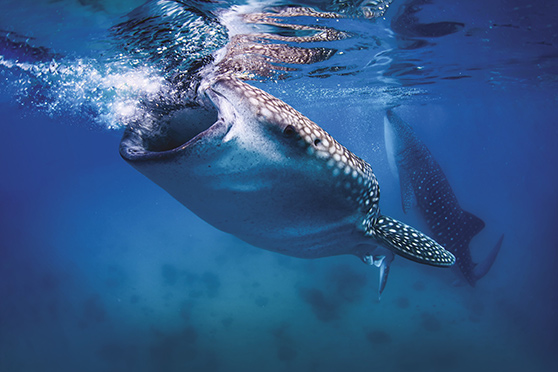
It’s a fish-eat-fish world out there, Sam Mossman reckons.
One rainy afternoon, not so long ago, my partner Tracey brought home the DVD of the Disney classic ‘Finding Nemo’. It seems that of all the inhabitants of the western world, I alone had never seen it. I enjoyed it – the fish species and their characteristics were well portrayed in an anthropomorphic fashion, and I had a particularly good laugh at the three sharks who were trying to reform from their ways with a carnivore’s version of Alcoholics Anonymous (singing):
Though we have long sharp teeth
We’re nice sharks underneath
We know that fish are friends, not food…
‘Finding Nemo’ is a great bit of entertainment, but not, of course, to be taken too seriously. Although ‘fish are friends, not food’ has become a catchphrase, in reality the natural world is a violent and unsentimental place: “nature, red in tooth and claw” is how the poet Tennyson more accurately put it. Above the very base of the food chain, plankton, every organism feeds on some other organism.
There are two basic types of plankton: tiny plants called phytoplankton (which are photosynthetic), and weak-swimming animals called zooplankton, (which include crustaceans, jellyfish and tiny worms, along with eggs and larvae of much larger species). In fact, the tiny zooplankton often feed on the phytoplankton, and there are crossovers right throughout the food chain, including the biggest animals (whales) and fish (whale sharks) which feed directly on the smallest, the plankton.
Even predatory fish that can ultimately grow to large sizes were once tiny larval or juvenile specimens (or eggs), subject to predation by adults of species they themselves may feed on if they survive to adulthood.
Any watcher of wildlife documentaries will be aware of the carnage that goes on in the seas, even if they have not seen it in the flesh, as it were. If a fish shows any form of weakness, it is likely to become the next meal. A friend who used to work for Kelly Tarlton’s Underwater World told me once that they found it necessary, for the health of the captive fish, to feed them some live baitfish from time-to-time. This feeding was not done in public hours in case this natural predatory behaviour upset any sensitive humans. When a bucket of live yelloweye mullet (given that they were probably stressed by capture and transport) was tipped into the main tank, pretty much every other fish in the tank was right onto their case.
According to my mate, the predators included many species of fish that most people would not think of as such (including spotties) and the fleeing baitfish were hounded relentlessly and quickly consumed.
What I am getting at is that every species, even the very largest, will be preyed on if it shows any indication of injury, or otherwise being vulnerable.
Bad behaviour
As a young ‘wharf rat’ I used to spend a lot of time watching baitfish and observing their behaviour. ‘Showing signs of weakness’ can mean erratic swimming and this is indicated by darting in all directions and swimming on their back or sides. This, in turn, means that the normal counter-shade camouflage (dark on the back, white or silver on the belly) that helps disguise a fish from above and below, is defeated, causing the distressed fish to flash in the water. This is the kiss of death if there are any predators in the area.
Another indication of distress that baitfish give when they are in trouble is to flare their gills. This makes the gill plates flash and exposes the red gill-rakers inside. Many lure manufacturers take advantage of this characteristic by highlighting the head or gill area in red when colouring their products.
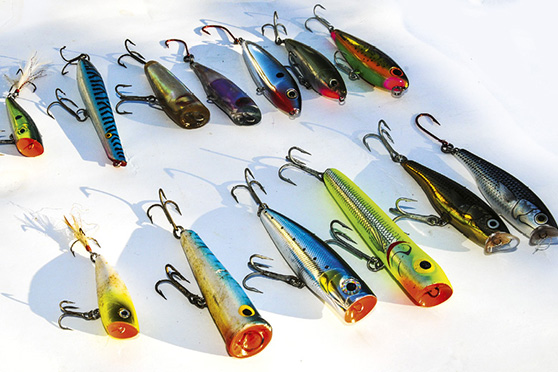
Injured fish often expose the red gill-rakers. Lure manufacturers take advantage of this by highlighting the head or gill area in red when colouring their products.
Have you ever wondered why, if a lure is made to closely resemble a baitfish, why a predator would single it out of a school of many thousands of the real thing? I reckon your lure gets nailed because, even with an angler’s best efforts, it is almost impossible to make a lure swim exactly like the real thing. And if it swims erratically it will stand out from the naturals and make itself more likely to be hit.
If someone ever invented a perfect imitation of a baitfish and managed to make it swim exactly like a natural, in a school of them, there would be nothing to make it stand out and I reckon the artificial would very rarely get a strike. An erratic retrieve, looking like an injured or otherwise disabled baitfish is more likely to attract a predatory fish to a lure. It is probably a good thing we cannot exactly ‘match the hatch’!
Just how tough are fish?
Obviously not all attacks or hunts by predators are going to be successful. I have watched john dory stalking small fish when I have been snorkelling. Even with their specialised adaptations, their success rate is low – under 10%, I would estimate. The mayhem of marlin or tuna attacking schools of baitfish like saury or pilchards can see plenty of injured fish sinking away unnoticed from the activity. And neither do kingfish, shags or sharks get it right all the time when hunting individual prey. So, what happens to injured fish that escape?
Although it would be impossible to research, I think that the survival rate of injured fish would not be high. Injuries mean weakness, inability to feed and compete effectively, and also being marked as a victim by sending out all the ‘weak and injured’ signals. The first thing that injured bait fish do is try to find some sort of shelter. As an example of this, some years ago I was staying at the Paradise Hotel on the northern Tongan Island of Vava’u. Big schools of otule (bigeye scad) were being attacked by trevally and other predators in the channel off the hotel wharf. A small protected basin behind the wharf had been adopted as a ‘hospital station’ by injured scad. They formed a school of ‘cripples’ that hung out in the shallows where the big boys couldn’t get at them.
Injured fish must also feed themselves, and this probably involves eating anything they can find and catch, while they get a chance to heal. This can involve dropping a trophic level or two and maybe even subsisting on plankton.
So how do fish heal from injury? Like humans, immuno-responses occur and skin regenerates. From the outside in, fish are protected by slime coats that shed bacteria and parasites; then scales; and finally, skin. The design and effectiveness of these three barriers varies with different fish species, depending on their defensive strategies.
The slime coat is constantly secreted and replenished, capturing bacteria and parasites and sloughing them off the body. Scales can be heavy and tough on some slower, usually bottom-dwelling species, but smaller and lighter on species that depend more on speed and manoeuvrability to avoid predators, Compare, say, a snapper with a trevally. Skin toughness varies too. A kahawai has tough skin, for example, compared to a skipjack. Research has shown fish can survive and recover from skin loss injuries of over 10% of their body covering. Kahawai have a reasonably robust set of scales, too and the combination of slime, scales and skin on this species is a decent defence. I have often come across kahawai that have survived bad maulings from sharks, especially makos.
Sharks themselves have particularly tough hides and can recover quickly from serious wounds caused by other sharks during dominance displays and mating. Blue sharks are particularly rough when it comes to mating, with the males biting the females extensively. As some compensation, female blue sharks have skin twice as thick as the males.
Critical care
Salt and salt-water can be an aid to the healing of wounds in humans and can be traced back to the Greeks, Romans and Egyptians, all of whom used it to treat cuts, wounds, mouth sores and skin irritations. Concentrated solutions of sterilised saline solution is still used to cleanse human wounds or surgical incisions today.
Salt-water helps to clean and promote healing by a process called osmosis. Salt – sodium chloride – forces the liquid in cells to move out of the body when in contact with them. Bacteria, are forced out too, effectively helping cleanse the wound. This process, which is effectively dehydration of damaged cells, is considered antibacterial and anti-inflammatory.
But remember, this is sterilised saline solution. Does swimming in plain old sea water help injured fish heal? It is thought that salt can help fish stop bleeding and help them control bacteria and parasites, although some sea water, especially in warmer regions, can teem with bacteria, so the jury is out on that one.
Although injury will make a fish more vulnerable to further predation and probably hinder their recovery by making them less efficient at catching food in competition with others, I have encountered a surprising number of specimens that have recovered from serious injury, or were well on their way to recovering. Here are a few examples that spring to mind:
During my first-ever gamefish charter with Whangaroa skipper Laurie Ross, a striped marlin with its whole lower tail lobe missing was caught. It had probably been hit by a mako from below at some point. It fought strongly, jumped well and to a good height, and was in good condition.
I drove the boat on another striped marlin off Tutukaka for angler Greg McKinney that would not allow the boat on its right side, only its left. When we finally got the leader, we found that it was blind in one eye (the right eyeball was missing) and the wound had healed over. Its behaviour suggested it was strongly ‘left-handed’ and wanted to keep us on its sighted side. It, too, was in great condition and made some hot runs. Clearly, it was still feeding itself well.
I have also caught snapper that were blind on one side but otherwise in good shape, several that had lost one pectoral fin, another with a big healed wound on it’s flank. All were in good condition, feeding, swimming and fighting well. I have even seen images of fish with no tails that seem to swim fine.
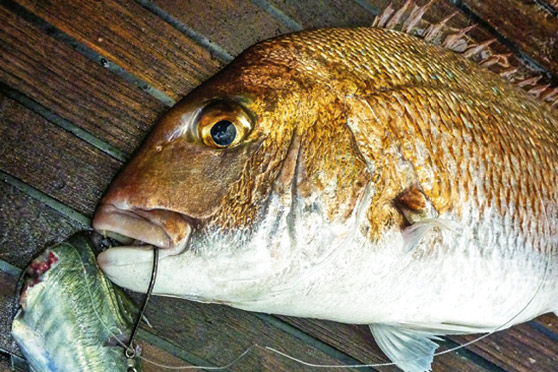
This snapper was minus one pectoral fin, but this had not affected its swimming.
I’ve caught several Hauraki-Gulf kahawai with substantial, deep, wounds from mako shark bites on their flanks. They were healing well, took lures, and fought strongly.
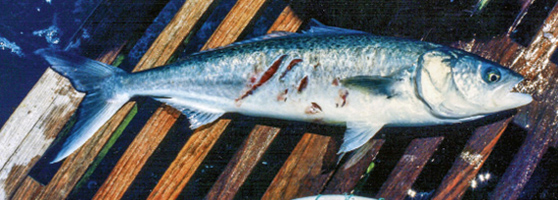
A kahawai that had an encounter with a mako but was already starting to heal.
One blue maomao came into my berley trail twice at Spirits Bay In two successive days. It was caught and released on both days (once on saltwater fly). It had fully healed wounds on back and belly with full regeneration of skin, scales and colour and was in good shape. In total it had been about one third cut through, perhaps by a seabird during its’ juvenile stage.
Cookie cutter sharks are small, strange deep-water sharks that glow in the dark. This attracts predatory fish, but the cookie monster quickly turns the tables on them by turning the lights off and sucking onto their sides with suction-cup lips, then using its’ cutter-like lower teeth to scoop a core-sample of flesh out. You mostly see the wounds and healed scars on tropical gamefish like mahimahi, tuna, wahoo and marlin, but we get them here in NZ too. Some years ago, game skipper and taxidermist Grant Mills sent me a photo of skipper Steve Haddock holding a White Island hapuku with a classic cookie cutter wound. This one had cut right through the ‘puka’s belly wall and half it’s stomach was poking through to the outside. Grant commented in his accompanying letter: “the fish seemed perfectly healthy and the state of the wound indicated it had been like this for some time.”
Other odd fish seem to suffer from skeletal deformities. This may be some sort of genetic issue or possibly some sort of trauma caused at larval or juvenile stage. Two malformations I have encountered a number of times are deformed jaws, (upper and lower, in kingfish, snapper and trout); and fish that seem to be missing several vertebra, making them short and stumpy (these are usually snapper, but most recently, a short, but fat Chatham Island kahawai).
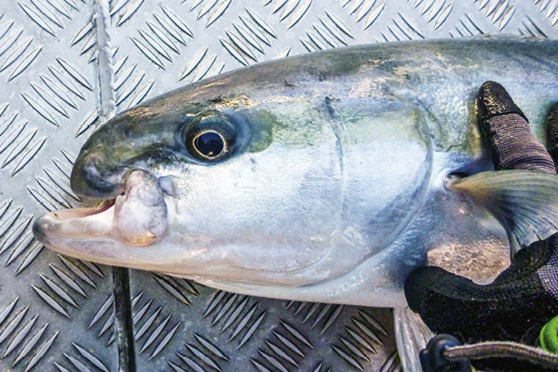
A kingie with an upper jaw deformation. Genetic or mechanical damage?
Although we will never know how many injured fish don’t make it, it is remarkable how some very badly injured and handicapped fish will survive, heal and thrive in what can be a very hostile environment to any fish that is not at the top of its game. Certainly, a hook puncture in a lip is a very minor thing by comparison. Hell, some humans have their lips pierced on purpose because they think lip jewellery looks pretty!
|
|
This article is reproduced with permission of |

Recent Forum Posts Visit Forum

Shane Jones
in Fisheries Management21 hours ago
Tzer
Far cry to the twats at Liegasea/NZSFC were proposing of 5 Tarakihi person in their submission for the central management area and this is what our...

Bluefin Tuna at the cavs.
in The Briny Bar40 hours ago
smudge
Despite my years of fishing I haven't really fished many places, my focus has always been on Auckland's west coast and out toward Great Barrier. I...

Casting gloves
in Popper and Topwater Fishing85 hours ago
Mc Tool
100 bucks for a lure 😬. Watching one of them flying over the horizon without the line attached would be " character building " for sure...
I thought Id post some nice photo's , join...
in The Briny Bar136 hours ago
Alan L
That is a very cool pic Krow.The Far North is very cool, the Far far North even cooler. Mint looking day.Alan...

Mc Tools berley mincer
in The Briny Bar144 hours ago
SaltyC
Good size, they scrap well. Got an 18kg one up in Vava'u back a few years ago fishing off squeaky Going's boat. That was quite a...

Out with the "Twelves"
in Fishing Reports198 hours ago
Pcj
I should be able to get out end of October. The nephew been out virtually every weekend over winter and has done well. It seems the...
Manukau Harbour & West Coast fishing
in Fishing Reports206 hours ago
smudge
Nice work Schecter, I think snapper may be around sooner than you think. Well I am hoping so...

Whangarei Harbour report.
in Fishing Reports638 hours ago
krow
180 +m is where I've had to be lately. A lot less low foul around these parts and some of it shallower that looks like Tarakihi...
Whangarei Harbour Scallops
in Fisheries Management748 hours ago
Pcj
Reopening WhangÄ쳌rei Harbour to recreational scallop fishingTÄ“nÄ쳌 koeFisheries New Zealand is seeking feedback from tangata whenua, stakeholders, and the public on whether WhangÄ쳌rei Harbour should be...
SNA1 Recc fishing cops the blame.
in Fisheries Management844 hours ago
Tzer
What Liegasea won’t tell you is that some of their own fisheries contractors were co-authors of this study for fear of being called hypocrites, one of...

Popular Articles

Softbait Fishing - Part 1 - gear selection
John Eichlesheim writes an article about selecting the right equipment for softbait fishing... Read More >
Softbait fishing Pt 2 - tips and tricks
Techniques, tips and tricks of softbait fishing – getting the most from your soft baits.... Read More >

Surfcasting - setting yourself up
Gary Kemsley helps sort out the necessary gear for intending surf fishers.... Read More >

Squid - How to catch them
Squid fishing is a rapidly growing aspect of fishing - Paul Senior shares some hints and tips to get started.... Read More >
Fishing Reports Visit Reports
Outer Hauraki Gulf Fishing Report 17/09/26
Spring wind the handbrake. Spring is starting to make its presence felt in the outer... Read More >
Top of the South Fishing Report - 17/09/26
Early snapper in Tasman Bay. Well, spring is finally here, and the days are getting... Read More >
Bream Bay Fishing Report - 17/09/26
Good snapper catches reported. After Tangaroa turned off the fish tap for a month or... Read More >
Bay of Islands Fishing Report - 17/09/26
Pacific bluefin tuna for the lucky few. The last fortnight has seen more fishable days... Read More >
Comments