
Point-loading and overloading your rod

Having recently passed my 60th birthday, it is interesting to reflect on the changes I have seen in fishing tackle over the years. Take rods, for example.
As a kid, I can remember Rangoon cane surfcasters and the last of the split-cane fly rods on the rivers. My first rods were robust solid-glass sticks, followed by much lighter hollow-glass rods. Then came the groundbreaking revelation of graphite – so light, so powerful, so crisp … and so fragile!
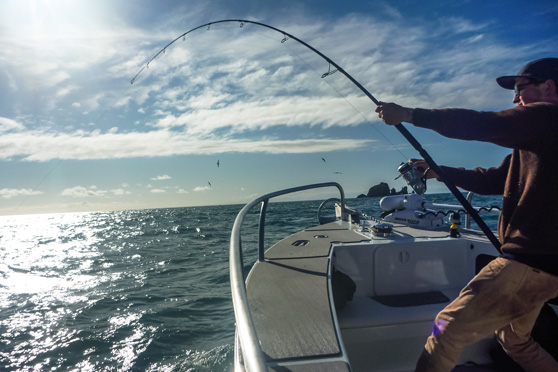
I remember how brilliant the first graphite fly rods were to cast, but also learned the hard lesson (several times) of their delicate nature. In recent years, new blank and resin technologies have resulted in much tougher rods.
Some rod breakages are inevitable over time – shutting rods in car doors or boots, walking the tips into trees and falling down banks were typical scenarios for breaking fly rods. A mate once drove his boat under a tree branch and took the tips off the six rods in the rocket launcher; three of them were mine.
A bad run
During my years in the rod-manufacturing industry, I destructiontested literally hundreds of prototype blanks, and think I heard every breakage story in the book. These included guys in the tropics rigging up gear in their resort rooms, extending fragile rod tips into fast-spinning ceiling fans. Common were rods that “just broke while playing a fish” – but had suspicious crush zones the width of a car tire!
A few years ago, on a trip up Brazil’s Amazon River, my guide took off my graphite spin rod’s tip by dropping an electric outboard on it. Last year I broke a light spin rod by pulling too hard on it while trying to free a snagged lure (although I suspect I must have dinged it at some point previously).
In the last few months I lost a couple of soft-bait rods in separate incidents, both while doing boat tests for this magazine. On one occasion, we were doing a soft-bait drift (just trying out the fishing aspects of the boat, you understand). My buddy hooked up a decent fish, so I dropped my rod in a holder and grabbed the camera. With my eye to the viewfinder, I heard a loud ‘BANG’ behind me and spun around to find my rod minus its tip and first guide, and with a broken braid line.
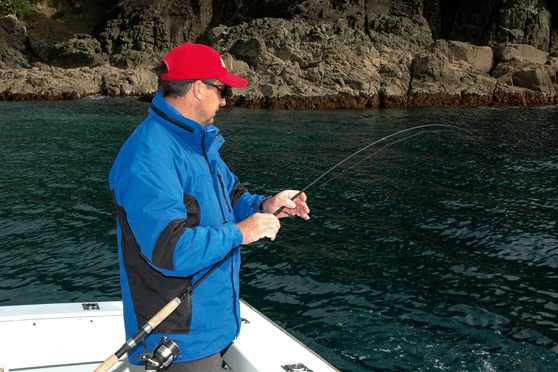
The second guide down was bent flat. It was obvious that I had got a tip wrap, followed by a hook-up on a substantial fish. The second loss came when my rod, and a couple of others, were stowed in the rocket launcher of a boat I was reviewing. Sea conditions were sloppy and I was doing the photo-shoot from another camera boat. I was horrified to see, through the lens, the two other rods (which were long and whippy with no appreciable butt grips) come bouncing almost right out of the rocket launcher.
The lead jig-head at the tip of one of these rods scored a direct hit on tip of my stick and broke it off, then wrapped around the second rod and nailed it as well! One of these rods clung to its holder – just – and with the two tangled together, the loose rod was prevented from going over the side! It was a tribute to the toughness of the material that even one of them survived. I wouldn’t have believed it if I hadn’t captured it with the camera (see pic on previous page).
This brings me to a downside of the latest trend of minimalist ‘skeleton’ butt grips on spin/soft-bait rods. While this design makes these rods lighter and more sensitive, a much-reduced frictional surface area on the butt means they are, as just mentioned, more likely to bounce out of a rod holder or rocket launcher in rough conditions.
A bloke I know reported the bottom section of the blank, unprotected by a butt grip, snapping off flush with the top of the rod holder when a decent fish hit an unattended rod with an enthusiastic drag setting. The rest of the rod, and the reel, went over the side. These days I look for rods with at least a partial grip beneath the reel seat that will protect the rod blank from the rod holder.
Point-loading and overloading
During my time working for a rod-manufacturing company, we experimented with differing materials, including various types of carbon fibre and fibreglass and blends of these materials, along with exotic additives including boron and even quartz. These days the latest generation resins, fibres and manufacturing techniques have hugely improved the robustness of rods, but as if to compensate for this, today’s fishermen seem to treat them more roughly!
Barring accidents, there are two good ways to break your rod: point-loading and overloading. ‘Point-loading’ sees all the pressure concentrated into a small section of the rod, rather than spread over the whole length, as it should be. If all the pressure is concentrated on the lighter tip section (often by lifting the rod too high or too far back), a breakage may occur.
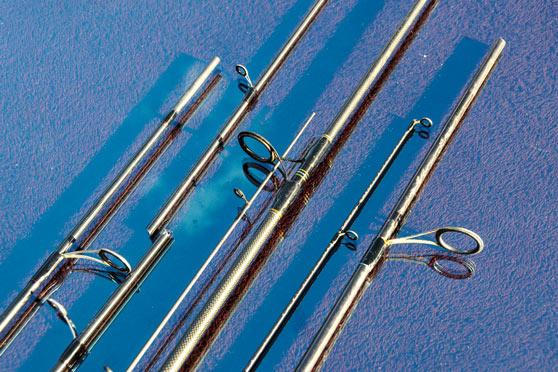
Nothing is unbreakable of course, and a rod can be broken by subjecting it to more pressure than it is designed to withstand – ‘overloading’. Using line that is heavier than the rod is rated for facilitates this, and a good indicator of overload is that the blank fails in multiple places at the same time.
A previous manager here at Fishing News, Mark Airey, had a cheaply-made fibreglass rod that he favoured for deep-water hapuku fishing. It had caught some good fish, but one day the small bluenose that Mark was pulling in was eaten by something very large (from later experience, I would say it was a broadbill or big thresher shark).
Mark’s old 6/0 Penn Senator reel was loaded with 60kg braid and he battled his unseen adversary gamely for an hour or so, putting on all the pressure he could. But eventually the rod started to creak and groan, then, abruptly, the pressure became too great and, BOOM! The rod broke simultaneously at the foregrip and the tip. I was amazed it had lasted so long. We hand-lined the fish for a while, but eventually the line broke.
Rods, especially lighter graphite sticks, that break under modest load for no apparent reason, may have been carrying hidden damage from an incident some time earlier. Rods that get clashed together, are smacked into other items, get hit by swinging sinkers or suffer other mechanical damage, may not finally give up the ghost until some time later, when the earlier damaging incident has been forgotten.
I once saw a very expensive graphite fly rod that had had the eye of a weighted Tongariro nymph punched straight through the rod wall on the cast. If the nymph had not stayed stuck in the rod, the tiny slot made by the eye in the graphite wall would never have been noticed and then hidden by the rod breakage when it inevitably happened.
Developing what I call ‘tip awareness’ will save a lot of rod damage and potential breakages, too. Tips are the thinnest and most fragile part of a rod, but are also the bits most likely to be damaged by being walked into things like trees, walls, or left where they can be damaged by being shut in doors, car boots and so on. Be aware of where the rod tip is when carrying a rod or putting it down.
|
|
This article is reproduced with permission of |

Recent Forum Posts Visit Forum

Trailer wheel clamp
in The Boat Shed7 minutes ago
610gc
Hey teamI have a wheel clamp like the one below on the boat trailer. its getting harder and harder to unlockI've sprayed it with CRC on...

Shane Jones
in Fisheries Management23 hours ago
Tzer
Far cry to the twats at Liegasea/NZSFC were proposing of 5 Tarakihi person in their submission for the central management area and this is what our...

Bluefin Tuna at the cavs.
in The Briny Bar43 hours ago
smudge
Despite my years of fishing I haven't really fished many places, my focus has always been on Auckland's west coast and out toward Great Barrier. I...
Casting gloves
in Popper and Topwater Fishing88 hours ago
Mc Tool
100 bucks for a lure 😬. Watching one of them flying over the horizon without the line attached would be " character building " for sure...
I thought Id post some nice photo's , join...
in The Briny Bar139 hours ago
Alan L
That is a very cool pic Krow.The Far North is very cool, the Far far North even cooler. Mint looking day.Alan...

Mc Tools berley mincer
in The Briny Bar146 hours ago
SaltyC
Good size, they scrap well. Got an 18kg one up in Vava'u back a few years ago fishing off squeaky Going's boat. That was quite a...

Out with the "Twelves"
in Fishing Reports200 hours ago
Pcj
I should be able to get out end of October. The nephew been out virtually every weekend over winter and has done well. It seems the...
Manukau Harbour & West Coast fishing
in Fishing Reports208 hours ago
smudge
Nice work Schecter, I think snapper may be around sooner than you think. Well I am hoping so...

Whangarei Harbour report.
in Fishing Reports640 hours ago
krow
180 +m is where I've had to be lately. A lot less low foul around these parts and some of it shallower that looks like Tarakihi...
Whangarei Harbour Scallops
in Fisheries Management750 hours ago
Pcj
Reopening WhangÄ쳌rei Harbour to recreational scallop fishingTÄ“nÄ쳌 koeFisheries New Zealand is seeking feedback from tangata whenua, stakeholders, and the public on whether WhangÄ쳌rei Harbour should be...
Popular Articles

Softbait Fishing - Part 1 - gear selection
John Eichlesheim writes an article about selecting the right equipment for softbait fishing... Read More >
Softbait fishing Pt 2 - tips and tricks
Techniques, tips and tricks of softbait fishing – getting the most from your soft baits.... Read More >

Surfcasting - setting yourself up
Gary Kemsley helps sort out the necessary gear for intending surf fishers.... Read More >

Squid - How to catch them
Squid fishing is a rapidly growing aspect of fishing - Paul Senior shares some hints and tips to get started.... Read More >
Fishing Reports Visit Reports
Outer Hauraki Gulf Fishing Report 17/09/26
Spring wind the handbrake. Spring is starting to make its presence felt in the outer... Read More >
Top of the South Fishing Report - 17/09/26
Early snapper in Tasman Bay. Well, spring is finally here, and the days are getting... Read More >
Bream Bay Fishing Report - 17/09/26
Good snapper catches reported. After Tangaroa turned off the fish tap for a month or... Read More >
Bay of Islands Fishing Report - 17/09/26
Pacific bluefin tuna for the lucky few. The last fortnight has seen more fishable days... Read More >
Comments