
Paddle Tail Soft-Baits

Soft-baits come in a myriad of shapes and sizes to suit all sorts of situations and purposes. In previous segments, Mark Kitteridge has discussed the advantages associated with curly-tail and jerk-type soft-baits; he moves on to paddle-tail soft-baits and why they are so effective at ‘pushing the right buttons’ of big, bad predators...
My earliest memories of paddler-style soft-baits come from Mangonui Wharf around 1980. At the time, we were facing a potential dream scenario, with many dozens of kingfish charging around the wharf in pursuit of panic-stricken mackerel, which sprayed across the surface as the kings crashed among them, white water going everywhere. Only one thing was missing: livebaits. With our usual kingfish offerings currently more interested in self-preservation than eating one of our sabiki flies, my friends and I could only watch on, excited but frustrated.
Then I remembered the packet of Mister Twister ‘Sassy Shad’ soft-baits I’d stored away in my tackle box for just such an occasion. Shaking hands slowed the knotting process, made worse by the yells and curses of the onlooking anglers and spectators as the carnage continued unabated, but finally I was ready for action.
Elbowing my way to the front of the crowd, I lobbed my paddle-tailed lure around six metres out and watched as it rapidly descended, its tail thrashing hard – and with several kingfish chasing down after it. Split seconds later, the line abruptly slackened and, upon engaging my reel and striking, my rod hauled down hard as line started accelerating off the spool. Hook-up!
Almost four decades have gone by since that day, but paddle-tailed soft-baits remain remarkably unchanged and just as lethal. Having said that though, there was a protracted period in between when soft-baits of all styles largely went out of favour, due to the weighty, clumsy outfits available at the time, the relatively thick, stretchy nylon we all used and a lack of suitably weighted lead-heads with strong hooks.
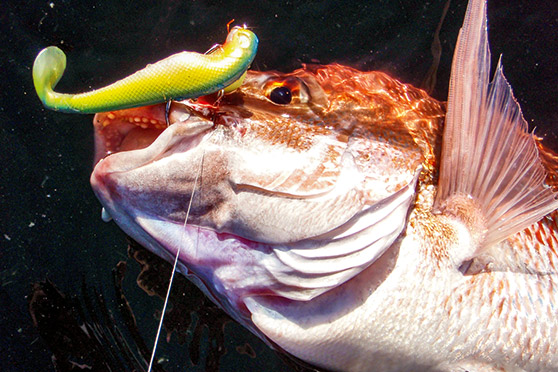
An early Basstrix paddle tail lure.
Then along came braided lines and, like so many other aspects of fishing, a whole new world opened up for soft-baiting techniques, including those used with paddle-style lures.
Gulp! was the only significant soft-bait brand on the scene early on, but my reasonably shallow-water fishing techniques suited jerk- and curly-tail-type shapes better.
My friend Paul Senior was one of the first to see the potential for fishing paddler-type lures in deeper waters, and was in the ideal position to uncover a lot of useful information in a very short time. Thanks to his charter-skipper role, which mostly involved chasing deepwater work-ups, he set his clients up with all sorts of rigs and lures to see which ones performed best on a regular basis.
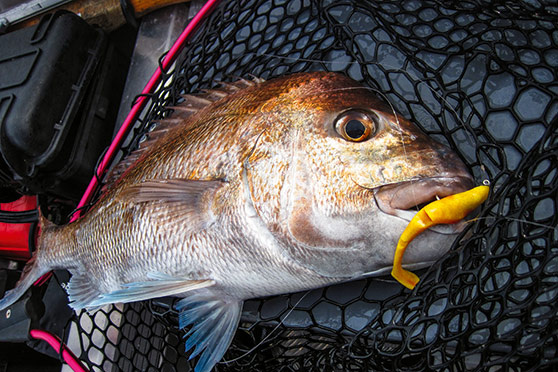 Note the strategically placed slices in the wrist of this paddle-tail; this allows the tail to waggle more readily.
Paul loved how the paddle-tail sprung to thrashing life when descending quickly, with the vibrations they produced adding to the falling lure’s attractiveness. Indeed, so effective was this style of lure, his anglers often hooked big snapper and kingfish during the initial descent, despite the attached four to six-ounce Cyclops rigs!
It was this particular aspect that really got me thinking, and I’m now convinced that much of the paddle-tail-type soft-baits’ success comes from being forced through the water at a decent pace, as this activates the thrashing tail. Such movements are achieved by the angler lifting or retrieving the lure, or while the paddler is being dragged down by a weighted lead-head during descent. To see what I mean, place a paddler-type soft-bait on a lead-head of at least 5/8oz (2-8oz with kingfish-size paddlers) and repeatedly lift and drop it next to the boat. Those soft-bait brands made from more flexible materials are especially impressive, looking for all intents and purposes like a live fish as they rise and fall!
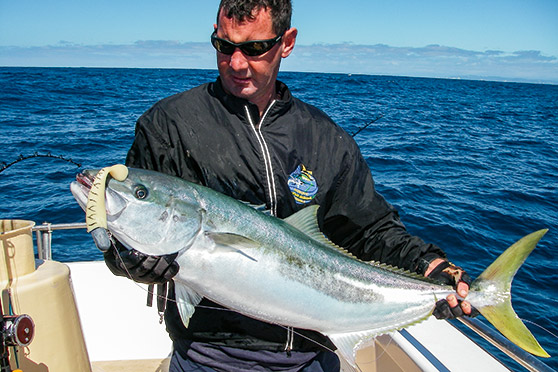
A large Storm paddler-type soft-bait proved too hard for this kingfish to resist.
But, as already mentioned, it is not just what they look like when moving that triggers all manner of predators into biting them. Their thrashing tail creates powerful water disturbances that get picked up by fishes’ lateral lines, bringing them in for a closer look and often exciting them into biting. It’s a quality that also makes them easier to detect in water with limited visibility, perhaps caused by natural turbidity, the time of day and/or the depth.
And, fortunately for us, this same thrashing tail also creates friction that can slow the descent when lighter jig heads are used, allowing valuable extra time for fish to detect the lure’s presence and react.
No luck on the descent? No worries. Just lift and drop the paddler yo-yo style near the bottom if targeting snapper, perhaps incorporating sporadic jiggles and twitches for added interest, or try a short series of mechanical jigging movements (a lift and drop of the rod in synchronisation with a single reel-handle turn) for maybe five metres before dropping back down. These movements are designed to get the best from paddle-type tails, but don’t discount dragging, especially if the brand has inherent buoyancy to lift the wagging tail off the bottom for added visibility – I hooked my biggest ever snapper this way!
Or, for those chasing kingfish with 7-12” paddlers, speed up the mechanical-jigging series of movements, or crank fast upwards with just the occasional short, sharp rod jerk every five seconds to create more interest, concentrating these efforts in the lower half of the water column in deeper water (unless your fish-finder suggests otherwise!).
Paddler-type soft-baits do have their disadvantages though. For example, in addition to being harder to effectively activate when placed on lighter jig heads, the much bulkier paddle tail (in relation to jerk and curly tails) can be grabbed by the fish and hung onto firmly. With just the soft-bait tail in the fish’s mouth, striking anglers can break that part off (if not especially elastic) or elongate the product like an elastic band before it’s finally let go. The latter action can see the soft-bait catapult back at high speed, resulting in bizarre hook repositionings that rarely attract another bite afterwards, or get dragged down the shank to the hook’s bend where bites are also unlikely to occur.
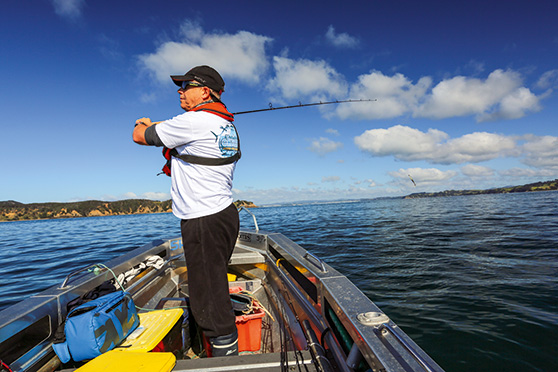 When cast hard, paddle tails are more susceptible to becoming repositioned or partially unhooked upon landing, especially the more elastic types.
Similarly, the paddle-tail’s bulk works against it when cast with some effort; the resulting crashing impact with the water sometimes causes the hook to be displaced so the lure won’t swim properly afterwards. This is especially the case when using the larger paddle tails – perhaps targeting kingfish with stick-bait gear. The problem is made worse if the angler’s hook lacks a system to firmly hold the product in place. Typically, this means the incorporation of various wire ‘snaggers’ or lead ribbing, with the more elastic Z-Man baits requiring bigger ribbing than the denser Gulp! products. It is one of the few times when super glue can provide the answer. Otherwise, stick to just dropping the paddle-tail down and jigging it as described earlier.
|
----- Advertisement -----
|
This article is reproduced with permission of |

Recent Forum Posts Visit Forum

Offshore Power Boats - Gulf Harbour 17 Oct
in The Briny Bar1 hour ago
Phantom Menace
The course goes anti-clockwise and turns around the little island (Kotanui / Frenchmans Cap) just off Gulf Harbour. That turn should make for interesting viewing -...

Manukau Harbour & West Coast fishing
in Fishing Reports36 hours ago
smudge
Thats a great catch Schecter, big fish. I'll post up a report from off the coast a bit later on...


Garmin vs Lowrance
in The Boat Shed129 hours ago
Roscoe C
Hi folksI'm looking at upgrading the electronics on my Stabi 1450. I've currently got a Lowrance Eagle 7 which I'm not especially impressed with. In particular...

Shimano 3500 baitrunner
in Buy Sell Trade or Exchange265 hours ago
0nlanders_Nz
Hello, I have come across to on the cash converters website search fishing reels $35 on there...
Manu bay boat ramp
in The Boat Shed270 hours ago
610gc
Hey teamhas any one tried the Manu bay boat ramp since the repairs?Is it any better to use?thank you ...

Out with the "Twelves"
in Fishing Reports274 hours ago
Telecaster
Popped out at about 3:30pm yesterday with a mate, usual zone and method. 10 snapper and 5 gurnard. The biggest snap we got (55cm) was definitely...
Wanted 10500 fin-nor reel
in Buy Sell Trade or Exchange321 hours ago
0nlanders_Nz
I am looking for a fin-nor 10500 fishing reel if any one has, please message me...
Wanted to Buy
in Buy Sell Trade or Exchange344 hours ago
honestbruce
Seen your post and that would work but its not up my alley or ability to make one. Dont have the means to manufacture here in...
Popular Articles

Softbait Fishing - Part 1 - gear selection
John Eichlesheim writes an article about selecting the right equipment for softbait fishing... Read More >
Softbait fishing Pt 2 - tips and tricks
Techniques, tips and tricks of softbait fishing – getting the most from your soft baits.... Read More >

Surfcasting - setting yourself up
Gary Kemsley helps sort out the necessary gear for intending surf fishers.... Read More >

Squid - How to catch them
Squid fishing is a rapidly growing aspect of fishing - Paul Senior shares some hints and tips to get started.... Read More >
Fishing Reports Visit Reports
Canterbury Fishing Report - 01/10/26
Freshwater season underway. Wow, it’s October already, and our freshwater season is underway, and the... Read More >
Top of the South Fishing Report - 01/10/26
Snapper about but not yet firing. It’s certainly nice to see daylight savings upon us... Read More >
Hauraki Gulf Fishing Report 01/10/26
Big reds in the shallows. The weather has made getting out on the water challenging... Read More >
Bay of Islands Fishing Report - 01/10/26
Snapper moving in. A few Pacific bluefin are still gracing the weigh stations with last... Read More >
Comments