
Overcoming fishing challenges
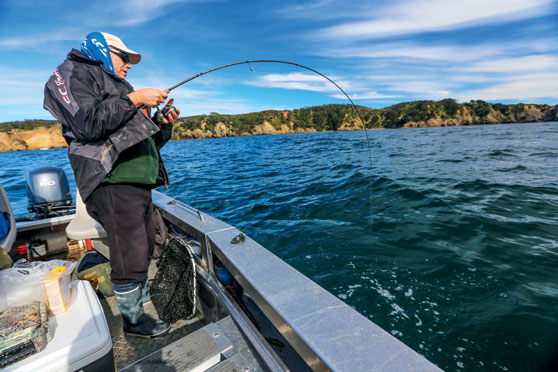
John Eichelsheim gets an exciting fishing opportunity and is faced by some unwanted hurdles in the process...
Recently, while fishing a soft-bait under scattered birds, I hooked something large, fast and seemingly unstoppable.
Gannets were diving into packed concentrations of baitfish, almost certainly anchovies or pilchards, which showed sporadically as dense marks on the sounder, sometimes turning the whole screen red. The birds were moving around a lot – too fast to realistically chase – but the activity was confined to the same general area and had been underway for at least a couple of hours. It looked very fishy.
Not surprisingly, we’d hooked a few nice snapper – not necessarily from amongst the working birds, but in the general area – by repeatedly drifting with the tide through the fishy-looking zone.
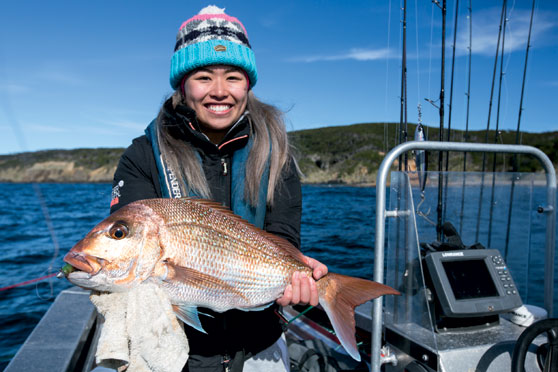
Unfortunately, I’d hooked the big fish on a light soft-plastics outfit: a 2.3m rod and a Penn Conflict 2500 reel loaded with 4kg SSP Fibre Glide braid from Black Magic. I’m a bit embarrassed to admit the braid had been on the reel for maybe two years, but only ever seem to remember it’s overdue for replacement when hooked up to good fish. Similarly, the reel was probably due a little TLC after several seasons of hard use, too.
The baitfish-coloured, three-inch soft-bait was hardly a big-fish attractor, but obviously closely matched the schooling baitfish; I was fishing it on a quarter-ounce 2/0 jig-head tied to a 15lb fluorocarbon trace.
The fish struck as the bait was descending through the water, and upon lifting my rod in response to the slight ‘tick’ felt through the line, I knew immediately it was a big one. For a split second I wondered if I’d snagged the bottom, but the ‘bottom’ soon started to accelerate away against the drag.
Big snapper can make impressive runs when hooked, especially in shallow water, but don’t run 30, 40 or maybe even 50 metres against the drag. My first instinct as my little spool emptied was to tighten the drag, but good sense prevailed and I backed it off instead. (With 40-odd metres of line dragging in the water behind the fish, and the reduced diameter of a half-empty spool increasing the effective drag pressure, not backing off the drag would almost certainly have resulted in a bust-off during the first run.)
The other tactic my companion Mark Kitteridge immediately employed was to fire up the engine and chase the fish. The goal was to shorten the line as much as possible to reduce water drag and lessen the change of snagging the line on any underwater obstructions.

The fish behaved itself to begin with, leaving the shallow, reefy area where it was hooked for deeper water over a sandy bottom. This allowed us to take stock and get settled into the fight. With such light tackle, lifting the fish was out of the question, so for most of the fight our opponent was very much in the driver’s seat.
While the fish – almost certainly a good kingfish due to its power and speed – was out in 25 metres over a sandy bottom, we were relatively safe, and I could concentrate on getting line back on to the reel. However, when the fight was straight up and down, I had to be careful of my rod angles to avoid point-loading my light graphite rod and also resist the temptation to pull too hard trying to lift the fish.
Over the sand, we used the boat to our advantage, sometimes letting the fish run away from us to change the angle of pull in an effort to plane it up from the bottom. Unfortunately, for most of the fight it stayed stubbornly deep, hugging the bottom, or diving back down again every time I made a few metres of line. With the light gear I was using, I didn’t have the means to control the fight.
After 20 minutes or so and no progress whatsoever, I was beginning to feel very under-gunned. Even after all this time, the kingfish would make powerful runs, forcing us to follow it with the boat all over the ocean. Unfortunately, the seafloor wasn’t sandy everywhere and the fish seemed to know exactly where it was going. Time and again it made a beeline for isolated outcrops of foul ground in an otherwise flat bottom, but somehow, each time we averted disaster.
After 45 minutes the kingfish decided it had had enough of deep water and headed inshore, dragging us all the way back to where we’d hooked it, over a reef in seven metres of water. This time we were unable to prevent it reaching its goal, and the bumps and vibrations coming up the taut line told me it was dragging my gear through the kelp.
Fearing the worst, I again eased the drag pressure and Mark drove the boat over the line until it was vertical in the water. Amazingly, the braid cut through the kelp and came free without contacting the rock beneath, leaving the line festooned with kelp fronds that were cleared upon sliding up to surface. The fish, meanwhile, set off on yet another run.
As time wore on, we kept revising the size of the fish upwards, from a well-legal kingfish initially, perhaps 10 or 12kg in weight, to 15 kilos, and then 18 kilos. As the hour mark approached, we began to talk 20-kilos plus.
But all was not well. About 20 minutes in I began to notice uneven patches on my braided line. As already mentioned, I knew the front section was a bit worn: it had started to look furry in places, as commonly happens with GSP lines over time, but I hadn’t got around to replacing it.
Pretty soon, though, the uneven patches became clumps of fibres clinging to the line and these became larger as the fight progressed. My line was disintegrating before my eyes, and I suspected the cause was either a damaged guide or a malfunctioning bail roller (I later found my roller was seized).
Fearful my line would break at any moment, I was again forced to ease the pressure, which extended the fight, and ironically resulted in further damage inflicted on the line.
Despite the damaged braid though, good teamwork had got the crew of Gotcha into a position where we began to think we might win the battle. I was finally starting to move the fish off the bottom.
Then, just as it clearly became visible on the sounder 9m below the boat, the rod tip flew up and suddenly it was gone. We were gutted but not surprised given the circumstances; I’d struggled with that fish for more than an hour – a hard-fought battle that had taxed angler and tackle to the limit (and beyond!). What did surprise us was where the break had come: it wasn’t the severely damaged braid that had failed, but the fluorocarbon trace, which had finally worn through at the knot.
I connect my jig heads with a Lefty’s loop/Rapala knot, which is strong and easy to tie, but the free-swinging jig head wears on the line, which can lead to failure. When the knot is under sustained pressure, as it was in this case, the damage is accelerated, and nor was it the first fish I’d hooked that day. In fact, I hadn’t tied the jig head on fresh that morning, either – it was still there from the previous session…
I tell other fishers to rig new traces and tie fresh knots at the beginning of every fishing session and then re-tie loop knots after catching big fish. It’s good advice I should have heeded myself…
So what lessons did I learn?
- If you hook a big fish on light tackle, don’t panic. Just take your time and settle in to a long fight – we nearly won this battle.
- Well-maintained fishing tackle inspires confidence and can be worked hard. My gear was not as wellmaintained as it should have been and I paid the price. I lost confidence in it partway through the fight, prolonging the battle and ultimately leading to a very large fish being lost.
- Take the time to regularly re-tie knots. If my terminal knot had been fresh, we may yet have boated that fish, despite the damaged mainline.
- Replace the line before it starts to break down. Braided lines are tough, but eventually wear out: two years of hard fishing is too long between line changes.
- Teamwork wins big fish battles. Good boat work and constant communication kept Mark and I in the fight for over an hour, eventually putting us in a position where we were winning before gear failure ended the entertaining challenge.
|
|
This article is reproduced with permission of |

Recent Forum Posts Visit Forum

Shane Jones
in Fisheries Management18 hours ago
Tzer
Far cry to the twats at Liegasea/NZSFC were proposing of 5 Tarakihi person in their submission for the central management area and this is what our...

Bluefin Tuna at the cavs.
in The Briny Bar38 hours ago
smudge
Despite my years of fishing I haven't really fished many places, my focus has always been on Auckland's west coast and out toward Great Barrier. I...

Casting gloves
in Popper and Topwater Fishing83 hours ago
Mc Tool
100 bucks for a lure 😬. Watching one of them flying over the horizon without the line attached would be " character building " for sure...
I thought Id post some nice photo's , join...
in The Briny Bar134 hours ago
Alan L
That is a very cool pic Krow.The Far North is very cool, the Far far North even cooler. Mint looking day.Alan...

Mc Tools berley mincer
in The Briny Bar141 hours ago
SaltyC
Good size, they scrap well. Got an 18kg one up in Vava'u back a few years ago fishing off squeaky Going's boat. That was quite a...

Out with the "Twelves"
in Fishing Reports195 hours ago
Pcj
I should be able to get out end of October. The nephew been out virtually every weekend over winter and has done well. It seems the...
Manukau Harbour & West Coast fishing
in Fishing Reports203 hours ago
smudge
Nice work Schecter, I think snapper may be around sooner than you think. Well I am hoping so...

Whangarei Harbour report.
in Fishing Reports635 hours ago
krow
180 +m is where I've had to be lately. A lot less low foul around these parts and some of it shallower that looks like Tarakihi...
Whangarei Harbour Scallops
in Fisheries Management745 hours ago
Pcj
Reopening WhangÄ쳌rei Harbour to recreational scallop fishingTÄ“nÄ쳌 koeFisheries New Zealand is seeking feedback from tangata whenua, stakeholders, and the public on whether WhangÄ쳌rei Harbour should be...
SNA1 Recc fishing cops the blame.
in Fisheries Management841 hours ago
Tzer
What Liegasea won’t tell you is that some of their own fisheries contractors were co-authors of this study for fear of being called hypocrites, one of...
Popular Articles

Softbait Fishing - Part 1 - gear selection
John Eichlesheim writes an article about selecting the right equipment for softbait fishing... Read More >
Softbait fishing Pt 2 - tips and tricks
Techniques, tips and tricks of softbait fishing – getting the most from your soft baits.... Read More >

Surfcasting - setting yourself up
Gary Kemsley helps sort out the necessary gear for intending surf fishers.... Read More >

Squid - How to catch them
Squid fishing is a rapidly growing aspect of fishing - Paul Senior shares some hints and tips to get started.... Read More >
Fishing Reports Visit Reports
Outer Hauraki Gulf Fishing Report 17/09/26
Spring wind the handbrake. Spring is starting to make its presence felt in the outer... Read More >
Top of the South Fishing Report - 17/09/26
Early snapper in Tasman Bay. Well, spring is finally here, and the days are getting... Read More >
Bream Bay Fishing Report - 17/09/26
Good snapper catches reported. After Tangaroa turned off the fish tap for a month or... Read More >
Bay of Islands Fishing Report - 17/09/26
Pacific bluefin tuna for the lucky few. The last fortnight has seen more fishable days... Read More >
Comments