
New Zealand's edible shellfish

One of the joys of fishing and foraging along our coastlines is exploring the diverse range of wild foods available and checking out new flavours, writes Peter Langlands.
We are lucky in NZ to have a good variety of shellfish. Some species have only gained popularity as food recently (such as the storm clams) and many species still remain relatively unknown as a food source in NZ (such as whelks and volutes), despite being popular edible species overseas. Shellfish offer great flavour, often with a strong umami (savoury) profile, and are also very healthy to eat. Once you know where good shellfish beds are you can return and get a feed with some dependability, as shellfish don’t move around as much as fish! In this article, I will scope out our shellfish resources, discuss some new options to try, and offer some tips on how to locate some of the more traditional species.
First up, one of my favourites – paua. I like to gather them from the shore in spots that are often overlooked. “Spring tide” (when the tide is at its lowest for the month) is when I have the most success. Interestingly, tides will vary in height each month throughout the year and there will be a period of 3-5 days each month when the tides are lower than normal. I check out a tide chart and target these dates. I go to rock platforms that are gently sloping. These intertidal areas are often overlooked by divers and offer a reasonable chance for the sharp-eyed person to find paua for a few days each month. Paua are often found in clusters so, when you find a few, look very closely in the surrounding areas. Paua like areas with good current, a diversity of seaweeds and often avoid heavily-silted waters. Make sure you use a blunt ended tool for removing them – the plastic paua tools designed by MPI are very useful. When measuring paua, it is the total shell length, not just the length of the bottom of the paua, that counts. For snorkelers, the yellow-footed paua is encountered most. They are often found in crevices, and tend to be located on vertical rock structures, rather than rock platforms. Yellow-foots have a clean sweet flesh and are not as strongly flavoured as the standard black-foot pauas. They can be taken at a smaller legal size (80mm compared to the 125mm for black-foot paua).

Shallow water paua are often well disguised.

Yellow-foot paua are often overlooked.
Another species often encountered when looking for paua is the Cook’s turban. These large shellfish, weighing up to 250 grams each, are great eating and have a sizeable white foot that has a sweet flavour and a paua-like texture. Over the last year or so, some of the country’s top chefs have started using Cook’s turban, and a small commercial fishery has developed. The spiraled shell means the flesh needs to be carefully twisted out after it’s cooked. Many of the smaller cats-eyes found in the inter-tidal area are edible too, and, once cooked, a toothpick is the best way to extract their flesh.
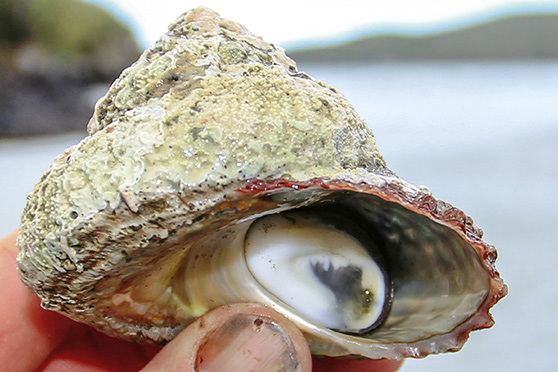
The Cook's Turban is often encountered when looking for paua and is great eating.
Whelks and volutes are also good eating. The knobbed whelk is the best eating of the shallow water whelks and, like the Cook’s turban, a fishery has developed in recent years. Knobbed whelks like sandy, sheltered areas and can be caught in a flat-bottomed baited pot (as they are scavengers). A larger type of whelk known as a volute can also be found in sheltered and deeper waters. The large pink volutes are great eating, with a sweet white flesh ideal for sashimi. Again, a flat-bottom baited pot is the best way of catching volutes, although they can also be taken when snorkeling/diving over open ground. To my knowledge, a commercial fishery has not yet developed for volutes in NZ, but small amounts are sold that are taken as bycatch by trawlers. Yet volutes are very popular in France and many overseas countries, so all it will take to lift their profile is for one of our top chefs to use them!
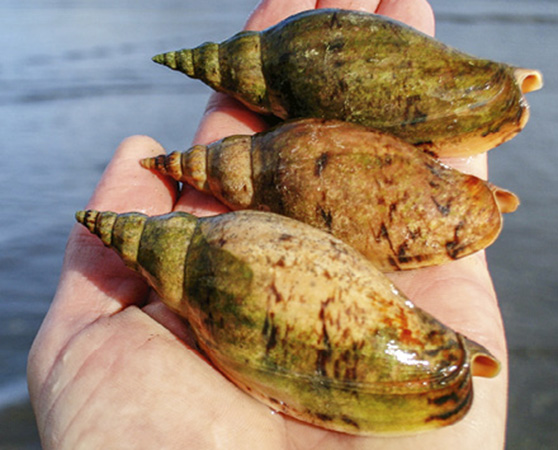
Volutes (a type of large whelk) are eaten widely through Europe and are a prized delicacy. They may be the next shellfish to enter the stage of culinary awareness here.
Flavour-wise, my favourite shellfish (other than oysters and scallops) is the tuatua. Tuatua are widespread throughout New Zealand, liking open sandy beaches with shifting sands. Tuatua occur in clusters so, as for paua, check the surrounding area closely once you find a few. Similarly, I like to choose the very low spring tides for getting tuatuas. They have a very sweet white flesh which makes them delicious eating. They do, however, have to be soaked in a bucket of seawater for at least 24 hours for them to purge the sand out of their bodies.

Tuatuas are delicious, but purge them first.
In more sheltered estuarine waters, the smaller and more oval shaped pipi is found. Unfortunately, pipi beds have recently been affected by reduced water quality in many areas in New Zealand. Slightly higher up in the estuaries, a little closer to freshwater sources, you find cockles. Cockles, or “littleneck clams” as they are known commercially, often occur in very dense beds and make great eating when steamed. Unlike tuatuas, cockles do not need to be left in salt water for purging. Sadly, like pipis, many cockle beds have been impacted by declining freshwater quality. Some of NZ’s best cockle grounds are found in Otago (where they are commercially harvested).
Finally, one of the most exciting groups of shellfish that have recently been commercially fished, are the surf clams. These species (the storm clam, triangle and moonshells) are extracted from the sand using a suction pump. The storm clam is large, often around 200 grams, and is found in waters from 4-20m deep. The largest are found in Pegasus Bay and Cloudy Bay, Marlborough. The storm clam has an amazingly sweet flavour and very soft juicy texture, making it a highly desirable species. With several hundred tonnes caught commercially each year, much is exported – yet there is still the possibility for recreational fishers to target storm clams. Two other surf clams, the triangle shell and moonshells, have risen in popularity over recent years, and these species occur a little shallower than storm clams, making them another potential target for recreational divers.
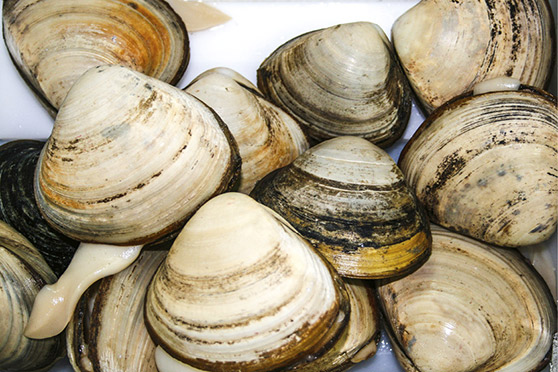
Weighing 200g each; storm clams offer a good feed.
At the end of the day, however, the most dependable and reliable shellfish feed for me is the green-lipped mussel. They have a great flavour and are unique to NZ. Good green-lipped mussel beds can be found throughout New Zealand, with some huge ones in the Marlborough Sounds. I love getting out onto some of the remoter bays of Banks Peninsula and gathering green-lipped mussels. Once steamed, I coat them in flour, egg and breadcrumbs and pan fry in butter. When serving, I add some wild Italian parsley foraged from the shoreline.
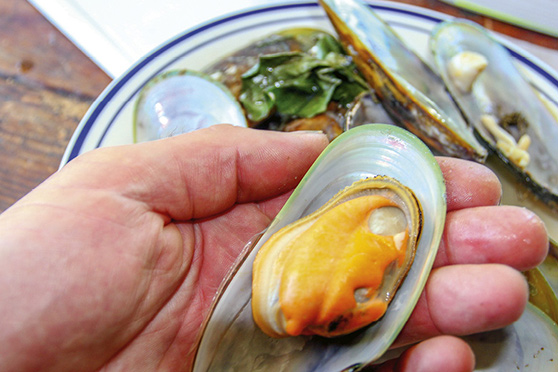
At the end of the day, a fat green-lipped mussel is hard to beat.
All shellfish are edible in NZ waters, and our stocks are far more diverse than most people realize. Only in recent years have surf clams been harvested. The Cook’s turban, widespread and easily harvested recreationally, has just hit the culinary stage. Next, I suspect volutes will be fished commercially. We are still exploring our shellfish resources, and while mussels and tuatuas are favourites (being readily available and tasty), there are certainly many other species out there with a spectrum of flavours to explore.
|
|
This article is reproduced with permission of |


Popular Articles

Softbait Fishing - Part 1 - gear selection
John Eichlesheim writes an article about selecting the right equipment for softbait fishing... Read More >
Softbait fishing Pt 2 - tips and tricks
Techniques, tips and tricks of softbait fishing – getting the most from your soft baits.... Read More >

Surfcasting - setting yourself up
Gary Kemsley helps sort out the necessary gear for intending surf fishers.... Read More >

Squid - How to catch them
Squid fishing is a rapidly growing aspect of fishing - Paul Senior shares some hints and tips to get started.... Read More >
Fishing Reports Visit Reports
Manukau/West Coast Fishing Report - 15/10/26
Big spring snapper in 60 metres. The El Niño weather pattern isn’t going to be... Read More >
Rotorua Fishing Report - 15/10/26
Solid start to the season! The Rotorua lakes have all started the season well, and... Read More >
Tutukaka Fishing Report - 15/10/26
Big snapper in shallow. Things remain relatively quiet on the fishing front out of Tutukaka,... Read More >
Tauranga Fishing Report - 15/10/26
Bait and temperature on the rise. It’s been great to get out and see some... Read More >
Comments