
New Zealand Reef fish
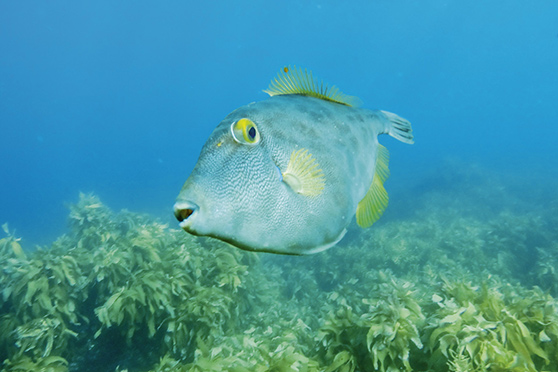
A weird and wonderful variety of marine life can be found around our reef systems here in New Zealand and contributor Jordy Bardin likes nothing more than exploring them on and above the water…
Reefs add a whole new aspect to inshore fishing, providing unpredictable and exciting experiences to a day out on the water. A range of species tend to aggregate around areas of reef or foul ground for a number of factors. For example, reefs provide habitats for creatures large and small – from sponges and worms to crustaceans and fish – which creates a steady supply of food. Reef structure also provides refuge from predators and even a place to spawn or lay eggs. As such, when fishing over a reef or foul ground, you never know what may jump on your hook! Some of the more common catches include the classic snapper, mighty kingfish and humble tarakihi. These fish get plenty of attention (not to forget fishing pressure too) so here I will showcase the more unorthodox species a moment in the spotlight!
John dory
Zeus faber or kuparu
Most kiwis are familiar with the distinctive john dory. With its striking and bizarre appearance, it is hard to miss! They use their incredible camouflage and thin, compressed body to blend into the weed and stalk their prey of small fish. Although difficult to see face-on underwater, when the john dory turns to the side, a large oval body appears with a flared crown of dorsal spines and a huge head and eye – not to mention the large, distinctive spot in the middle of their body which appears as a big scary eye to their predators. Another curious trait of the john dory is that it tends to grunt when captured or in distress!
This winter in the Bay of Plenty has been particularly productive, with these fish occurring in numbers around our inshore reefs and foul ground from May through to August. John dory are typically found where lots of baitfish or juvenile fish are holding and you can spot them in the shallows along the weed edges while spearfishing. I have seen them during the warmer months hanging out on the sand not far off the beach. A great childhood memory was rounding them up onto the sand and spearing them like flounder! Lately, however, I have been catching them while drifting either with soft-baits or livebaits. More natural coloured soft-baits seem to be popular, and I keep it close to the bottom by using a 5/8oz head and letting line out as needed on my Shimano Sustain 3000 and #KAOS rod set up. I have been using small kahawai from about 5-10cm in size for livebait. I rig a 6/0 live-bait J-hook just under the skin of the back on a diagonal angle so that the tip of the hook points back towards the head of the livebait. John dory have a huge protractible mouth but are slow swimmers, so a small livebait is more likely to be caught and eaten. John dory will usually try to swallow the bait and slowly swim off with it, so a few winds should secure the hook. And then the thrilling fight begins as you wind up what feels like a chunk of seaweed. They are a reasonably lifeless weight, a distinctive characteristic of the charismatic john dory. However, that feeling on the end of my line always gets me excited because john dory are such a tasty treat and always a welcome addition to the chilly bin. They are such a fantastic fish to eat because the beautiful white fillets contain no bones (when filleted properly) and their lack of scales means you don’t have to skin them before throwing in a pan with a bit of butter! Easy catch, easy fillet, easy cook, delicious result!
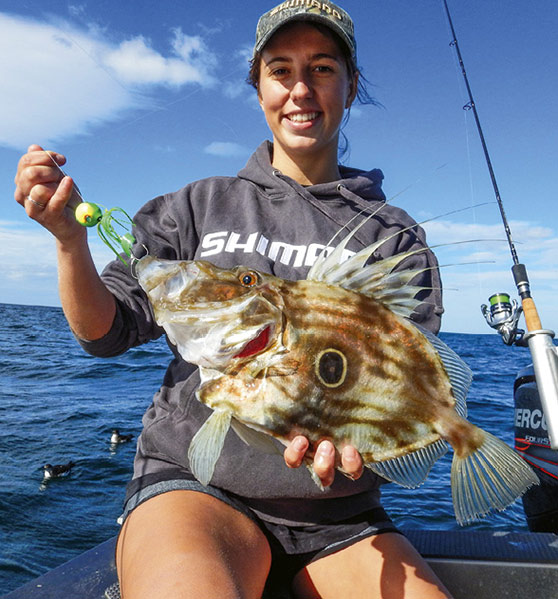
One of Jordy's favourite fish, caught on a Shimano slider.
Blue cod
Parapercis colias or rawaru
Being the third most popular recreational fish in NZ, blue cod are much more abundant in the colder waters of the South Island (down to 150m) than in the North. Juvenile blue cod are found in shallower water, and we quite often foul hook little ones during winter in the north while fishing over a reef or foul – pulling up the odd one over 30cm is a treat! It’s a different story down south where the blue cod seem to be everywhere and grow to impressive sizes. Underwater they are brave, territorial little fish which will sit puffed up on their pectoral fins and face you with a grumpy downturned mouth. This always makes me smile but also makes the blue cod an easy target on the spear. They also feed on a huge variety of prey and are tempted by any sort of baited hook, although blue cod are mostly caught in pots. To make the blue cod even more interesting: they are endemic to NZ, can change sex from female to male and their fillets are delicious! Quite commonly used for fish and chips, the medium textured, low-fat meat is suitable for a range of cooking and is beautiful pan-fried with a squeeze of lemon.
Golden or Red Snapper
Centroberyx affinis or kaorea
Not a lot is known about this striking little fish which occurs throughout NZ waters. The golden snapper is associated with deep coastal reefs and open water down to depths of 400m. They tend to be caught when deep-sea fishing over 100m but are also pulled from shallower reefs, usually as bycatch. I once accidentally foul hooked one while jigging for kingfish in 30m! Despite their bright warning colour, they are excellent eating but be aware of the nasty spines. There is currently no size limit for the golden snapper in NZ; however, they are uncommon and slow-growing. They reach 30-40cm on average, so if a good size one appears on your hook, it’s worth taking it home and giving it a taste. The tender, pale fillets have a pinkish tinge and are versatile when it comes to cooking. It is also eaten as sashimi in other parts of the world and considered an appetising fish.
Pink maomao and blue maomao
Caprodon longimanus and Scorpis violaceus
Maomao can be a bit of a nuisance when targeting other species with smaller gear over reefs or drop-offs. Although they don’t grow very big, they tend to swarm your bait and are quite aggressive little fighters. Not often targeted by fisherman, or seen as a table fish, the abundance of maomao around the North Island and the lack of fishing pressure on the species means it could be a great alternative to target.
Blue maomao are generally found shallower than pink maomao, quite often coming right up to the surface if you are anchored and have berley. The water turns an electric blue as they school in their tens to their hundreds, and a small hook or sabiki is sure to catch you at least one! They can be gutted, scaled and pan-fried whole or smoked.
Pink maomao are typically found between 20-50m, and are more well known for their eating quality compared to their blue lookalike. You’ll most likely find these vibrant pink fish while snapper or tarakihi fishing over a deeper rise or drop off next to a reef. If your hooks are small enough and the pink maomao are there, you’ll probably catch more of them than your target catch! However, they are another non-target species whose thick white fillets provide excellent eating.
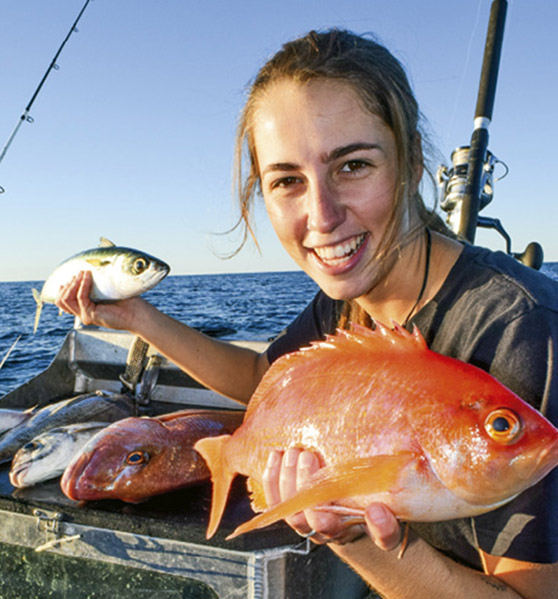
An array of reef fish all pulled from one session over a patch of reef in 50m.
Trevally
This smaller gamefish is still regarded as bait by many fishers and is thrown back; however, trevally not only put up a great fight, but make for some fantastic sashimi too! Although not always associated with reef structure, the trevally’s varied diet results in surface schooling as well as sedimentary bottom-feeding in all sorts of inshore areas. However, they quite often school in large numbers off headlands, islands or pinnacles where there is current. Lures or soft-baits tend to work well, especially when they are schooling, but a long trace with strip baits has also resulted in good catches of trevally when anchored in the current. Make sure you bleed your trevally straight away to ensure quality eating fillets and if you don’t fancy sashimi, chuck it in the smoker for some excellent smoked fish.

Josh Gordon with a trevally, caught on a soft-bait.
Other
Between my Dad and I, several weird and wonderful creatures have come up on our lines while reef fishing. Here’s a few – have you caught any of these on a hook?
Crayfish: Although I have never managed this feat, my Dad has caught a few and it just blows my mind seeing crayfish come up on a line! Reef structure obviously provides nooks and crannies for creatures such as crayfish to live in, and the bait sitting on the bottom is sometimes enough to lure a crayfish out of its hole. Somehow, the hook can then get stuck in its leg or shell! I can’t really give you any tips on this one – it’s just luck!
Octopus: This is another curious critter (one which preys on crayfish!) who lives in or around reef structure. Octopus will also try to make a meal out of your bait and end up stuck on your hook. They are a delicacy to some and a pretty interesting catch, whether you eat or release it.
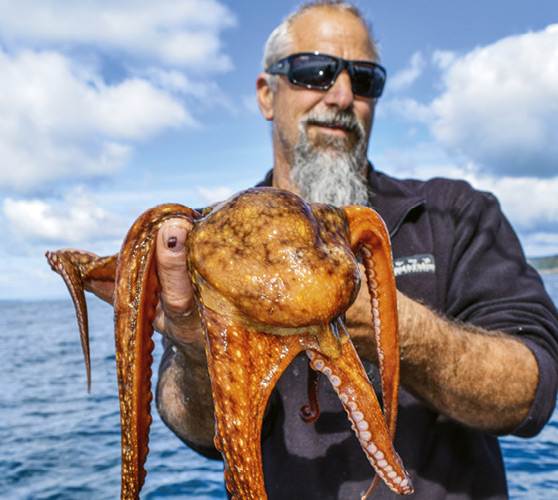
The writer's father, Shaun, with an octopus pulled up from the reef on his hook.
Jock stewart, granddaddy hapuka, red cod and leather jacket: This array of bizarre-looking fish are all common bycatch on reefs. Although not known as your typical table species, they are all edible and provide good tucker if you know how to treat and cook them right.
|
|
This article is reproduced with permission of |

Popular Articles

Softbait Fishing - Part 1 - gear selection
John Eichlesheim writes an article about selecting the right equipment for softbait fishing... Read More >
Softbait fishing Pt 2 - tips and tricks
Techniques, tips and tricks of softbait fishing – getting the most from your soft baits.... Read More >

Surfcasting - setting yourself up
Gary Kemsley helps sort out the necessary gear for intending surf fishers.... Read More >

Squid - How to catch them
Squid fishing is a rapidly growing aspect of fishing - Paul Senior shares some hints and tips to get started.... Read More >
Fishing Reports Visit Reports
Bream Bay Fishing Report - 29/10/26
'Softly softly' approach to workups. Now is the time most inshore snapper fishers dream of... Read More >
Rotorua Fishing Report - 29/10/26
Fantastic fishing set to only get better! The fishing around the Rotorua region has been... Read More >
Eastern Coromandel Fishing Report - 29/10/26
Kingfish, snapper and crayfish on the menu. The anticipation is building as we find ourselves... Read More >
Tauranga Fishing Report - 29/10/26
Fishing and diving heating up. Let’s start on a positive note this week, as water... Read More >
Comments