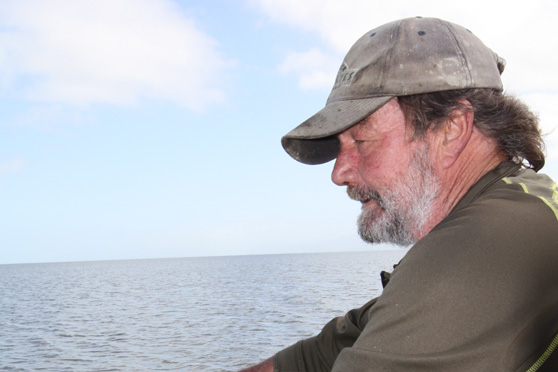
When you first meet commercial flounder fisherman Peter Thorburn (AKA Piako Pete), he fits the traditional mould: a little unkempt with wind-blown hair and untrimmed beard. He’s missing a couple of front teeth and has a rolly in his hand – a rough diamond, so to speak.
I have been calling in to pick up a feed of fresh flounder at Piako Pete’s shop at Pipiroa on the Hauraki Plains, regardless of how successful my own fishing trip may have been, for many years. Flounder is a favourite seafood, and I also like supporting a ‘mum and dad’ operation where the catch is sold direct to the public – fresh and at a fair price.
Speaking earlier in the year with Pete and his wife Gail about doing a story on a professional gill-netter (Pete prefers the term set-netter, and stresses that they are not necessarily the rape and pillagers of the ocean many people think they are), I was told, “Come back in November - the fish will be running then.” So I did.
Pete has had a love of the sea and commercial fishing since he was a youngster growing up in Meadowbank, Auckland. His extended family were all fishers, both recreational and commercial, so the opportunity to get out on the water was always there.
Pete was given his first net as a 10-year-old, about the same time he had his first boat, a small 2.4m (8ft) pram dinghy he used to fish the Orakei area with some success. He recalls his best snapper ‘back then’ was 8.4kg (18.5lb).
“It was hard work - a two-hour row to get to the spot,” he recalls.
But Pete has never been afraid of hard work, something you quickly realise after spending time with the man.
School holidays were a mixture of set-netting and long-lining the Hauraki Gulf and Firth of Thames, with the young Pete taking every opportunity he could to get out fishing.
In the intervening years he did a stint as a navy diver, went share milking for a while, spent two years in the bush culling pigs, deer and goats, worked in a sawmill, as well as doing some commercial fishing. To subsidise their winter income while farming, Pete fished for a Kaiaua-based operation gill-netting snapper and trevally, but didn’t particularly like what he saw regarding wastage.
The sea was never far from his thoughts, and seeing a good friend die young, he decided he would never work in a job he did not particularly like.
So, 20 years ago, he bought a boat, some nets, and set out to fish for one of the big companies.
He put up with this for a short while, before he and Gail made a change of direction. They would become not only fishers, but licensed fish receivers, and sell direct to the public.
What resulted was a much happier ‘Piako Pete’: despite catching half as much fish, he was making much more money.
The Thorburns currently hold seven tonnes of flatfish quota, along with a few other ‘bits and pieces’ to cover by-catch. A snapper by-catch is not targeted by Pete, with snapper quota leased each year at a considerable cost.
Pete adjusts the number of nets he fishes to ensure a continuous supply of fish for the shop over the year.
While fishing together we landed 62kg of flounder, an amount Pete described as ‘perfect’ for the shop's needs. He employs a skipper, Igon, for his second boat, which supplies any extras the shop needs, with the surplus going to a company. In poor fishing years, this boat is crucial to the survival of the shop.
Firth of Thames fishermen can deploy up to 1000 metres of net per person, but these must be hauled by hand.
We set ours just as the tide began to flood up over the banks, laying an extended line of eight, 80-metre lengths of monofilament net in a metre of water, and waiting just 45 minutes before pulling them.
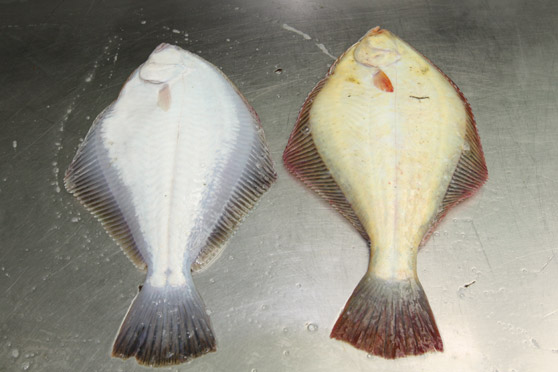
There was an interesting mixture of sand dabs and yellow-bellied flounder – about 60-40 in favour of the dabs. Apparently, the dab catch falls away as the water heats up and they head for deeper, cooler water after spawning.
To this was added four kahawai, several small school sharks, yelloweyed mullet, a couple of mini-hammerheads, valamay prawns and some juvenile gurnard, grey mullet and trevally. Only the kahawai were kept, destined for the smokehouse.
There are two reasons Pete likes short soak times: he catches enough fish for the shop’s immediate needs and any by-catch can mainly be released unharmed. (I noticed Pete took care when de-meshing fish he didn’t want to keep, so they could be put back in as good a shape as possible.)
Some of the more unusual catches Pete has encountered include a boarfish, slender tuna, leatherjackets and sea-run brown trout.
The bane of his life are big snapper and stingrays. Any snapper over 2-3 kilos damage the net, and stingrays are an absolute disaster. Last year was particularly bad, with Pete going through 58 nets in the season. He has a retired fisherman help him re-sling the nets (“last year he had a full-time job”), a task he and Gail once did themselves over winter. In a ‘normal’ season they will go through 35-40 nets, the mesh for which is constructed from fine 0.028mm diameter monofilament.
“The bigger fish brush through this like we would a cobweb.”
Pete says the Firth of Thames flatfish fishery is in as good a shape as it has ever been. He suggests everything ‘runs in seven- to eight-year cycles’, and this season is shaping up to be one of the better ones, catch wise.
“We never get anywhere near the TACC (Total Allowable Commercial Catch) for this management area, but what does concern me is the lack of scientific knowledge about flounder, in particularly their breeding.”
To this end, Pete dedicates a day each month to assisting a research programme being conducted by the Bay of Plenty Polytechnic and Waikato University, catching 18 flounder that are kept alive and taken back to tanks in Tauranga.
Commercial fishing is a tough job, especially as the nets are pulled manually. It was made easy on the day I went with Pete – light winds and a beautiful, sunny day. It is not always this pleasant.
Pete fishes from a 4.6-metre (15ft) dory – Twiny – purpose built to his design by Allenco Marine in Matamata some 15 years ago and powered by a 50hp Evinrude.
It was originally a centre-console boat, but Pete had it modified to a bow helm, which made it easier to control when working the gear from the forward position. Pete says the Evinrude has proven a good workhorse, its large-capacity water pump dealing better with the abrasive, silty water he operates in better than most other brands.
“Even so, I need to change the impeller every couple of months or so, and a stainless-steel prop only lasts a couple of seasons.”
When not used for commercial fishing, Twiny is converted into a ‘gunship’ for the duck-shooting season with the addition of a metal frame and cover. Pete describes the shooting on the Firth of Thames as ‘fantastic’.
While Gail, a legal secretary for 30 years, no longer fishes with Pete – she did a season right at the start so she could understand all aspects of the business – she runs the shop, does all the bookwork (each fish is accounted for three different ways) and helps process the catch. This partnership has stood the test of time.
As well as the fishing, Pete also runs a smokehouse processing kahawai, snapper, mullet and eels. He reckons he’s perfected the art of smoking wild duck, too.
He also fillets flounder, something that started when he did some for a blind customer who had difficulty dealing with the fine bones. This has grown to the point he processes up to 300 fish a week this way for the shop. Fillets, floured, dipped in egg then ‘Cook and Coat’, and fried in a hot pan for no more than 90 seconds a side, is their favourite way of eating flounder. Interestingly, after all this time, they still enjoy a meal of flounder at least once a week.
It was great to see the passion Pete continues to hold for the fishery and his ‘take only what you need’ philosophy – long may it continue!
So if you are travelling on SH25 between the Coromandel and Auckland this summer, call in to Piako Pete’s (just before the Piako River bridge at Pipiroa) and check out just how good fresh flounder can be!
Tips for recreational set-netters
• Set on the edges of the channel – position is more important than the state of the tide.
• Don’t use small-mesh nets – 5-inch rather than 4.5-inch legal minimum – you will catch less by-catch and rubbish. With 5-inch mesh you can legally keep any snapper caught. If caught in 4.5-inch mesh, they have to go back.
• Fish the smaller tides – the big tides carry too much rubbish.
• An outgoing tide is better than an incoming. Outgoing, the fish have to get off the banks, whereas incoming, they can always back off and turn for deeper water if they encounter your nets.
• Always pocket your nets. Flounder will swim along a non-pocketed net until they reach the end and escape.
• November to February is the best time for flounder fishing.
Smoking guidelines
Pete prefers to hand salt rather than brine his fish, and makes the following suggestions for processing fish for a conventional smokehouse, where the fish is hung as opposed to being laid flat on trays.
• Always chill the fish for at least 12 hours before smoking. Fish not chilled properly will ‘puff up’.
• Split the fish and rub plain salt into the flesh at a rate of about a tablespoon per fish.
• Make the process a long and slow one: 4.5-5 hours per smoke.
• Heat the fish up ‘quietly’, and once the fish is completely dry, let the fire smoulder away.
• Manuka is the best all-round wood for smoking. I only use branches, not sawdust or chips. Peach, plumb, apple and puhutukawa are other good woods to experiment with.


.jpg)
.jpg)





Comments